Encyclopedia Guide: Best Practices for Blow Drying Hair
9 min read ·
Learn the evidence-based best practices for blow drying hair safely, from optimal drying distances and heat settings to preventing cuticle bubbling and fibre breakage.
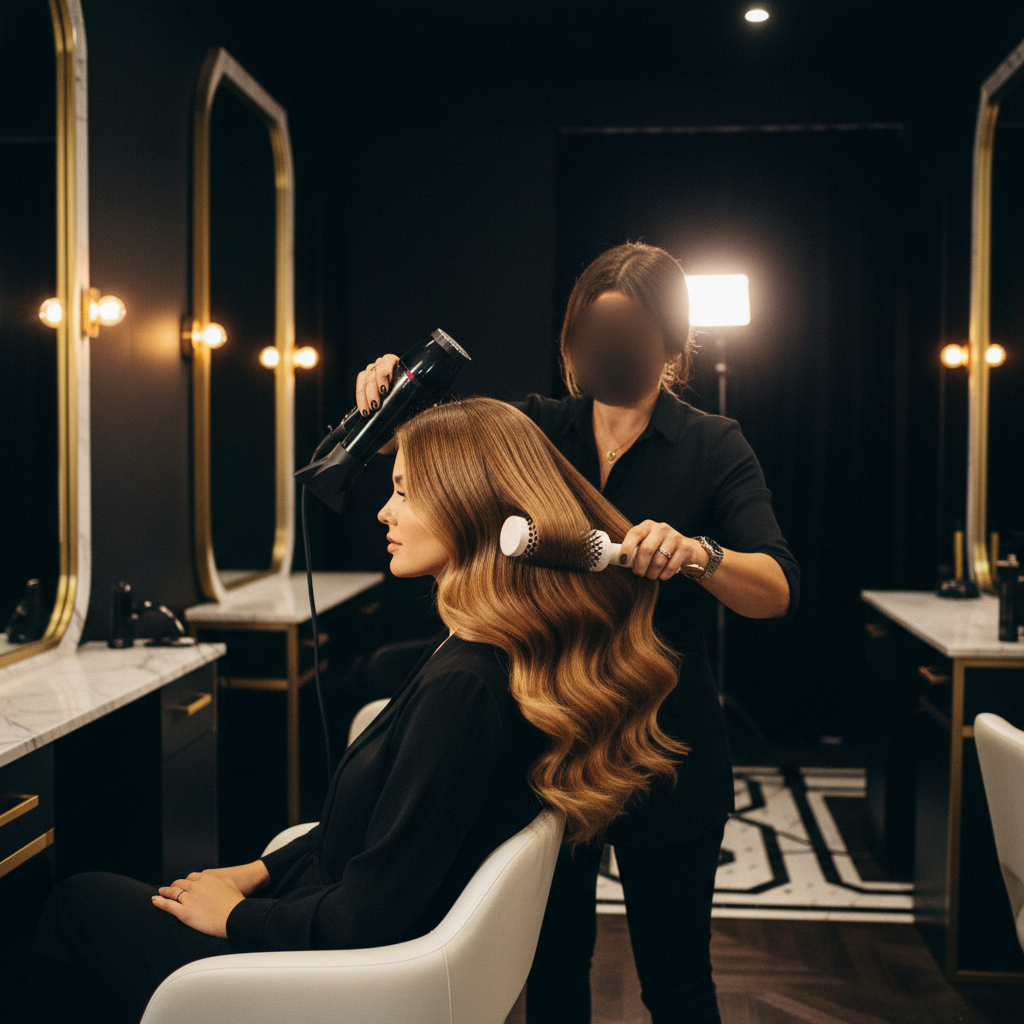
Quick answer: The established Best Practices for Blow Drying Hair involve partially air-drying hair to roughly 70 percent, applying a silicone- or polymer-based heat protectant, maintaining a 15 cm working distance, and keeping the airflow moving continuously on medium heat. Clinical hair fibre studies show that while prolonged air-drying causes cell membrane complex swelling, improper blow drying strips surface lipids and blisters the cuticle. Mastering this balance minimises shaft breakage, though heat styling cannot repair pre-existing structural damage.
Key takeaways
- Pre-dry hair gently with a microfibre towel or air-dry to roughly 70 to 80 percent moisture before introducing concentrated blow dryer heat.
- Maintain a minimum distance of 15 cm between the dryer nozzle and the hair shaft to avoid localised cuticle bubbling.
- Always direct the airflow downward along the hair shaft, from root to tip, to keep cuticle scales flat and intact.
- Use a targeted heat protectant formulated with ingredients like dimethicone or polyquaterniums to buffer thermal transfer.
- Distinguish between breakage and shedding: heat damage snaps the hair fibre along the shaft, whereas true shedding originates inside the follicle.
Best Practices for Blow Drying Hair: what the evidence shows
Scientific research reveals that neither pure air-drying nor aggressive heat drying is harmless. A landmark 2011 study published in the Annals of Dermatology examined the morphological changes in hair fibres under various drying methods. The researchers discovered that prolonged air-drying keeps the hair swollen with water for an extended period. This sustained swelling exerts hydrostatic pressure on the cell membrane complex (CMC), which acts as the intercellular cement holding cuticle and cortical cells together.
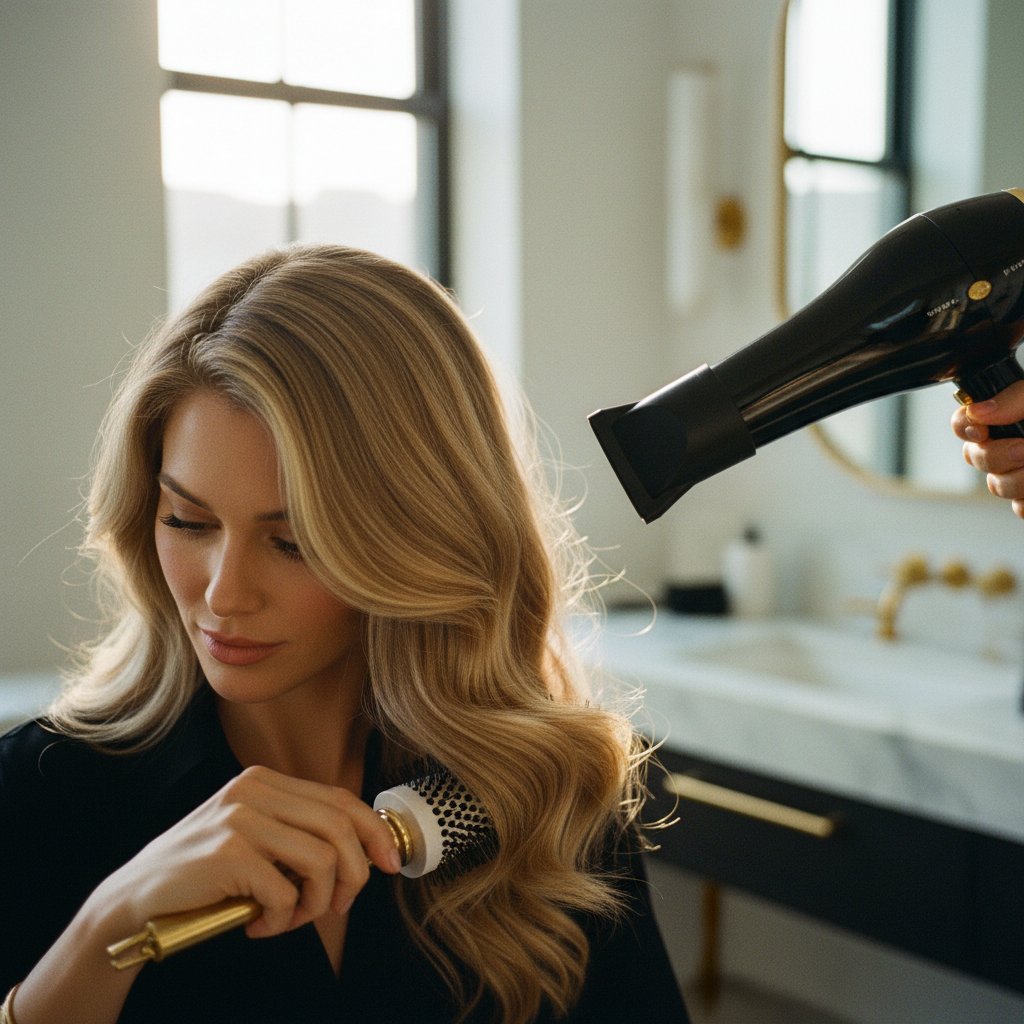
Conversely, high-temperature blow drying directly degrades the outer cuticle layers. When wet hair encounters temperatures exceeding 140 degrees Celsius, moisture trapped within the cortex can vaporise rapidly. This rapid expansion creates microscopic cavities or bubbles within the fibre, a condition clinically termed bubble hair.
Following established Best Practices for Blow Drying Hair provides a balanced compromise. By removing excess water quickly without subjecting the fibre to extreme surface temperatures, you limit CMC swelling while protecting the cuticular envelope. The evidence demonstrates that drying hair with continuous movement at a distance of 15 cm causes significantly less structural damage to the cuticle and cortex than holding a hot dryer close to the hair.
| Drying Method | Impact on Cuticle | Impact on Cortex / CMC | Optimal Protocol |
|---|---|---|---|
| High Heat, Close Distance (<5 cm) | Severe cracking, lipid stripping, scale lifting | Cuticle bubbling, protein denaturation | Avoid entirely; creates brittle fibre prone to snapping |
| Unassisted Air-Drying | Minimal surface thermal damage | Prolonged swelling, fatigue of cell membrane complex | Acceptable for low-porosity, short hair; risky for thick hair |
| Controlled Blow Drying (15 cm) | Intact, flattened cuticle scales | Preserved cortex moisture, minimal CMC strain | Pre-dry to 70%, use heat defence, dry on medium heat |
What the evidence does not show
Controlled research does not support the claim that blow drying inevitably leads to hair loss. Hair loss, whether patterned thinning (androgenetic alopecia) or temporary shedding (telogen effluvium), occurs at the follicular level underneath the scalp surface. Blow drying affects only the non-living keratin shaft that has already emerged from the skin.
Additionally, the evidence does not show that cold air settings can reverse or seal pre-existing split ends. While finishing a blowout with a cool shot helps set temporary hydrogen bonds into a smooth alignment, it cannot physically weld fractured keratin fibres back together. Claims that cosmetic serums or dryers can permanently mend broken hair fibres misrepresent hair biology.
The thermal mechanism: how heat alters the hair shaft
Hair is composed primarily of keratin proteins bound together by chemical bonds: strong covalent disulphide bonds, ionic salt bonds, and weaker hydrogen bonds. When hair is wet, water molecules break the hydrogen bonds, making the fibre flexible and malleable.
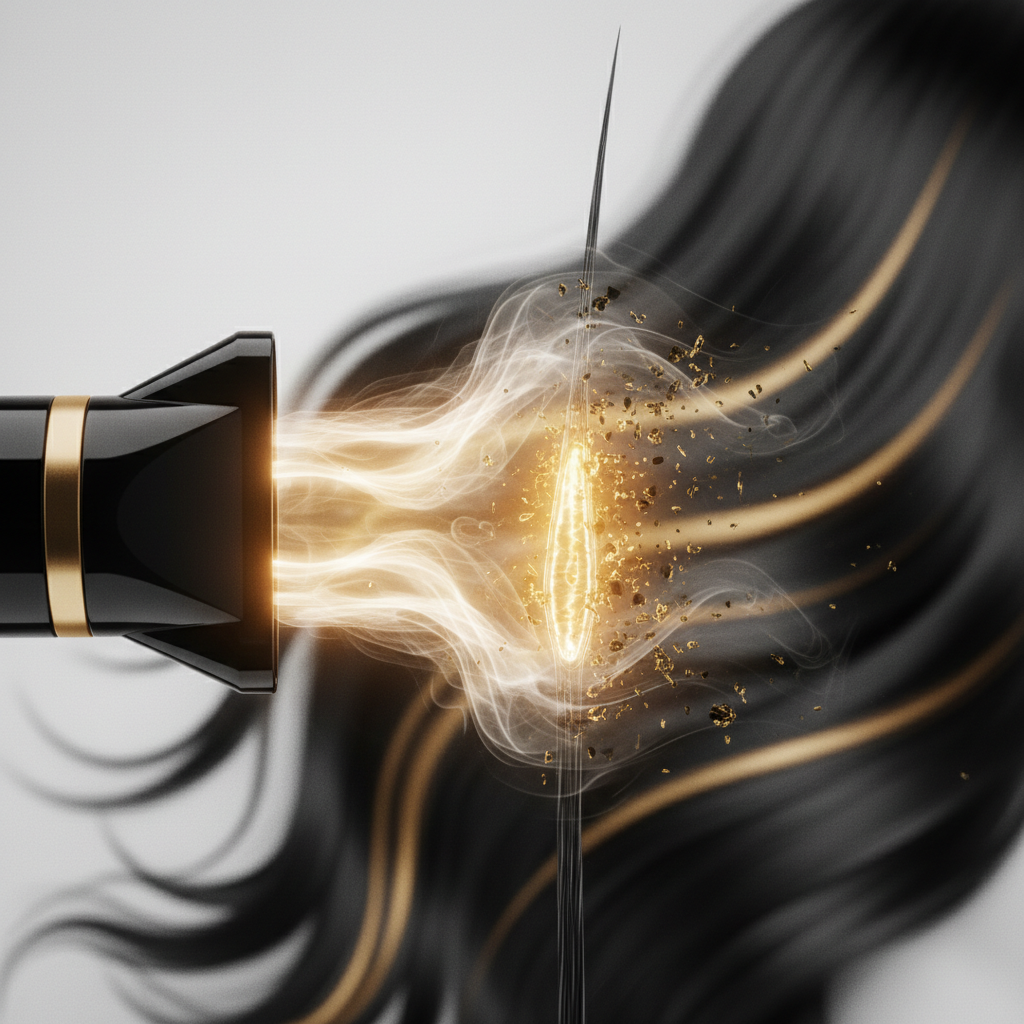
Blow drying works by evaporating this moisture while mechanically shaping the hair, allowing hydrogen bonds to reform in the desired position. However, excessive heat alters more than just hydrogen bonds:
- Lipid loss: The outermost layer of the hair fibre is coated with 18-methyleicosanoic acid (18-MEA), a protective lipid layer that provides hydrophobicity and slip. Temperatures above 100 degrees Celsius strip these lipids, leaving hair porous and susceptible to friction.
- Cuticle lifting: As water inside the shaft heats unevenly, steam pushes against the overlapping cuticle scales, forcing them outward. Raised cuticles increase inter-fibre friction, resulting in tangles and dullness.
- Protein denaturation: Sustained temperatures above 150 degrees Celsius begin to denature keratin, degrading the structural alpha-helices within the cortex into random coils, permanently weakening the tensile strength of the hair.
Signs of blow dryer damage to look for
Thermal damage does not happen overnight; it accumulates along the hair shaft. Because the ends of the hair are the oldest, they exhibit the earliest signs.
- Trichoptilosis (Split ends): The longitudinal splitting of the hair shaft caused by the erosion of protective cuticles.
- Trichorrhexis nodosa: The formation of tiny, microscopic nodes or weak spots along the fibre where the cuticle has worn away, leaving exposed cortical fibres that snap easily under light tension.
- Dullness and rough texture: Light reflects poorly off lifted or cracked cuticle scales, creating a matte, straw-like appearance.
- High wet friction: Damaged hair feels gummy or excessively tangled when wet because the loss of 18-MEA allows raw protein surfaces to rub against each other.
Practical steps: executing a safe blowout
To apply the Best Practices for Blow Drying Hair at home or in the salon, follow this systematic procedure:
1. Remove bulk water without mechanical friction
Never rub wet hair aggressively with a standard terrycloth towel. Wet hair swells, softening the cuticle and making it vulnerable to frictional erosion. Instead, squeeze and blot gently with a smooth microfibre towel or cotton wrap. Allow hair to air-dry until it is roughly 70 percent dry (damp to the touch, but not dripping).
2. Apply a certified thermal protectant
Distribute a heat protectant evenly from mid-lengths to ends. Formulations containing silicones (such as amodimethicone or dimethicone), hydrolysed wheat protein, or specialised styling polymers coat the fibre. These ingredients conduct heat more slowly than water or keratin, lowering thermal transfer rates and providing lubricating slip that reduces brush drag.
3. Attach a concentrator nozzle
A concentrator nozzle directs airflow precisely where it is needed, preventing turbulent air from whipping adjacent strands around and lifting cuticles. Keep the nozzle aligned parallel to the hair growth, pointing down toward the floor.
4. Maintain distance and continuous movement
Hold the dryer nozzle at least 15 cm away from the hair. Never hold the appliance stationary over a single section. Sweep the airflow along the hair continuously to distribute heat evenly. Use a medium heat setting for the rough dry, reserving higher heat strictly for the final shaping pass if necessary.
5. Finish with the cool shot
Once a section is dry and styled over a brush, switch to the cold setting for 10 to 15 seconds. Rapid cooling locks the newly reformed hydrogen bonds into place, ensuring hold and encouraging cuticle scales to sit flat against the shaft.
When the cause of hair thinning is something else
If you observe excessive hair gathering in your brush or on the bathroom floor, inspect the strands carefully. A broken hair fibre will be short, lack a white bulb, and often feature frayed ends. This indicates mechanical or thermal breakage from styling routines.
In contrast, if the hair strands are full-length and feature a tiny white keratin bulb at the tip, the hair has shed naturally from the follicle. Experiencing more than 50 to 100 shed hairs per day over several weeks is not caused by blow drying. Potential underlying causes include:
- Telogen effluvium triggered by systemic illness, acute psychological stress, rapid weight loss, or high fever.
- Hormonal shifts, such as post-partum hormone drops, thyroid imbalances, or peri-menopause.
- Androgenetic alopecia (pattern hair loss), which miniaturises follicles over time due to dihydrotestosterone (DHT) sensitivity.
- Nutritional deficiencies, particularly low serum ferritin (iron stores), vitamin D, or zinc.
If you observe diffuse shedding from the root, widening parts, or bald patches, consult a GP or a registered trichologist. Thermal styling habits do not produce follicular hair loss.
Supporting hair condition: the Watermans approach
While refining your styling technique limits external physical wear, maintaining strong, resilient hair also requires regular cosmetic care. Watermans designs products formulated to support the appearance of hair density and vitality.
Using Watermans Grow Me Shampoo alongside Condition Me Conditioner provides a nourishing base for heat styling. Packed with ingredients such as biotin, rosemary extract, caffeine, and argan oil, this routine cleanses the scalp environment gently while moisturising the hair shaft. Well-conditioned hair retains greater elasticity, making it far more capable of withstanding the mechanical stress of round brushes and concentrator nozzles during regular blow drying.
Frequently asked questions about Best Practices for Blow Drying Hair
Is it better to let hair air-dry naturally or blow dry it?
Scientific research indicates a combination is best. Air-drying hair completely keeps the inner core swollen with water for hours, stressing the cell membrane complex. The ideal method is to let hair air-dry to roughly 70 percent, then finish with a blow dryer kept 15 cm away on medium heat.
What are the core Best Practices for Blow Drying Hair without causing breakage?
The core Best Practices for Blow Drying Hair involve blotting with a microfibre towel, applying a silicone- or polymer-based thermal protectant, maintaining a 15 cm working distance, and constantly moving the airflow downward along the cuticle to prevent concentrated thermal hotspots.
Does blow drying hair cause permanent hair loss from the root?
No. Blow drying cannot cause true follicular hair loss or conditions like telogen effluvium. Excessive heat causes hair breakage along the shaft. If you notice full-length hairs with white bulbs attached, the cause is internal shedding, not your blow dryer.
Can a cool-shot button seal split ends?
No cosmetic tool or cold setting can physically repair a split end once the hair fibre has fractured. The cool-shot button functions by rapidly locking temporary hydrogen bonds into place, which smooths the cuticle and improves shine, but severed ends must be trimmed away.
What temperature should my blow dryer be set to?
For general drying, surface hair temperatures should remain below 100 degrees Celsius. Most quality dryers achieve this on a warm or medium setting held at a 15 cm distance. High heat settings should only be used briefly for final shaping on coarse, thick hair textures.
Refining your blow drying routine
Adopting the verified Best Practices for Blow Drying Hair transforms this daily routine from a source of chronic cuticle damage into a safe, reliable styling step. By acknowledging the structural limits of human keratin, you can protect the fibre from both excessive water swelling and thermal bubbling. Prioritise a generous working distance, gentle pre-drying, and consistent heat defence to preserve the natural strength and shine of your hair over time.
Sources and references
- Lee, Y. W., Choi, E. H., et al. (2011). Hair shaft damage from heat and drying time of hair dryer. Annals of Dermatology, 23(4), 455-462.
- Robbins, C. R. (2012). Chemical and Physical Behavior of Human Hair (5th ed.). Springer-Verlag.
- British Association of Dermatologists. (2020). Telogen Effluvium: An Overview. BAD Patient Information Leaflet.
- National Institute for Health and Care Excellence (NICE). (2021). Alopecia androgenetica: Clinical Knowledge Summaries. NICE Guidelines.
Find these ingredients in Watermans products
- Zinc: you will find this ingredient in our Hair Vitamins.