Benefits of Glycolic Acid for Hair: A Guide to Scalp and Strand Health
9 min read ·
Discover the science-backed Benefits of Glycolic Acid for Hair, from clarifying scalp buildup to improving strand elasticity and reducing everyday breakage.
Quick answer: The core Benefits of Glycolic Acid for Hair stem from its role as an alpha hydroxy acid (AHA) with the smallest molecular weight. It chemically exfoliates dead skin cells from the scalp, dissolves stubborn product residue, and penetrates the hair shaft to improve hydration and reduce mechanical breakage. However, glycolic acid cannot treat genetic hair loss, cure inflammatory scalp conditions like psoriasis, or rebuild severed disulphide bonds within damaged hair fibres.
Key takeaways
- Dual-action chemistry: Glycolic acid works on both living scalp tissue and non-living hair fibre, exfoliating the former while softening and hydrating the latter.
- Flake and sebum control: By breaking down desmosomes (the cellular glue binding dead corneocytes), it clears sebum buildup and dry scalp flaking without rough physical scrubbing.
- Internal fibre penetration: Because its molecular weight is remarkably low (76.05 Da), glycolic acid diffuses past the cuticle into the cortex, increasing moisture retention and fibre flexibility.
- Limits on use: It is not an anti-fungal agent, meaning it cannot cure microbial dandruff caused by Malassezia overgrowth, nor can it reverse follicular miniaturisation.
- Concentration matters: Formulations between 3% and 7% are standard for weekly scalp treatments; leaving high-strength professional peels on the scalp risks chemical irritation and barrier damage.
Benefits of Glycolic Acid for Hair: what the evidence shows
When discussing the Benefits of Glycolic Acid for Hair, trichologists separate its actions into two distinct biological zones: the scalp epithelium and the hair shaft.
First, on the scalp surface, glycolic acid acts as a chemical exfoliant. Traditional scalp scrubs rely on physical abrasives (such as salt, sugar, or ground seeds) that can scratch delicate skin or snag wet hair strands, causing mechanical breakage. Glycolic acid dissolves the ionic bonds between dead skin cells on the stratum corneum. This allows shedding cells to lift away gently during rinsing. The result is a cleaner environment around the follicular ostia (openings), preventing trapped sebum and environmental debris from oxidising and inflaming the scalp.
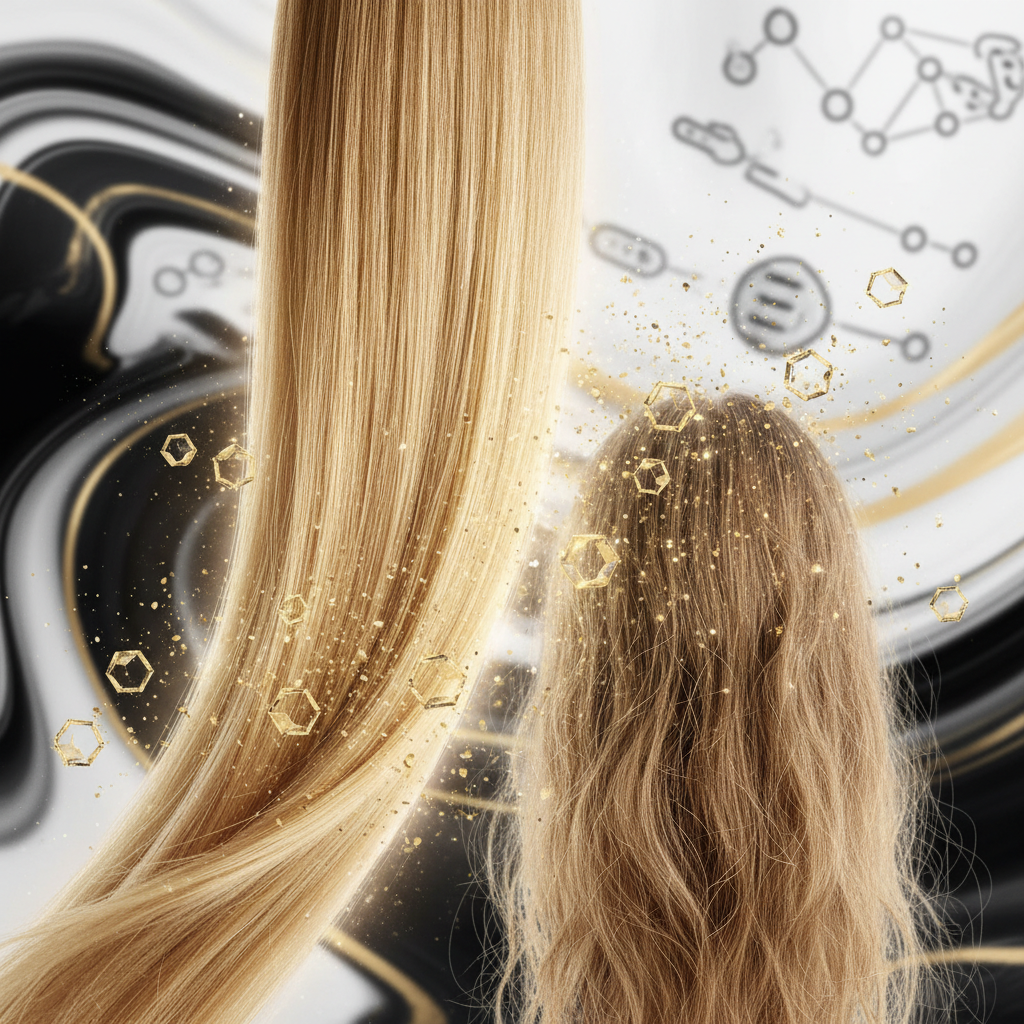
Second, within the hair fibre itself, glycolic acid demonstrates unique structural benefits. In cosmetic chemistry research, specifically studies evaluated by textile and cosmetic science bodies, glycolic acid is shown to penetrate the hair shaft due to its minimal molecular size. Once inside the cortex, it binds water molecules, softening the keratin matrix. This improves the fibre's tensile response to combing, measurably decreasing friction-induced hair breakage.
Scalp application (3% to 7% concentration)
 │
 ├─► Stratum Corneum: Dissolves desmosomes ──► Clears flakes & excess sebum
 │
 └─► Hair Shaft (Cortex): Penetrates cuticle ──► Binds water & enhances elasticity
How glycolic acid works: the molecular mechanism
Glycolic acid is an alpha hydroxy acid derived from sugar cane, synthesised commercially to high purity. Its structure consists of a two-carbon chain containing a carboxyl group and a hydroxyl group. Because its molecular weight is a tiny 76.05 Daltons, it slips past barrier lipids that block larger cosmetic actives.
Scalp desquamation
The outer layer of your scalp, the stratum corneum, sheds cells constantly through a process called desquamation. Sebum, styling polymers, and hard water minerals can cement these cells into persistent flakes. Glycolic acid operates at an acidic pH (typically 3.5 to 4.2 in hair products). At this pH, it weakens calcium-dependent desmosomes, accelerating turnover without scraping the skin.
Fibre plasticity and moisture uptake
Hair is composed primarily of alpha-keratin proteins. When hair undergoes chemical bleaching, heat styling, or sun exposure, the protective lipid layer (18-methyl eicosanoic acid or 18-MEA) wears away, leaving cuticles raised and vulnerable. When formulated into rinse-off conditioners or treatments, glycolic acid integrates into the cortex. It creates weak hydrogen bonds with keratin chains, acting as a humectant and plasticiser. This allows dry, brittle hair to bend further before snapping.
| Attribute | Glycolic Acid (AHA) | Salicylic Acid (BHA) | Physical Scalp Scrubs |
|---|---|---|---|
| Molecular weight | Very small (76 Da) | Medium (138 Da) | Macro (particulate) |
| Solubility | Water-soluble | Oil / lipid-soluble | Insoluble |
| Primary target | Surface dead cells & hair cortex | Pore-clogging sebum inside follicles | Surface debris only |
| Internal hair penetration | Yes (proven cortex entry) | Minimal | No (cannot penetrate) |
| Risk of physical breakage | None | None | Moderate to high |
| Ideal for | Dry flakes, brittle hair, dullness | Greasy buildup, acne, oily flakes | Occasional thick paste removal |
What the evidence does not show
It is critical to distinguish between realistic cosmetic improvements and biological falsehoods. Glycolic acid has achieved significant social media visibility, but consumer expectations must match the science.

Glycolic acid does not stimulate new hair growth. Hair loss conditions such as androgenetic alopecia (pattern baldness) are governed by dihydrotestosterone (DHT) interacting with genetically susceptible receptors, leading to progressive follicular miniaturisation. An exfoliating acid cannot alter hormone levels or awaken dormant follicles.
Furthermore, hair shedding (telogen effluvium) is triggered by physiological shocks, such as systemic illness, nutritional deficiencies, or severe psychological stress. Applying an exfoliating acid to the scalp will not shorten the telogen resting phase or halt diffuse shedding.
Finally, glycolic acid is not a medical treatment for seborrhoeic dermatitis or scalp psoriasis. While it removes loose scales, seborrhoeic dermatitis involves an immune response to Malassezia yeast overgrowth, which requires anti-fungal agents such as ketoconazole or zinc pyrithione. In fact, applying low-pH acids to active, inflamed flares can cause severe stinging, contact dermatitis, and worsening inflammation.
Signs your scalp and hair might benefit from glycolic acid
You do not need to use chemical exfoliants continuously. Instead, monitor your hair and scalp for specific physical indicators:
- Persistent product buildup: Your hair feels heavy, gummy, or fails to lather properly even after a thorough shampoo, often caused by heavy styling silicones, waxes, or dry shampoos.
- Dull, light-scattering cuticle: Hair appears lacklustre and rough to the touch because mineral salts or styling deposits have created a dusty coating on the cuticle scales.
- Dry, superficial flaking: You notice fine, powdery white flakes on your shoulders, but your scalp is not red, swollen, or infected.
- Combing resistance: Your hair tangles easily when wet, leading to snapping along the mid-lengths and ends.
How to use glycolic acid safely on hair and scalp
Using an acid safely requires respecting the scalp barrier. The skin on your scalp has a natural pH of roughly 5.5, while hair fibres sit between 4.5 and 5.0.
- Check the concentration: For at-home scalp use, choose products formulated at 3% to 7% glycolic acid. Do not apply 20% to 70% facial peels to your scalp; doing so can cause chemical burns, folliculitis, and patchy breakage.
- Apply to dry or damp hair before washing: Part your hair in sections and apply the liquid or light gel directly onto the scalp. Use your fingertips to distribute it gently without scratching.
- Control contact time: Leave the product on for 5 to 10 minutes. If you experience tingling that turns into burning, rinse it out immediately with lukewarm water.
- Shampoo and condition thoroughly: Follow with a gentle sulphate-free shampoo to clear the exfoliated debris, followed by a nourishing conditioner to seal the cuticles.
- Frequency: Limit treatments to once weekly, or once every two weeks for sensitive skin. Over-exfoliation compromises the scalp moisture barrier, provoking reactive oiliness and sensitivity.
When scalp issues point to something else
If your scalp remains irritated or flakes aggressively despite gentle exfoliation, the underlying problem is rarely simple dead cell buildup.
- Thick, greasy, yellow scales accompanied by itching: This indicates seborrhoeic dermatitis. Acid exfoliation alone will not resolve the yeast population causing the condition.
- Well-defined, silvery plaques: This is a hallmark of scalp psoriasis, an autoimmune disorder. Acids applied to psoriatic plaques can provoke the Koebner phenomenon, worsening the lesions.
- Sudden widespread shedding: If you are losing hundreds of whole hairs from the roots daily, this is telogen effluvium, which originates deep inside systemic health pathways, not the surface layer.
- Localised bald patches: Smooth, circular patches of total loss point toward alopecia areata, requiring medical dermatological intervention.
If you experience persistent itching, bleeding, visible redness, or noticeable loss of hair density, consult a trichologist, dermatologist, or your GP rather than attempting self-treatment with acids.
Maintaining scalp balance with Watermans
Chemical exfoliants work best when integrated into a sensible, supportive long-term routine. While an occasional glycolic treatment resets the surface by clearing dead skin cells and environmental accumulation, day-to-day maintenance requires consistent nourishment that supports the scalp ecosystem.
Watermans Grow Me Shampoo and Condition Me Conditioner are formulated to support the scalp without harsh abrasion. Utilising biotin, rosemary extract, caffeine, and niacinamide alongside gentle cleansing agents, the range cleanses the scalp effectively while supporting the feel and strength of the hair fibre. Following an occasional clarifying acid treatment with a hydrating, nutrient-dense routine ensures the newly cleared scalp receives balanced moisture without stripping essential protective lipids.
Frequently asked questions about Benefits of Glycolic Acid for Hair
What are the main benefits of glycolic acid for hair strands versus the scalp?
The primary benefits of glycolic acid for hair strands focus on mechanical resistance: it penetrates the cuticle to hydrate the cortex and reduce breakage. On the scalp, its action is purely keratolytic, dissolving the bonds holding dead skin cells and clearing product buildup to leave the surface clean and refreshed.
Can glycolic acid help with hair loss or thinning?
No. Glycolic acid cannot treat androgenetic hair loss, stimulate new follicles, or stop telogen effluvium. It works strictly on the superficial layer of the scalp and within the dead fibre of the hair shaft. It supports a healthy foundation for hair to emerge, but it has no impact on follicular miniaturisation.
How often should I use glycolic acid on my scalp?
Most people benefit from using a 3% to 7% glycolic acid treatment once weekly or once every fortnight. Overusing it can strip the scalp barrier, leading to irritation, stinging, and rebound sebum production. If you have sensitive skin, start with a patch test and apply it once every two weeks for no longer than five minutes.
Does glycolic acid cause hair colour to fade?
Because glycolic acid operates at an acidic pH, it generally keeps cuticles aligned. However, frequent chemical exfoliation or leaving strong acids on dyed hair can loosen surface pigments, especially semi-permanent dyes. It is best applied directly to the scalp rather than run repeatedly down the lengths of freshly coloured hair.
Can I leave glycolic acid on my scalp overnight?
You should not leave rinse-off glycolic acid formulations on your scalp overnight. Prolonged contact increases the risk of irritant contact dermatitis, redness, and scalp dryness. Stick to the product instructions, which almost always recommend rinsing thoroughly after 5 to 15 minutes of application.
The bottom line on glycolic acid in haircare
Understanding the true Benefits of Glycolic Acid for Hair allows you to use powerful cosmetic chemistry without succumbing to exaggerated marketing claims. By clearing stubborn surface debris from the scalp and improving the elasticity of vulnerable strands, glycolic acid serves as an exceptional reset treatment for tired, product-laden hair. Used in moderation alongside a balanced, nourishing wash routine, it keeps both the scalp environment and the hair fibre performing at their absolute best.
Sources and references
- Journal of Cosmetic Science: Effects of organic acids on hair structure and mechanical properties
- International Journal of Cosmetic Science: Alpha hydroxy acids in dermatological and cosmetic formulations: mechanisms of action
- British Association of Dermatologists: Seborrhoeic Dermatitis and Scalp Care Guidelines
- Clinical, Cosmetic and Investigational Dermatology: Scalp condition impacts hair growth and retention via oxidative stress
- National Institute for Health and Care Excellence (NICE): Alopecia: Clinical Knowledge Summary
Find these ingredients in Watermans products
- Zinc: you will find this ingredient in our Hair Vitamins.
- Niacinamide: you will find this ingredient in our Hair Mask.