The 18-MEA Lipid Layer in Hair Care: The Cuticle's Natural Shield
9 min read ·
Learn what the 18-MEA lipid layer in hair care does, how chemical processing removes it, and evidence-based ways to mimic its protective barrier.
Quick answer: The 18-MEA lipid layer in hair care refers to 18-methyleicosanoic acid, a branched-chain fatty acid covalently bonded to the outer cuticle surface that provides virgin hair with natural hydrophobicity, slip, and barrier protection against moisture. Because it is chemically bound via thioester bonds, oxidative processing such as bleaching and permanent colouring permanently strips it away. The primary limitation is that cosmetic treatments cannot re-covalently bond 18-MEA once lost; they can only deposit temporary biomimetic conditioners to simulate its protective behaviour.
Key takeaways
- 18-methyleicosanoic acid (18-MEA) forms an integral part of the F-layer, making up roughly 40% to 50% of the total lipid content on the cuticle surface.
- It creates a hydrophobic shield that repels water, prevents swelling of the cortex, and lowers surface friction between hair fibres.
- Chemical processes with an alkaline pH (such as bleaching, permanent waving, and oxidative dyes) cleave the thioester bonds holding 18-MEA in place.
- Once chemically cleaved, the biological 18-MEA layer cannot regenerate on existing hair fibre because hair is biologically dead tissue.
- Cosmetic products containing quaternised lipids, cationic polymers, and synthetic fatty acids can mimic the hydrophobic and anti-friction benefits of 18-MEA temporarily.
The 18-MEA lipid layer in hair care: what the evidence shows
The 18-MEA lipid layer in hair care represents the outermost protective chemical boundary of human hair fibres, technically referred to as the epicuticle or F-layer. First identified in detail through biochemical research in the late 20th century, 18-methyleicosanoic acid is a 21-carbon branched-chain fatty acid. What makes it unique compared to free surface sebum is its covalent attachment. 18-MEA is anchored to cysteine-rich sub-cuticular proteins through stable thioester linkages.
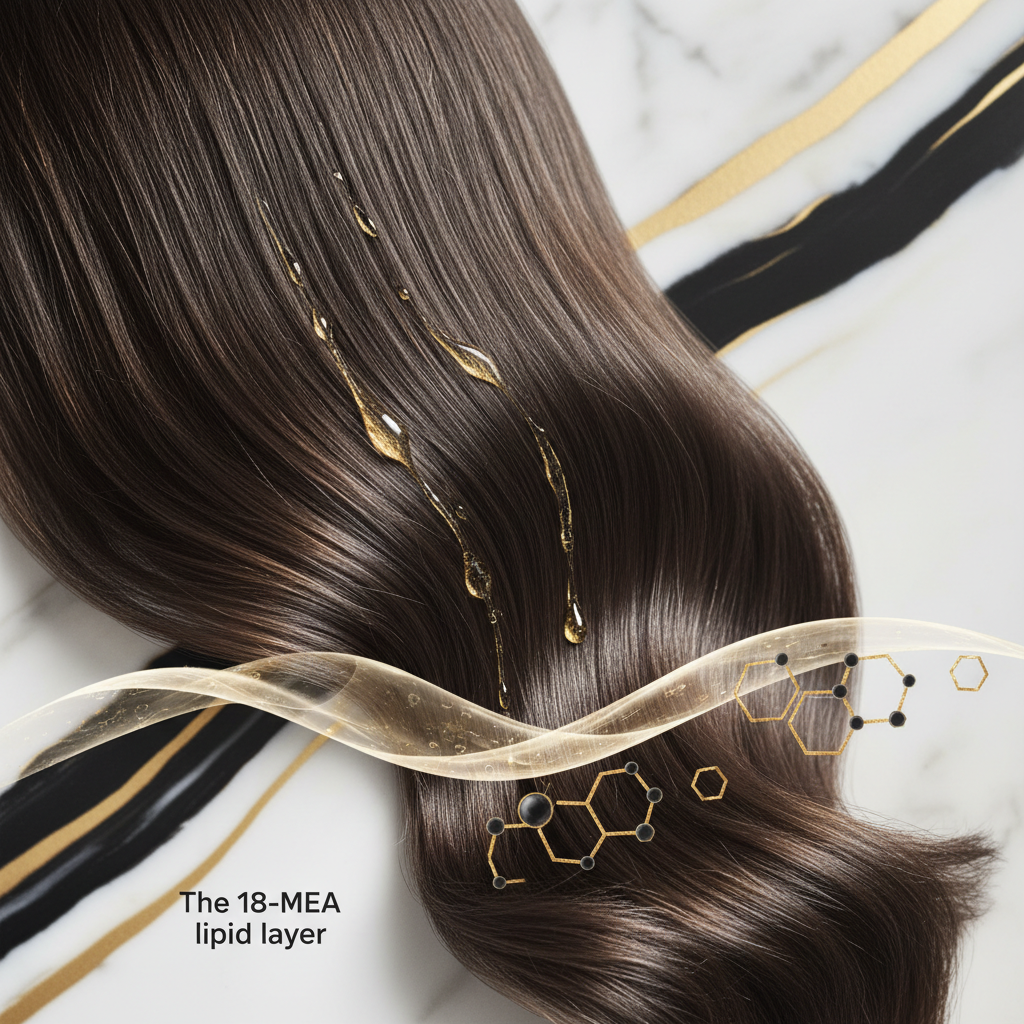
This biological architecture creates a self-assembling monolayer oriented outward. The hydrocarbon tails point away from the hair surface, which gives healthy, untreated virgin hair a high water contact angle (typically exceeding 90 to 100 degrees). This extreme hydrophobicity ensures that water beads on the hair surface rather than penetrating directly into the cortex.
Peer-reviewed cosmetic science shows that this hydrophobic monolayer serves three critical physical functions:
- Frictional control: The lipid coating lubricates individual fibres, reducing dry and wet comb friction by up to 50% compared to stripped hair, directly reducing mechanical hair breakage during styling.
- Moisture regulation: By resisting rapid water absorption, 18-MEA prevents severe moisture-induced swelling. Rapid swelling and deswelling weakens the internal protein structure of the hair cortex over time (hygral fatigue).
- Electrostatic repulsion: The uncharged lipid layer shields the underlying negative charges of the protein matrix, preventing severe static flyaway and environmental particulate accumulation.
What happens when 18-MEA is lost: the biological mechanism
Hair grows from the follicle with a complete, pristine 18-MEA monolayer. However, because hair shaft fibres consist of non-living, keratinised cells, they cannot produce new lipids or repair damaged bonds along the length of the fibre.
The thioester bonds linking 18-MEA to the epicuticle are vulnerable to alkaline hydrolysis and oxidation. A single alkaline bleaching session (pH 9.0 to 10.5) or permanent hair colouring treatment can remove the vast majority of surface-bound 18-MEA. When these chemical treatments cleave the thioester bond, cysteic acid groups are generated on the cuticle surface.
This reaction causes a dramatic surface inversion:
- The surface shifts from hydrophobic (water-repelling) to hydrophilic (water-attracting).
- The net negative surface charge increases significantly (higher zeta potential).
- The water contact angle drops sharply, often falling below 40 degrees.
- The hair swells excessively upon contact with water, lifting the cuticle scales and exposing the cortex to physical abrasion and chemical leaching.
Virgin hair: [Cuticle Protein]--S--CO--(CH2)14-CH(CH3)-CH2-CH3 (Hydrophobic)
Chemical lift: [Alkaline Peroxide Oxidation]
Damaged hair: [Cuticle Protein]--SO3- + Free Carboxylic Fatty Acids (Hydrophilic)
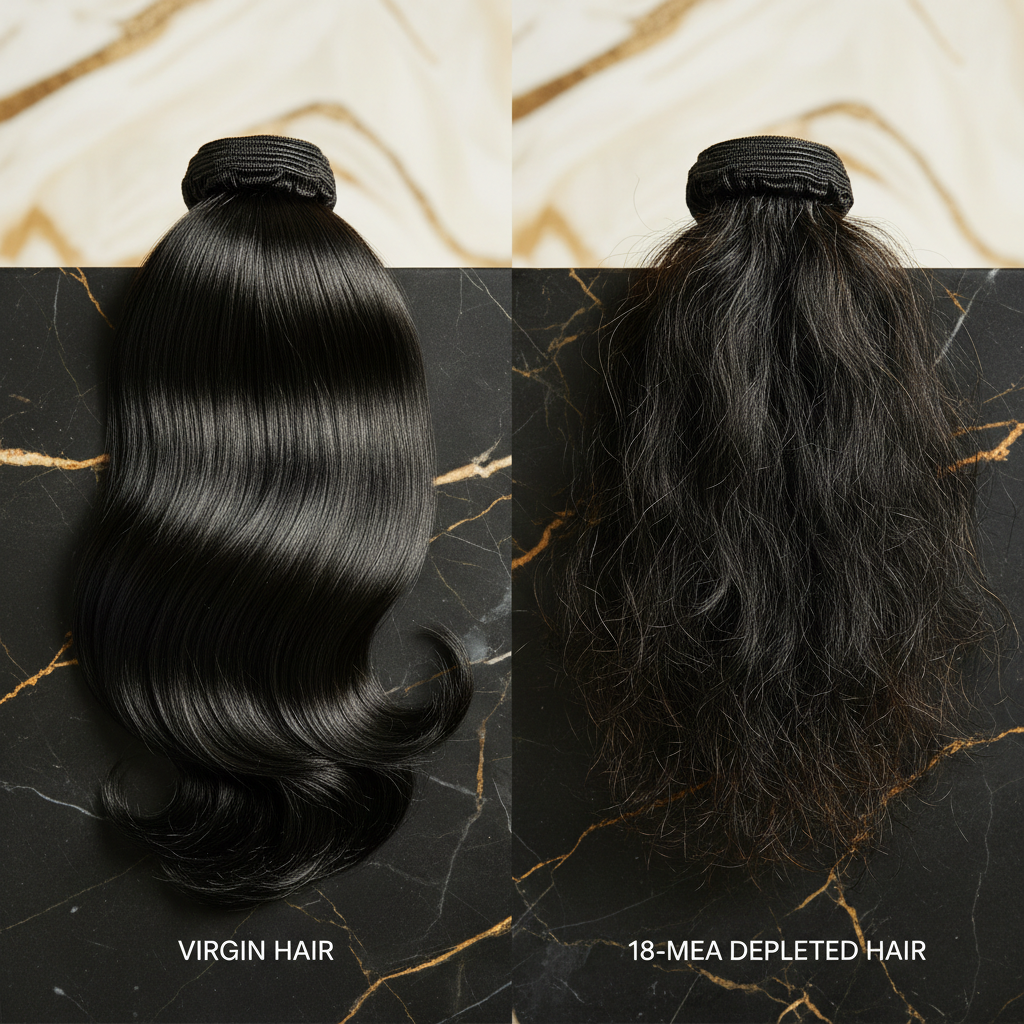
Virgin hair vs 18-MEA depleted hair
| Property | Virgin Hair (Intact 18-MEA) | Chemically Processed Hair (18-MEA Depleted) |
|---|---|---|
| Surface Wetting | Hydrophobic (repels water; beads easily) | Hydrophilic (readily absorbs water; soaks quickly) |
| Water Contact Angle | High (> 95 degrees) | Low (< 40 degrees) |
| Surface Charge | Neutral to weakly anionic | Highly anionic (dense cysteic acid presence) |
| Wet Friction | Low (smooth gliding, low tangling) | High (rough, grabby, prone to tangling) |
| Water Absorption Rate | Controlled and slow | Rapid and excessive (hygral swelling) |
| Cuticle Integrity | Flat, tightly sealed edges | Flared, chipped, or stripped scale edges |
| Restoration Potential | Intact naturally | Requires continuous synthetic biomimetic replenishment |
What the evidence does not show
Marketing claims frequently assert that specific conditioning masks, bond builders, or serums can permanently rebuild or "restore" the natural lipid layer. The biological evidence does not support this.
Current cosmetic science has not developed an in-salon or at-home treatment that can re-form the specific covalent thioester linkages between synthetic 18-MEA molecules and the keratin substrate under ambient, consumer-safe conditions. Once 18-MEA is stripped by oxidation, that specific chemical bond is gone until new hair emerges from the scalp.
Furthermore, loss of 18-MEA is not a driver of hair loss or follicular shedding. The F-layer is strictly a component of the emerged hair fibre. Its degradation leads to surface roughness, cuticle chipping, dull appearance, and mechanical hair breakage along the shaft, but it has no influence on follicular cycling, telogen effluvium, or androgenetic alopecia.
Recognising lipid depletion: signs to look for
Stylists and consumers can easily detect the absence of an intact 18-MEA layer through physical observation and tactile handling:
- The sink test phenomenon: When placed in water, pristine hair floats for an extended period due to surface tension and hydrophobicity. Hair devoid of 18-MEA wets out almost instantly and sinks.
- Prolonged blow-drying times: Hydrophilic hair absorbs massive amounts of interior water, taking considerably longer to dry under heat.
- Velcro effect: When dry or damp, hair ends cling to each other and snag, caused by increased surface friction and lifted cuticle margins.
- Dullness: An uneven, lipid-depleted surface scatters light diffusely rather than reflecting it specularly, resulting in a lack of natural shine.
Restorative hair care strategies for lipid-depleted hair
While you cannot biologically re-graft the lipid layer, you can effectively mimic its function through modern cosmetic formulation.
Cationic surfactants and biomimetic lipids
Because damaged hair carries an elevated negative charge, it creates an electrostatic target for positively charged ingredients. Formulators utilise quaternised conditioning agents (such as behentrimonium chloride, cetrimonium chloride, and quaternium-87) alongside synthetic fatty acids. These positively charged molecules adhere tenaciously to the negatively charged cysteic acid sites on the damaged cuticle, creating a pseudo-hydrophobic film that mimics the slipperiness of 18-MEA.
Lipid replenishing oils and ceramides
Non-polar plant oils, synthetic esters, and bio-identical ceramides deposit along the outer cuticle. While they wash away with surfactant use and require regular reapplication, they seal microscopic fissures, lower surface friction, and slow moisture loss during heat styling.
Acidic post-colour rinses
Using formulations adjusted to a low pH (3.5 to 4.5) immediately following chemical processing helps contract the cuticle scales, counteracting the swelling caused by the loss of the natural lipid shield.
When the cause of hair changes may be something else
If your hair feels persistently brittle, thinning, or dry despite diligent conditioning, the primary issue might not be 18-MEA depletion alone:
- Internal nutritional shortfalls: Diets deficient in protein, iron, zinc, or essential fatty acids impact the initial keratogenesis within the follicle, leading to structurally weak hair shafts.
- Severe cortical breakdown: High heat styling (above 200 degrees Celsius) denatures internal keratin protein and breaks cortical disulphide bonds, damage that sits far deeper than the surface 18-MEA layer.
- Follicular shedding: If hair is coming out from the root with a white bulb attached, this is physiological shedding, not structural hair breakage caused by lipid loss.
When to seek professional guidance
Consult a qualified trichologist or dermatologist if:
- You observe widespread diffuse shedding or patchy loss at the scalp level.
- Your scalp displays erythema, scaling, pain, or persistent itching.
- Hair snaps off in large volumes close to the root immediately following a chemical service, which indicates severe structural chemical over-processing requiring specialist intervention.
Supporting hair health from scalp to tip: Watermans
Maintaining hair vitality requires a two-pronged strategy: protecting the delicate fibre shaft while maintaining an optimal environment at the scalp surface where new hair forms. While the fibre requires biomimetic conditioning to counteract the daily weathering of surface lipids, the follicle needs nourishing, non-stripping care.
Watermans approaches this balance through targeted formulas designed to care for both the scalp microbiome and the emerged hair strand. By combining mild, non-stripping cleansing bases with fortifying botanical extracts, caffeine, biotin, and hydrolysed lupin protein, Watermans products support clean, resilient hair without unnecessarily eroding natural surface lipids. Utilising gentle hair care routines minimises needless friction and mechanical breakage, helping treated and mature hair look full, shiny, and strong.
Frequently asked questions about The 18-MEA Lipid Layer in Hair Care
What exactly is the 18-MEA lipid layer in hair care?
The 18-MEA lipid layer in hair care is a thin, natural layer of 18-methyleicosanoic acid attached to the outer cuticle of human hair. It forms a hydrophobic barrier that repels water, minimises surface friction, and preserves hair softness and shine.
Can chemically damaged hair naturally regrow its 18-MEA layer?
No. Because the emerged hair fibre is biologically inactive non-living tissue, it cannot regenerate lipids. Once chemical bleaching or permanent colouring breaks the covalent bonds anchoring 18-MEA, the loss is permanent for that section of hair until fresh hair emerges from the scalp.
How do modern hair products mimic 18-MEA?
Cosmetics use cationic surfactants, silicones, and synthetic biomimetic lipids. Because damaged cuticle sites carry a strong negative charge, these positively charged conditioning agents bind electrostatically to the surface, temporarily restoring hydrophobicity, slip, and combability.
Does washing hair with hot water remove 18-MEA?
Hot water alone does not break the covalent thioester bonds of 18-MEA, but it accelerates physical cuticle lifting and strips free surface sebum. Over time, high temperatures combined with harsh, high-pH detergents accelerate mechanical erosion of the surface cuticle.
Is loss of 18-MEA responsible for hair loss?
No. The loss of 18-MEA causes surface roughness and hair breakage along the shaft due to friction, but it does not cause hair loss or shedding from the follicle. Follicular disorders stem from internal biological, hormonal, or scalp-related factors.
Summary of the 18-MEA lipid layer in hair care
Understanding the 18-MEA lipid layer in hair care clarifies why virgin hair looks and behaves so differently from chemically processed hair. This single layer of covalently bound fatty acid is nature's protective raincoat for the hair strand, maintaining hydrophobicity, suppressing friction, and preventing excessive water absorption. While oxidative processing irreversibly cleaves this natural shield, intelligent conditioning regimens featuring biomimetic lipids, cationic softeners, and balanced pH products allow you to effectively recreate its protective qualities, keeping hair resilient against daily styling stress.
Sources and references
- Society of Cosmetic Chemists, Chemical and Physical Behavior of Human Hair, Clarence R. Robbins, 5th Edition, Springer, 2012.
- Journal of Cosmetic Science, "The surface properties of human hair," 2004.
- International Journal of Cosmetic Science, "The hair surface: morphology, chemistry and comparative physical properties," 2008.
- National Center for Biotechnology Information (NCBI) / PubMed, "Structure and chemical reactivity of the 18-MEA layer on human hair cuticle," 2014.
Find these ingredients in Watermans products
- Biotin: you will find this ingredient in our Hair Growth Shampoo.
- Zinc: you will find this ingredient in our Hair Vitamins.