Vitamin D and Hair Follicle Health: Mechanisms, Evidence, and Care
9 min read ·
Understand the link between Vitamin D and Hair Follicle Health, how deficiencies disrupt cycling, and what clinical evidence says about healthy hair growth.

Quick answer: The relationship between Vitamin D and Hair Follicle Health centres on the vitamin D receptor (VDR) located in keratinocytes, which regulates follicle cycling and initiates the anagen (growth) phase. Deficiencies are frequently associated with shedding disorders like telogen effluvium and autoimmune conditions like alopecia areata. However, while correcting a diagnosed deficiency restores normal cellular conditions, high-dose supplementation alone will not cure genetic pattern hair loss or reverse conditions where follicular receptors are permanently inactive.
Key takeaways
- Vitamin D functions as a secosteroid hormone, activating specific nuclear receptors within hair follicle keratinocytes to trigger and sustain the anagen growth phase.
- Clinical research consistently correlates low serum levels (below 50 nmol/L) with increased shedding, particularly in diffuse telogen effluvium and alopecia areata.
- The vitamin D receptor (VDR) is critical for hair cycling even in the absence of active vitamin D; receptor defects cause irreversible hair thinning in laboratory models.
- Correcting a nutritional deficit takes roughly three to six months to reflect visibly in shedding patterns due to the natural timeline of the follicular cycle.
- Over-supplementing carries clinical risks like hypercalcaemia and does not accelerate hair growth beyond normal physiological rates.
Vitamin D and Hair Follicle Health: what the evidence shows
Understanding Vitamin D and Hair Follicle Health requires viewing vitamin D not merely as a dietary vitamin, but as a prohormone. When converted into its active form, calcitriol (1,25-dihydroxyvitamin D3), it binds to the vitamin D receptor (VDR) inside follicular keratinocytes.

Keratinocytes line the outer root sheath of the hair follicle. These cells must undergo rapid proliferation and differentiation for a dormant follicle to enter anagen, the active growth phase. Multiple peer-reviewed studies published in the British Journal of Dermatology and the Journal of Investigative Dermatology show that when serum 25-hydroxyvitamin D [25(OH)D] falls below 30 nmol/L (12 ng/mL), follicular cycling falters. Cells struggle to maintain optimal protein synthesis, often precipitating premature catagen (the transitional regression phase).
Clinical evidence strongly ties low vitamin D status to three primary presentations:
- Telogen effluvium: Marked by widespread, sudden shedding. Observational trials show a high prevalence of serum levels under 50 nmol/L in women presenting with acute and chronic shedding.
- Alopecia areata: An autoimmune condition causing patchy loss. Studies repeatedly find that patients with severe or refractory alopecia areata demonstrate significantly lower circulating vitamin D levels than healthy control groups, with inverse correlations between serum concentrations and disease severity.
- Female pattern hair loss: Emerging evidence suggests low serum vitamin D may exacerbate thinning in genetically susceptible individuals, though it is not the primary driver.
What the evidence does not show
It is vital to separate biological necessity from commercial marketing claims. Vitamin D is essential for baseline metabolic function, but it is not a standalone cure for all types of hair thinning.
Controlled trials do not show that supplementing vitamin D beyond optimal physiological ranges (75 to 100 nmol/L) provides extra hair thickness or faster linear growth. If your blood levels are already adequate, taking extra vitamin D will not activate additional follicles or reverse androgenetic alopecia (pattern baldness).
Furthermore, clinical research demonstrates that the physical receptor (VDR) plays a role independent of the ligand (vitamin D itself). In rare genetic conditions where the VDR gene is mutated, patients develop total alopecia (alopecia universalis) that does not respond to dietary or supplemental vitamin D. Simply consuming high doses cannot force an inactive receptor to work.
How vitamin D acts on the hair follicle
The lifecycle of every hair strand relies on coordinated cellular signals within the dermal papilla and the stem cell niche of the bulge region. Calcitriol and its receptor modulate several pathways critical to this cycle:
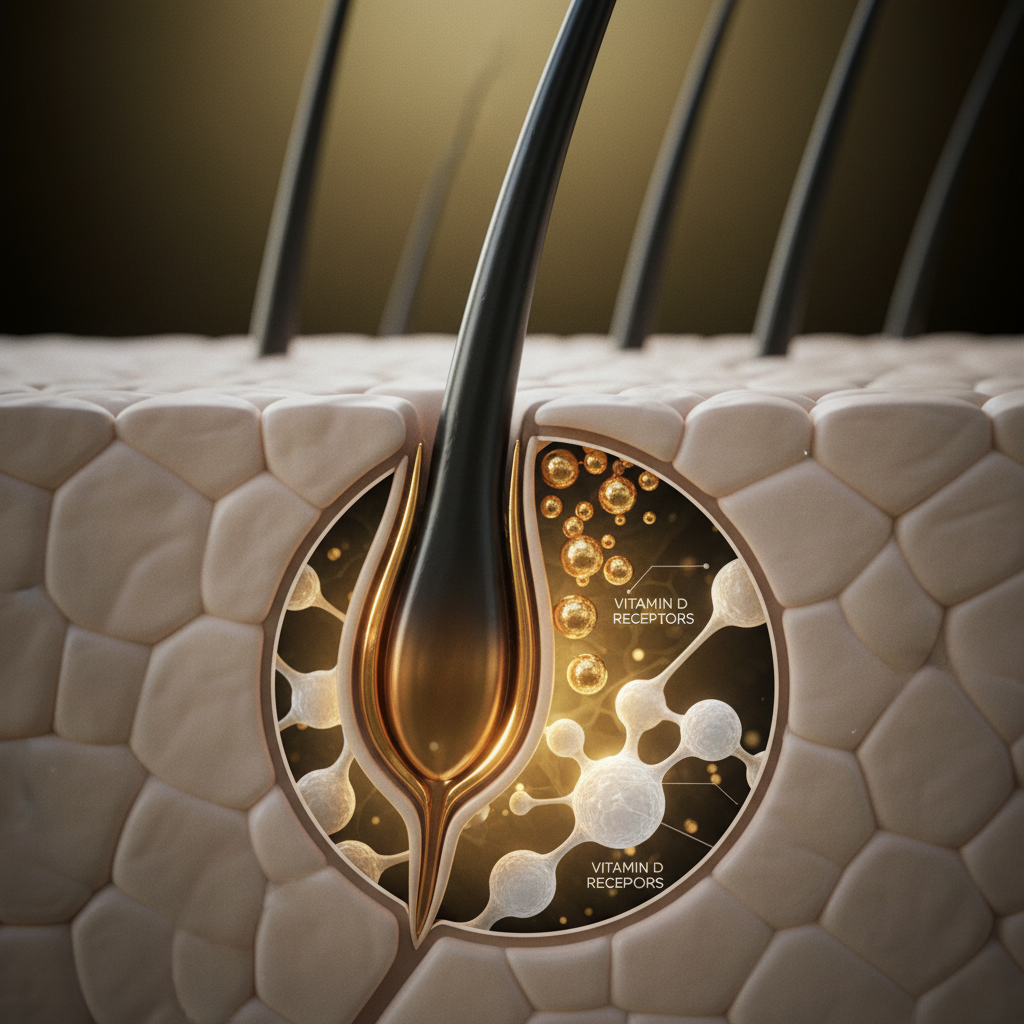
- Stem cell activation: The VDR regulates genes required for the transition of stem cells from the quiescent state into active matrix cells that build the hair shaft.
- Wnt/beta-catenin signalling: This is the primary biochemical pathway governing follicle initiation and regeneration. Calcitriol directly supports Wnt pathway transcription.
- Immune modulation: Vitamin D exerts an anti-inflammatory, immunomodulatory effect within the scalp environment. It dampens pro-inflammatory T-cell activity around the follicle, helping protect against autoimmune collapse of the follicle's immune privilege, as seen in alopecia areata.
- Keratinocyte differentiation: Without sufficient VDR signalling, keratinocytes fail to form the structural layers of the inner root sheath, leading to fragile anchors and premature shedding.
Distinguishing deficiency shedding from other hair issues
Because shedding can stem from hormonal shifts, mechanical trauma, or autoimmune activity, checking your symptoms helps determine whether vitamin D status warrants investigation.
| Condition / Mechanism | Primary Visual Signs | Follicle Status | Typical Response to Vitamin D |
|---|---|---|---|
| Vitamin D Deficiency Shedding | Diffuse thinning across the entire scalp; excessive daily shed (over 100 hairs) with white bulbs attached. | Intact follicles prematurely forced into telogen (resting) phase. | Shedding stabilises within 3 to 6 months after serum levels normalised. |
| Hair Fibre Breakage | Uneven lengths, split ends, small snapped pieces on clothing without a bulb. | Follicles healthy; damage is structural to the external keratin shaft. | No response; requires structural conditioning, protein balance, and gentler handling. |
| Androgenetic Alopecia | Gradual widening of the central part or receding temples; miniaturised, thinner hairs. | Follicles shrink progressively due to dihydrotestosterone (DHT) sensitivity. | Minimal direct effect; may improve overall scalp resilience, but cannot halt DHT-driven miniaturisation. |
| Alopecia Areata | Distinct, smooth, round or oval bald patches; exclamation mark hairs at the periphery. | Follicles attacked by auto-reactive T-cells; immune privilege compromised. | Adjuvant benefit; correcting deficiency helps calm immune dysregulation alongside clinical care. |
Practical steps to support your levels
If you suspect low vitamin D is contributing to increased shedding, structured intervention is essential.
- Request a venous blood test: Ask your GP for a 25-hydroxyvitamin D [25(OH)D] blood test. Aim for a target range of 75 to 100 nmol/L (30 to 40 ng/mL) for optimal cellular and follicular health.
- Sensible sun exposure: During UK spring and summer months (April to September), 10 to 20 minutes of midday sunlight on uncovered arms and legs without burning stimulates natural synthesis.
- Nutritional sources: Regularly incorporate oily fish (wild salmon, mackerel, sardines), egg yolks, and fortified foods into your meals. Diet alone rarely corrects a pronounced clinical deficit, but it provides baseline maintenance.
- Targeted supplementation: If blood tests reveal a deficiency (below 50 nmol/L), clinical guidance typically recommends daily vitamin D3 (cholecalciferol) combined with vitamin K2 to ensure calcium is directed away from arteries and into bones. Dosages vary from 1,000 to 4,000 IU daily based on medical advice. Avoid self-prescribing mega-doses without blood monitoring.
External support: the Watermans approach
While internal nutritional balance supplies the raw requirements for hair synthesis, external care protects the scalp microbiome and the newly emerging fibre.
Watermans focuses on non-medicinal, nutrient-dense topicals designed to support a healthy scalp environment. Products like Watermans Grow More Elixir and Cleanse Shampoo use natural botanicals, biotin, rosemary, and caffeine. These formulas do not treat clinical vitamin deficiencies or replace blood tests, but they provide direct scalp conditioning, promote cleaner follicle openings, and reduce fibre breakage so that hair looks and feels significantly fuller while your body works to rebalance internal vitamin levels.
When to seek medical advice
Hair shedding is a delayed reaction. The physiological stress or nutritional drop that triggers telogen effluvium usually occurs two to four months before noticeable shedding begins.
You should consult a GP or a registered trichologist if:
- You observe rapid, patchy hair loss appearing over a few days or weeks.
- Shedding continues unchecked for more than six months without signs of stabilising.
- Your scalp presents with pain, burning, redness, thick scaling, or pustules.
- You feel persistent systemic fatigue, joint pain, or unprovoked weight changes alongside hair loss, which may indicate thyroid dysfunction or ferritin depletion.
Frequently asked questions about Vitamin D and Hair Follicle Health
Can correcting low vitamin D regrow hair immediately?
No. Because the human hair growth cycle is slow, it takes three to six months after your serum levels reach optimal ranges (75 to 100 nmol/L) to see a reduction in shedding. Once dormant follicles re-enter the anagen phase, the new hair shaft takes several weeks to surface through the scalp skin.
What is the exact role of Vitamin D and Hair Follicle Health in pattern baldness?
The connection between Vitamin D and Hair Follicle Health in pattern baldness (androgenetic alopecia) is indirect. Androgenetic alopecia is primarily dictated by genetics and sensitivity to dihydrotestosterone (DHT). While a vitamin D deficiency can cause concurrent shedding and exacerbate the visual appearance of thinning, raising vitamin D levels will not block DHT or reopen miniaturised follicles on its own.
How much vitamin D should I take daily for hair growth?
Standard health guidelines from the NHS recommend a baseline intake of 400 IU (10 micrograms) daily during autumn and winter for general wellbeing. For individuals with proven follicular shedding linked to a confirmed deficiency, medical practitioners often prescribe between 1,000 IU and 4,000 IU daily of vitamin D3 until blood levels stabilise. Never take higher doses without medical supervision, as excess vitamin D can cause toxicity.
Can having too much vitamin D cause hair loss?
Yes, indirect toxicity can occur. While direct vitamin D toxicity is uncommon, chronic mega-dosing leads to hypercalcaemia (elevated calcium in the bloodstream). Extreme hypercalcaemia disrupts normal cellular signalling, stresses kidneys, and can trigger systemic physiological shock, which paradoxically forces follicles into sudden telogen effluvium shedding.
Does topical vitamin D work for hair thinning?
Prescription topical calcitriol or synthetic analogues are sometimes studied for specific scalp conditions like plaque psoriasis or alopecia areata to suppress local inflammation. However, for everyday hair thinning or nutritional support, topical cosmetic vitamin D cannot penetrate adequately to replace systemic blood levels. Maintaining healthy internal serum concentrations remains the established approach.
Summary
Maintaining adequate levels of secosteroid hormones is foundational to cellular turnover across the human body. The biological link between Vitamin D and Hair Follicle Health lies within the vitamin D receptors of follicular keratinocytes, which orchestrate the transition into active anagen growth. Ensuring optimal circulating 25-hydroxyvitamin D protects follicles from premature regression and supports robust scalp vitality. Always verify your blood levels through formal diagnostic testing rather than guessing, pair nutritional recovery with gentle cosmetic hair care, and consult registered medical professionals when facing persistent shedding.
Sources and references
- British Association of Dermatologists. Clinical Guidelines for the Management of Alopecia Areata. 2020.
- National Institute for Health and Care Excellence (NICE). Vitamin D: supplement use in specific population groups. Clinical Guideline [PH56]. 2017.
- Journal of Investigative Dermatology. The role of the vitamin D receptor in hair follicle biology. 2010; 130(10): 2356-2364.
- Dermatology and Therapy. The Role of Vitamins and Minerals in Hair Loss: A Review. 2019; 9(1): 51-70.
- National Health Service (NHS). Vitamin D Guidelines and Recommendations. 2023.
Find these ingredients in Watermans products
- Vitamin D: you will find this ingredient in our Hair Vitamins.