Understanding the Scalp Microbiome: A Guide to Scalp Health
9 min read ·
Explore the essentials of understanding the scalp microbiome, from key bacteria and yeasts to practical evidence-based habits for keeping your scalp barrier balanced and healthy.
Quick answer: Understanding the scalp microbiome means examining the complex ecosystem of bacteria, fungi, and viruses living on your head. Dominated by Cutibacterium acnes, Staphylococcus epidermidis, and Malassezia yeasts, this community regulates skin barrier function, oil breakdown, and local immune responses. When this delicate balance shifts, irritation, flaking, and inflammation follow. However, topical products cannot permanently reshape your microbial profile overnight, as host genetics, sebum levels, and environmental exposures continually govern these microscopic populations.
Key takeaways
- The scalp microbiome is a specialised ecosystem dominated by two main bacterial genera (Cutibacterium and Staphylococcus) and one fungal genus (Malassezia).
- Imbalances between these organisms, known as dysbiosis, correlate strongly with conditions such as dandruff, seborrhoeic dermatitis, and scalp pruritus.
- The normal scalp maintains an acidic surface pH between 4.5 and 5.5, which naturally repels pathogenic invaders and stabilises resident microbes.
- Harsh cleansing, occlusive styling practices, and extreme pH shifts disrupt microbial diversity, often provoking inflammatory flaking rather than simple dry skin.
- Topical haircare can support microbial equilibrium by respecting the acid mantle and gently clearing excess lipids, but it cannot override underlying hormonal or immunological drivers.
Understanding the Scalp Microbiome: what the evidence shows
Understanding the scalp microbiome begins with recognising how uniquely hostile and nutrient-dense the scalp is compared to the rest of human skin. The scalp houses roughly 100,000 hair follicles, each accompanied by large sebaceous glands pumping out sebum. Sebum is a lipid cocktail composed of triglycerides, wax esters, squalene, and free fatty acids. This oily environment creates a distinct niche where only specialised micro-organisms can survive.
Genomic sequencing studies, particularly those using 16S rRNA gene sequencing for bacteria and internal transcribed spacer (ITS) sequencing for fungi, reveal that healthy scalps have relatively low microbial diversity compared to the forearm or gut. Two bacterial species make up the vast majority of the bacterial biomass: Cutibacterium acnes (formerly Propionibacterium acnes) and Staphylococcus epidermidis.
Cutibacterium acnes thrives deep within the anaerobic conditions of the follicular infundibulum, feeding on sebum triglycerides. In doing so, it secretes lipases that break triglycerides down into free fatty acids, helping maintain the scalp's acidic pH (typically 4.5 to 5.5). Meanwhile, Staphylococcus epidermidis occupies the more aerobic surface layers of the stratum corneum, producing antimicrobial peptides that prevent colonization by more aggressive pathogens, such as Staphylococcus aureus.
On the fungal side, lipid-dependent yeasts belonging to the genus Malassezia predominate, specifically Malassezia restrictor and Malassezia globosa. These yeasts lack the genes to synthesize their own fatty acids, so they depend entirely on host sebum. They consume specific saturated fatty acids and leave behind unsaturated free fatty acids, particularly oleic acid, on the skin surface. In susceptible individuals, oleic acid penetrates the stratum corneum, triggering barrier disruption, inflammatory signalling, and rapid epidermal turnover that manifests as visible dandruff.
| Micro-organism | Primary Niche | Nutritional Source | Physiological Role / Consequence |
|---|---|---|---|
| Cutibacterium acnes | Deep follicular canal (anaerobic) | Sebum triglycerides | Produces free fatty acids; stabilizes acidic pH |
| Staphylococcus epidermidis | Superficial stratum corneum | Cellular debris, sweat, lipids | Secretes antimicrobial peptides; checks pathogens |
| Staphylococcus aureus | Transient surface coloniser | Damaged tissue fluids, sebum | Opportunistic pathogen; amplifies skin inflammation |
| Malassezia globosa / restricta | Follicular openings and surface | Sebum lipids | Digests lipids; releases irritating oleic acid |
What the evidence does not show
Research into skin microbiology has surged, but the commercial claims surrounding it frequently outpace validated clinical evidence. Understanding the scalp microbiome requires separating biological facts from marketing overreach.
First, scientific literature does not support the idea of a universal "ideal" microbiome that can be bottled and applied. Microbial profiles vary significantly between individuals based on age, biological sex, ethnicity, climate, and personal sebum production rates. A bacterial ratio associated with comfort in one person might coincide with irritation in another.
Second, topical "probiotic" shampoos do not colonise your scalp with permanent, living colonies. Most cosmetics labelled as probiotic contain postbiotics (inactivated bacterial lysates, cell wall fragments, or fermentation filtrates) or prebiotics (sugars like inulin intended to nourish native flora). True live biotherapeutic products are exceptionally rare in cosmetic haircare because living bacteria cannot survive standard preservative systems designed to keep products shelf-stable.
Finally, while persistent micro-inflammation from microbial dysbiosis can impair follicle anchorage and trigger telogen shedding, an imbalanced microbiome is not the primary cause of pattern hair loss (androgenetic alopecia). Androgenetic alopecia is driven by follicular sensitivity to dihydrotestosterone (DHT) and genetic programming. Rebalancing surface yeasts will not reverse miniaturised hair follicles.
Mechanisms of scalp dysbiosis
Microbial harmony relies on continuous cross-talk between host cells, glandular secretions, and microbial populations. When this dynamic equilibrium breaks down, the clinical result is dysbiosis.
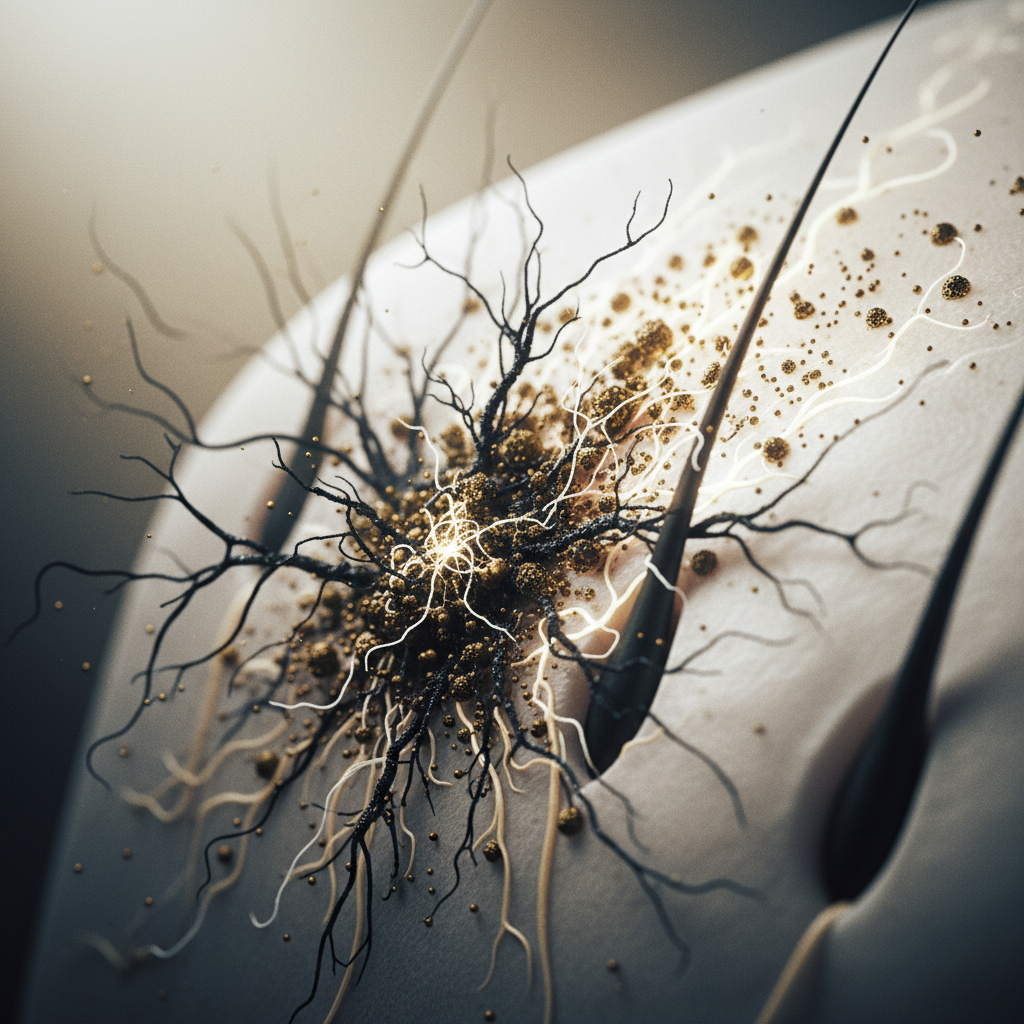
Dysbiosis typically follows a predictable cascade:
- Lipid Alteration: Fluctuations in sebum production, whether driven by hormonal shifts, stress-induced cortisol release, or infrequent cleansing, alter the food supply for resident microbes.
- Fungal Overactivity: Malassezia yeasts proliferate or increase their metabolic consumption of lipids, releasing high concentrations of irritating unsaturated fatty acids.
- Barrier Permeation: These fatty acids compromise the lipid bilayers of the stratum corneum, accelerating trans-epidermal water loss (TEWL) and permitting irritants to penetrate deeper into viable tissue layers.
- Bacterial Shifts: As the barrier weakens and moisture dynamics shift, the baseline ratio between C. Acnes and S. Epidermidis destabilises. In many inflammatory scalp states, the proportion of Staphylococcus rises significantly while Cutibacterium declines.
- Immune Activation: Keratinocytes respond to microbial metabolites and barrier disruption by producing inflammatory cytokines (such as IL-1alpha, IL-6, and TNF-alpha). This response causes vascular dilation, itchiness, and dysregulated desquamation, shedding large clumps of parakeratotic cells seen as visible flakes.
Signs of an imbalanced scalp ecosystem
A disrupted microbiome rarely goes unnoticed. Because the ecosystem sits directly on the skin's living interface, dysbiosis produces unmistakable sensory and visual signs:
- Pruritus (Persistent Itch): Often the earliest symptom, caused by irritant penetration through a compromised stratum corneum.
- Flaking and Scales: Greasy, yellowish flakes typically indicate elevated Malassezia activity and rapid skin turnover, whereas fine, white flakes may indicate dry barrier disruption.
- Erythema (Redness): Localised or diffuse capillary dilation triggered by cytokine release in the upper dermis.
- Tenderness or Burning: Altered sensory nerve endings reacting to barrier degradation and inflammatory mediators.
- Unusual Odour: Microbial breakdown of sebum components can produce volatile organic compounds, yielding a sour or musty smell even shortly after washing.
Supporting your scalp environment
Cultivating a healthy scalp environment does not require sterilising your skin. In fact, attempting to eradicate surface micro-organisms usually backfires by wiping out protective commensal strains. Evidence-based support focuses on preserving barrier integrity and managing surface substrate.
Maintain an optimal surface pH by using cleansers formulated close to the skin's natural baseline (pH 4.5 to 5.5). Alkaline soaps and harsh surfactant profiles strip protective surface lipids and swell the hair cuticle, creating an environment where Staphylococcus aureus flourishes over beneficial flora.
Cleanse with adequate frequency. Sebum accumulation provides an unmetered feast for Malassezia. Allowing oils to build up on the scalp for extended periods increases the release of irritating fatty acids. Conversely, washing too aggressively with stripping agents strips away moisture and damages the barrier. Find a balance that keeps oil manageable without leaving the scalp feeling taut or dry.
Avoid heavy occlusives directly on the skin. Pure plant butters, petroleum jellies, and thick waxes applied heavily to the scalp create a warm, low-oxygen barrier that encourages the uncontrolled proliferation of anaerobic species and lipid-loving yeasts. If your hair fibres need heavy conditioning, keep those formulas confined to mid-lengths and ends.
Watermans: focused approach to scalp wellness
Education on scalp physiology underlines a clear reality: your hair follicles rely on a clean, calm, and balanced skin foundation to produce strong-feeling hair. Watermans designs products with this anatomical surface in mind.
Formulas such as Watermans Grow Me Shampoo incorporate purposeful washing agents alongside ingredients like rosemary extract, biotin, and allantoin, working to clear excess sebum and impurities without stripping the protective moisture barrier. By washing away redundant surface oils, supporting scalp cleanliness, and leaving the hair fibre invigorated, Watermans helps maintain an environment where natural hair vitality can thrive.
When the cause may be something else
Not every flaky or sensitive scalp stems from simple microbial dysbiosis. Psoriasis, for instance, is an autoimmune condition driven by T-cells that causes hyperproliferation of keratinocytes, resulting in thick, silvery, well-demarcated plaques that resist ordinary anti-dandruff care.
Similarly, contact dermatitis can mimic dysbiosis. Allergic reactions to fragrance components, preservatives (such as methylisothiazolinone), or paraphenylenediamine (PPD) in hair dyes provoke intense itching, redness, and blistering. Treating an allergic reaction with aggressive anti-dandruff regimens will only inflame the skin further.
When to seek professional advice
Consult a GP, dermatologist, or qualified trichologist if:
- Your scalp exhibits severe redness, weeping, crusting, or bleeding.
- Over-the-counter care yields no improvement after 3 to 4 weeks of consistent use.
- You observe patches of true hair loss, widening partings, or smooth, round bald spots.
- Scalp discomfort significantly interferes with sleep or day-to-day comfort.
Prescription interventions, such as topical corticosteroids, targeted antifungals (like ciclopirox or high-strength ketoconazole), or calcineurin inhibitors, may be necessary to resolve clinical dermatoses.
Frequently asked questions about Understanding the Scalp Microbiome
What kills the healthy bacteria on your scalp?
Over-cleansing with high-pH alkaline soaps, using harsh chemical treatments without adequate scalp protection, and applying broad-spectrum topical antibiotics can decimate healthy bacterial populations. Excessive heat, chronic sun exposure, and picking at the scalp also disrupt the stratum corneum, compromising the physical micro-habitats where S. Epidermidis and C. Acnes survive.
Can hair oiling damage your scalp microbiome?
Yes, heavy oiling can harm microbial balance. Pure plant oils rich in triglycerides or oleic acid provide direct fuel for Malassezia yeasts. Leaving these oils on the scalp for prolonged periods can accelerate yeast proliferation, leading to barrier disruption, inflammation, and flaking. If you use scalp oils, use them sparingly and wash them out thoroughly.
How does understanding the scalp microbiome help treat dandruff?
Understanding the scalp microbiome clarifies that dandruff is not merely simple dry skin, but an inflammatory reaction to the metabolic by-products of Malassezia feeding on sebum. Instead of applying heavy moisturisers, which feed the yeast, effective management involves anti-fungal agents, gentle keratolytic exfoliants (like salicylic acid), and pH-balanced cleansers to lower fungal density and calm the skin.
Can an imbalanced scalp microbiome cause hair shedding?
Yes, but indirectly. Dysbiosis produces localised inflammation, oxidative stress, and structural barrier compromise. While it does not cause genetic male or female pattern hair loss, severe and sustained scalp inflammation can disrupt follicular anchorage, pushing growing hair prematurely into the telogen (shedding) phase. Restoring microbial balance usually resolves this temporary shedding.
Summary
Understanding the scalp microbiome shifts how we view everyday haircare. Your scalp is not a sterile surface to be stripped clean, but a living ecosystem that protects against pathogens and maintains cellular balance. By respecting its natural pH, moderating oil levels without harsh stripping, and recognising the interplay between host biology and microbial populations, you lay the groundwork for a comfortable scalp and resilient hair.
Sources and references
- British Association of Dermatologists. Seborrhoeic Dermatitis Guidelines.
- Clinical, Cosmetic and Investigational Dermatology. "The Scalp Microbiome: Composition, Role in Health and Disease, and Therapeutic Opportunities."
- Journal of Investigative Dermatology. "Microbial Ecology of the Scalp in Health and Dandruff."
- Nature Microbiology. "Analysis of the human skin microbiome and its association with dermatological conditions."
Find these ingredients in Watermans products
- Oleic Acid: you will find this ingredient in our Camellia & Black Castor Hair & Body Oil.