Scalp pH Balance: The Complete Guide to Acid Mantle Health
9 min read ·
Learn how maintaining an optimal Scalp pH Balance protects the skin's acid mantle, reduces hair breakage, and supports healthy barrier function with clinical facts.
Quick answer: Scalp pH balance refers to maintaining the skin on your head within its natural, slightly acidic range of approximately 4.5 to 5.5. This natural acidity sustains the protective acid mantle, limits microbial overgrowth, and preserves barrier lipids. Disruption from alkaline cleansers or hard water compromises this barrier, leading to irritation, dryness, or flaking. However, managing your Scalp pH Balance is a cosmetic and barrier-maintenance strategy; it cannot cure underlying medical scalp disorders or reverse genetic hair loss.
Key takeaways
- The healthy scalp maintains an acidic surface pH between 4.5 and 5.5, which is essential for skin barrier function.
- Hair fibre has no biological mechanism to regulate its own pH, making it dependent on slightly acidic external environments to keep the cuticle compact.
- Alkaline hair products (pH above 7.0) swell the hair cuticle, increase negative electrical charge, and promote friction and breakage.
- Disrupting the acid mantle encourages opportunistic microbes, including Malassezia species, to proliferate and trigger irritation or flaking.
- Water alone can temporarily raise scalp pH because tap water typically sits between pH 6.5 and 8.5.
- Restoring barrier function supports comfortable skin and cosmetically resilient hair, but it does not treat follicular conditions such as androgenetic alopecia.
Scalp pH balance: what the evidence shows
Scalp pH balance is defined by the surface acidity of the stratum corneum, which normally registers between pH 4.5 and 5.5 in healthy adults. This mildly acidic environment, termed the acid mantle, is formed by sebum, sweat, lactic acid, and amino acids generated during normal skin cell turnover. Published dermatological research demonstrates that this acidity plays three non-negotiable roles: activating the enzymes responsible for lipid barrier synthesis, inhibiting pathogenic bacterial colonisation, and preserving the integrity of cutaneous microflora.
The hair shaft itself differs fundamentally from the scalp skin. While the scalp is living, metabolically active tissue capable of buffered acid recovery, hair strands are non-living keratin fibres with an isoelectric point around pH 3.67. When hair is exposed to solutions with a pH above 5.5, the cuticle scales lift due to increased negative surface charges. This structural swelling leaves the hair porous, prone to moisture loss, and vulnerable to mechanical breakage.
Clinical evaluations of commercial cleansers have revealed significant variance. A landmark study published in the International Journal of Trichology examined 123 shampoos and discovered that only 38 percent possessed a pH equal to or below 5.5. Alkaline formulations (often ranging from pH 7.0 to 9.0) strip the stratum corneum of essential ceramides and fatty acids while drastically increasing cuticle friction along the hair shaft.
Acidic (pH 3.5 - 5.5) Neutral (pH 7.0) Alkaline (pH 8.0 - 10.0)
|---------------------------|----------------------|-----------------------|
Healthy scalp surface Pure water Traditional lye soaps
Compact cuticle scales Cuticle swelling
Controlled microflora Microbial dysbiosis
How the acid mantle mechanism works
The acid mantle serves as the primary biochemical shield for the scalp. Sebaceous glands produce sebum containing free fatty acids, while eccrine sweat glands deposit lactic acid. Together with the sodium-hydrogen antiporter system in epidermal keratinocytes, these secretions maintain the acidic surface gradient.
This acidic gradient directly regulates key enzymes:
- Beta-glucocerebrosidase and acidic sphingomyelinase: These enzymes require an optimal pH of roughly 5.0 to process precursor lipids into ceramides. When the pH rises, ceramide synthesis slows, leading to transepidermal water loss (TEWL) and a weakened physical barrier.
- Kallikreins (KLK5 and KLK7): These serine proteases control desquamation (the shedding of dead skin cells). Alkaline conditions artificially accelerate their activity, causing premature breakdown of corneodesmosomes and resulting in visible flaking and barrier impairment.
- Microbial regulation: The scalp hosts a balanced microbiome, including Cutibacterium acnes, Staphylococcus epidermidis, and lipophilic yeasts from the Malassezia genus. Normal acidity holds opportunistic pathogens in check. When pH shifts upward toward alkalinity, bacterial adhesion rises and Malassezia populations can generate inflammatory free fatty acids that provoke pruritus (itching) and seborrhoeic dermatitis.
Comparing pH levels across hair products and water
Understanding product chemistry helps identify what supports or destabilises your skin barrier:
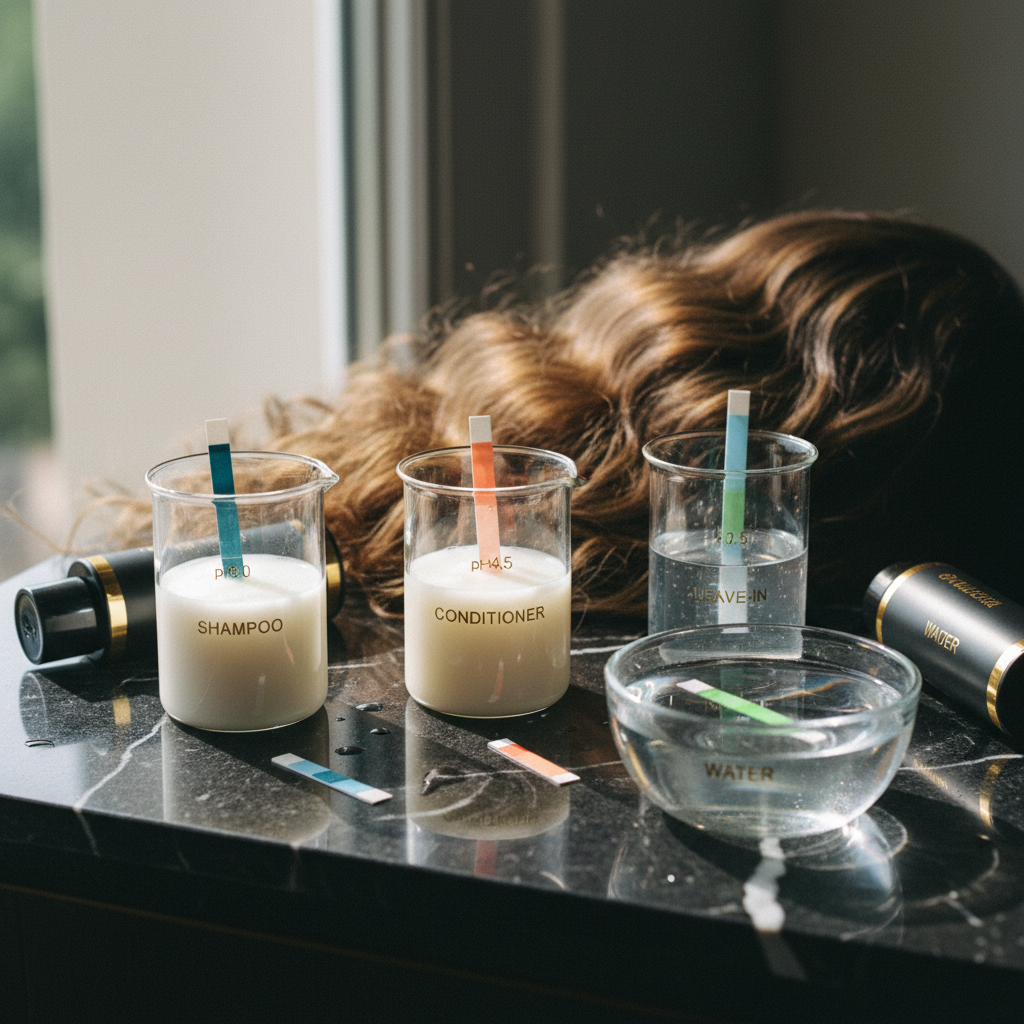
| Substance / Product | Typical pH Range | Impact on Scalp Barrier | Impact on Hair Fibre |
|---|---|---|---|
| Healthy Scalp Surface | 4.5 to 5.5 | Optimal lipid synthesis, balanced flora | Baseline condition |
| Tap Water (UK / EU standards) | 6.5 to 8.5 | Temporarily raises surface pH | Minor, temporary swelling |
| Acid-Balanced Shampoo | 4.5 to 5.5 | Maintains acid mantle and lipid barrier | Keeps cuticle flat, reduces friction |
| Alkaline Bar Soaps | 8.5 to 10.5 | Strips barrier lipids, triggers flaking | Severe cuticle lifting, high breakage risk |
| Standard Hair Conditioners | 3.5 to 4.5 | Re-acidifies surface after cleansing | Seals cuticles, neutralises negative charges |
| Permanent Hair Colour / Bleach | 9.0 to 11.0 | Acute chemical irritation, barrier damage | Forces cuticles open, degrades cortex bonds |
Signs of an imbalanced scalp pH
When scalp surface chemistry is disrupted, the signs manifest both on the skin surface and in the physical state of the hair:
- Persistent itching and tightness: A rise in pH accelerates water evaporation across the stratum corneum, creating unbuffered sensory irritation.
- Atypical flaking: Uneven desquamation caused by hyperactive serine proteases produces fine, powdery white flakes distinct from oily seborrhoeic scales.
- Microbial flare-ups: Pruritus accompanied by redness often signals that opportunistic microbes are proliferating in an alkaline environment.
- Tangled, dull hair lengths: As alkaline wash water or soaps lift the cuticles, adjacent hair fibres generate high electrostatic repulsion and catch against one another, causing friction and subsequent hair breakage.
What the evidence does not show
It is critical to separate established dermatological mechanisms from marketing claims. Preserving your Scalp pH Balance is vital for skin comfort, but the scientific literature does not support the following claims:
- It does not cure genetic pattern hair loss: Androgenetic alopecia is driven by follicular sensitivity to dihydrotestosterone (DHT) and genetic signalling, not surface acidity. Altering product pH will not stop follicular miniaturisation.
- It does not halt telogen effluvium: Hair shedding triggered by physiological stressors, nutritional deficiencies, or hormonal fluctuations occurs deep within the dermal papilla. Surface pH adjustments cannot force resting follicles back into anagen.
- Acidic rinses cannot permanently mend split ends: While acidic solutions smooth the outer cuticle scales, they cannot rebuild severed polypeptide chains inside a damaged hair shaft.
Practical steps to support scalp pH balance
You can protect and restore your scalp surface acidity using simple cosmetic and lifestyle adjustments:
- Select cleansers labelled with a target pH: Look for formulations explicitly balanced between pH 4.5 and 5.5. Avoid traditional lye-based bar soaps on the scalp, as their naturally alkaline chemistry (pH 9.0 to 10.0) strips protective lipids.
- Always follow with an acidic conditioning step: Conditioners and post-wash treatments typically register between pH 3.5 and 4.5. Applying these formulas helps re-acidify the hair shaft, flattening cuticle scales raised by wash water.
- Mind your tap water contact: Because tap water naturally sits between pH 6.5 and 8.5, prolonged rinsing exposes the scalp to an alkaline buffer. Minimise excessive soaking times in hard water areas.
- Use DIY acidic rinses with extreme caution: Diluted apple cider vinegar is often recommended online, but undiluted or poorly measured vinegar sits at pH 2.0 to 3.0. Applying solutions this strong can cause acute chemical burns and contact dermatitis. If you choose to use an acid rinse, ensure it is formulated and safety-tested commercially.
Supporting the scalp environment with Watermans
Cosmetic formulations designed to respect cutaneous biology make daily scalp maintenance straightforward. Watermans GrowMe Shampoo is formulated to cleanse the hair and scalp effectively while respecting the delicate natural environment of the skin. By avoiding aggressive, heavily alkaline cleansing agents, it cleanses without stripping away essential surface lipids.
Paired with Watermans ConditionMe Conditioner, which delivers targeted hydration within a cuticle-smoothing pH range, this approach supports skin barrier function and helps minimise mechanical hair breakage along the strand. Incorporating nutrient-rich topical care helps sustain a resilient, comfortable scalp environment.
When the cause is something else
Not all scalp irritation stems from cosmetic pH disruption. Several clinical conditions present with identical symptoms:
- Seborrhoeic dermatitis: While influenced by microbial changes, this inflammatory disorder involves complex interactions between sebum production, Malassezia metabolites, and systemic immune reactivity. It frequently requires antifungal treatments containing ketoconazole or zinc pyrithione.
- Scalp psoriasis: This is an autoimmune condition marked by rapid epidermal proliferation that produces thick, silvery plaques. It cannot be remedied by acid-balanced cosmetics and demands prescription medical care.
- Contact dermatitis: An allergic reaction to fragrances, preservatives (such as methylisothiazolinone), or paraphenylenediamine (PPD) in hair dyes causes acute erythema, burning, and weeping that requires medical identification and allergen avoidance.
When to seek professional advice
Consult a GP, dermatologist, or registered trichologist if you observe any of the following:
- Intense itching that disrupts sleep or daily focus.
- Scalp redness accompanied by swelling, heat, oozing, or honey-coloured crusting (signs of secondary infection).
- Thick, adherent scaling that does not respond to standard over-the-counter anti-dandruff cleansers after four weeks.
- Patchy hair loss, follicular pustules, or tenderness, which may indicate a scarring alopecia requiring immediate clinical intervention.
Frequently asked questions about Scalp pH Balance
How long does it take to restore Scalp pH Balance after washing?
Under normal conditions, a healthy scalp recovers its baseline acidity within 30 minutes to a few hours after washing with tap water. However, if you use a high-pH soap or an aggressive alkaline shampoo, full recovery of the barrier lipids and acid mantle can take over 48 hours, leaving the scalp vulnerable to irritation and moisture loss.
Can tap water disrupt my Scalp pH Balance?
Yes, tap water can temporarily disrupt the surface pH. Most municipal water supplies are buffered between pH 6.5 and 8.5 to prevent plumbing corrosion. Because your scalp sits around pH 5.5, water exposure temporarily shifts the skin toward neutral or alkaline territory. Rinsing thoroughly and applying an acidic conditioner quickly counteracts this shift.
Does apple cider vinegar safely fix an alkaline scalp?
Diluted apple cider vinegar can temporarily lower scalp surface pH, but it carries risks. Pure vinegar has a pH between 2.0 and 3.0, which is acidic enough to cause chemical irritation, redness, and peeling on sensitive skin. Commercially formulated, pH-tested scalp tonics are substantially safer and more reliable than unstandardised home remedies.
Will correcting my scalp pH stop my hair shedding?
No. Correcting your scalp pH supports barrier health, reduces itching, and minimises cuticle-related hair breakage, but it does not stop physiological hair shedding. Shedding conditions like telogen effluvium originate inside the hair follicle due to systemic stress, hormonal changes, or nutritional gaps, which operate independently of the acid mantle.
The foundation of scalp health
Maintaining an optimal Scalp pH Balance between 4.5 and 5.5 is one of the most effective ways to preserve the acid mantle, support lipid production, and keep the hair cuticle compact and smooth. While gentle, acid-balanced products cannot alter internal genetics or cure inflammatory medical conditions, respecting this biological baseline prevents cosmetic dryness, reduces mechanical breakage, and keeps the scalp comfortable and resilient.
Sources and references
- International Journal of Trichology: "The Shampoo pH can Affect the Hair: Myth or Reality?" (Gavazzoni Dias et al., 2014, doi:10.4103/0974-7753.139200)
- British Journal of Dermatology: "Natural skin surface pH is on average below 5, which is beneficial for its resident flora" (Lambers et al., 2006, doi:10.1111/j.1365-2133.2006.07468.x)
- Acta Dermato-Venereologica: "The concept of the acid mantle of the skin: its relevance for the treatment of sensitive skin" (Schmid-Wendtner & Korting, 2006, doi:10.2340/00015555-0166)
- Journal of Cosmetic Dermatology: "Evaluation of the pH of commercial shampoos and its influence on hair health" (Tarun et al., 2014)
Find these ingredients in Watermans products
- Zinc: you will find this ingredient in our Hair Vitamins.