Understanding Hair Types: A Comprehensive Guide to Your Hair’s Characteristics
9 min read ·
Understanding Hair Types helps you identify your hair’s unique characteristics, including curl pattern, texture, porosity, and density, to inform tailored care routines. It’s important to remember that these categories are descriptive tools, not rigid classifications.
Quick answer: Understanding Hair Types is crucial for developing an effective hair care routine tailored to your individual needs. It involves assessing several key characteristics of your hair, such as its natural curl pattern, the thickness of individual strands (texture), its ability to absorb and retain moisture (porosity), and the overall number of strands on your scalp (density). This comprehensive approach helps you choose the right products and techniques, though it's important to recognise these are descriptive frameworks, not rigid scientific classifications.
Key takeaways
- Your hair type is a combination of curl pattern, texture, porosity, and density, each influencing how your hair behaves.
- Curl pattern classifications, while popular, are not scientifically rigorous and serve as guides rather than strict rules.
- Hair texture describes the thickness of individual strands (fine, medium, coarse), impacting strength and styling.
- Hair porosity indicates how well your hair absorbs and retains water, crucial for choosing moisturisers and conditioners.
- Hair density refers to the number of hairs on your scalp, affecting perceived volume and product application.
- Accurately Understanding Hair Types can help minimise breakage and improve overall hair health by informing product and routine choices.
Understanding Hair Types: what the evidence shows
Understanding Hair Types is not about fitting your hair into a single, definitive category, but rather about appreciating the interplay of its various characteristics. Your hair’s specific traits are influenced by genetics, diet, and environmental factors, all of which contribute to its unique behaviour and needs. Scientific literature often focuses on the structural properties of hair fibres, such as their diameter, shape, and surface characteristics, which correlate with perceived curl, texture, and porosity. While popular categorisation systems exist, they are primarily descriptive tools to help guide consumers, rather than strict scientific classifications.
Curl Pattern: more than just straight or curly
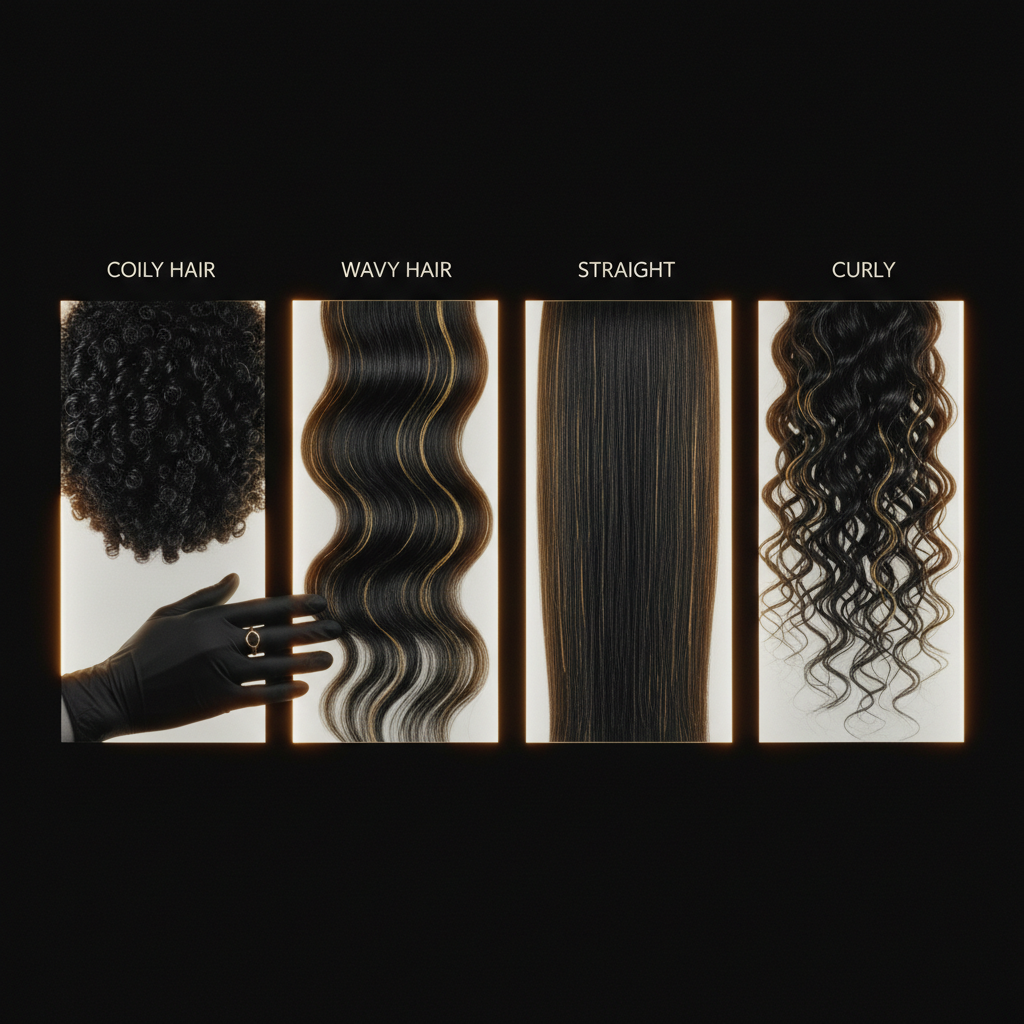
The curl pattern of your hair is determined by the shape of the hair follicle. Oval or asymmetrical follicles produce curlier hair, while round follicles produce straighter hair. The angle at which the follicle emerges from the scalp also plays a role. Popular systems, like the Andre Walker Hair Typing System, categorise hair into types 1 (straight), 2 (wavy), 3 (curly), and 4 (coily or kinky), with sub-types (A, B, C) indicating the tightness of the curl or coil. While widely used, these categories are not universally recognised in scientific research as precise differentiators, but they offer a practical way to describe hair’s visual appearance and manageability.
-
Type 1: Straight Hair has no natural curl. Sebum, your scalp's natural oil, can travel easily down the smooth shaft, often making it prone to oiliness. It typically reflects light well, appearing shiny.
-
1A: Very fine, pin-straight, often struggles to hold a curl.
-
1B: Straight with some body, medium texture, can hold a curl.
-
1C: Coarse and thick, very straight, often resistant to curling.
-
Type 2: Wavy Hair forms an S-shape or loose spirals. It has more body than straight hair but less definition than curly hair. Wavy hair can be prone to frizz and might need specific care to enhance its natural pattern.
-
2A: Loose, stretched-out S-waves, generally fine, easy to straighten.
-
2B: More defined S-waves, medium texture, can be prone to frizz.
-
2C: Well-defined S-waves, can include some spirals, coarser texture, often frizzy.
-
Type 3: Curly Hair forms distinct loops or spirals. The shape of the hair shaft means the cuticles (outermost layer) may not lie as flat as straight hair, making it more prone to dryness and frizz. Moisture retention is a key focus for caring for curly hair.
-
3A: Large, loose curls, often corkscrew-shaped.
-
3B: Bouncy, tighter curls, often the size of a permanent marker.
-
3C: Tightly packed curls, often the size of a pencil, with significant volume.
-
Type 4: Coily/Kinky Hair has very tight, small, and often fragile coils, frequently in a zig-zag pattern. This hair type can appear dense but is often the most delicate and prone to breakage. It experiences significant shrinkage when wet and requires intensive moisturising and gentle handling. See Caring for Afro Hair for more details.
-
4A: Densely packed, S-shaped coils that are visible, can be the size of a crochet needle.
-
4B: Z-shaped coils with sharper angles, less defined curl pattern than 4A.
-
4C: Densely packed zig-zag pattern, minimal defined curl, maximal shrinkage.
Hair Texture: the thickness of individual strands
Hair texture refers to the diameter or circumference of an individual hair strand. It's not about how your hair feels, but rather its actual thickness. This characteristic impacts your hair's strength, its susceptibility to damage, and how it holds styles.
- Fine: Individual strands are very thin and often difficult to see. Fine hair is delicate and can be easily damaged, but it generally holds styles well without being weighed down. It can lack volume.
- Medium: Individual strands are neither fine nor coarse. This is the most common hair texture and is relatively strong and elastic.
- Coarse: Individual strands are thick and strong. Coarse hair is durable but can be more resistant to chemical processes and may feel dry if not adequately moisturised. It often has significant volume.
Hair Porosity: how well your hair absorbs moisture
Hair porosity describes your hair’s ability to absorb and retain moisture. This is primarily determined by the condition of the cuticle, the outermost layer of the hair shaft. Understanding your hair porosity is vital for selecting appropriate conditioners and moisturisers.
| Porosity Level | Cuticle Condition | Characteristics | Care Focus |
|---|---|---|---|
| Low Porosity | Tightly closed | Resists moisture, prone to product buildup, slow to dry | Lightweight products, gentle heat to aid absorption |
| Medium Porosity | Slightly raised | Easily absorbs and retains moisture, balanced | Balanced routine, minimal special considerations |
| High Porosity | Raised or damaged | Absorbs moisture quickly, loses it quickly, prone to frizz | Rich moisturisers, sealing products, protein treatments |
To roughly gauge your hair's porosity, take a clean, shed strand of hair and place it in a glass of room-temperature water. If it floats, you likely have low porosity. If it sinks slowly, it suggests medium porosity. If it sinks quickly, you likely have high porosity. This is a descriptive test, and professional assessment can provide more precise information.
Hair Density: how many hairs you have
Hair density refers to the number of individual hair strands on your scalp per square centimetre. This is distinct from hair texture, which measures the thickness of a single strand. Density influences how full or voluminous your hair appears.
- Low Density (Thin): Fewer hairs per square centimetre. The scalp may be visible, and hair can look sparse.
- Medium Density: An average amount of hair per square centimetre.
- High Density (Thick): Many hairs per square centimetre. Appears very full and voluminous.
To estimate your hair density, simply gather your hair in a ponytail. A small circumference suggests low density, while a large circumference indicates high density. Alternatively, part your hair and observe how easily your scalp is visible.
What Understanding Hair Types doesn't show
While curl pattern, texture, porosity, and density are valuable descriptive tools, they don't tell the whole story of your hair health. These categorisations do not account for other critical factors such as scalp health, hair elasticity, hair damage from chemical treatments or heat styling, or underlying health conditions that might affect hair quality or shedding. For instance, two individuals with the same curl pattern might have vastly different needs due to varying levels of damage or scalp conditions.
Signs your hair type needs different care
Recognising the signs that your current hair care routine isn't working for your hair type is key. Persistent dryness, excessive frizz, lack of volume, product buildup, or hair feeling weighed down are common indicators. For example, if you have low porosity hair and use heavy, oil-rich products, you might experience buildup and greasy-feeling hair, as the products sit on the surface rather than absorbing. Conversely, high porosity hair might always feel dry and frizzy if not adequately sealed with emollients after moisturising.
When to get professional advice
If you're struggling to understand your hair's needs, experiencing significant changes in hair quality, or dealing with excessive shedding or hair loss, it's advisable to consult a trichologist or dermatologist. They can provide an accurate diagnosis, rule out underlying medical conditions, and offer personalised advice that goes beyond basic hair typing, taking into account scalp health and overall hair integrity.
Frequently asked questions about Understanding Hair Types
Is the Andre Walker system the only way of Understanding Hair Types?
No, the Andre Walker system is one popular descriptive method, but not the only one. Other systems exist, and many professionals combine various characteristics like porosity and density to create a more comprehensive hair profile. Scientific literature often focuses on specific hair fibre properties rather than broad categorisations. Ultimately, it's a tool to guide product choice, not a strict scientific classification.
Can my hair type change over time?
Yes, your hair type can change due to various factors. Hormonal shifts (e.g., pregnancy, menopause), age, diet, chemical treatments, illness, and even certain medications can alter your hair's texture, density, or porosity. For example, hair can become finer and less dense with age, and chemical damage can increase porosity.
Does Understanding Hair Types help with hair loss?
Understanding Hair Types primarily helps with managing the cosmetic health and appearance of your hair. While a good hair care routine can prevent breakage (which can be confused with hair loss), hair typing itself does not diagnose or treat follicular hair loss or alopecia. For genuine hair loss, consult a medical professional.
Why does my hair sometimes feel dry even after conditioning?
If your hair still feels dry, it could be related to its porosity. High porosity hair absorbs moisture quickly but loses it just as fast, requiring sealing products. Low porosity hair might resist water penetration, meaning conditioners sit on the surface without hydrating the core. Hard water can also contribute to dryness, as mineral buildup can prevent moisture from entering the hair shaft.
What's the difference between hair texture and hair density?
Hair texture refers to the thickness of individual hair strands (fine, medium, coarse). Hair density, on the other hand, refers to the number of hair strands on your scalp per square centimetre. You can have fine hair with high density (many fine hairs) or coarse hair with low density (few thick hairs).
How important is pH for my hair type?
Maintaining the correct pH balance is important for all hair types. Healthy hair and scalp are mildly acidic, typically around pH 4.5 to 5.5. Products with a similar pH help to keep the cuticle flat and smooth, reducing frizz and improving shine. Understanding The pH Scale and Hair can help you choose appropriate products that respect this natural balance.
Where Watermans fits
Watermans hair care products are formulated to support various hair needs, aligning with the principles of Understanding Hair Types. For those seeking to address concerns related to hair strength, growth, or overall scalp health, Watermans offers solutions designed to complement your hair's natural characteristics. For example, our shampoos and conditioners are crafted with ingredients aimed at nourishing the scalp and strengthening the hair fibre, which is beneficial regardless of your specific curl pattern or density. For individuals with Afro-textured hair, Frojus offers specialised ranges that cater to the unique needs of coily hair, focusing on intense moisture and protection against breakage.
Sources and references
- American Academy of Dermatology Association, "Hair care: How to shampoo and condition", accessed 2023. Available at: aad.org
- Gavazzoni Dias, M. F. R. (2015). Hair Cosmetics: An Overview. International Journal of Trichology, 7(1), 2-15. Available at: pubmed.ncbi.nlm.nih.gov/25729144/
- National Institutes of Health (NIH), National Library of Medicine, PubMed. General hair biology and physiology research.
- The International Journal of Cosmetic Science. Peer-reviewed research on hair structure and product efficacy.
- British Association of Dermatologists, Patient Information Leaflets. Accessed 2023. Available at: bad.org.uk
- S. L. Johnson, S. B. Johnson, "The Science of Black Hair: A Comprehensive Guide to Textured Hair Care", 2011. (Reference for general principles of textured hair care, not a specific study).