Understanding Hair Miniaturisation: Causes, Signs, and Solutions
8 min read ·
Learn the science behind hair miniaturisation, the role of DHT, how to recognise shrinking follicles early, and evidence-based ways to protect hair density.

Quick answer: Hair miniaturisation is the biological process where genetically sensitive scalp follicles progressively shrink under the influence of androgens, converting robust terminal hairs into wispy, unpigmented vellus hairs. Understanding Hair Miniaturisation is vital for identifying androgenetic alopecia early, as each successive growth cycle yields thinner shafts with shorter lifespans. The main limitation is that miniaturisation cannot be fully reversed once a follicle has completely atrophied, making early clinical intervention essential before permanent fibrosis takes place.
Key takeaways
- Miniaturisation transforms thick terminal hairs into thin, fine vellus fibres through repetitive, shortened hair cycles.
- The primary driver is dihydrotestosterone (DHT) binding to androgen receptors in genetically susceptible dermal papilla cells.
- Miniaturisation represents true progressive follicular hair loss, distinguishing it from diffuse shedding like telogen effluvium or physical hair breakage.
- Dermatologists diagnose the process using dermoscopy to spot hair diameter diversity exceeding 20 percent across the scalp.
- Medical treatments aim to block DHT or stimulate follicular perfusion, while cosmetic scalp routines support an optimal environment for existing strands.
Understanding Hair Miniaturisation: what the evidence shows
Understanding Hair Miniaturisation requires examining how healthy follicles transition into compromised ones over successive growth cycles. In a typical scalp, roughly 85 to 90 percent of hair follicles reside in the active anagen (growth) phase, which lasts between two and seven years. Terminal hairs produced during anagen emerge with a thick diameter, typically measuring 0.06 to 0.08 millimetres, and maintain deep anchors within the subcutaneous fat layer.
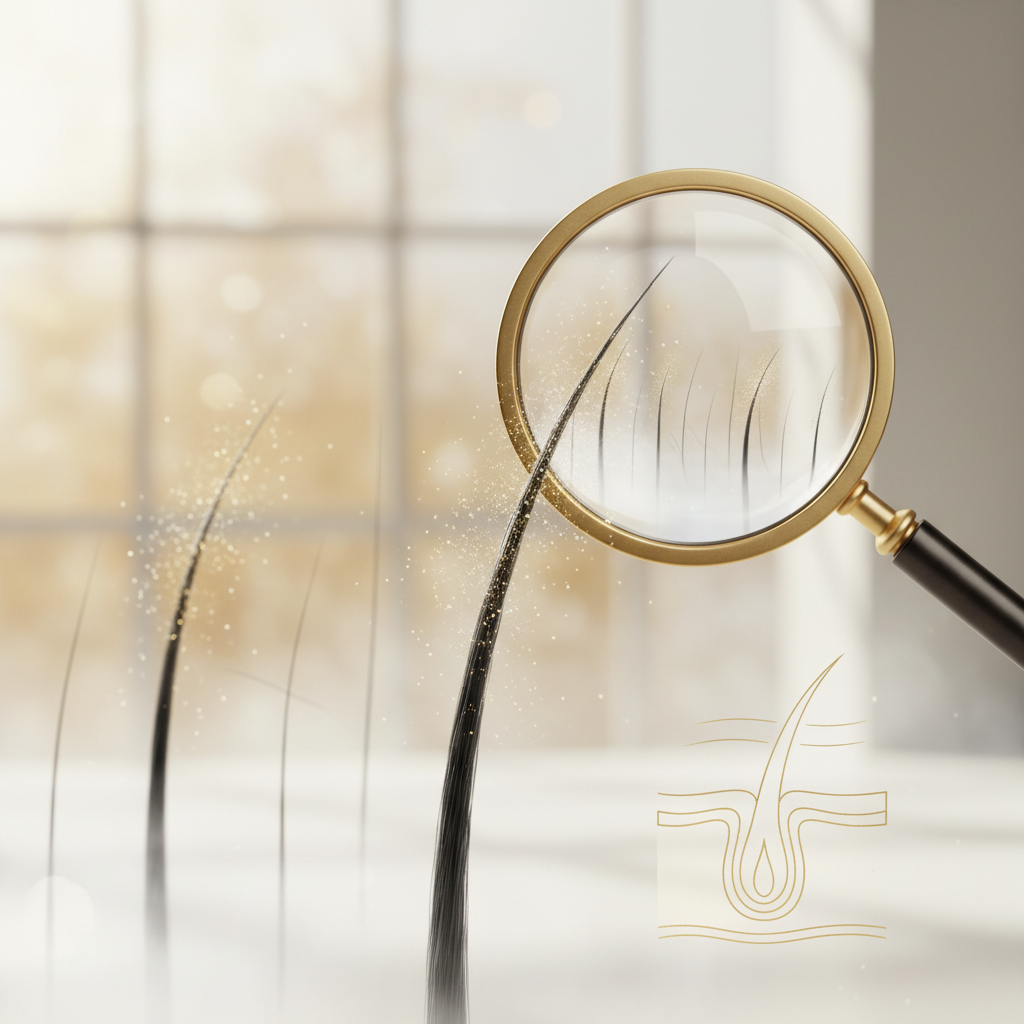
When miniaturisation occurs, the anagen phase truncates dramatically, sometimes shrinking to just a few months or weeks. Concurrently, the telogen (resting) phase lengthens. Because the hair matrix cells have less time to divide and synthesise keratin, each new fibre grows back finer, shorter, and with less pigment than its predecessor. Over several cycles, robust terminal hairs degrade into intermediate hairs, and eventually into barely visible vellus hairs measuring under 0.03 millimetres in diameter.
Dermatological research published in journals such as the British Journal of Dermatology confirms that miniaturisation is the hallmark feature of androgenetic alopecia (pattern hair loss in men and women). It is not an overnight event; it is an insidious, progressive deterioration that unfolds over years across specific scalp zones, notably the temples, crown, and mid-scalp.
The biological mechanism behind miniaturisation
The physiological cascade responsible for follicle shrinking centres on steroid hormone metabolism within the scalp tissue.
Circulating testosterone enters target cells where the enzyme 5-alpha reductase (specifically type II, which is abundant in scalp follicles) converts it into dihydrotestosterone (DHT). DHT possesses an affinity for androgen receptors that is roughly five times higher than that of testosterone.
When DHT binds to androgen receptors inside the dermal papilla cells of genetically susceptible follicles, it triggers the release of inhibitory signalling factors, particularly transforming growth factor beta (TGF-beta) and Dickkopf-related protein 1 (DKK-1). These signalling proteins suppress the proliferation of matrix cells, induce premature catagen (the regression phase), and restrict the microvasculature supplying oxygen and nutrients to the follicle base. Deprived of adequate signalling and blood flow, the dermal papilla physically shrinks, producing a progressively narrower shaft.
Signs and symptoms to look for
Because miniaturisation develops gradually, it often goes unnoticed until roughly 30 to 50 percent of hair density has already vanished from an affected area. Watch for these distinct physical indicators:
- Hair diameter diversity (anisotrichosis): When examining shed hairs or looking closely at the scalp, you notice a mix of thick, medium, and very fine, translucent hairs emerging from the same area.
- Loss of styling volume: Ponytails feel noticeably thinner, or hair parts appear wider under bright lighting, despite not seeing large clumps fall out in the shower.
- Shorter maximum length: Certain sections of hair, especially near the frontal hairline or crown, refuse to grow past a few centimetres because their anagen phase has become too short.
- Increased scalp visibility: The scalp skin becomes visible beneath the hair, even though individual follicular openings may still contain tiny, wispy fibres.
- Reduced follicular units: Healthy scalp tissue typically features groupings of two, three, or four hairs emerging from a single follicular ostium. Miniaturisation reduces these groupings to solitary hairs.
Comparing hair conditions
To manage scalp health effectively, you must distinguish follicular miniaturisation from other common hair complaints.
| Feature | Hair Miniaturisation | Telogen Effluvium | Hair Breakage |
|---|---|---|---|
| Primary site | Follicle base (dermal papilla) | Hair cycle timing | Hair shaft (cuticle / cortex) |
| Root cause | DHT sensitivity, genetics | Physiological shock, stress, illness | Mechanical, chemical, or heat trauma |
| Shaft thickness | Highly variable (anisotrichosis) | Uniform across the shaft | Normal diameter until break point |
| Pattern | Patterned (crown, temples, parting) | Diffuse across the entire scalp | Patchy, localised to styled zones |
| Reversibility | Progressive; difficult if delayed | Usually self-correcting in 3 to 6 months | Immediate once damage is trimmed |
| Bulb present | Yes, but tiny and fragile | Yes, standard white club bulb | No bulb (snapped end) |
What the evidence does not show
There are several persistent myths regarding hair miniaturisation that scientific literature firmly rejects:
First, the evidence does not show that miniaturisation is caused by clogged pores, sebum build-up, or wearing tight hats. While sebum contains small amounts of DHT, surface sebum does not choke follicles into shrinking. The hormonal conversion occurs deep inside the dermis.
Second, poor scalp blood circulation is a secondary consequence of follicular atrophy, not its root cause. The microvasculature recedes because the shrinking follicle demands fewer metabolic resources, not because tight scalp muscles randomly cut off blood flow.
Third, cosmetic shampoos cannot cure genetic miniaturisation. Cleansers, conditioners, and cosmetic treatments can remove debris, strengthen the exterior hair fibre, and improve cosmetic density, but they do not alter underlying genetic androgen sensitivity.
What you can do: clinical and supportive strategies
Managing miniaturisation requires realistic expectations and a multi-layered approach.
Medical interventions
Licensed medical treatments are the first line of defence against genetic miniaturisation. In the UK, the National Institute for Health and Care Excellence (NICE) notes minoxidil and finasteride as established therapies for pattern loss. Topical minoxidil works as a potassium channel opener, extending the anagen phase and increasing blood supply to dormant follicles. Oral finasteride inhibits type II 5-alpha reductase, reducing scalp DHT levels by over 60 percent. These medications aim to halt progression and can restore intermediate hairs to terminal status, though they must be continued indefinitely to maintain results.
Supportive cosmetic care
While medical agents tackle internal hormones, gentle topical care supports the surrounding environment:
- Maintain scalp hygiene to prevent secondary inflammation (such as seborrhoeic dermatitis), which accelerates shedding.
- Use gentle, sulphate-free cleansers that do not strip moisture from fine, vulnerable fibres.
- Avoid aggressive bleaching, high-heat tools, and tight tension styles that snap fragile miniaturising hairs.
The role of Watermans
For individuals seeking to optimise their daily wash routine alongside targeted hair care strategies, Watermans offers products formulated to care for fragile hair. Watermans GrowMe Shampoo blends caffeine, biotin, argan oil, niacinamide, and rosemary extract. While cosmetic shampoos do not treat medical conditions like androgenetic alopecia, this blend supports a clean, invigorated scalp and helps fortify delicate hair shafts against everyday breakage, lending a thicker, fuller appearance to thinning areas.
When to seek professional advice
You should consult a GP, registered trichologist, or dermatologist as soon as you detect persistent thinning or widening of your hair parting. Professional diagnosis is critical because other conditions, including iron deficiency anaemia, thyroid disorders, and scarring alopecias (such as frontal fibrosing alopecia), can mimic pattern loss.
A clinician will use a dermatoscope to examine your scalp under magnification. If more than 20 percent of hairs in an area exhibit diameter variation, miniaturisation is confirmed, and an evidence-based clinical treatment plan can be designed before follicles reach irreversible atrophy.
Frequently asked questions about Understanding Hair Miniaturisation
Can miniaturised hair follicles grow back to normal size?
Yes, but only if addressed before the follicle undergoes complete fibrous degeneration. Intermediate follicles that are partially miniaturised can often be widened and revived using approved medical treatments like topical minoxidil or 5-alpha reductase inhibitors. However, follicles that have spent years in total atrophy cannot regenerate new terminal fibres.
How does trichoscopy assist in Understanding Hair Miniaturisation?
Trichoscopy allows practitioners to magnify the scalp surface up to 70 times. In Understanding Hair Miniaturisation, trichoscopy provides definitive proof by revealing anisotrichosis (variations in hair shaft thickness exceeding 20 percent), empty follicular apertures (yellow dots), and peripilar signs, which are brown halos around follicular openings that indicate active perifollicular inflammation.
Does washing hair daily accelerate follicle miniaturisation?
No. Washing your hair daily or every few days does not influence the genetic or hormonal mechanisms that drive miniaturisation. Shed hairs seen in the drain during washing are fibres that had already detached from the dermal papilla weeks prior during the telogen phase. Gentle washing merely dislodges loose fibres and clears scalp grime.
What is the difference between shedding and miniaturisation?
Hair shedding (telogen effluvium) is an acute, temporary increase in the number of full-thickness hairs falling out across the entire head, usually triggered by systemic stress, nutritional deficits, or illness. Miniaturisation is a chronic, progressive narrowing of individual hair shafts in specific zones, causing thinning without necessarily triggering dramatic daily hair fall.
Realities of managing follicular thinning
Understanding Hair Miniaturisation transforms how you approach scalp care and thinning hair. Rather than attributing thinning locks to general wear and tear, understanding the underlying hormonal and cellular shrinking process allows you to take decisive, evidence-backed action early. Pairing medical therapies with supportive, fortifying scalp care gives vulnerable follicles their best chance of sustaining healthy, visible hair growth for years to come.
Sources and references
- British Association of Dermatologists. Androgenetic Alopecia Guidelines, 2021.
- National Institute for Health and Care Excellence (NICE). Alopecia, androgenetic - Clinical Knowledge Summaries, 2023.
- Sinclair, R. "Male androgenetic alopecia: Mechanisms and management." The Lancet, 1998.
- Whiting, D. A. "Diagnostic and predictive value of horizontal sections of scalp biopsy specimens in male pattern androgenetic alopecia." Journal of the American Academy of Dermatology, 1993.
- Rossi, A. Et al. "Dermoscopy in the diagnosis of hair and scalp disorders." Acta Dermatovenerologica Croatica, 2015.
Find these ingredients in Watermans products
- Niacinamide: you will find this ingredient in our Hair Mask.