Understanding Hair Keratin Structure: Biology, Bonds, and Care
10 min read ·
Master the science of hair anatomy with our guide to understanding hair keratin structure, from chemical bonds to effective damage prevention.
Quick answer: Understanding hair keratin structure reveals that human hair consists of roughly 65 to 90 percent fibrous proteins held together by chemical bonds. Keratin forms the structural backbone of the cuticle, cortex, and medulla, dictating tensile strength, elasticity, and porosity. However, topical cosmetic products cannot permanently rebuild broken covalent bonds or regenerate living cells inside dead fibres. Grasping this architecture helps you protect existing bonds from chemical, thermal, and mechanical damage.
Key takeaways
- Hair is roughly 65 to 90 percent protein by weight, predominantly alpha-keratin rich in the amino acid cysteine.
- Three primary bonds maintain hair architecture: hydrogen bonds, salt (ionic) bonds, and covalent disulphide bonds.
- The hair shaft contains three concentric layers: the outer protective cuticle, the structural cortex, and the central medulla.
- Disulphide bonds provide permanent mechanical strength, whereas hydrogen and ionic bonds temporarily break and reform with water exposure and pH changes.
- Cosmetic keratin treatments and topical proteins coat or temporarily patch microscopic defects, but they cannot biologically regenerate damaged fibre architecture.
Understanding hair keratin structure: what the evidence shows
Understanding hair keratin structure begins with the fundamental biology of the hair follicle. Hair is non-living once it emerges through the scalp surface. The mature hair fibre consists predominantly of keratin, a family of tough, insoluble, filamentous structural proteins. Analytical biochemistry shows that dry human hair contains approximately 65 to 90 percent protein, 15 to 30 percent water, 1 to 9 percent lipids, and small traces of trace elements and melanin pigment.
The structural foundation of hair keratin relies on its unique amino acid composition. Keratin features high amounts of cysteine, an amino acid containing sulphur. When two cysteine residues oxidise, they form cystine, creating a covalent disulphide bridge. These bridges link adjacent polypeptide chains together, providing human hair with remarkable physical resistance against environmental forces, enzymatic degradation, and mechanical stretching.
The structural hierarchy of hair operates from the sub-microscopic to the visible level:
- Polypeptide chains: Long sequences of amino acids fold into right-handed alpha-helical coils.
- Protofibrils and microfibrils: Two alpha-helices twist together to form a dimer, which combines into protofilaments and intermediate filaments (microfibrils).
- Macrofilaments and cortical cells: Intermediate filaments embed inside an amorphous, sulphur-rich protein matrix, packing tightly into cortical cells.
- The hair fibre: Thousands of cortical cells align longitudinally to create the hair cortex, shielded by flattened, overlapping cuticle cells.
Individual Keratin Alpha-Helices
 │
 ▼
 Coiled-Coil Dimers
 │
 ▼
Intermediate Filaments (Microfibrils)
 │
 ▼
Amorphous Matrix + Cortical Cells (Cortex)
 │
 ▼
Complete Hair Shaft (Cuticle + Cortex + Medulla)
The three morphological layers of the hair shaft
A complete cross-section of a human hair fibre reveals three distinct anatomical regions. Each layer serves a specific role in maintaining physical integrity.
1. The cuticle
The cuticle acts as the protective outer shield. It consists of 5 to 10 overlapping layers of flattened, scale-like cells pointing toward the hair tip. The cuticle contains three sub-layers: the epicuticle, the exocuticle (very high in sulphur), and the endocuticle (lower in sulphur, vulnerable to swelling). A healthy, intact cuticle lies flat, minimising moisture loss and protecting the delicate interior cortex from friction and UV radiation.
2. The cortex
The cortex forms roughly 75 to 85 percent of the total fibre volume. It houses the dense parallel bundles of keratin intermediate filaments surrounded by the matrix. The cortex determines almost all physical properties of your hair: elasticity, tensile strength, natural curl pattern, and colour (via melanin granules).
3. The medulla
The medulla is the central core, composed of loosely packed, porous cells and air spaces. Fine hair often lacks a medulla entirely, whereas coarse, thick fibres frequently display continuous or fragmented medullary channels. Research indicates the medulla contributes very little to the mechanical strength or elasticity of the fibre.
Chemical bonds within the keratin matrix
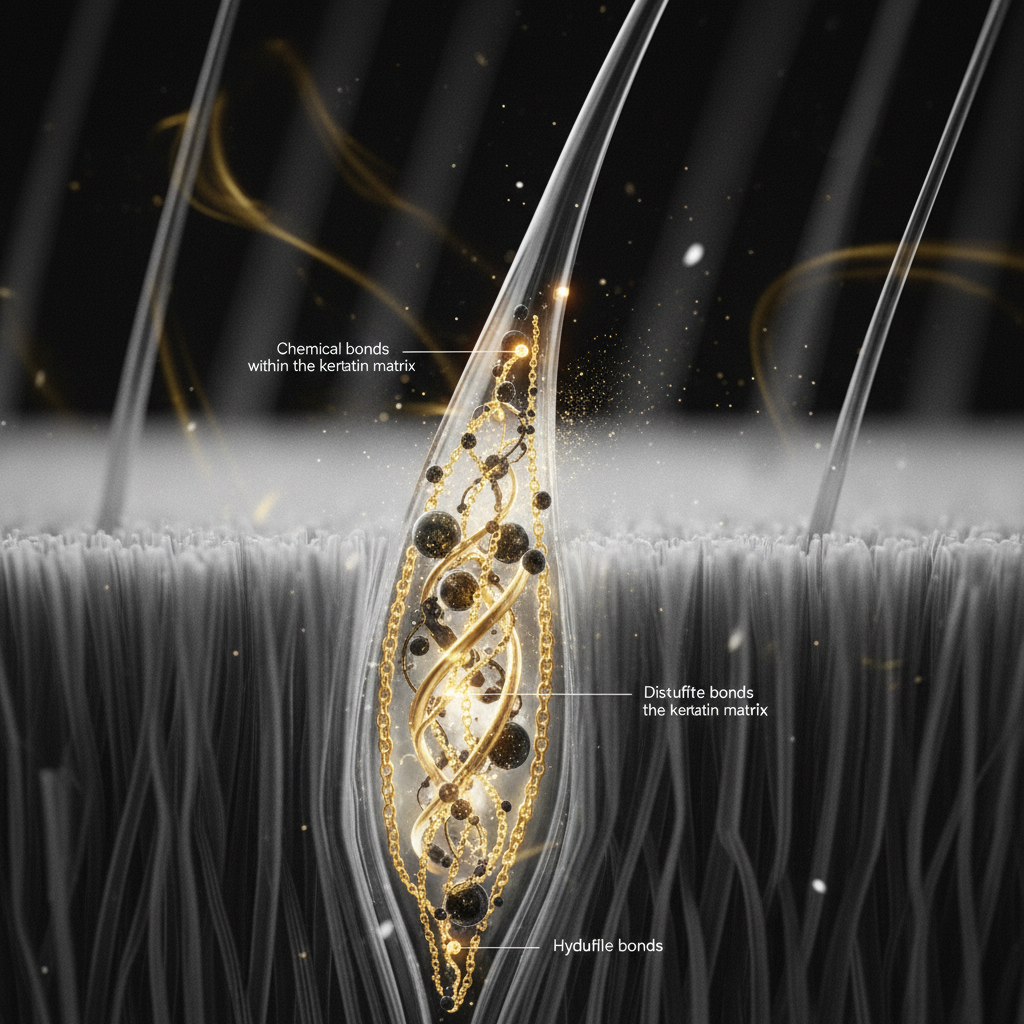
The structural stability of hair depends on three distinct types of chemical bonds. Each bond reacts differently to water, heat, and chemicals.
| Bond Type | Bond Mechanism | Relative Strength | How It Breaks | How It Reforms |
|---|---|---|---|---|
| Disulphide Bonds | Covalent links between sulphur atoms in cysteine residues | Very strong; accounts for structural permanence | Strong alkaline chemicals, reducing agents, bleaching agents | Neutralising / oxidising lotions, or remains permanently broken |
| Hydrogen Bonds | Weak electrostatic attraction between polar hydrogen and oxygen/nitrogen atoms | Weak individually, but massive in total number | Water exposure, atmospheric humidity, wet heat | Dries into place as water evaporates |
| Salt (Ionic) Bonds | Electrostatic attractions between positive and negative amino acid side chains | Moderate; dependent on physiological pH | Extreme pH shifts (strong acids or alkalis) | Normalising hair pH back to its isoelectric point (pH 3.67 to 5.5) |
Hydrogen bonds break whenever hair becomes wet. This temporary breakdown makes wet hair pliable, allowing you to blow-dry or style it into a new shape. As water leaves the fibre, hydrogen bonds reform in their new positions.
In contrast, disulphide bonds require aggressive chemical disruption. Relaxers, perm solutions, and bleaching peroxides cleave these covalent bonds. When too many disulphide bonds break without reformation, the cortex permanently loses its tensile resilience, leading straight to hair breakage.
What the evidence does not show about keratin products
Topical hair products frequently advertise "keratin repair" or "protein restoration". Understanding hair keratin structure helps separate cosmetic benefits from biological reality.
The scientific evidence does not show that topical cosmetic treatments can resurrect dead hair tissue. Once keratin exits the scalp, cell division has ceased. Topical proteins, whether hydrolysed keratin, wheat protein, or silk amino acids, cannot insert themselves cleanly into the intermediate filament lattice to recreate original structural bonds.
Instead, cosmetic proteins work by adsorption. They adhere to the negatively charged, damaged regions of the outer cuticle and cortex. This forms a temporary microscopic film that fills surface gaps, smooths rough edges, and reduces friction. This shielding effect reduces daily combing breakage and makes hair feel substantially thicker and softer. However, these cosmetic molecules eventually wash away with repeated cleansing.
Furthermore, salon "keratin straightening" treatments rely on chemical cross-linking agents and intense flat-iron heat (often exceeding 200 degrees Celsius) rather than natural keratin nourishment. Some historical formulations relied on aldehydes or glyoxylic acid derivatives to fix hair into a flattened alignment. Overusing high heat during these procedures can inadvertently cause thermal protein denaturation, degrading native alpha-keratin into disordered beta-pleated sheets.
Signs of keratin breakdown and structural damage
Keratin degradation presents distinct physical symptoms along the hair shaft:
- Loss of wet elasticity: Healthy hair stretches up to 30 percent of its dry length in water and bounces back. Compromised keratin over-stretches and fails to snap back, feeling gummy or mushy when wet.
- High porosity: Damaged, lifted, or missing cuticle scales allow water to flood the cortex rapidly and escape just as quickly, leaving hair chronically parched.
- Increased snapping and split ends: Trichorrhexis nodosa (microscopic fracture nodes along the shaft) and longitudinal splitting occur when cortical keratin fibrils lose cohesive bonding.
- Dull, rough texture: Loss of the natural protective 18-methyleicosanoic acid (18-MEA) lipid layer exposes raw keratin, creating surface friction and diffusing reflected light.
Remember to distinguish between hair shedding and hair breakage. Hair shedding involves entire hairs dropping out from the follicle, complete with a small white bulb at the root. Hair breakage involves structural snapping along the shaft due to compromised keratin integrity, producing short, jagged strands without roots.
Protecting your hair keratin structure
Preserving hair structure requires minimising mechanical, chemical, and environmental stressors:
- Maintain optimal pH: Human hair has an isoelectric point around pH 3.67, while typical hair fibre rests happily between pH 4.5 and 5.5. Using pH-balanced cleansers prevents cuticle swelling and limits unnecessary salt bond disruption.
- Buffer against heat damage: Never apply direct heat tools exceeding 180 to 200 degrees Celsius. Thermal stress above 200 degrees Celsius permanently denatures alpha-keratin proteins. Always apply heat protection products that contain silicones or polymers to distribute thermal energy evenly.
- Handle wet hair gently: Water temporarily disassembles hydrogen bonds, leaving the wet fibre structurally vulnerable. Detangle with a wide-tooth comb starting from the ends, moving slowly up to the roots.
- Incorporate hydrolysed proteins thoughtfully: Hydrolysed keratin proteins possess low molecular weights (roughly 500 to 2,000 Daltons), allowing them to penetrate slightly past lifted cuticle layers and temporarily reinforce fragile areas. Balance protein treatments with emollient conditioners to avoid protein overload, which leaves hair brittle.
Watermans approaches hair maintenance from a holistic perspective. While topical formulas like Watermans Grow Me Shampoo cleanse the scalp and introduce conditioning compounds that smooth the hair surface, healthy long-term hair quality begins at the follicle. Supplying balanced nutrition and maintaining a clean, healthy scalp environment ensures that new keratin fibrils emerge strong, resilient, and well-structured from the very start.
When structural problems stem from internal factors
Sometimes weak, fragile hair fibres do not originate from external styling damage alone. Structural keratin abnormalities can trace back to internal health disturbances:
- Severe nutritional deficiencies: Keratin synthesis requires adequate dietary protein, sulphur-containing amino acids (cysteine and methionine), iron, and zinc. Extreme caloric restriction or protein malnutrition can alter hair shaft diameter and structural tensile strength.
- Congenital hair shaft disorders: Genetic conditions such as monilethrix (beaded hair) or trichothiodystrophy cause inherent defects in keratin synthesis, resulting in extreme fibre fragility from early childhood.
- Thyroid dysfunction: Both hypothyroidism and hyperthyroidism can alter the rate of protein synthesis in the follicular matrix, yielding brittle, dry, and easily broken hair fibres.
If your hair breaks off near the scalp without any history of chemical bleaching, perming, or aggressive heat styling, consult a qualified trichologist or dermatologist for a detailed clinical examination.
Frequently asked questions about Understanding Hair Keratin Structure
What is the primary role of keratin in hair?
Keratin is the core fibrous protein that builds roughly 65 to 90 percent of the hair fibre. It forms the cuticle scales that shield the inner fibre and constructs the cortex filaments that provide mechanical strength, shape, and elasticity. Without intact keratin architecture, hair collapses into weak, split, and easily snapped strands.
How does understanding hair keratin structure help prevent breakage?
Understanding hair keratin structure helps you identify which daily habits break structural bonds. Knowing that water temporarily disrupts hydrogen bonds reminds you to handle wet hair gently. Knowing that bleach permanently cleaves covalent disulphide bonds encourages you to limit aggressive processing and use pH-balanced products to protect the cuticle.
Can damaged keratin in hair ever truly repair itself?
No, hair cannot biologically repair itself because the hair shaft contains dead, non-living cells. Once disulphide bonds break or cuticle scales chip away, the fibre cannot regenerate replacement tissue. Cosmetic treatments, hydrolysed proteins, and bond-building formulas can temporarily patch or reinforce weakened areas, but they cannot restore original, virgin hair anatomy permanently.
How does heat styling affect hair keratin?
Excessive heat styling alters the physical geometry of keratin. Temperatures above 150 degrees Celsius begin to soften the protein matrix, while heat above 200 degrees Celsius permanently denatures alpha-helical keratin into disordered beta-sheet configurations. This thermal shock dries out the cortex, creates microscopic bubbles inside the fibre, and causes irreversible snapping.
Final thoughts on keratin architecture
Understanding hair keratin structure gives you the scientific blueprint needed to care for your hair intelligently. The hair shaft is a resilient biological composite of alpha-helical intermediate filaments, rich sulphur bonds, and overlapping protective scales. Because this complex structure lacks living cells, it cannot heal itself once broken. Protecting these vital protein layers through gentle detangling, sensible heat settings, and pH-balanced care ensures your hair maintains its natural strength, shine, and structural integrity over time.
Sources and references
- Robbins, C. R. (2012). Chemical and Physical Behavior of Human Hair. 5th ed. Springer-Verlag.
- Feughelman, M. (1997). Mechanical Properties and Structure of Alpha-Keratin Fibres: Wool, Human Hair and Related Fibres. UNSW Press.
- Cruz, C. F., Fernandes, M. M., Gomes, A. C., & Cavaco-Paulo, A. (2016). Keratins and hair damage: molecular basis and treatment. International Journal of Cosmetic Science, 38(4), 327-335.
- Gavazzoni Dias, M. F. (2015). Hair cosmetics: An overview. International Journal of Trichology, 7(1), 2-15.
- National Institute for Health and Care Excellence (NICE). (2022). Alopecia - Clinical Knowledge Summaries.
Find these ingredients in Watermans products
- Zinc: you will find this ingredient in our Hair Vitamins.