Understanding Hair Fibre Anatomy: The Science of Shaft Structure
9 min read ·
Explore the structure of hair with this guide to Understanding Hair Fibre Anatomy, covering the cuticle, cortex, medulla, and how to protect hair integrity.
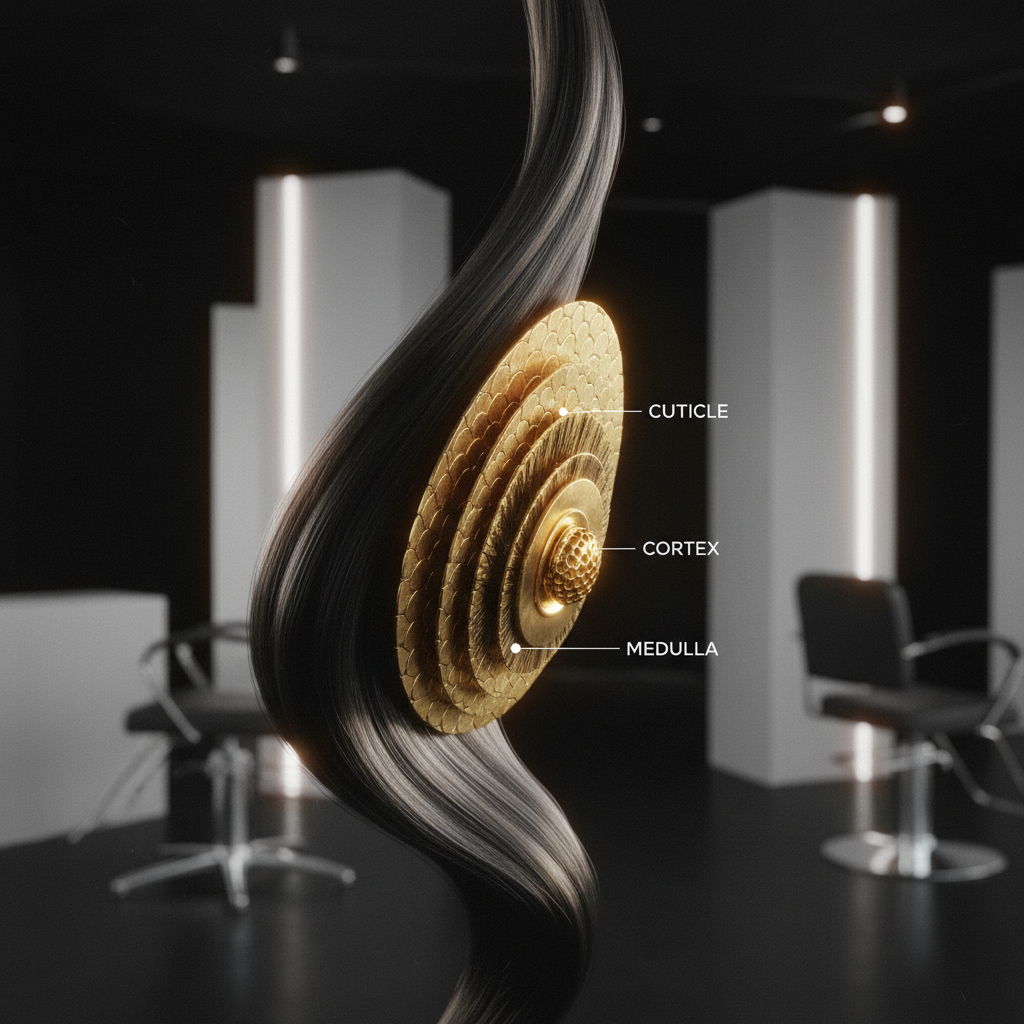
Quick answer: Understanding Hair Fibre Anatomy requires looking at the physical makeup of the hair shaft, which consists of three distinct concentric layers: the outer protective cuticle, the structural protein-rich cortex, and the central medulla. The fibre is composed of approximately 85% to 90% keratin proteins bound by lipids and water. The main limitation is that once the hair fibre emerges from the scalp, it is biologically non-living tissue, meaning structural damage cannot be biologically regenerated by living cells, only temporarily smoothed or fortified through cosmetic means.
Key takeaways
- The hair fibre contains three anatomical layers: the protective outer cuticle, the load-bearing cortex, and the central medulla (which is often discontinuous or absent in fine hair).
- Keratin proteins provide 85% to 90% of the dry weight of the fibre, linked by disulfide, hydrogen, and ionic salt bonds.
- The cell membrane complex (CMC) and natural lipid layers (specifically 18-methyleicosanoic acid, or 18-MEA) protect the fibre against moisture penetration and mechanical friction.
- Hair fibres are non-living structures; cosmetic conditioning products can shield, coat, or temporarily lubricate damaged areas, but they cannot biologically heal broken bonds permanently.
- Chemical processing, thermal heat above 185°C, and mechanical friction progressively erode cuticle scales, exposing the cortex to fracture and split ends.
Understanding Hair Fibre Anatomy: what the evidence shows
Understanding Hair Fibre Anatomy starts with clarifying that human hair consists of two primary regions: the living follicle rooted beneath the scalp, and the non-living fibre that projects above the skin surface. The visible fibre is a keratinised filament built to withstand mechanical tension, friction, and environmental wear.
When analysed under electron microscopy, the cross-section of a human hair fibre reveals three core zones:
- The Cuticle: The outermost perimeter consists of 6 to 10 overlapping cellular layers, arranged like shingles on a roof. Each cuticle cell measures roughly 0.3 to 0.5 micrometres thick. The free edges point toward the fibre tip. The outer face is covered by an ultra-thin lipid barrier known as the epicuticle, which is rich in 18-methyleicosanoic acid (18-MEA). This fatty acid layer makes virgin hair naturally hydrophobic (water-repelling) and creates a low-friction surface.
- The Cortex: Making up roughly 80% to 90% of the total fibre volume, the cortex gives the hair its tensile strength, elasticity, and natural colour. Cortical cells are elongated, spindle-shaped cells tightly packed along the longitudinal axis of the hair. Inside these cells lie macrofibrils, microfibrils, and protofibrils, which are bundles of alpha-helical keratin chains embedded in a high-sulfur protein matrix. The cortex also houses melanin pigment granules (eumelanin and pheomelanin).
- The Medulla: The innermost core consists of loosely connected, porous cells containing structural air spaces. It is generally present in coarse, thick terminal hairs, but frequently fragmented or entirely absent in fine hair and naturally blonde hair. Biologists believe the medulla plays a role in thermoregulation in mammals, but in human scalp hair, it contributes negligibly to mechanical strength.
| Layer | Primary Composition | Structural Role | Thickness / Volume |
|---|---|---|---|
| Cuticle | Keratinised scales, high cystine content, 18-MEA lipids | Friction reduction, chemical barrier, moisture control | 5 to 10 micrometres (around 10% of fibre volume) |
| Cell Membrane Complex (CMC) | Polar and non-polar lipids, non-keratinous proteins | Intercellular cement holding cuticle and cortical cells together | ~30 nanometres between cell interfaces |
| Cortex | Alpha-helical keratin, cystine-rich matrix, melanin granules | Tensile strength, elastic recovery, natural colouration | Roughly 80% to 90% of fibre volume |
| Medulla | Amorphous proteins, lipid droplets, air vacuoles | Thermal buffering (minimal functional role in modern human hair) | Highly variable; 0% to 15% of diameter |
The internal chemical bonds of the hair fibre
The physical resilience of hair stems from three specific chemical bonds within the cortical keratin matrix:
- Disulfide bonds: These are strong, covalent bonds formed between two sulfur atoms of adjacent cystine amino acid residues. They do not break in water and require chemical reduction (such as perm lotions, relaxers, or bleaching agents) to dissolve. Disulfide bonds dictate whether hair is naturally straight, wavy, or curly based on the angle and symmetry of the follicle.
- Hydrogen bonds: These are weak, physical bonds formed between polar amino acid side chains. They break readily when exposed to water or moisture, allowing you to reshape hair temporarily with blow-drying, curling tongs, or rollers. As the hair dries, these bonds reform in the new configuration.
- Salt (ionic) bonds: These bonds form between positively charged and negatively charged amino acid groups. They are pH-dependent. The hair fibre possesses an isoelectric point between pH 3.67 and 4.0, where positive and negative charges balance. At extreme acidic or alkaline pH levels, salt bonds break, leading to fibre swelling and cuticle lifting.
What the evidence does not show about the hair shaft
A common myth in haircare is that hair shafts can "absorb nutrients" to self-heal like skin or bone. The evidence does not show that non-living hair fibres possess a circulatory system, cell division mechanisms, or cellular repair pathways.
Cosmetic treatments, deep conditioners, and leave-in serums do not "feed" or "revive" dead protein chains. While ingredients such as hydrolysed proteins or biomimetic peptides can adhere to cracks, fill porous crevices, and provide temporary structural fortification, they eventually wash away with surfactant use. Similarly, splitting ends cannot be permanently glued back together; once split, trimming is the only permanent solution to prevent the tear from migrating upwards.
How damage alters fibre morphology
When the hair fibre suffers physical or chemical trauma, the degradation happens sequentially:
- Lipid depletion: Aggressive cleansing or chemical bleaching strips the outer 18-MEA layer. The hair changes from hydrophobic to hydrophilic (water-absorbing), causing it to soak up excessive water during washing, swell dramatically, and dry out slowly.
- Cuticle lifting and scale loss: Alkaline products (such as permanent hair colour or bleach at pH 9 to 11) force cuticle scales open. Heat styling tools above 185°C degrade cuticular protein. With repeated abuse, cuticle scales crack, chip, and peel away, exposing the vulnerable cortex beneath.
- Cortical degradation: With the outer armour gone, internal microfibrils separate. Hydrogen and disulfide bonds snap under lower levels of mechanical stress, manifesting as hair breakage along the shaft, diminished elasticity, and frizzy split ends.
Practical care: protecting your hair architecture
Because your body cannot produce new cells to repair damaged hair fibres, preventative habits are your primary defence:
- Keep washing formulations pH-balanced: Opt for shampoos and conditioners with a pH between 4.5 and 5.5. This keeps the cuticle flattened against the shaft, maintains the isoelectric balance, and prevents unnecessary swelling.
- Minimise mechanical drag: Wet hair is fragile because water disrupts hydrogen bonds, stretching the fibre up to 30% beyond its dry length before breaking. Detangle gently using a wide-tooth comb or flexible brush, starting at the ends and working upward toward the roots.
- Limit thermal degradation: Keep styling tools below 185°C. Beyond this threshold, keratin undergoes structural denaturation, and moisture trapped inside the cortex can rapidly boil, creating microscopic cavities known as "bubble hair". Always apply heat protectants containing film-forming silicones, polyquaterniums, or plant oils to buffer thermal transfer.
- Restore surface slip: Emollients, fatty alcohols, and cosmetic conditioning agents replace the functional slip lost when natural 18-MEA is depleted, reducing the friction coefficient between individual strands.
When breakage mimics hair shedding
It is critical to distinguish between hair fibre breakage and medical hair shedding:
- Breakage: The hair fibre snaps along the shaft due to mechanical, thermal, or chemical wear. You will find short, uneven strands on your shoulders or brush without a white bulb at the root.
- Telogen effluvium or follicular loss: The entire hair strand sheds naturally from the scalp with its rounded keratin bulb attached at the tip.
If you are experiencing systemic thinning across the scalp, widening parts, or excessive daily shedding of full-length hairs with bulbs, the underlying issue lies within the follicle biology, not fibre damage. In such instances, consult a qualified trichologist or dermatologist for an accurate diagnostic evaluation.
Supporting fibre integrity with Watermans
While hair fibres are non-living, creating optimal conditions for the emerging strand at the scalp level is vital for long-term fibre resilience. Watermans focuses on providing scalp care designed to nurture hair as it grows.
Using gentle, balancing cleansers such as Watermans GrowMe Shampoo helps support the scalp environment without stripping away critical natural lipids from the hair shaft. Following with targeted conditioners and scalp elixirs supports surface smoothness, leaving hair looking thicker, feeling stronger, and far less prone to premature mechanical breakage during everyday styling.
Frequently asked questions about Understanding Hair Fibre Anatomy
What are the three primary layers of the hair fibre?
The three primary layers are the outer cuticle, the intermediate cortex, and the inner medulla. The cuticle consists of overlapping scale-like cells that protect inner structures. The cortex constitutes the bulk of the fibre, housing keratin protein chains and melanin. The medulla is a central, porous canal that may be discontinuous or absent, especially in fine hair.
How does Understanding Hair Fibre Anatomy help prevent breakage?
Understanding Hair Fibre Anatomy helps you recognise that hair is non-living keratin protected by a fragile lipid barrier. When you know that high heat, alkaline pH, and rough brushing physically tear cuticle scales and break cortex bonds, you can adapt your routine to use heat protection, detangle gently when wet, and use pH-balanced formulas to prevent irreversible snapping.
Can split ends be permanently healed back together?
No. Because hair fibres contain no living cells or biological repair mechanisms, split ends cannot be permanently mended. While protein treatments, conditioning polymers, and cosmetic serums can temporarily seal split ends together through surface adhesion until the next wash, cutting off the split ends is the only permanent solution.
What causes hair fibres to become porous?
Porosity increases when the protective cuticle scales are lifted, cracked, or completely removed. Chemical bleaching, permanent colouring, excessive sun exposure, and high-heat styling strip the protective 18-MEA lipid layer and erode cuticle margins. This leaves microscopic gaps, allowing water and chemicals to enter and exit the cortex far too rapidly.
Final perspectives on hair fibre architecture
Understanding Hair Fibre Anatomy provides the foundation for all effective haircare routines. By recognising the hair shaft as an intricately engineered, non-living composite of keratin, lipids, and chemical bonds, you can move past marketing claims that promise cellular repair. Treating the cuticle with respect, managing thermal exposure, detangling with care, and keeping formulations balanced preserves the internal architecture of your hair, keeping strands resilient, soft, and visibly healthy.
Sources and references
- Journal of Investigative Dermatology, "The Structure of the Human Hair Fibre", 2005.
- Robbins, C. R., Chemical and Physical Behavior of Human Hair, 5th ed., Springer-Verlag, 2012.
- International Journal of Cosmetic Science, "Hair shaft damage from heat and chemical processing", 2011.
- British Association of Dermatologists, "Hair Structure and Common Shaft Disorders", 2019.
- Clinical and Experimental Dermatology, "The cell membrane complex of the human hair fibre: an overview", 2007.