Trichorrhexis Nodosa and Split Ends: Structural Causes and Care
9 min read ·
Understand the structural differences between Trichorrhexis Nodosa and Split Ends, exploring cortical fibre damage, causes, prevention, and treatment.
Quick answer: The relationship between Trichorrhexis Nodosa and Split Ends comes down to distinct forms of structural hair shaft damage. While split ends (trichoptilosis) involve longitudinal fraying at the fibre tip, trichorrhexis nodosa produces weak, swollen nodes along the hair shaft that resemble two interlocked paintbrushes under a microscope. Both conditions stem from cuticle breakdown due to thermal, chemical, or mechanical trauma, but trichorrhexis nodosa causes mid-shaft snapping rather than simple terminal splitting, often mimicking true hair shedding.
Key takeaways
- Trichorrhexis nodosa is not follicular hair loss: It is a structural hair shaft defect where cortex fibres splay sideways, causing the fibre to snap along its length.
- Split ends (trichoptilosis) occur at the tips: Cuticle loss at the ends allows cortex protofibrils to unravel longitudinally, whereas trichorrhexis nodosa creates fragile swelling along the mid-shaft.
- Acquired trauma is the primary driver: Excessive heat, chemical bleaching, perming, and aggressive dry brushing strip the protective 18-methyleicosanoic acid (18-MEA) lipid layer.
- Congenital variants exist: Rare genetic conditions such as Menkes disease or Netherton syndrome can manifest as fragile hair nodes in early childhood without chemical exposure.
- Cosmetic repair cannot rebuild broken bonds: Once the cortical structure fractures, no topical product can permanently weld it back together; trimming and preventative lubrication are necessary.
Trichorrhexis Nodosa and Split Ends: what the evidence shows
Microscopic analysis reveals that Trichorrhexis Nodosa and Split Ends represent two points on a spectrum of physical cuticle failure. Healthy hair fibres rely on an outer cuticle composed of overlapping scales coated in 18-MEA, a protective lipid layer that provides hydrophobicity and lowers inter-fibre friction.
Healthy Hair Shaft:
[Cuticle: Flat, overlapping scales with 18-MEA lipid layer]
═══════════════════════════════════════════════════════════
[Cortex: Densely packed keratin intermediate filaments]

Split Ends (Trichoptilosis):
═══════════════════════════\ <-- Longitudinal fracture
 \ at the distal tip
═══════════════════════════/

Trichorrhexis Nodosa:
═════════════\ /═════════════ <-- Swollen node with
 ) * * * * * ( splayed cortical fibres
═════════════/ \═════════════ (brushes pushed together)
In split ends (technically termed trichoptilosis), wear and tear gradually strips the cuticle from the oldest, most exposed distal ends of the hair. Without this protective armour, moisture loss occurs and mechanical stress causes the parallel cortical fibres to fissure longitudinally.
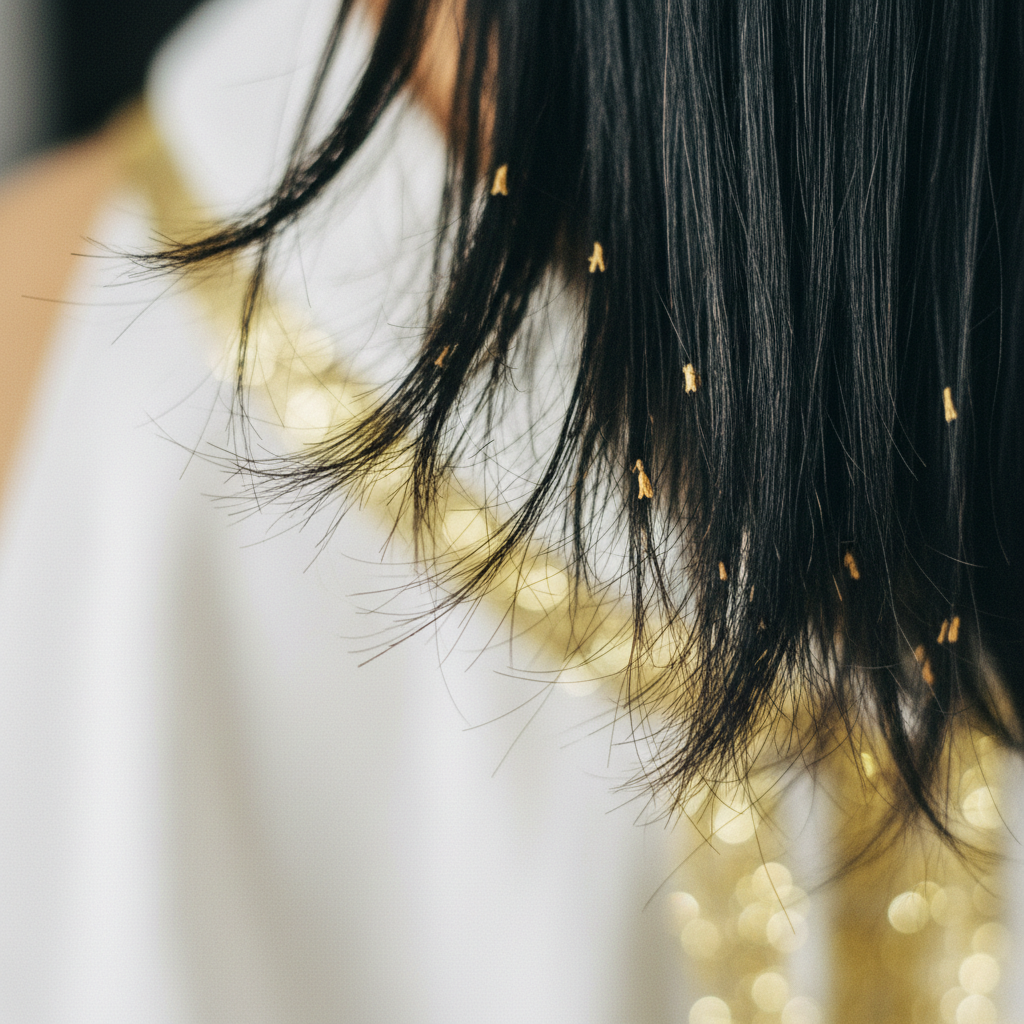
Trichorrhexis nodosa develops when physical, thermal, or chemical damage is concentrated or severe enough to disrupt the cortex mid-shaft. The cortical cells separate, ballooning outwards into microscopic, nodule-like swellings. When looked at under light microscopy, these nodes look like two broom heads or paintbrushes pushed firmly into one another. Because these nodes represent structural failure points, minimal tensile force causes complete fibre breakage along the shaft.
People frequently confuse trichorrhexis nodosa with shedding conditions like telogen effluvium. When hair breaks mid-shaft, you may notice short, broken hairs across your pillows, sink, or clothing. However, examining the broken end reveals a jagged, frayed tip without the white keratin bulb that identifies a root shed from the follicle.
| Feature | Split Ends (Trichoptilosis) | Trichorrhexis Nodosa |
|---|---|---|
| Primary Location | Distal ends (fibre tips) | Mid-shaft or proximal hair shaft |
| Microscopic Appearance | Y-shaped or feather longitudinal splits | Swollen nodes resembling pushed-together brushes |
| Structural Integrity | Fibre remains intact until split travels up | Severe weak point; breaks with low tension |
| Primary Cause | Gradual weathering, friction, dry ends | Intense chemical processing, severe heat, genetics |
| Visible Sign | Frayed ends, loss of blunt line at hemline | Small white dots along fibre, sudden mid-shaft breakage |
| Clinical Resolution | Trimming distal ends (dusting or shears) | Cutting above affected nodes; eliminating trauma |
The biological mechanism of hair shaft fracture
Hair fibres consist of three main regions: the outer protective cuticle, the structural cortex, and occasionally a central medulla. The cortex makes up roughly 85% of total fibre volume and contains long keratin filament cables held together by disulphide bonds, salt bridges, and hydrogen bonds.
When you use chemical processing like sodium hydroxide relaxers, ammonium thioglycolate, or hydrogen peroxide bleaching, it breaks the disulphide bridges that give keratin its stability. When combined with heat tools running above 180°C, the water trapped inside the cortex boils, creating microscopic voids (bubble hair) and denaturing the alpha-keratin structure into amorphous protein.
As outer cuticle cells are stripped away by repeated friction or high pH solutions (above pH 8.0, which forces the cuticle scales to flare), the exposed cortex loses its protective mantle. Without the binding cement of the cell membrane complex, mechanical brushing forces the parallel cortical fibrils to splay outwards. In trichoptilosis, this split follows the natural vertical alignment of the macrofibrils to the tip. In trichorrhexis nodosa, localised mechanical shear forces fracture the weakened cortex horizontally and outwards, creating a focal node of failure.
Signs to look for: distinguishing nodes from splits
Identifying the difference between normal wear and more advanced structural failure requires close inspection:
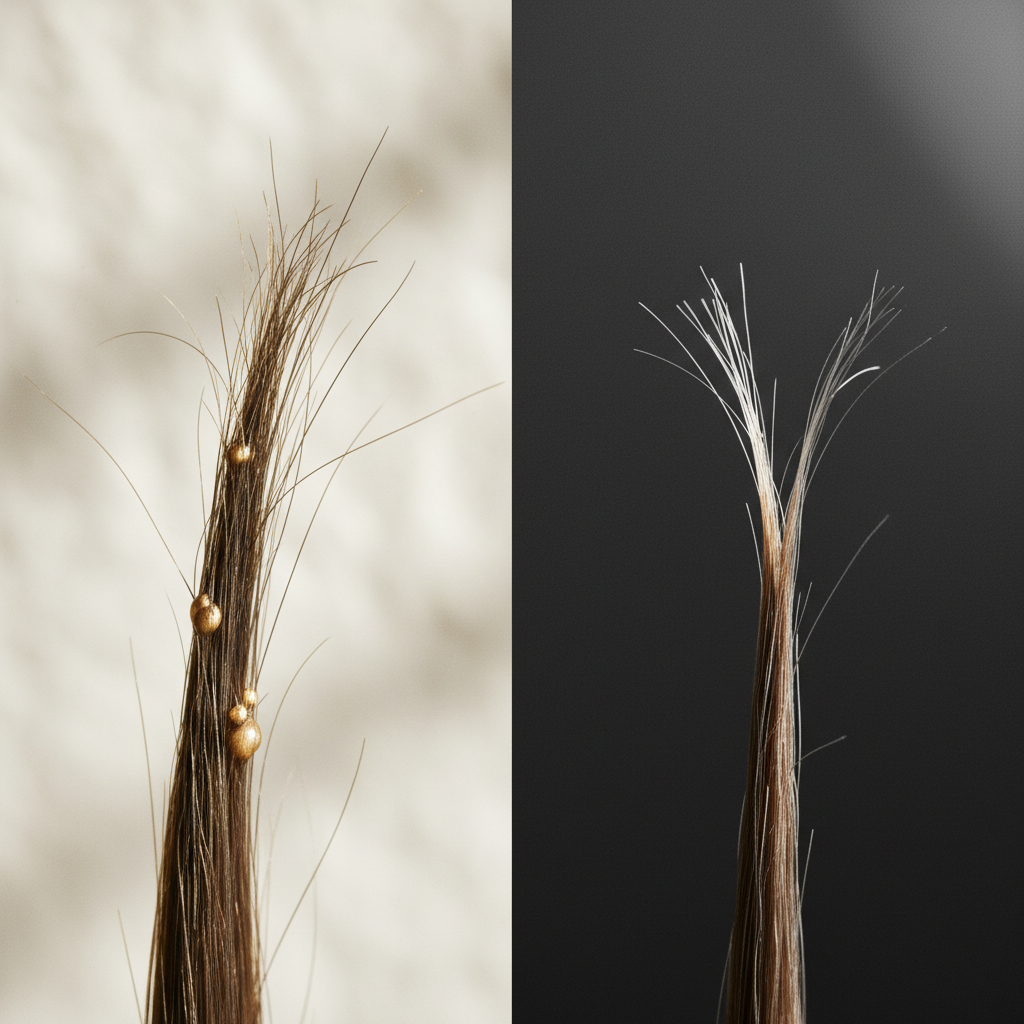
- White speckling on the shaft: Trichorrhexis nodosa often looks like tiny white specks distributed along the hair strand, several inches away from the scalp. People often mistake these specks for head lice nits or dandruff, but unlike flakes, they cannot be slid along the fibre without catching.
- Ragged, uneven lengths: While split ends leave the hemline looking thin or frizzy at the bottom, trichorrhexis nodosa produces broken hairs of completely irregular lengths throughout the mid-canopy.
- Lack of hair bulb: If you find broken strands on your clothing, inspect the root end. Hair shed from the follicle features a smooth, rounded, club-shaped white root. Hair broken due to trichorrhexis nodosa features a jagged, brush-like tip at both ends.
- Velcro-like tangling: Because the splayed nodes catch on neighbouring hair fibres, the hair snarls rapidly, leading to secondary mechanical breakage during detangling.
What you can do to manage and prevent fibre fractures
Once cortical rupture occurs, the damaged section cannot be biologically healed. Keratin in the hair shaft is biologically non-living tissue. However, you can manage the remaining hair and stop progression through methodical cosmetic intervention:
- Precision shear trimming: Cut above the highest visible node. Split ends and trichorrhexis nodosa nodes will continue to travel upward along the fibre if left alone, shearing the strand further as friction catches on the exposed microfibrils.
- Lower processing temperatures: Limit heat styling tools to 150°C or below. Always use heat protectants containing high-molecular-weight polymers like silicones, polyquaterniums, or hydrolysed proteins that slow heat transfer and reduce cuticle scorching.
- Optimise formulation pH: Shampoos and conditioning agents should remain close to the hair's isoelectric point (pH 3.67) and scalp pH (roughly 5.5). Alkaline formulations swell the shaft, lifting cuticle scales and exposing the cortex to rapid friction erosion.
- Lubricate before detangling: Never brush damaged hair while completely dry without a slip agent, and avoid pulling through wet hair when it is stretched to its elastic limit. Plant oils (such as argan, jojoba, and coconut oil) lower friction and prevent water absorption that swells the shaft.
- Protect hair during sleep: Friction between hair and cotton pillowcases exacerbates cuticle stripping. Using silk or satin sleep coverings reduces friction coefficients significantly.
When the cause may be an underlying systemic condition
While acquired mechanical or chemical trauma accounts for the vast majority of cases, trichorrhexis nodosa can occasionally indicate an internal health issue or congenital disorder.
Argininosuccinic aciduria is an inherited metabolic defect that disrupts the urea cycle, causing high levels of argininosuccinic acid in the blood and urine. Because arginine is a critical amino acid for keratin synthesis, children with this condition produce structurally flawed hair shafts that break under minimal tension.
Other congenital conditions include Menkes kinky hair syndrome (a copper transport disorder impairing disulphide bond formation), Netherton syndrome, and trichothiodystrophy. Hypothyroidism and severe iron deficiency can also reduce the metabolic activity of follicular matrix cells, leading to a thinner, structurally weaker hair shaft that is more susceptible to physical trauma. If fragile nodes appear spontaneously in young children or alongside systemic symptoms like fatigue, nail changes, or cognitive delays, consult a dermatologist or trichologist.
Supporting hair condition: Watermans haircare
Managing structural fragility requires minimising mechanical tension while providing substantive conditioning to the hair fibre. While no cosmetic formula can permanently re-fuse split ends or severed cortical nodes, routine cosmetic care protects intact lengths from further damage.
Watermans GrowMe Shampoo and ConditionMe Conditioner deliver concentrated surface protection. The shampoo is formulated without harsh sulphates, cleansing the scalp without aggressively stripping the hair's delicate lipid layer. The ConditionMe formula incorporates hydrolysed lupin protein, caffeine, niacinamide, and natural oils like argan oil. These ingredients smooth down lifted cuticle scales, deposit a protective coating over exposed cortical areas, improve wet combability, and reduce the friction that triggers trichorrhexis nodosa.
Frequently asked questions about Trichorrhexis Nodosa and Split Ends
Can split ends turn into trichorrhexis nodosa?
No, split ends do not directly transform into trichorrhexis nodosa. They are separate manifestations of structural damage. Split ends involve longitudinal separation of cortex fibres at the fibre tip. Trichorrhexis nodosa involves focal swelling and transverse cortical fracture along the shaft. However, the same continuous thermal, chemical, or physical trauma can cause both conditions to appear on the same head of hair simultaneously.
How do I tell the difference between Trichorrhexis Nodosa and Split Ends?
The primary difference lies in the location and structural appearance of the damage. Split ends occur at the ends of your hair, visibly branching into two or more strands. Trichorrhexis nodosa forms along the mid-shaft, appearing as tiny white specks or swollen nodes where the fibre has bent and begun to splinter like an old piece of rope.
Can bonding treatments permanently repair trichorrhexis nodosa?
Bonding treatments and protein conditioners provide temporary structural reinforcement by cross-linking protein fragments or coating the cuticle layer, but they cannot permanently rebuild severed cortical fibres. The microscopic nodes created by trichorrhexis nodosa remain vulnerable fracture points. Trimming above the damaged nodes is the only definitive way to remove the structural weakness.
Does brushing wet hair cause hair shaft nodes to form?
Aggressive brushing of wet hair significantly increases the risk of developing hair shaft nodes. Hair stretches up to 30% beyond its original length when wet before permanent deformation occurs. Stretching the fibre while applying friction strips the softened cuticle scales, forcing internal cortex macrofibrils to buckle and form the distinctive swollen nodes of trichorrhexis nodosa.
Is trichorrhexis nodosa a type of alopecia?
Trichorrhexis nodosa is a hair shaft defect, not a follicular alopecia. The hair follicle itself remains completely healthy and continues normal production cycles. However, because the hair snaps easily along the mid-shaft, it often produces noticeable thinning and loss of length, which many people mistake for follicular shedding or thinning.
Conclusion
Understanding the structural differences between Trichorrhexis Nodosa and Split Ends is essential for maintaining long-term hair fibre integrity. While split ends represent normal distal weathering that can be managed with routine haircuts, trichorrhexis nodosa signals deeper structural breakdown of the cortex caused by aggressive thermal tools, chemical treatments, or excessive tension. By diagnosing the issue correctly, reducing mechanical friction, and eliminating harsh cosmetic habits, you can stop hair breakage in its tracks and allow healthy hair to grow to its full potential.
Sources and references
- American Academy of Dermatology. "Hair breakage and hair shaft disorders." AAD.org.
- British Association of Dermatologists. "Hair shaft abnormalities: Clinical guidelines." Bad.org.uk.
- Robbins, C. R. (2012). Chemical and Physical Behavior of Human Hair. 5th ed. Springer-Verlag.
- Whiting, D. A. (2001). "Hair shaft defects." Clinics in Dermatology, 19(4), 415-422.
- Dawber, R. (1996). "Hair: Its structure and response to cosmetic preparations." Clinics in Dermatology, 14(1), 105-112.
- Sinclair, R. D. (2007). "Healthy hair: What is it?" Journal of Investigative Dermatology Symposium Proceedings, 12(2), 2-5.
Find these ingredients in Watermans products
- Copper: you will find this ingredient in our Hair Vitamins.
- Niacinamide: you will find this ingredient in our Hair Mask.