Hair Shaft Defects: Types, Mechanisms, and Fibre Care
8 min read ·
Hair Shaft Defects alter the physical structure and strength of hair. Learn the differences between genetic and acquired defects, breakage versus shedding, and care tips.
Quick answer: Hair Shaft Defects are structural abnormalities along the physical hair fibre that alter its shape, strength, or surface integrity. They fall into two categories: congenital forms caused by genetic mutations, and acquired forms caused by mechanical, chemical, or thermal trauma. While inherited defects cannot be cured by topical products, recognising the specific defect is crucial. Many manifest purely as hair breakage rather than true follicular hair loss, requiring tailored handling and gentle care to preserve fibre integrity.
Key takeaways
- Hair Shaft Defects involve physical irregularities in the cuticle, cortex, or medulla rather than disorders of the hair follicle root.
- They are broadly split into conditions with increased hair fragility (prone to snapping) and conditions without increased fragility.
- Most acquired defects stem from repeated physical weathering, chemical processing like bleaching or relaxing, and excessive heat styling.
- Genetic variants, such as trichorrhexis invaginata or monilethrix, often appear in childhood and can signal broader systemic conditions.
- True hair shedding (telogen effluvium) and follicular miniaturisation (androgenetic alopecia) must be differentiated from shaft breakage.
- Topical haircare cannot alter follicle genetics, but cosmetic conditioning can dramatically reduce friction and mitigate further mechanical breakage.
Hair Shaft Defects: what the evidence shows
Dermatological literature classifies Hair Shaft Defects by whether they cause increased fibre fragility. Under light microscopy or scanning electron microscopy, healthy hair displays smooth, overlapping cuticle scales that protect an organised cortex of keratin filaments bound by disulphide bonds. When an abnormality disrupts this architecture, the fibre's tensile strength drops significantly.

Clinical research identifies several classic defects characterised by heightened fragility:
- Trichorrhexis nodosa: The most common defect, characterised by node-like swellings where the cortical fibres splay apart like two paintbrushes pressed together. It is usually acquired through mechanical brushing, thermal damage, or chemical treatments, though rare congenital forms exist.
- Monilethrix: An inherited autosomal dominant condition, often linked to mutations in hair keratins (KRT81, KRT86), producing regular beaded swellings separated by narrow, fragile internodes where fractures occur.
- Trichorrhexis invaginata: Known colloquially as bamboo hair, where the soft proximal shaft invaginates into the harder distal shaft, forming a ball-and-socket appearance. It is a hallmark of Netherton syndrome, a genetic disorder involving the SPINK5 gene.
- Pili torti: The hair fibre is flattened and twisted through 180 degrees along its longitudinal axis at irregular intervals. It can occur in isolation or alongside inherited conditions such as Menkes disease.
Conversely, some Hair Shaft Defects do not inherently cause severe fragility:
- Pili annulati: The hair features alternating bright and dark bands due to air-filled cavities within the cortex, giving a shimmering appearance under reflected light without causing fibre breakage.
- Woolly hair: Characterised by tightly coiled, kinky curls in non-African ancestry populations, often without an increase in breakage unless paired with aggressive chemical handling.
- Trichothiodystrophy: Marked by sulphur-deficient brittle hair displaying a distinctive tiger-tail banding pattern under polarised light microscopy, frequently tied to DNA repair gene variants.
What the evidence does not show
Topical shampoos, serums, and conditioning masks cannot rewrite genetic coding or repair congenital Hair Shaft Defects at the cellular level within the follicle matrix. Furthermore, scientific evidence does not show that hair shaft breakage equals hair loss. In follicular hair loss, the hair bulb separates from the scalp at the base of the follicle. In shaft defects, the root remains intact and healthy while the damaged fibre snaps midway or near the scalp surface.
No clinical evidence demonstrates that dietary supplements or collagen drinks can restructure an inherited shaft defect such as monilethrix. While nutritional deficiencies (like severe iron deficiency or protein malnutrition) can weaken hair synthesis, popping high-dose vitamins will not alter established structural shaft mutations.
Understanding the mechanisms of fibre structural failure
The hair fibre's mechanical resilience relies on the outer cuticle layer protecting the high-tensile cortex. When looking at acquired Hair Shaft Defects, the mechanism is progressive structural degradation. Chemical processes like lifting melanin with alkaline persulphates (bleach) swell the cuticle scales and oxidise the protective 18-methyleicosanoic acid (18-MEA) lipid layer. This exposes the cortex to subsequent friction.
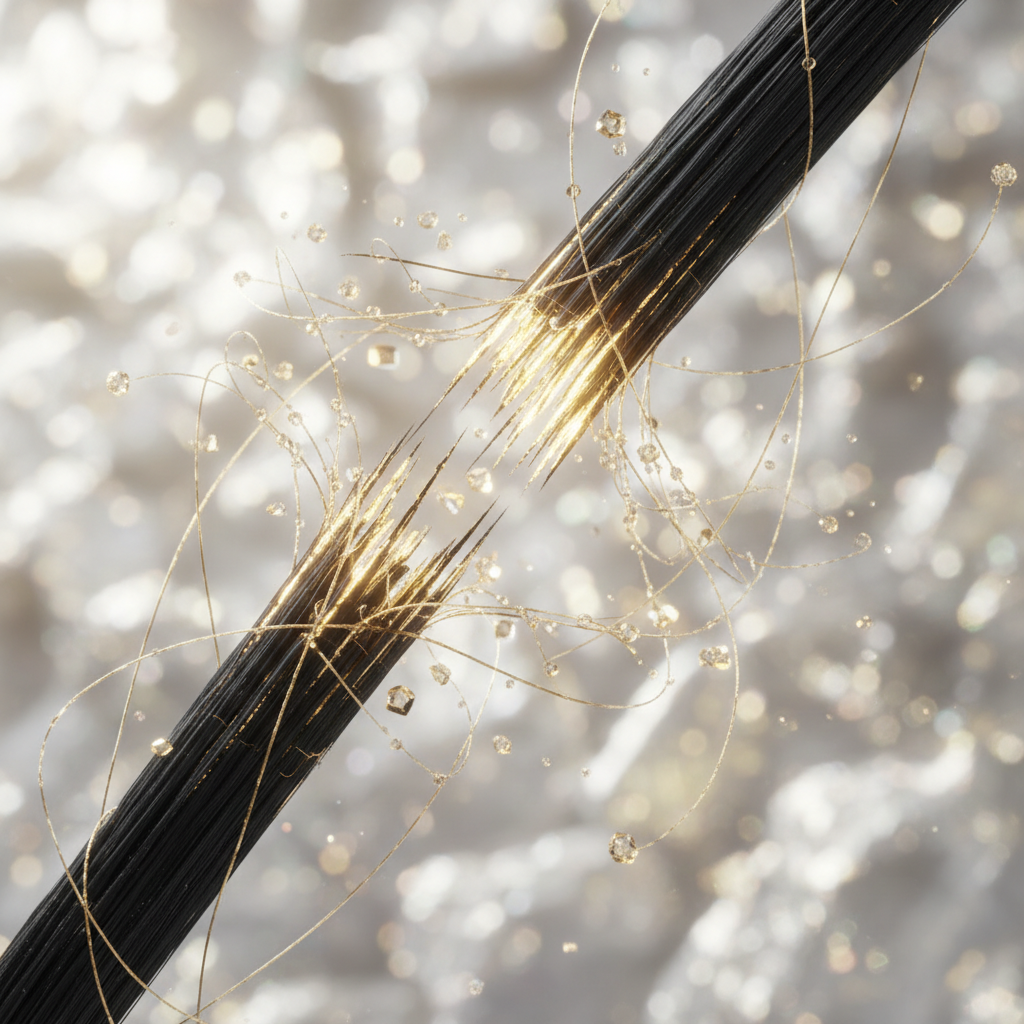
Repeated mechanical stress, such as vigorous backcombing or using fine-toothed combs on wet hair, strips away loose cuticle cells. Without the protective sheath, cortical keratin fibrils split longitudinally under low tensile strain. In congenital defects, the fault lies in initial keratinisation. Faulty proteins or irregular cell division within the dermal papilla matrix produce an intrinsically distorted or hollowed fibre that lacks standard mechanical elasticity. When subjected to basic grooming forces, the hair shears at its weakest structural point.
Identifying the signs: breakage versus shedding
Differentiating between fibre fracture and follicular loss requires close examination of both the hair shaft and the scalp.
| Defect / Condition | Primary Microscopic Feature | Fibre Fragility | Typical Cause |
|---|---|---|---|
| Trichorrhexis nodosa | Paintbrush-like frayed nodes | Very High | Heat, chemicals, excessive friction |
| Monilethrix | Beaded swellings with narrow internodes | High | Genetic (KRT81, KRT86 mutations) |
| Trichorrhexis invaginata | Ball-and-socket bamboo deformity | Very High | Genetic (SPINK5 mutation / Netherton syndrome) |
| Pili torti | Flat shaft twisted 180 degrees | Moderate to High | Inherited syndromes or acquired scarring |
| Pili annulati | Alternating light and dark bands | Low to Normal | Autosomal dominant trait or sporadic |
| Trichoptilosis | Longitudinal splitting at distal tip | Moderate | Everyday weathering and dry friction |
Key physical signs include:
- Hairs that break off unevenly, leaving a rough, sandpaper feel along the scalp.
- A collection of short, broken fibres on pillows and clothing that lack a white bulb at the root end.
- Patchy thinning where hair fails to grow beyond a few centimetres before snapping.
- Visible white specks along the hair shaft (frequently mistaken for nits or dandruff, but adhering firmly to the shaft).
Everyday management and salon strategies
When managing Hair Shaft Defects, the primary objective is minimising external friction to preserve existing fibre integrity.
- Reduce mechanical stress: Use wide-toothed seamless combs or flexible detangling brushes. Never detangle dry hair aggressively, and avoid tension-heavy styles such as tight ponytails, braids, or weaves.
- Control heat application: High temperatures (above 185°C) degrade keratin alpha-helices into weaker beta-keratin and boil residual water within the cortex, causing bubble hair deformity. Limit heat styling and use protective conditioning layers.
- Optimise formulation pH: Hair sits naturally at an acidic isoelectric point of roughly pH 3.6 to 5.5. Washing with high-pH alkaline soaps swells the cuticle, making it catch and snap. Use pH-balanced shampoos and deeply moisturising, acidic rinse-out conditioners to keep the cuticle flat.
- Lubricate the fibre: Leave-in conditioners containing silicones, fatty alcohols, or light plant oils lower the wet and dry combing friction coefficient, directly shielding fragile shafts against shear stress.
Supportive care from Watermans
For individuals dealing with acquired structural breakage or managing the delicate handling requirements of fragile hair, topical cosmetic care should focus on fortifying the scalp environment and safeguarding the fibre surface. Watermans GrowMe Shampoo delivers a nutrient-rich, pH-balanced wash designed to cleanse without stripping the cuticle, supported by ingredients like biotin, rosemary, and hydrolysed lupin protein that help reinforce the cosmetic feel of thin, fragile strands. Paired with Watermans ConditionMe Conditioner, which delivers targeted slip and surface replenishment, this routine reduces the mechanical friction that triggers snapping in compromised hair fibres. While these products do not treat genetic conditions, they provide the essential cosmetic protection needed to prevent avoidable everyday breakage.
When to seek a professional diagnosis
If you or a client experience sudden, unexplained hair breakage, patchy loss that does not respond to gentle handling, or brittle hair from early childhood, consult a qualified trichologist or dermatologist. Genetic Hair Shaft Defects sometimes accompany broader systemic conditions, including skin disorders, metabolic imbalances, or sensory abnormalities. A dermatologist can perform a simple, non-invasive trichoscopy or pluck a small sample of hair for polarised light microscopy to deliver an accurate diagnosis.
Frequently asked questions about Hair Shaft Defects
Can cosmetic conditioners repair Hair Shaft Defects?
Cosmetic conditioners cannot alter congenital Hair Shaft Defects or knit a severed hair fibre back together permanently. However, quality conditioners deposit protective films, reduce combing friction, and temporarily smooth lifted cuticles. This cosmetic reinforcement significantly reduces the mechanical strain that causes fragile hair shafts to break prematurely.
How do I know if my hair is shedding or breaking?
Inspect the hairs you find on your brush or pillow. Shedding involves the entire hair fibre releasing from the follicle, which displays a small white or clear bulb at one end. Breakage caused by Hair Shaft Defects produces shorter, fragmented strands with blunt, frayed, or split ends, without a follicle bulb.
Are Hair Shaft Defects permanent?
Congenital Hair Shaft Defects are genetic and persist throughout a person's life, although their visual severity can fluctuate with hormonal stages or improved hair care habits. Acquired Hair Shaft Defects, such as trichorrhexis nodosa caused by bleach or heat styling, are temporary; new hair growing from the follicle will emerge healthy if damaging practices stop.
Can tight hairstyles cause physical hair shaft deformities?
Yes. Chronic mechanical traction, tight braiding, and tight elastics place immense shear stress on the hair fibre. Over time, this mechanical fatigue degrades the cuticle and induces localised structural weaknesses like trichorrhexis nodosa, causing the shaft to snap along the line of tension.
Managing fragile hair with care
Navigating Hair Shaft Defects requires separating true follicular conditions from structural fibre weaknesses. While genetic variations dictate how hair fibres are assembled at the follicle level, acquired damage remains within your control through thoughtful grooming, sensible heat management, and friction-reducing formulations. By identifying whether your hair is shedding at the root or breaking along the shaft, you can adopt a targeted routine that shields fragile fibres and preserves your hair's natural length.
Sources and references
- British Association of Dermatologists. Clinical Guidelines for the Management of Hair Shaft Defects.
- Whiting, D. A. (2001). Hair shaft defects. Dermatologic Clinics, 19(2), 211-229.
- Miteva, M., & Tosti, A. (2012). Hair and scalp evaluation: the technique of trichoscopy. Journal of the American Academy of Dermatology, 67(4), 1040-1048.
- National Center for Biotechnology Information (NCBI). Monilethrix and Inherited Hair Shaft Disorders Overview.
- DermNet NZ. Hair Shaft Disorders Clinical Summary.