Telogen Effluvium vs Androgenetic Alopecia: Key Differences and Management
9 min read ·
Understand Telogen Effluvium vs Androgenetic Alopecia: discover differences in causes, shedding speed, hair miniaturisation, and effective treatments.
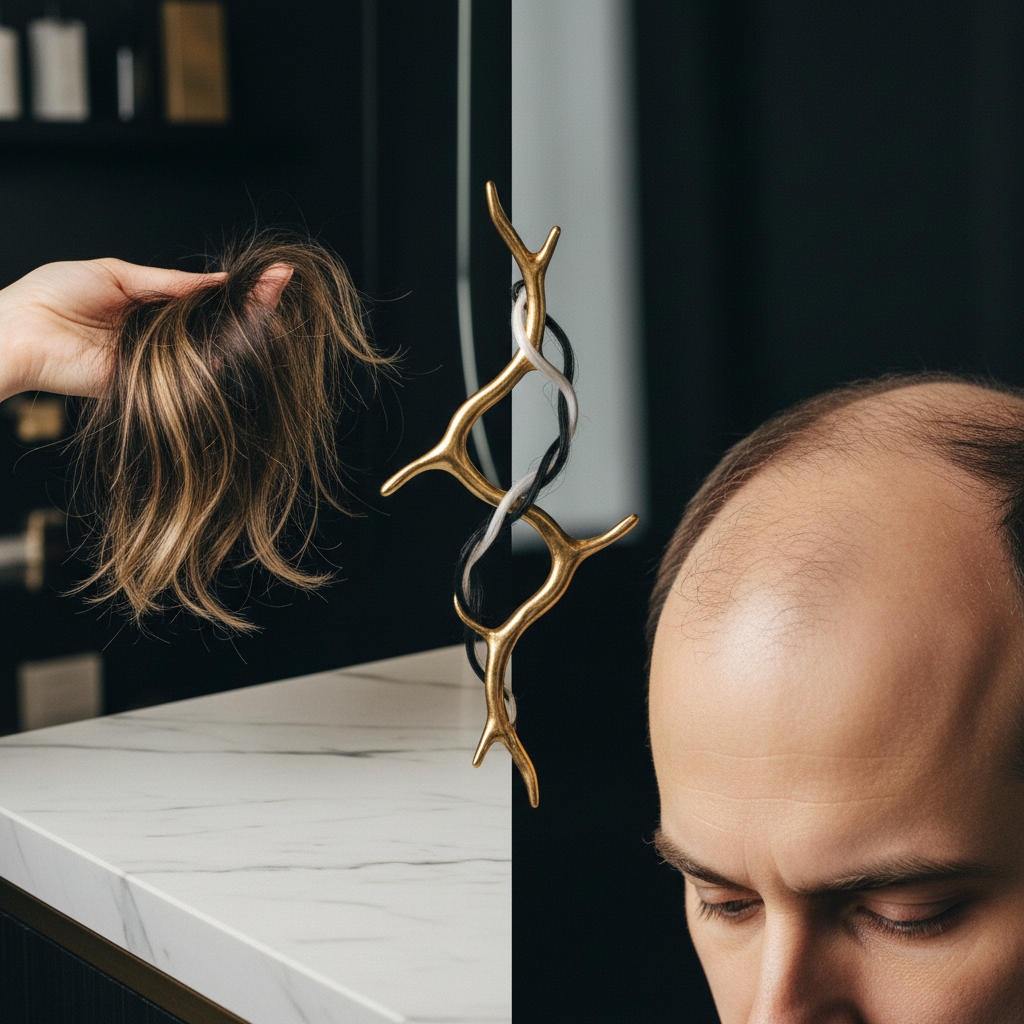
Quick answer: The core distinction in Telogen Effluvium vs Androgenetic Alopecia lies in whether you are experiencing rapid, widespread hair shedding or slow, progressive hair thinning. Telogen effluvium is a temporary disruption of the natural hair cycle causing diffuse daily shedding across the entire scalp, typically triggered by physiological shock. Androgenetic alopecia is a progressive, genetic sensitivity to dihydrotestosterone (DHT) that shrinks hair follicles in specific patterns over years. A key limitation is that both conditions can occur simultaneously, requiring professional assessment to confirm.
Distinguishing between sudden daily shedding and gradual scalp visibility is essential for choosing the right path forward. When people notice more strands on their brush, understanding Telogen Effluvium vs Androgenetic Alopecia helps avoid misplaced panic and ineffective remedies.
Key takeaways
- Onset and speed: Telogen effluvium appears abruptly two to three months after a physiological trigger, whereas androgenetic alopecia develops gradually across several years.
- Shedding vs miniaturisation: Telogen effluvium involves full-thickness club hairs falling out in high volume; androgenetic alopecia shrinks the follicle diameter over time without dramatic daily shedding spikes.
- Pattern of loss: Telogen effluvium affects the entire scalp diffusely. Androgenetic alopecia follows identifiable patterns (receding temples and crown in men; widening midline parting in women).
- Reversibility: Telogen effluvium is usually self-limiting and fully reversible once the underlying trigger resolves. Androgenetic alopecia is progressive and requires ongoing management to preserve density.
- Coexistence: Having androgenetic alopecia does not protect you from telogen effluvium; an episode of acute shedding can unmask underlying pattern hair loss earlier than expected.
Telogen Effluvium vs Androgenetic Alopecia: what the evidence shows
Clinical dermatology clearly differentiates non-scarring hair disorders by biological mechanism. In a healthy human scalp, roughly 85 to 90 percent of follicles reside in the growing (anagen) phase, while 10 to 15 percent rest in the telogen phase. Daily shedding of 50 to 100 hairs is completely physiological.
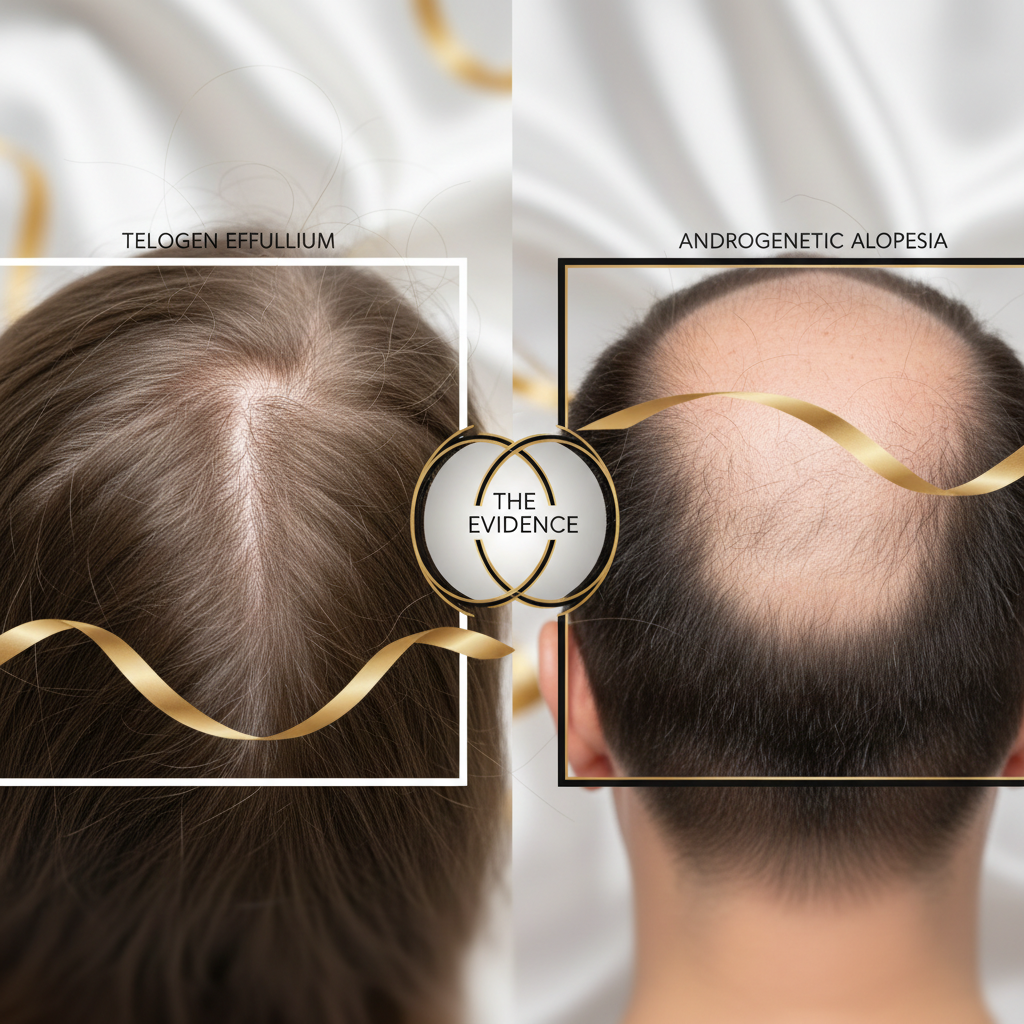
In telogen effluvium, an acute physiological shock precipitates a premature shift of up to 30 to 50 percent of growing follicles into the telogen phase. Because the telogen phase lasts approximately 100 days (three to four months) before the hair detaches from the dermal papilla, the shedding typically starts 8 to 12 weeks after the triggering event. The hairs shed are fully grown, pigmented terminal club hairs with a characteristic small white bulb at the proximal end. The follicle itself remains intact and healthy, ready to cycle back into anagen once the disruption subsides.
Conversely, androgenetic alopecia (pattern hair loss) is driven by genetics and endocrine signalling. Circulating testosterone is converted by the enzyme 5-alpha reductase into dihydrotestosterone (DHT) within hair follicles. In genetically susceptible follicles, DHT binds to androgen receptors, shortening the anagen growth phase and lengthening the telogen resting phase. Over repeated cycles, the follicle undergoes follicular miniaturisation. It produces progressively shorter, finer, less pigmented hairs (vellus-like hairs) until the hair barely surfaces above the scalp. The total hair count does not immediately drop; instead, hair calibre diminishes, creating the appearance of reduced coverage.
| Feature | Telogen Effluvium | Androgenetic Alopecia |
|---|---|---|
| Primary mechanism | Sudden shift of anagen hairs into telogen phase | Progressive follicular miniaturisation via DHT |
| Onset speed | Acute (often noticed over days or weeks) | Insidious (develops over years) |
| Typical trigger | High fever, severe stress, surgery, rapid weight loss | Genetic predisposition, androgen sensitivity |
| Pattern of distribution | Diffuse thinning across the entire scalp | Patterned (temples, crown, or midline parting) |
| Nature of shed hair | Full-thickness club hairs with white bulbs | Fine, miniaturised hairs with varying shaft widths |
| Scalp visibility | Generalised density reduction; ponytail feels thinner | Visible scalp at the crown, temples, or part line |
| Prognosis | Usually resolves spontaneously in 3 to 6 months | Progressive without medical intervention |
What the evidence does not show
Research does not support several common assumptions surrounding these two conditions:
- Shampooing does not cause telogen effluvium: Washing your hair dislodges hairs that have already separated from their blood supply weeks earlier. Skipping washes simply means loose hairs accumulate, causing alarming clumps on the next wash day.
- Androgenetic alopecia is not caused by poor scalp circulation: While microcirculation supports tissue health, pattern hair loss is driven by cellular hormone receptors and genetic expression, not constricted blood vessels alone.
- Telogen effluvium does not permanently kill follicles: The dermal papilla and stem cell reservoir in the follicular bulge remain undamaged. Follicles do not form scar tissue or vanish.
- Topical cosmetics cannot alter genetic receptor sensitivity: Cosmetic cleansers and conditioners improve fibre strength, scalp comfort, and visual fullness, but they do not reverse the genetic transcription behind androgenetic alopecia.
Signs to look for: how to tell the difference
You can often spot clues by evaluating shedding volume, hair diameter, and location on the scalp.
Assessing the shed hairs
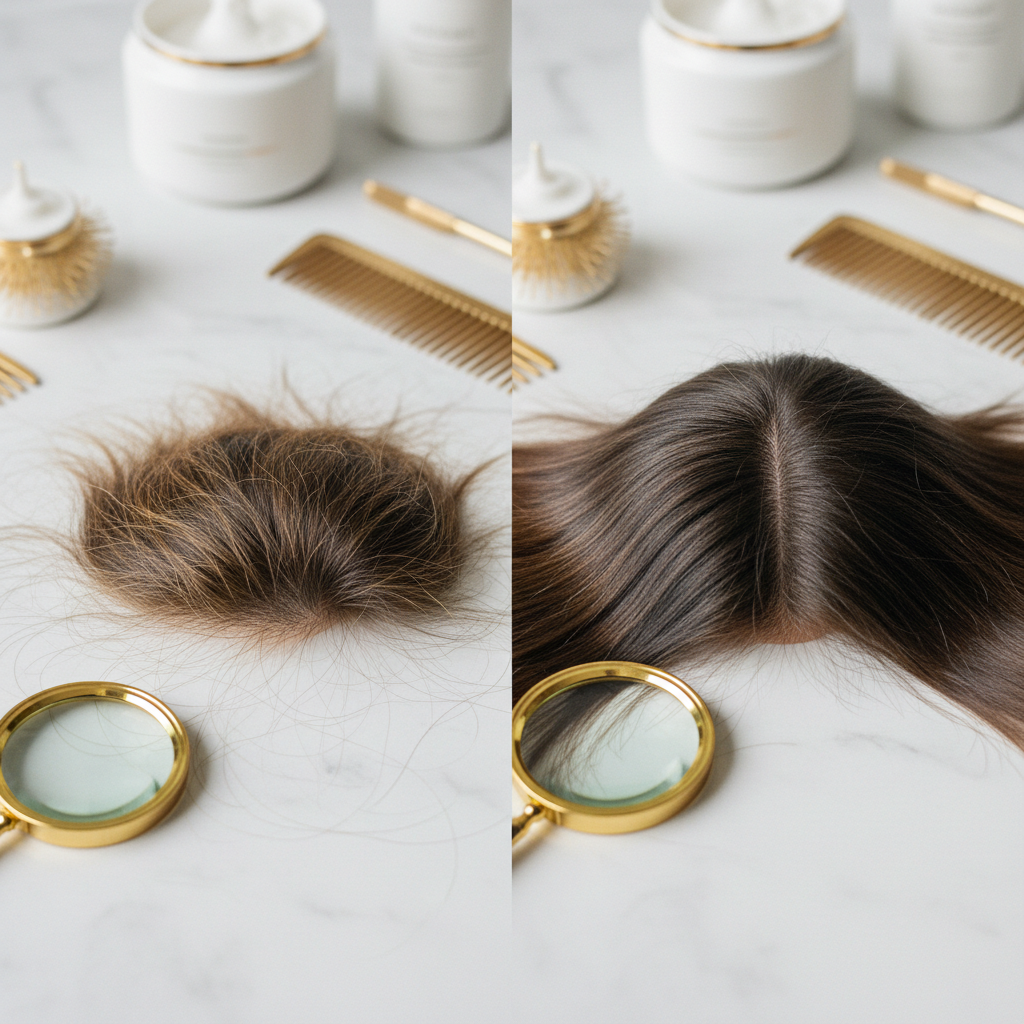
Examine the hairs left on your pillow, shower drain, or brush. In acute telogen effluvium, you will see a noticeable volume of long, uniform hairs matching your normal hair thickness, each bearing a small white keratin bulb at the root. In androgenetic alopecia, shedding may stay within normal limits (under 100 hairs daily), but the hairs on your scalp show marked diameter diversity (anisotrichosis), where thick terminal hairs sit right next to whisper-thin, wispy hairs.
Evaluating the distribution
Check where the scalp is most noticeable. If you pull your hair into a ponytail and the overall circumference feels halved, but your hairline has not moved, telogen effluvium is the prime suspect. If your hairline is receding into an M-shape, your crown is widening, or the central parting on top of your head reveals significantly more skin while the back of your head remains dense, androgenetic alopecia is likely at play.
Using the hair pull test
Dermatologists often use a gentle pull test. Grasping approximately 50 to 60 hairs between the thumb and forefinger, the clinician applies firm, gentle traction from base to tip. Extracting more than five or six club hairs across different scalp regions typically indicates active telogen shedding. In stable androgenetic alopecia, the pull test is usually negative unless a concurrent effluvium is occurring.
When the cause may be something else
Not all shedding or thinning fits neatly into these two categories. Several other conditions mimic their presentation:
- Alopecia Areata (diffuse variant): An autoimmune condition where T-cells attack the hair bulb, sometimes presenting as sudden diffuse thinning rather than classic circular patches.
- Nutritional deficiencies: Chronic low ferritin (iron stores below 30 to 50 mcg/L), severe zinc deficiency, or vitamin D depletion can trigger prolonged shedding or impair anagen regrowth.
- Thyroid dysfunction: Both hypothyroidism and hyperthyroidism disrupt follicle metabolism, leading to persistent, diffuse shedding that mimics chronic telogen effluvium.
- Traction alopecia: Mechanical tension from tight buns, braids, or extensions pulls hairs out from the root, causing loss along the marginal hairline that can be confused with genetic thinning.
- Hair shaft breakage: Chemical processing, heat damage, or harsh brushing snaps hair shafts mid-strand. This creates sparse ends and flyaways without root bulbs, which is mechanical damage rather than biological shedding.
What you can do: practical management
Addressing scalp changes depends on which mechanism is active.
For telogen effluvium, patience and physiological support are paramount. Identify the trigger from three months prior. If you experienced high fever, childbirth, nutritional restriction, or major emotional shock, your body simply needs time. Ensure adequate dietary protein (roughly 0.8 to 1.2 grams per kilogram of body weight daily) and check your ferritin and vitamin levels. Once the underlying stressor is resolved, shedding usually tapers within three to six months, with visible regrowth following over the subsequent year.
For androgenetic alopecia, early intervention yields the best cosmetic outcomes because miniaturised follicles are easier to maintain than to revive. Evidence-based options approved by regulatory authorities include topical minoxidil and prescription 5-alpha reductase inhibitors like finasteride, which lower DHT production. These treatments require continuous use to sustain results.
Alongside targeted treatments, maintaining a balanced scalp routine supports fibre longevity. Products like Watermans Grow Me Shampoo and Condition Me Conditioner provide a nutrient-rich, stimulating wash experience with ingredients like biotin, rosemary, caffeine, and niacinamide. While cosmetic formulas do not alter your genetics or cure androgenetic alopecia, they help keep the scalp clean, clear of sebum build-up, and create optimal conditions for fragile emerging fibres to thrive.
When to seek professional advice
Consult a GP, dermatologist, or registered trichologist if:
- Rapid shedding continues past six months without slowing down (suggesting chronic telogen effluvium).
- You notice burning, itching, redness, or scaling on your scalp.
- Hair loss occurs in discrete, smooth, coin-sized patches.
- Eyebrows, eyelashes, or body hair begin falling out.
- You want an accurate dermoscopic evaluation to identify follicular miniaturisation before visible baldness sets in.
Frequently asked questions about Telogen Effluvium vs Androgenetic Alopecia
Can telogen effluvium trigger androgenetic alopecia?
Telogen effluvium does not cause androgenetic alopecia, as pattern hair loss relies on genetic sensitivity to DHT. However, a severe shedding episode can unmask androgenetic alopecia. When anagen hairs shed prematurely in someone with underlying genetic susceptibility, the hairs that grow back in their place may return visibly miniaturised, revealing thinning that was previously hidden.
How do doctors diagnose Telogen Effluvium vs Androgenetic Alopecia?
Clinicians use trichoscopy (scalp dermoscopy) alongside patient history and blood tests. Under high magnification, androgenetic alopecia shows hair diameter diversity greater than 20 percent, yellow dots, and peripilar signs around follicles. Telogen effluvium exhibits uniform hair shaft diameter across the scalp and short, upright regrowing hair tips without significant follicle miniaturisation.
Does hair always grow back after telogen effluvium?
Yes, in the vast majority of cases. Acute telogen effluvium is completely non-scarring. The follicular stem cells remain healthy within the scalp. Once the trigger (such as illness, medication, or severe stress) has passed, the follicle resets into the anagen growth phase. Noticeable fullness typically returns over 6 to 12 months as the new hair shafts gain length.
Can you have both conditions at the same time?
Yes, it is common to experience both conditions simultaneously. Someone with mild, unnoticeable androgenetic alopecia might contract a severe illness or undergo major surgery. Two to three months later, they experience acute telogen effluvium. The sudden shedding rapidly exposes the thinning crown or temples, compounding the visual density loss across the entire scalp.
Supporting your hair through shedding and thinning
Understanding the biological differences between Telogen Effluvium vs Androgenetic Alopecia removes much of the uncertainty surrounding hair changes. Telogen effluvium is a temporary, self-correcting reaction to acute bodily stress, requiring calm patience and foundational nutrition. Androgenetic alopecia is a progressive genetic trait that demands early, consistent management to protect follicle calibre over time. By accurately identifying whether your issue is shedding or miniaturisation, you can choose the right evidence-based approach to protect your scalp and keep your hair looking its healthiest.
Sources and references
- British Association of Dermatologists. Clinical Guidelines for the Management of Alopecia. British Journal of Dermatology, 2012.
- National Institute for Health and Care Excellence (NICE). Alopecia androgenetica: Scenario: Management. NICE Clinical Knowledge Summaries, 2021.
- Asghar, F., Shamim, N., Farooque, U., et al. Telogen Effluvium: A Review of the Etiology and Pathophysiology. Cureus, 2020.
- Trüeb, R. M. Molecular mechanisms of androgenetic alopecia. Experimental Gerontology, 2002.
- Sinclair, R. Diffuse hair loss: its triggers and management. Cleveland Clinic Journal of Medicine, 2010.
- Headington, J. T. Telogen effluvium: New concepts and review. Archives of Dermatology, 1993.
Find these ingredients in Watermans products
- Zinc: you will find this ingredient in our Hair Vitamins.
- Niacinamide: you will find this ingredient in our Hair Mask.