Understanding Telogen Effluvium and Hair Shedding: Causes, Biology, and Recovery
9 min read ·
Understand the causes, mechanisms, and timeline of Telogen Effluvium and Hair Shedding, from biological triggers to practical scalp care and evidence-based recovery.

Quick answer: Telogen Effluvium and Hair Shedding describe a non-scarring, diffuse hair release triggered when a physiological or psychological shock shifts growing follicles prematurely into their resting state. Typically appearing two to three months after a triggering event, daily shed counts can leap from the normal 50 to 100 hairs up to 300 or more. The condition is usually self-limiting and fully reversible once the underlying trigger resolves, though recovery requires time because hair follicles cycle slowly.
Key takeaways
- Normal physiological shedding accounts for roughly 50 to 100 club hairs per day, whereas telogen effluvium can triple this rate across the entire scalp.
- A biological lag of two to three months occurs between the initial trigger (such as illness, childbirth, extreme stress, or nutritional deficiency) and visible shedding.
- Telogen effluvium is a shedding disorder, not permanent follicular miniaturisation or scarring hair loss; the follicles remain alive and capable of regrowth.
- Differentiating between root shedding (club hair with a small white bulb) and mid-shaft breakage is essential for accurate assessment.
- Resolution depends on identifying and removing the trigger, followed by supporting general scalp and nutritional health while waiting for the next growth cycle.
Telogen Effluvium and Hair Shedding: what the evidence shows
Telogen Effluvium and Hair Shedding represent one of the most common presentations encountered in trichology and dermatology clinics. In healthy scalps, roughly 85 to 90 percent of terminal follicles actively grow in the anagen phase at any given moment. This phase lasts between two and seven years. Another 1 to 2 percent occupy the short transitional catagen phase, while the remaining 10 to 15 percent rest in the telogen phase for approximately 100 days. At the end of telogen, the resting club hair sheds (the exogen phase) as a newly developing anagen hair emerges beneath it.

When the body experiences acute physical stress, hormonal shifts, or metabolic shock, up to 30 to 50 percent of anagen follicles can exit the growth phase abruptly. They transition through catagen and enter telogen simultaneously. Because the resting phase lasts about 8 to 12 weeks, the individual experiences no immediate hair loss at the moment of trauma. Instead, widespread shedding begins two to three months later, catching many people completely off guard.
Clinical dermatology confirms that telogen effluvium presents diffusely across the entire scalp. While individuals often notice thinning around the temples or a wider parting line, the condition does not typically cause completely smooth, circular bald patches. That pattern is characteristic of alopecia areata. Nor does it cause follicular destruction, which defines scarring alopecias.
Biological triggers behind acute shedding
Identifying the precise cause of telogen effluvium requires examining a person's medical history two to four months before shedding started. Clinical research highlights several major categories of triggers:
- Systemic illness and high fevers: Severe viral or bacterial infections, surgical operations, and systemic inflammatory episodes frequently cause follicles to suspend anagen. Post-viral shedding gained global prominence following the COVID-19 pandemic, where dermatologists documented significant spikes in acute cases.
- Hormonal fluctuations: The sudden drop in circulating oestrogen and progesterone following childbirth triggers postpartum telogen effluvium, usually beginning two to four months after delivery. Stopping oral contraceptives or undergoing fertility treatments can produce a similar hormonal rebound.
- Nutritional and metabolic deficits: The hair follicle matrix is one of the most metabolically active tissues in the human body. Depleted serum ferritin (stored iron), vitamin D deficiency, zinc insufficiency, or rapid weight loss from crash dieting disrupt follicular protein synthesis.
- Endocrine disorders: Both hypothyroidism and hyperthyroidism disrupt normal hair cycling, often precipitating diffuse thinning.
- Psychological trauma: Severe emotional shock, intense bereavement, or acute psychological distress stimulates the release of substance P, cortisol, and local neurogenic inflammatory markers around the follicle, nudging it toward early rest.
- Medication side-effects: Certain prescription drugs can induce shedding, including specific beta-blockers, anticoagulants, high-dose retinoids, and changes in psychiatric medications.
The mechanism: distinguishing shedding from breakage and miniaturisation
A crucial step in hair assessment is establishing whether an individual is losing hairs from the follicle or experiencing fibre fracture along the shaft.
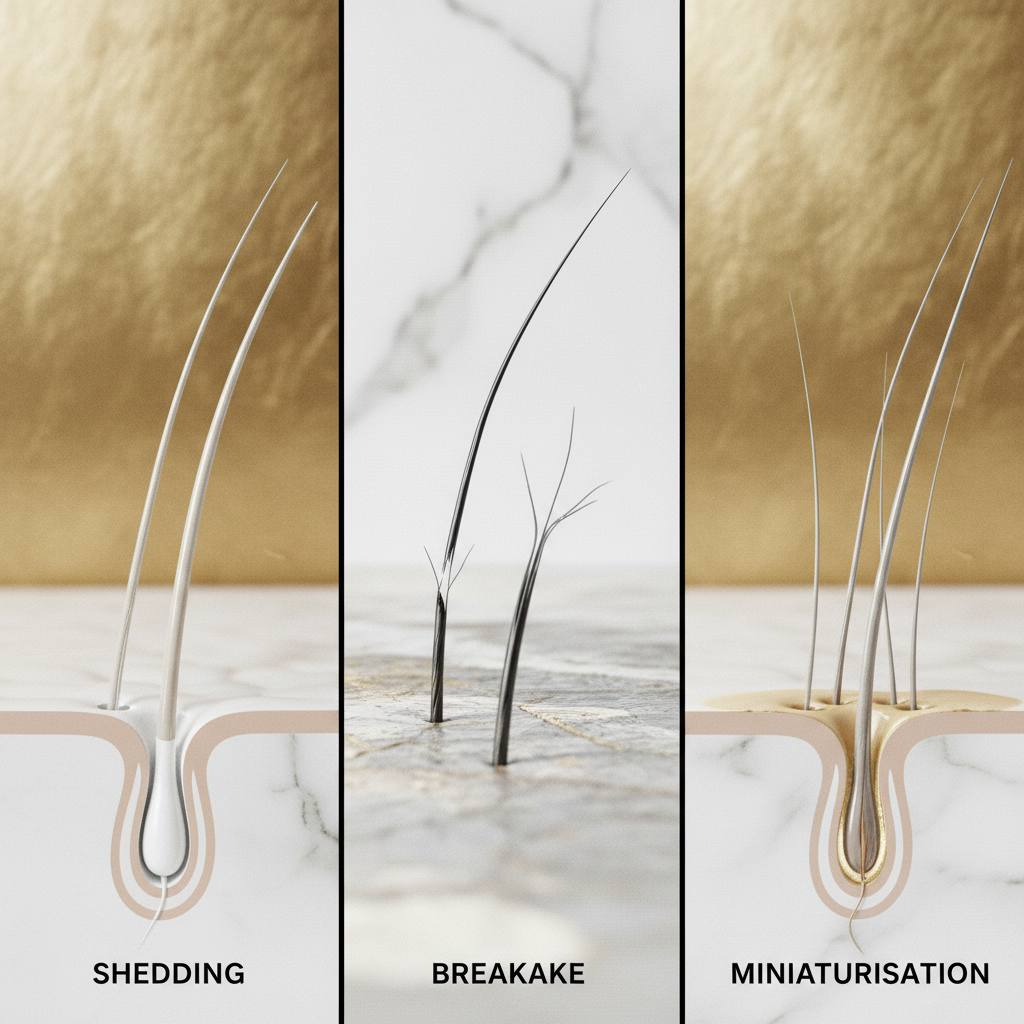
In telogen effluvium, hair leaves the scalp at the root level. When examined closely, the proximal end features a small, hard, translucent or white bulb. This is the keratinised club hair typical of the resting telogen phase. The follicle itself remains fully intact beneath the dermis. Because the stem cell reservoir inside the follicular bulge is undamaged, the follicle can immediately restart anagen once the resting period completes.
By contrast, hair breakage occurs along the shaft without a root bulb attached. Breakage results from mechanical stress, chemical over-processing (such as bleaching or excessive permanent waving), heat tool damage, or UV degradation. Cosmetic measures and deep conditioning treatments can protect against breakage, but they do not stop biological shedding originating deep in the follicle.
Similarly, telogen effluvium differs fundamentally from androgenetic alopecia (pattern hair thinning). Androgenetic alopecia is a progressive miniaturisation process driven by dihydrotestosterone (DHT) binding to sensitive androgen receptors. This causes hair shafts to grow progressively finer and shorter over multiple cycles. Telogen effluvium involves full-calibre hairs falling out all at once across the scalp.
| Clinical Feature | Acute Telogen Effluvium | Androgenetic Alopecia | Hair Fibre Breakage |
|---|---|---|---|
| Onset | Sudden, rapid diffuse shedding | Slow, progressive thinning | Gradual or sudden after chemical/heat insult |
| Shed Hair Structure | Intact shaft with white telogen club bulb | Finer, shorter hairs with miniaturised roots | Fragmented shafts without root bulbs |
| Scalp Distribution | Diffuse across entire scalp | Vertex, crown, and bitemporal recession | Localised to areas of physical or chemical wear |
| Follicular Integrity | Healthy, capable of full regrowth | Gradually miniaturised by DHT | Healthy; follicles are not involved |
| Primary Timeline | Peaks at 2 to 4 months; resolves in 6 | Lifelong, progressive without treatment | Immediate or ongoing until styling alters |
What the evidence does not show
Misinformation regarding telogen effluvium is widespread. Scientific and clinical evidence contradicts several common myths:
- Washing hair does not cause telogen effluvium: People experiencing heavy shedding often avoid shampooing, fearing the water and lather cause hairs to drop. In reality, hairs shed in the shower entered the resting phase months earlier and were already detached in the upper follicle. Washing merely dislodges loose fibres. Reducing hair washing creates an accumulation of sebum, dead skin cells, and microbial imbalance on the scalp without preserving a single follicle.
- Topical cosmetic products do not cure systemic shedding: Shampoos, oils, and tonics cannot bypass systemic biology to reverse an illness- or hormone-induced catagen shift. While scalp-care formulas can maintain an optimal environment for incoming new growth, they cannot halt shedding that was set in motion months prior.
- Telogen effluvium does not lead to permanent baldness: Because it is non-scarring and non-miniaturising, telogen effluvium does not destroy the hair factory. Unless complicated by untreated underlying disease or unmasked androgenetic alopecia, hair density recovers.
Practical steps to support recovery
While you cannot fast-forward follicular cycling overnight, you can support your body and scalp during the regrowth phase.
First, identify and address the original shock. If you suspect an internal deficit, ask a medical doctor for targeted blood testing. Relevant markers include a full blood count, serum ferritin, total iron-binding capacity, thyroid stimulating hormone (TSH), free T4, and vitamin D levels. Correcting an iron deficit to bring ferritin above optimal clinical thresholds (often recommended around 50 to 70 mcg/L for active hair cycling) provides essential metabolic support.
Second, maintain balanced, protein-rich nutrition. Keratin accounts for roughly 85 to 90 percent of the hair fibre's dry weight. Ensure your daily intake includes sufficient dietary protein, essential fatty acids, and micro-nutrients.
Third, adjust your physical hair maintenance. Handle wet hair gently, avoid aggressive towel-drying, and switch to wide-tooth detangling combs to minimise mechanical tension. Minimise chemical bleaching and high-heat styling while the hair density is diminished to avoid compounding shedding with shaft breakage.
The Watermans perspective: supporting your scalp environment
At Watermans, our focus is grounded in cosmetic scalp wellness and hair fibre integrity. While no topical cosmetic product can alter the biological timeline of internal telogen effluvium, maintaining the condition of the scalp skin and newly emerging fibres is essential for overall hair health.
Products such as Watermans Grow Me Shampoo and Condition Me Conditioner are formulated without harsh sulphates, using ingredients like biotin, rosemary, caffeine, and hydrolysed lupin protein to cleanse without stripping natural lipids. These cosmetic formulations help keep the scalp free of sebum buildup while strengthening existing and emerging hair shafts against everyday mechanical breakage. Clean follicles and well-conditioned strands give new regrowth the best physical foundation as your natural hair cycle rebalances.
When to seek professional advice
Most acute telogen effluvium episodes stabilise within three to six months once the trigger is resolved. However, you should consult a GP, registered trichologist, or dermatologist if:
- Hair shedding continues intensely beyond six months (indicating possible chronic telogen effluvium).
- You notice distinct, coin-shaped bald patches, which suggest alopecia areata.
- Your scalp presents signs of inflammation, such as severe itching, burning, pain, redness, or scaling.
- You see signs of scarring, including absent follicular openings or skin textural changes.
- Shedding is accompanied by unexplained lethargy, significant weight changes, cold sensitivity, or irregular menstrual cycles.
Frequently asked questions about Telogen Effluvium and Hair Shedding
How long does Telogen Effluvium and Hair Shedding last?
Acute Telogen Effluvium and Hair Shedding typically lasts between three and six months. Once the underlying trigger, such as illness, nutritional deficiency, or severe stress, is resolved, the follicles gradually transition back into the anagen growth phase. However, because hair grows at roughly one centimetre per month, visible density recovery often takes six to twelve months.
Can Telogen Effluvium turn into permanent baldness?
No, telogen effluvium does not destroy the hair follicle. It is a non-scarring, functional disturbance of the hair cycle. Once the biological stressor is addressed, the follicular stem cells produce a new anagen fibre. However, an acute shedding episode can unmask existing pattern hair thinning in individuals genetically predisposed to androgenetic alopecia.
How can I tell if my hair is shedding or breaking?
Examine the ends of the fallen hairs. If the strand features a small, white or translucent club bulb at one end, it has shed from the follicle, typical of telogen effluvium. If the hair is shorter, frayed, and lacks a bulb, it has snapped along the shaft due to mechanical or chemical breakage.
Should I wash my hair less often during acute shedding?
No. Washing your hair less frequently does not prevent shedding; it merely allows loose hairs to accumulate until the next wash, creating the illusion of heavier shedding. Furthermore, infrequent washing can cause scalp inflammation and sebum accumulation, which interferes with a clean follicular environment. Wash gently and regularly.
Can chronic telogen effluvium last for years?
Yes. If diffuse shedding persists for more than six months without obvious resolution, it is classified as chronic telogen effluvium. This form is more common in women aged 30 to 60 and often requires thorough medical evaluation to identify subtle ongoing drivers, such as subclinical thyroid dysfunction, chronic low ferritin, or ongoing systemic stress.
Concluding insights
Understanding Telogen Effluvium and Hair Shedding requires recognising the natural biological lag between an internal disturbance and physical hair loss. When sudden, diffuse shedding appears, look backward two or three months to pinpoint the physiological or emotional trigger. By separating shedding from breakage, consulting healthcare professionals for necessary blood work, and maintaining a healthy, balanced scalp environment, you allow your follicles the time and resources they need to re-enter their normal, active growth cycle.
Sources and references
- British Association of Dermatologists. Telogen Effluvium Patient Information Leaflet. 2021.
- National Institute for Health and Care Excellence (NICE). Alopecia: Clinical Knowledge Summaries. 2022.
- Headington, J. T. "Telogen effluvium: New concepts and review." Archives of Dermatology, 1993.
- Asghar, F., Shamim, N., Farooque, U., Sheikh, H., & Aqeel, R. "Telogen Effluvium: A Review of the Science and Current Practices." Cureus, 2020.
- Trüeb, R. M. "Systemic therapy for hair disorders." Dermatologic Therapy, 2008.
Find these ingredients in Watermans products
- Zinc: you will find this ingredient in our Hair Vitamins.