Telogen Effluvium and Diffuse Shedding: Mechanisms, Triggers, and Recovery
9 min read ·
Telogen Effluvium and Diffuse Shedding causes sudden hair fall following systemic stress. Learn the biological mechanisms, common triggers, and recovery steps.

Quick answer: Telogen Effluvium and Diffuse Shedding refers to a reactive scalp condition where a physiological or emotional stressor abruptly pushes a high percentage of actively growing hair follicles into their resting phase. This triggers sudden, widespread shedding across the entire scalp roughly two to three months later. The condition is fundamentally a temporary disruption of the hair growth cycle, not permanent follicular miniaturisation or scarring. The primary limitation is that shedding resolves only once underlying metabolic, systemic, or nutritional triggers are fully addressed.
Key takeaways
- Telogen effluvium is diffuse shedding characterised by hairs coming away from the follicle with a small, white keratinised bulb attached.
- Shedding typically starts 60 to 90 days after a distinct triggering event such as high fever, surgery, child birth, rapid weight loss, or severe acute stress.
- Normal shedding accounts for 50 to 100 hairs daily, whereas acute telogen effluvium can push daily shedding counts to 300 hairs or more.
- This process represents hair shedding rather than hair breakage (shaft snapping) or follicular miniaturisation (pattern hair loss).
- Most acute episodes resolve spontaneously within three to six months once the primary trigger is identified and stabilised.
Telogen Effluvium and Diffuse Shedding: what the evidence shows
Telogen Effluvium and Diffuse Shedding is recognised by dermatologists as the most common cause of sudden, widespread non-scarring alopecia. Under normal physiological conditions, approximately 85% to 90% of your scalp hairs sit in the anagen (active growth) phase, while roughly 1% to 2% are in catagen (transition), and 10% to 15% occupy the telogen (resting) phase. In telogen effluvium, an acute physiological disturbance abruptly shifts up to 30% to 50% of anagen hairs directly into the catagen and telogen phases.

The hair fibre does not shed immediately when it enters the telogen stage. The club hair remains loosely anchored in the follicular canal for roughly 60 to 100 days while the follicle reorganises below. When new anagen hair begins to form, or when external mechanical tension from washing and brushing is applied, the resting hairs release simultaneously. This creates a delayed, distressing wave of diffuse shedding across the entire scalp.
Clinical research published in peer-reviewed dermatology literature confirms that this shedding is diffuse, meaning it affects the entire scalp rather than presenting in distinct circular patches or a receding hairline. While the vertex and temporal areas may appear noticeably thinner because hair density is naturally lower there, follicle counts remain stable across the scalp.
What the evidence does not show
Controlled medical research does not support several persistent myths surrounding diffuse shedding:
- It does not lead to total baldness: Telogen effluvium is inherently self-limiting. The follicles do not die or scar over. Complete baldness does not occur because a substantial proportion of follicles remain in the anagen phase throughout the episode.
- Topical cosmetics do not halt active telogen shedding: No shampoo, oil, or topical cosmetic can force a hair already in the telogen phase back into the anagen phase. Once a follicle enters telogen, that hair fibre will inevitably shed.
- Washing your hair does not cause shedding: Patients often believe shampooing causes hair loss because wet styling dislodges loose fibres. Clinical studies show that gentle cleansing simply releases hairs that had already detached from their dermal papillae days earlier. Restricting washing does not prevent shedding; it merely causes loose club hairs to accumulate and shed in larger clumps during subsequent washes.
The biological mechanism and underlying triggers
Understanding the physiological mechanism helps demystify the delayed timeline of diffuse shedding. The follicular cycle relies on high metabolic turnover, making dermal papilla cells exceptionally sensitive to systemic stress, hormonal fluctuations, and cellular energy deficits.
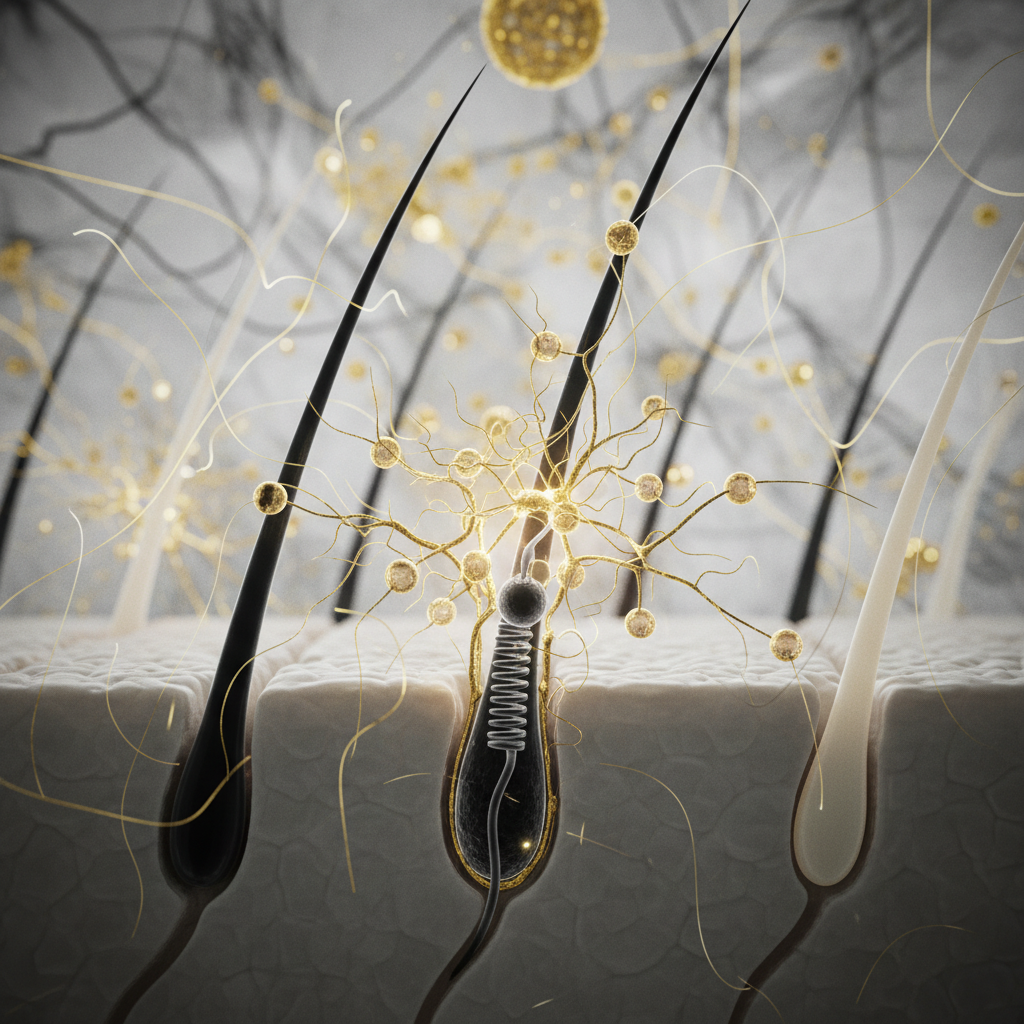
Trigger Event (Day 0)
 │
 ▼
Premature Anagen Arrest (Follicles shift to Catagen/Telogen)
 │
 ▼
Latent Resting Phase (Club hair retained for 60 to 90 days)
 │
 ▼
Diffuse Shedding (Hairs release en masse during washing/brushing)
 │
 ▼
Spontaneous Regrowth (New anagen fibres emerge 3 to 6 months later)
Common systemic triggers confirmed in medical literature include:
- Systemic illness and febrile states: High fever (temperatures exceeding 39 degrees Celsius) or severe infections arrest the energy-intensive anagen process.
- Postpartum hormonal withdrawal: Elevated oestrogen levels during pregnancy prolong the anagen phase. Postpartum hormonal drops trigger a synchronised shift into telogen (telogen gravidarun), often starting two to four months after delivery.
- Nutritional and metabolic deficiencies: Ferritin (stored iron) levels below 30 to 50 micrograms per litre, severe protein restriction, acute zinc deficiency, and rapid caloric deficits (such as crash dieting or bariatric surgery) starve follicular matrix cells.
- Endocrine disruption: Hypothyroidism and hyperthyroidism disrupt cell division in the hair matrix.
- Pharmacological triggers: Starting or abruptly stopping certain medications, including anticoagulants, beta-blockers, retinoids, and oral contraceptives, can precipitate diffuse shedding.
Distinguishing shedding, breakage, and miniaturisation
Correct identification determines the right path forward. Hair breakage involves mechanical failure of the keratin shaft, shedding involves full follicular release, and miniaturisation represents androgenic progressive thinning.
| Diagnostic Feature | Telogen Effluvium | Androgenetic Alopecia | Hair Fibre Breakage |
|---|---|---|---|
| Primary Mechanism | Premature follicle transition to telogen | Progressive androgenic follicular miniaturisation | Structural breakdown of cuticle and cortex |
| Onset Speed | Sudden, dramatic (2 to 3 months post-trigger) | Slow, insidious (progresses over years) | Variable (often post-chemical processing) |
| Distribution | Diffuse across entire scalp | Vertex, crown, and frontal hairline | Localised to styled, heat-treated, or bleached zones |
| Shed Fibre Morphology | Full length with distinct white keratin bulb | Finer, shorter, miniaturised club hairs | Broken fragments of varying lengths, no bulb |
| Follicle Density | Follicles intact and viable | Follicles progressively shrink | Follicles completely intact |
| Prognosis | High likelihood of full spontaneous recovery | Progressive without active clinical management | Resolves with modified styling and gentle care |
What you can do during active shedding
Because hairs in the telogen phase must inevitably shed, proactive management focuses on supporting overall scalp health, minimising mechanical damage to remaining hair fibres, and correcting systemic imbalances.
- Check core blood markers: Request a targeted blood panel through your GP. Essential markers include serum ferritin, full blood count, thyroid stimulating hormone (TSH), free T4, vitamin D3, and serum zinc.
- Maintain nutritional sufficiency: Ensure daily dietary intake includes adequate bioavailable protein (aiming for roughly 0.8 to 1.2 grams per kilogram of body weight) and balanced micronutrients.
- Reduce mechanical traction: Avoid tight ponytails, extensions, vigorous friction towel drying, and aggressive brushing. Mechanical tension places unnecessary pull on loosening club hairs and risks breakage on surrounding anagen strands.
- Cleanse the scalp regularly: Maintain a clean, balanced scalp environment using a gentle, pH-balanced shampoo (around pH 4.5 to 5.5). Accumulation of sebum and environmental debris can encourage inflammatory scalp conditions such as seborrhoeic dermatitis, which compounds hair loss.
The cosmetic role of Watermans haircare
While medical conditions such as telogen effluvium require systemic evaluation, high-performance topical haircare plays an important supportive cosmetic role.
Watermans Grow Me Shampoo and Condition Me Conditioner provide a gentle, revitalising environment for thinning, fragile strands. Formulated with cosmetic caffeine, biotin, rosemary extract, niacinamide, and argan oil, the range is engineered to cleanse the scalp without stripping protective natural lipids. These cosmetic actives help improve the appearance of hair density, soften the hair shaft to reduce physical breakage during washing, and leave thinning hair looking fuller, thicker, and visibly revitalised while natural growth cycles normalise.
When the cause may be something else
Diffuse shedding does not always follow an acute, self-limiting course. If shedding persists past six months, it may be classified as chronic telogen effluvium, an ongoing condition that primarily affects women between 30 and 60 years of age without a single identifiable trigger.
Diffuse shedding can also mimic or unmask female pattern hair loss. In some cases, a severe bout of telogen effluvium acts as the initial catalyst that reveals an underlying genetic predisposition to pattern hair loss, where the regrowing hairs return thinner and finer. Diffuse alopecia areata, secondary syphilis, and systemic lupus erythematosus can also present as diffuse hair fall and require differential diagnosis by a dermatologist.
When to seek professional advice
You should arrange an evaluation with a trichologist or dermatologist if:
- Shedding persists beyond six continuous months without signs of slowing down.
- You notice distinct patchy loss, scalp redness, burning, intense pruritus, scaling, or pustules.
- Hair shedding is accompanied by systemic signs such as unintended weight changes, severe lethargy, irregular menstrual cycles, or heat/cold intolerance.
- You observe permanent widening of the central part or scarring of the scalp surface.
Frequently asked questions about Telogen Effluvium and Diffuse Shedding
How long does Telogen Effluvium and Diffuse Shedding typically last?
Acute Telogen Effluvium and Diffuse Shedding generally lasts between three and six months. Shedding typically begins around two to three months after the initial stressor. Once the body recovers and underlying triggers are removed, shedding slows naturally, followed by gradual visual regrowth over the subsequent three to twelve months.
Does brushing or washing make diffuse shedding worse?
Brushing and washing do not worsen the underlying condition, although they dislodge hairs that have already detached inside the follicle. Avoiding washing merely allows shed hairs to gather, causing larger amounts to release at once, which increases psychological distress.
Can severe psychological stress trigger diffuse hair fall?
Yes. Severe emotional shock, psychological distress, or prolonged bereavement can alter neuroendocrine signalling, elevating cortisol and substance P around the hair follicle. This stress cascade can prompt actively growing follicles to abort anagen prematurely, prompting diffuse shedding months down the line.
How can you tell if shed hair is regrowing?
Regrowth is characterised by fine, short, soft hairs standing upright along the frontal hairline and throughout the parting. These new anagen hairs have tapered tips (unlike broken hairs, which feature blunt, fractured ends) and gradually thicken over several months as their normal growth cycle resumes.
Will taking hair supplements stop my shedding immediately?
Supplements will not halt hair that is already in the telogen phase. If a proven nutritional deficiency (such as low ferritin or vitamin D) triggered the shedding, targeted supplementation helps restore follicle function, ensuring that newly emerging anagen hairs grow back strong and healthy.
Supporting recovery from diffuse shedding
Navigating an episode of Telogen Effluvium and Diffuse Shedding can feel deeply distressing, but understanding the biological delay inherent to the hair cycle provides reassuring perspective. Because shedding is a delayed reaction to a past event, the peak of hair fall often coincides with the moment your body is already starting to recover. By pinpointing systemic triggers with medical professionals, maintaining a balanced diet, and protecting fragile strands with gentle haircare, you allow your hair follicles the time and physiological environment they need to resume healthy, balanced cycles.
Sources and references
- British Association of Dermatologists. Clinical Guidelines for the Management of Alopecia. 2021.
- Headington, J. T. Telogen Effluvium: New concepts and review. Archives of Dermatology, 1993.
- National Institute for Health and Care Excellence (NICE). Alopecia: Clinical Knowledge Summaries. 2022.
- Sinclair, R. Diffuse hair loss: An approach to diagnosis and management. Australian Family Physician, 2005.
- Asghar, F. Et al. Telogen Effluvium: A Review. Cureus Journal of Medical Science, 2020.
- Trüeb, R. M. Systematic approach to hair loss in women. Journal of the German Society of Dermatology, 2010.
Find these ingredients in Watermans products
- Niacinamide: you will find this ingredient in our Hair Mask.