Surfactant Science in Haircare: The Chemistry of Cleansing
9 min read ·
Explore surfactant science in haircare: discover how cleansing agents interact with hair lipids, balance scalp hygiene, and protect your cuticles from breakage.
Quick answer: Understanding surfactant science in haircare reveals how cleansers remove sebum, debris, and cosmetic residue without stripping the delicate hair fibre. Surfactants are surface-active compounds with hydrophilic heads and lipophilic tails that organise into micelles to lift oils into water. While essential for scalp hygiene, their primary limitation is that aggressive cleansing agents can extract structural lipids from the cuticle and denature keratin, causing dryness and cuticle wear rather than treating underlying biological hair disorders.
Key takeaways
- Surfactants reduce surface tension between water and hydrophobic sebum, enabling dirt and lipid buildup to rinse away smoothly.
- Cleansers classify into four main chemical categories: anionic, amphoteric, non-ionic, and cationic, each offering distinct cleaning power and cuticle compatibility.
- Anionic surfactants provide the most thorough cleanse, but unbuffered formulations can swell the hair shaft and elevate cuticle scales.
- Amphoteric and non-ionic surfactants temper irritation, making them vital components in gentle, daily-use formulations.
- Surfactants interact exclusively with the non-living fibre and the skin barrier; they do not alter hair follicle growth cycles or reverse genetic pattern hair loss.
Surfactant science in haircare: what the evidence shows
Surfactant science in haircare focuses on the molecular behaviour of surface-active agents at the interface of water, sebum, and the keratinised protein structure of hair. Hair is naturally hydrophobic near the scalp due to the 18-methyleicosanoic acid (18-MEA) lipid layer chemically bound to the outer cuticle. As hair grows, environmental exposure, friction, and chemical processing degrade this lipid shield, exposing hydrophilic, negatively charged keratin.
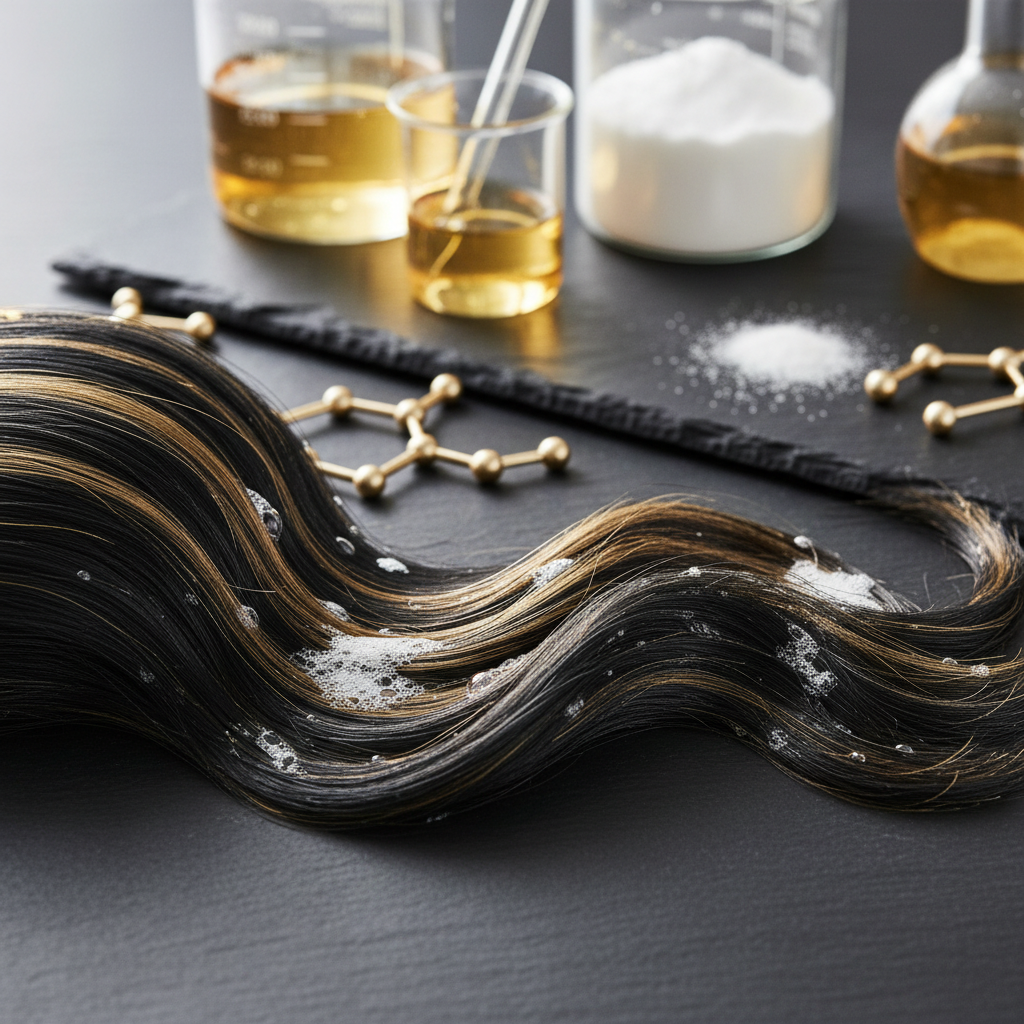
Surfactants possess an amphiphilic structure consisting of a water-loving (hydrophilic) polar head and an oil-loving (lipophilic) hydrocarbon tail. When introduced to water and agitated over the hair and scalp, surfactant molecules aggregate into spherical structures known as micelles once they surpass their critical micelle concentration (CMC). The lipophilic tails face inward, capturing non-polar sebum, styling polymers, and airborne particulates, while the hydrophilic heads face outward toward the rinse water. This mechanism allows insoluble oils to disperse into water and wash down the drain.
Peer-reviewed cosmetic chemistry shows that the charge of the surfactant determines its affinity for hair proteins. The hair fibre possesses an isoelectric point around pH 3.67. At standard shampoo pH levels (typically 4.5 to 6.5), hair maintains a net negative electrostatic charge. Anionic surfactants carry a negative charge and repel the negative fibre, which aids in washing away dirt without excessive residue. However, strong anionics can solubilise essential internal lipids within the cell membrane complex (CMC), which over time leads to fibre porosity and moisture loss.
 [ Hydrophilic Head ] (Water-attracting)
 |
 ~~~~~~~~~~~~~ (Lipophilic Tail / Oil-attracting)
 |
 Traps Sebum & Dirt Inside Micelle
Surfactant classes and their hair performance
Modern cosmetic formulating relies on combining multiple surfactant classes to balance cleansing efficiency, foam aesthetics, and scalp tolerability.
| Surfactant Class | Electrical Charge | Primary Mechanism | Cleansing Strength | Irritation Potential | Common Cosmetic Examples |
|---|---|---|---|---|---|
| Anionic | Negative (-) | Lifts heavy sebum and styling oils; creates rich lather | High | Moderate to High | Sodium Lauryl Sulfate, Sodium Laureth Sulfate, Sodium Cocoyl Isethionate |
| Amphoteric | Dual (+ / - depending on pH) | Buffers harshness; conditions while providing mild cleansing | Moderate | Low | Cocamidopropyl Betaine, Sodium Cocoamphoacetate |
| Non-ionic | Neutral (0) | Emulsifies oils gently without electrical interaction | Mild to Moderate | Very Low | Decyl Glucoside, Lauryl Glucoside, PEG-100 Stearate |
| Cationic | Positive (+) | Binds electrostatically to damaged keratin; conditions | Negligible | Low to Moderate (if unrinsed) | Behentrimonium Chloride, Cetrimonium Bromide |
Anionic surfactants
Anionics remain the backbone of clarifying and standard shampoos. Sulfated versions, such as sodium lauryl sulfate (SLS), exhibit exceptional detergency and high CMC values, yielding copious lather. However, their small molecular size allows them to penetrate the hair shaft and stratum corneum, which can lead to protein denaturation and scalp barrier disruption. Ethoxylated variants like sodium laureth sulfate (SLES) have larger molecular structures, making them significantly milder while retaining strong detergency. Gentler anionics, including sodium cocoyl isethionate and disodium laureth sulfosuccinate, clean efficiently while respecting the lipid envelope.
Amphoteric surfactants
Amphoterics possess both positive and negative charges depending on the formulation pH. At physiological skin and hair pH levels, they behave as mild zwitterions. Formulators blend amphoterics like cocamidopropyl betaine with anionics to form mixed micelles. These mixed micelles reduce the concentration of free surfactant monomers in the solution, dramatically decreasing irritation potential without diminishing cleaning ability.
Non-ionic surfactants
Non-ionics carry no electrical charge. Derived frequently from plant sugars and fatty alcohols (such as alkyl polyglucosides), these surfactants are largely unaffected by water hardness. Calcium and magnesium ions present in hard water do not bind to non-ionic heads, allowing them to lather and clean consistently across different water supplies. While they leave the hair cuticle smooth, their lather profile is typically denser and less expansive.
Cationic surfactants
Because cationics carry a positive charge, they adsorb directly onto the negatively charged damage sites of the cuticle. Due to this high affinity, they perform poorly as primary cleansers and are instead the cornerstone of conditioners and conditioning washes. They neutralise static electrical charges, smooth out raised cuticle scales, and reduce combing friction.
What the evidence does not show
Surfactant science in haircare is frequently misunderstood when consumers assess scalp disorders and shedding. The evidence does not show that surfactant choice directly causes or reverses non-scarring alopecia, such as androgenetic alopecia or telogen effluvium.
Follicles reside several millimetres beneath the skin surface within the dermis, well beyond the reach of standard topical cleansing agents. While an improperly rinsed or overly harsh surfactant can create contact dermatitis, skin flaking, or superficial barrier irritation, it does not alter androgen receptor activity or stop genetic thinning.
Similarly, the claim that sulfate-free formulations automatically prevent fibre damage is inaccurate. A poorly formulated sulfate-free product with an alkaline pH can cause more cuticle swelling and frictional breakage than a well-buffered, acidic shampoo containing mild sulfates paired with protective polymers and amphoterics. Cleanser efficacy depends entirely on overall formulation pH, active surfactant concentration, and polymer pairing, rather than the absence of a single chemical family.
Fibre impact: cuticle dynamics and lipid extraction
The outer cuticle acts as the protective casing of the hair fibre, comprising flattened, overlapping scales rich in cross-linked cysteine. Repeated exposure to surfactants with high detergency can strip both external 18-MEA and integral structural lipids like ceramides, cholesterol, and free fatty acids.
When structural lipids are stripped, water penetrates the hair cortex unchecked during washing, causing repeated swelling and contracting known as hygral fatigue. Furthermore, an alkaline wash environment (pH above 5.5) causes the cuticle scales to lift. If the scales lift during vigorous mechanical scrubbing, individual cuticle edges can chip and break off. This manifests visibly as dullness, tangling, static, and brittleness along the length of the shaft, which represents physical hair breakage rather than shedding from the root.
Practical application: selecting and managing cleansers
To maintain fibre integrity and scalp comfort, your washing technique and product selection should adapt to your personal sebum output and hair geometry.
- Check the formulation pH: Aim for shampoos balanced between pH 4.5 and 5.5. An acidic pH maintains the cuticle in a flattened, compact state, shielding the inner cortex and limiting surfactant penetration.
- Match cleansing power to hair type: Coarse, curly, or chemically processed hair has lower natural sebum distribution along the lengths and requires gentle, amphoteric-rich or non-ionic cleansers. Fine, straight hair accumulates sebum rapidly and benefits from mild anionic cleansers to prevent greasy buildup.
- Dilute and emulsify first: Rub the cleanser between wet hands before applying it directly to the roots. This disperses the surfactant monomers evenly, preventing local over-concentration on a single area of the scalp.
- Focus mechanically on the scalp: Cleanse the scalp where sebum and sweat concentrate. Allow the diluted foam to rinse through the lengths without scrubbing the ends, which preserves fragile cuticle lipids.
Scalp health and complementary support
A clean scalp environment provides the foundation for optimal hair growth conditions. Persistent accumulation of sebum, dead keratinocytes, and ambient grime creates an environment where Malassezia yeasts can flourish, potentially triggering seborrhoeic dermatitis and secondary hair shedding. Regular, balanced cleansing removes this organic debris before inflammatory cascades take hold.
For those experiencing thinning or excessive shedding alongside everyday cleansing concerns, Watermans offers targeted cosmetic haircare formulated to revitalise the scalp feel and support fibre strength. Products like Watermans Grow Me Shampoo blend gentle cleansing agents with caffeine, biotin, argan oil, and rosemary extract. This balanced approach cleanses the scalp effectively while delivering essential cosmetic conditioning agents directly to the hair shaft, reinforcing the hair against breakage without stripping away essential hydration.
When to seek professional advice
If you experience persistent scalp redness, intense itching, burning sensations, or thick, adherent silvery scaling, discontinue your current routine and consult a trichologist or dermatologist. These symptoms often indicate allergic contact dermatitis, scalp psoriasis, or severe seborrhoeic dermatitis rather than standard cosmetic dryness.
Similarly, if you observe sudden diffuse hair shedding exceeding 100 hairs per day over several weeks, or notice patchy bald spots, seek medical evaluation. These changes point toward physiological shedding triggers or follicular hair loss mechanisms that surfactant adjustments cannot resolve.
Frequently asked questions about surfactant science in haircare
What is the primary role of surfactant science in haircare products?
Surfactant science in haircare explains how cleansing compounds reduce surface tension to dissolve and rinse away insoluble sebum, dirt, and cosmetic build-up. It guides formulators in choosing molecular combinations that clear impurities while preserving the structural integrity and natural lipid barrier of the hair cuticle.
Can harsh surfactants cause permanent hair loss?
No. Harsh surfactants do not cause permanent hair loss or damage the hair follicle bulb deep within the skin. However, aggressive cleansing can dry out the hair shaft, leading to cuticle chipping, moisture loss, and physical breakage, which is often mistakenly identified as hair loss from the root.
Are sulfate-free shampoos always better for hair health?
Not necessarily. While sulfate-free shampoos often use milder amphoteric or non-ionic surfactants, the overall formula dictates hair health. A sulfate-free shampoo formulated at a high, alkaline pH can cause more cuticle disruption than an acidic, beautifully balanced shampoo that contains gentle, ethoxylated sulfates.
How do surfactants interact with hard water?
Certain anionic surfactants, particularly soap bases and unethoxylated molecules, bind with the dissolved calcium and magnesium ions in hard water. This reaction forms an insoluble precipitate often called soap scum, leaving hair feeling coated, dull, and prone to tangles. Non-ionic and amphoteric surfactants resist hard water minerals far better.
Why do some shampoos leave hair feeling rough after rinsing?
When strong anionic surfactants strip away surface oils and 18-MEA lipids without depositing conditioning agents, the cuticles experience high friction. The negative charges on individual hair fibres repel each other, while exposed cuticle scales catch during handling, creating a coarse, rough sensation until a conditioning cationic surfactant is applied.
The foundation of intelligent cleansing
Mastering surfactant science in haircare allows consumers and stylists to separate marketing trends from physical chemistry. Cleansing is fundamentally a balancing act between lifting unwanted sebum and protecting the vulnerable protein structure of the hair shaft. By selecting well-buffered products designed for your hair's specific porosity and cleansing needs, you protect cuticle health, limit preventable breakage, and maintain an optimal scalp environment for healthy-looking hair.
Sources and references
- Robbins, C. R. (2012). Chemical and Physical Behavior of Human Hair. 5th ed. Springer-Verlag.
- D'Souza, P., & Rathi, S. K. (2015). Shampoo and Conditioners: What a Dermatologist Should Know? Indian Journal of Dermatology, 60(3), 248-254.
- Gavazzoni Dias, M. F. (2015). Hair Cosmetics: An Overview. International Journal of Trichology, 7(1), 2-15.
- Trüeb, R. M. (2007). Shampoos: Ingredients, benefits and adverse effects. Journal of the German Society of Dermatology, 5(5), 356-365.
- Evans, T., & Wickett, R. R. (2012). Practical Modern Hair Science. Allured Business Media.