Sulphate-Free Shampoos and Scalp Health: The Dermatological Guide
9 min read ·
Explore the science of Sulphate-Free Shampoos and Scalp Health, detailing barrier function, surfactant chemistry, lipid balance, and signs of under-cleansing.
Quick answer: The relationship between Sulphate-Free Shampoos and Scalp Health centres on barrier preservation versus sebum removal. Sulphate-free cleansers use milder surfactants that reduce the risk of irritation, lipid stripping, and transepidermal water loss on sensitive or inflamed skin. However, their main limitation is reduced cleansing power. On oily or seborrhoeic scalps, inadequate removal of sebum and environmental residue can foster yeast overgrowth and worsen scalp conditions if not balanced correctly.
Key takeaways
- Sulphate surfactants, such as Sodium Lauryl Sulphate (SLS), effectively strip away oil but can disrupt the scalp's protective stratum corneum.
- Gentle surfactants like cocamidopropyl betaine, sodium cocoyl isethionate, and alkyl polyglucosides protect natural lipids and reduce cuticle friction.
- People with eczema, contact dermatitis, chemically processed hair, or sensitive skin usually experience noticeable comfort benefits from switching.
- Those with naturally high sebum output or chronic seborrhoeic dermatitis might experience product buildup and microfloral imbalance if their cleanser is too mild.
- Maintaining an optimal scalp surface pH between 4.5 and 5.5 is just as crucial for barrier integrity as eliminating sulphates.
Sulphate-Free Shampoos and Scalp Health: what the evidence shows
Evaluating Sulphate-Free Shampoos and Scalp Health requires examining how surfactants interact with the skin barrier. The scalp is an extension of the facial skin, complete with a dense network of sebaceous glands, a complex microbiome, and an acid mantle.
Traditional shampoos frequently rely on anionic surfactants like Sodium Lauryl Sulphate (SLS) and Sodium Laureth Sulphate (SLES). SLS has a high charge density and a small molecular structure. These attributes allow it to penetrate the outer layer of the stratum corneum, where it denatures structural proteins (keratin) and extracts intercellular lipids like ceramides, cholesterol, and free fatty acids. Dermatology research has long used SLS as a benchmark irritant to induce barrier disruption in patch testing. SLES is chemically ethoxylated to make it larger and significantly milder, yet it can still prove too drying for reactive skins when used daily.
In contrast, sulphate-free formulations substitute these compounds with gentler cleansing agents:
- Amphoteric surfactants: Cocamidopropyl betaine and disodium cocoamphodiacetate provide mild cleansing with low skin irritation potential.
- Non-ionic surfactants: Decyl glucoside, coco-glucoside, and lauryl glucoside are derived from plant sugars and fatty alcohols. They do not alter the electrical charge of the hair shaft and cause minimal barrier disturbance.
- Mild anionic surfactants: Sodium cocoyl isethionate ("baby foam"), sodium lauroyl sarcosinate, and disodium laureth sulfosuccinate cleanly lift sebum without aggressive protein denaturation.
By avoiding harsh cleansing mechanisms, sulphate-free options help maintain lipid integrity, minimise transepidermal water loss (TEWL), and prevent post-wash tightness, stinging, and redness.
| Surfactant Category | Common Examples | Cleansing Power | Irritation Potential | Ideal Scalp Profile |
|---|---|---|---|---|
| Primary Alkyl Sulphates | Sodium Lauryl Sulphate (SLS) | Very High | High | Rarely recommended for regular scalp care |
| Ethoxylated Sulphates | Sodium Laureth Sulphate (SLES) | High | Low to Moderate | Heavy sebum production, product buildup |
| Mild Anionics (Sulphate-Free) | Sodium Cocoyl Isethionate, Sodium Lauroyl Methyl Isethionate | Moderate to High | Low | Balanced, dry, coloured, or sensitive scalps |
| Amphoterics | Cocamidopropyl Betaine | Low to Moderate | Very Low | Sensitive skin, infant formulations |
| Non-ionics (Glucosides) | Decyl Glucoside, Coco-Glucoside | Low to Moderate | Extremely Low | Reactive skin, eczema-prone scalps |
What the evidence does not show
Marketing campaigns often make unsupported claims regarding sulphate-free products. Peer-reviewed research does not indicate that sulphates cause systemic toxicity or cancer in cosmetic concentrations. Regulatory bodies, including the Cosmetic Ingredient Review (CIR) and the European Commission's Scientific Committee on Consumer Safety, consider sulphates safe when formulated correctly and rinsed away.
Furthermore, sulphates do not cause follicular miniaturisation or pattern hair loss (androgenetic alopecia). While a severe, chronic contact allergy to a harsh surfactant can cause inflammation that triggers temporary telogen effluvium (excessive shedding), sulphates do not affect hormone receptors or disrupt the dermal papilla.
Equally, sulphate-free formulas are not automatically superior for every individual. The common belief that going sulphate-free cures every scalp ailment is inaccurate. In cases of seborrhoeic dermatitis, inadequate cleansing can actually trigger a flare-up.
The mechanism: surfactant action and the epidermal barrier
Surfactants are amphiphilic molecules possessing a hydrophilic (water-attracting) head and a lipophilic (oil-attracting) tail. During washing, the lipophilic tails bind to sebum, skin scales, and cosmetic residues, encapsulating them into structures called micelles. When you rinse, the hydrophilic heads face outward toward the water, allowing the entire complex to wash away.
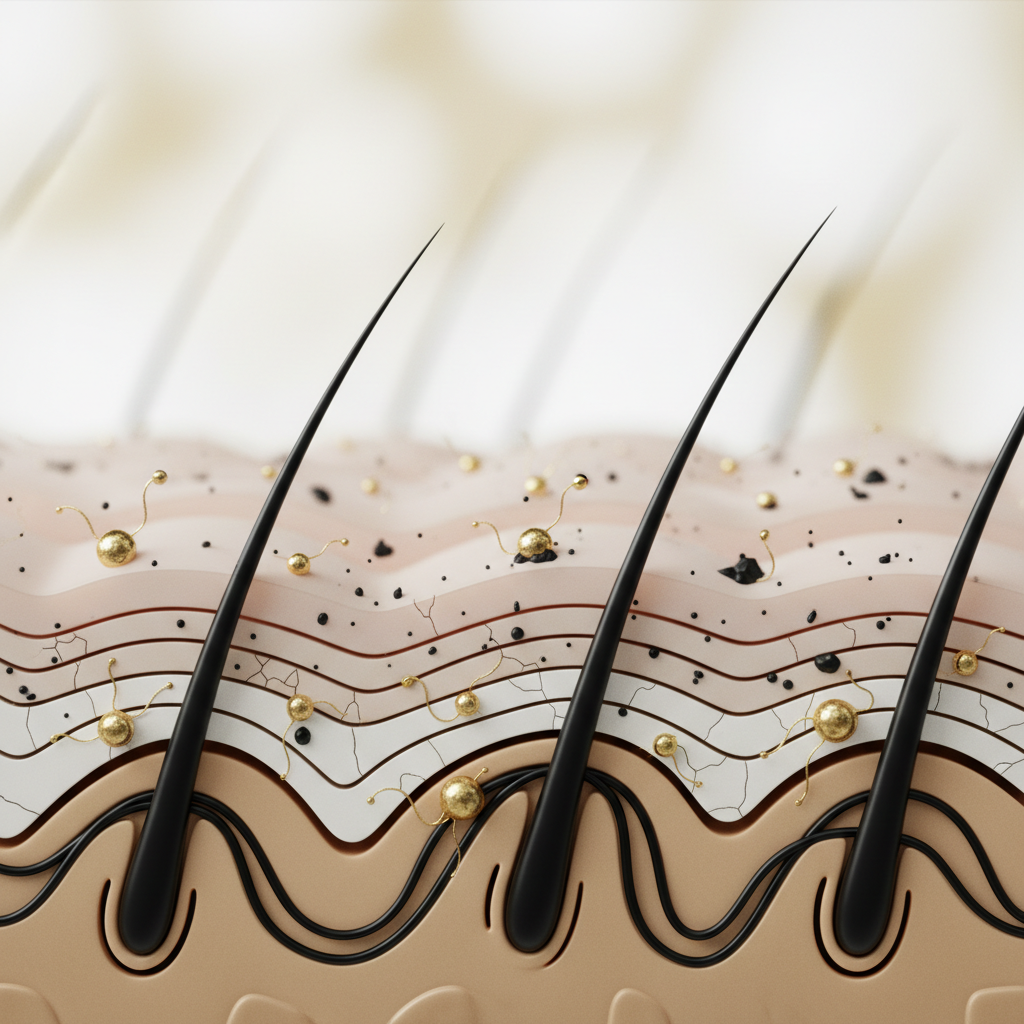
Harsh surfactants create problems through indiscriminate solubilisation. Beyond removing surface dirt, they dissolve the physiological lipid bilayers of the scalp. These intercellular lipids (comprising roughly 50% ceramides, 25% cholesterol, and 15% free fatty acids) act as the mortar between your skin cells, retaining water and barring allergens.
When these lipids wash away, the stratum corneum dries out, structural proteins stiffen, and microscopic fissures form. Environmental irritants and microorganisms can then penetrate the epidermal layers, sparking an inflammatory cascade. This triggers the release of pro-inflammatory cytokines like interleukin-1 alpha, causing itching, tightness, and visible flaking.
Sulphate-free alternatives feature larger micelle structures that cannot slip between the corneocytes as easily. They lift surface dirt without extracting essential structural lipids, leaving the acid mantle (ideally pH 4.5 to 5.5) intact.
Signs your scalp needs a sulphate-free formula
Consider switching to a milder cleansing routine if you regularly encounter:
- Persistent tightness, stinging, or burning within an hour of washing.
- Fine, dry, powdery flaking across the scalp accompanied by dry lengths.
- Increased redness, especially along the hairline and around the crown.
- Excessive hair breakage near the roots caused by the cuticle being repeatedly stripped of protective 18-methyleicosanoic acid (18-MEA).
- A flare-up of pre-existing atopic eczema or neurodermatitis.
When mild cleansing causes problems: the risk of under-washing
Sulphate-free options present one distinct challenge: under-cleansing.
The scalp is home to millions of micro-organisms, primarily Malassezia yeasts. These yeasts feed on the saturated fatty acids found in natural human sebum. If a mild surfactant fails to clear excess oil, dead skin cells, and cosmetic residues, Malassezia proliferates rapidly.
As Malassezia consumes sebum, it releases by-products like oleic acid. In susceptible individuals, this irritates the skin, accelerates epidermal turnover, and creates large, greasy, yellowish flakes. This condition, known as seborrhoeic dermatitis, is often mistaken for a dry scalp. Responding by switching to an even gentler shampoo or cutting back on washing only worsens the problem.
Individuals with oily hair, gym-goers who sweat frequently, and people who use heavy waxes or silicones often need stronger surfactant combinations or targeted clarifying washes to maintain scalp balance.
Practical steps for healthy washing
To support your scalp barrier without risking microbial overgrowth:
- Emulsify properly: Sulphate-free shampoos contain less aggressive lathering agents. Dispense the product onto wet palms and rub them together to create a lather before massaging it into your roots.
- Double cleanse: If you wash your hair only once or twice a week, perform two consecutive applications. The first round breaks down topical oils, while the second washes away loosened debris.
- Target the skin, not the hair: Concentrate the lather directly onto the scalp using your fingertips (never your fingernails). Let the suds naturally rinse down through the lengths without vigorously scrubbing the ends.
- Mind the water temperature: Hot water strips natural lipids and causes vasodilation, increasing scalp sensitivity. Keep the water lukewarm.
- Incorporate clarifying washes when needed: If you use styling products or live in a hard water area, wash with a slightly stronger clarifying formulation once every two to three weeks to prevent buildup.
When the cause is something else
Scalp irritation, itching, and hair shedding do not always stem from your shampoo. Several underlying factors share similar symptoms:
- Contact allergies: Fragrances, essential oils (such as tea tree, peppermint, or citrus oils), and preservatives (like methylisothiazolinone) trigger allergic contact dermatitis far more frequently than sulphates do.
- Internal deficiencies: Sudden telogen effluvium often traces back to low ferritin levels, vitamin D deficiency, thyroid dysfunction, or acute physiological stress.
- Microbial infections: Persistent red patches, severe scaling, or pustules can signal tinea capitis (fungal ringworm), psoriasis, or folliculitis, none of which can be resolved purely through cosmetic shampoo adjustments.
When to seek professional advice
Consult a GP, dermatologist, or qualified trichologist if you notice:
- Thick, silvery, adherent plaques that bleed when disturbed (indicative of scalp psoriasis).
- Tender, pus-filled bumps or painful inflamed areas around the hair follicles.
- Patchy hair loss or changes in the texture of newly growing strands.
- Flaking and itching that fail to improve after four weeks of using targeted anti-dandruff or sensitive-scalp products.
Targeted cosmetic care: the Watermans approach
For individuals wanting to maintain a clean, comfortable scalp without aggressive stripping, cosmetic formulation design is vital. Watermans develops hair care products that avoid harsh cleansing agents like SLS, relying instead on balanced systems that purify the scalp without drying out the skin barrier.
By combining gentle cleansing agents with functional ingredients such as biotin, rosemary extract, caffeine, and allantoin, Watermans formulations help keep the scalp clean and revitalised. This provides a supportive cosmetic environment that helps reduce breakage and leaves hair looking thicker and fuller.
Frequently asked questions about Sulphate-Free Shampoos and Scalp Health
Will switching to a sulphate-free shampoo stop my hair loss?
No. Sulphate-free shampoos cannot treat or cure pattern hair loss (androgenetic alopecia) or internal shedding conditions like telogen effluvium. They do, however, reduce friction and cuticle stripping. This helps prevent hair breakage along the shaft, helping your hair retain its natural density.
How do Sulphate-Free Shampoos and Scalp Health relate to dandruff?
Sulphate-Free Shampoos and Scalp Health are directly linked when managing flaking. If your flakes are caused by dryness and barrier irritation, a sulphate-free formula usually resolves the issue. However, if your flaking stems from seborrhoeic dermatitis caused by Malassezia yeast overgrowth, you may need an active antifungal ingredient rather than simply a gentler surfactant.
Why does my scalp feel oily after switching to a sulphate-free shampoo?
Mild surfactants do not strip sebum as aggressively as alkyl sulphates. If you have an oily scalp, you might notice an adjustment period where your hair feels heavier. Ensuring you emulsify the shampoo with plenty of water and double cleansing usually rectifies this issue.
Can sulphate-free shampoos lather as well as traditional formulas?
Yes, modern formulations using secondary surfactants like cocamidopropyl betaine and sodium lauroyl methyl isethionate can produce a rich, dense lather. While the foam structure feels slightly creamier than the light bubbles of SLS, it cleanses effectively without damaging your skin barrier.
Are sulphates completely safe to use on the scalp?
From a toxicological standpoint, sulphates are safe when used in consumer products. However, from a cosmetic standpoint, their strong degreasing properties can lead to dehydration, redness, and irritation for individuals with dry, sensitive, or eczema-prone scalps.
Summary on Sulphate-Free Shampoos and Scalp Health
Navigating Sulphate-Free Shampoos and Scalp Health comes down to balancing gentle care with thorough cleansing. While sulphate-free options are ideal for preventing lipid stripping and calming sensitive, dry, or chemically treated hair, they require mindful application to avoid sebum buildup. By matching your surfactant choices to your specific scalp type, sebum output, and styling routine, you can build a wash regimen that supports a calm, balanced skin barrier and healthier-looking hair.
Sources and references
- Cosmetic Ingredient Review (CIR). "Final Report on the Safety Assessment of Sodium Lauryl Sulfate and Ammonium Lauryl Sulfate." International Journal of Toxicology, 1983.
- European Commission Scientific Committee on Consumer Safety (SCCS). Opinions on Cosmetic Ingredients and Surfactant Safety, European Union.
- British Association of Dermatologists (BAD). "Seborrhoeic Dermatitis and Scalp Care Guidelines."
- National Health Service (NHS). "Contact Dermatitis: Causes and Treatments."
- Draelos, Z. D. "Essentials of Hair Care often Neglected: Hair Cleansing." International Journal of Trichology, 2010.
- Robbins, C. R. Chemical and Physical Behavior of Human Hair. 5th Edition, Springer, 2012.
Find these ingredients in Watermans products
- Vitamin D: you will find this ingredient in our Hair Vitamins.
- Oleic Acid: you will find this ingredient in our Camellia & Black Castor Hair & Body Oil.