Sulphate Free Shampoo Benefits: An Evidence-Based Guide
10 min read ·
Discover the scientifically proven Sulphate Free Shampoo Benefits, how gentle cleansers protect the hair cuticle, and what to expect when you switch your routine.
Quick answer: The primary Sulphate Free Shampoo Benefits centre on preserving the hair fibre's natural lipid layer, reducing scalp irritation, and preventing premature colour fade. Because sulphate-free cleansers use milder surfactants, they remove excess sebum and dirt without aggressively stripping moisture or eroding cosmetic colour pigments. However, their main limitation is cleaning power: they may struggle to clear heavy silicone buildup, intense mineral deposits from hard water, or severe seborrhoeic scale without repeated washing or clarifying treatments.
Key takeaways
- Sulphates like Sodium Lauryl Sulphate (SLS) are potent anionic detergents that can strip intercellular lipids and swell the hair cuticle.
- The most proven Sulphate Free Shampoo Benefits include prolonged colour retention, improved moisture in dry or textured hair, and fewer incidences of contact scalp dermatitis.
- Sulphate-free cleansers rely on gentler alternatives such as glucosides, isethionates, and betaines to lift grime without disrupting your scalp's acid mantle.
- Switching to sulphate-free formulas will not treat or reverse medical hair loss conditions like androgenetic alopecia or telogen effluvium, though it can curb fibre breakage.
- Those who use heavy styling waxes or water-insoluble silicones may require an occasional clarifying wash to prevent residue accumulation.
Sulphate Free Shampoo Benefits: what the evidence shows
When dermatologists and cosmetic chemists evaluate hair washing, the conversation always returns to surfactant strength. Sulphates, primarily Sodium Lauryl Sulphate (SLS) and Sodium Laureth Sulphate (SLES), have been cosmetic staples since the 1930s due to their low cost and high foam volume. However, peer-reviewed cosmetic science reveals distinct Sulphate Free Shampoo Benefits when replacing these harsh detergents with milder cleansers.
The primary benefit is the preservation of the lipid barrier. Natural sebum and the cell membrane complex (CMC) between cuticle scales keep the hair shaft flexible and hydrophobic. Strong sulphates denature keratin proteins and strip 18-methyleicosanoic acid (18-MEA), the outermost protective fatty acid on the cuticle. Sulphate-free formulations leave more of this hydrophobic shield intact, resulting in hair that feels softer and resists moisture loss in dry environments.
A second documented advantage is the preservation of artificial colour. Water exposure causes hair fibres to swell, letting dye molecules leach out. Sulphates amplify this process by raising cuticle scales and solubilising pigments. Clinical wash tests demonstrate that sulphate-free shampoos significantly slow down colour leaching, maintaining vibrancy across red, brunette, and pastel shades for multiple weeks longer than standard SLS-based formulas.
Finally, scalp barrier integrity improves markedly. For individuals with sensitive skin, atopic eczema, or mild scalp flaking, standard sulphates can irritate skin cells and trigger trans-epidermal water loss. Milder surfactants allow the stratum corneum to repair itself, calming itching and tightness.
| Feature | Standard Sulphate Formula (SLS/SLES) | Sulphate-Free Formula (Glucosides/Isethionates) |
|---|---|---|
| Detergency Level | High to aggressive; deep degreasing | Moderate; selective lipid removal |
| Cuticle Swelling | Significant swelling at neutral to alkaline pH | Minimal swelling; maintains cuticle alignment |
| Colour Retention | Rapid pigment leaching after 10 to 15 washes | Slower fading; preserves artificial pigment |
| Scalp Irritation Potential | Moderate to high (especially SLS) | Very low to negligible |
| Foam Characteristics | Dense, voluminous, quick flash-foam | Creamy, fine-bubbled, requires more water |
| Buildup Removal | Clears heavy resins, silicones, and waxes | May require double-cleansing for heavy polymers |
What the evidence does not show
It is vital to separate cosmetic benefits from medical claims. The beauty sector frequently markets sulphate-free formulas as a cure-all, but the evidence does not support several widespread assertions.
First, sulphates do not cause follicular hair loss or pattern baldness. Androgenetic alopecia is governed by genetics and dihydrotestosterone (DHT), while telogen effluvium stems from physiological shocks like severe illness, nutritional deficits, or stress. Shampoos wash the surface; they do not dictate follicular growth phases.
Second, sulphates are not toxic or carcinogenic at concentrations used in cosmetic products. Regulatory agencies including the UK Cosmetic, Toiletry and Perfumery Association (CTPA), the European Scientific Committee on Consumer Safety (SCCS), and the US Food and Drug Administration (FDA) have repeatedly affirmed that SLS and SLES are safe when formulated correctly. Their primary drawback is physical drying and cutaneous irritation, not systemic toxicity.
Third, sulphate-free shampoos do not eliminate the need for routine cleansing. Neglecting thorough scalp cleaning out of fear of sulphates can lead to a buildup of dead skin cells, malassezia yeast proliferation, and seborrhoeic dermatitis, which creates scalp inflammation that can worsen hair shedding.
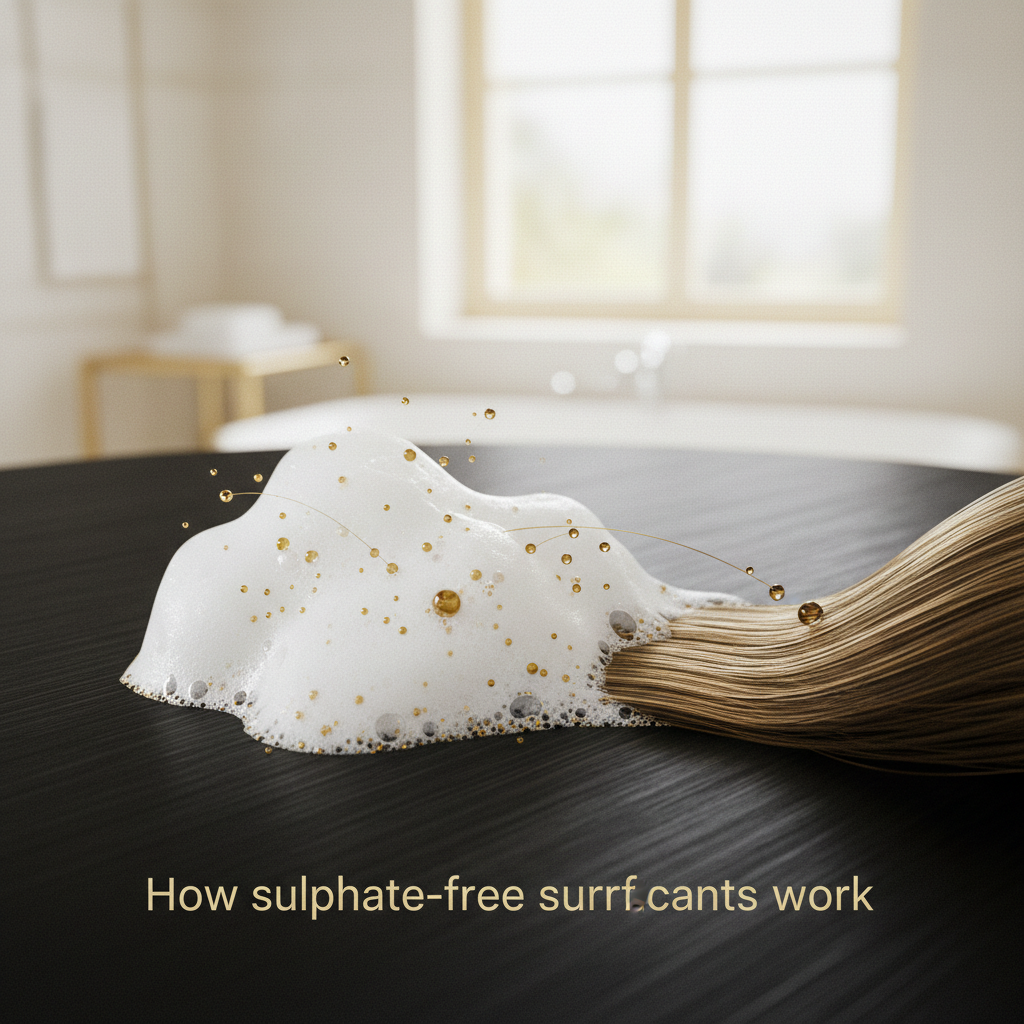
How sulphate-free surfactants work
Surfactants are amphiphilic molecules possessing a hydrophilic (water-loving) head and a lipophilic (oil-loving) tail. When you wash your hair, the lipophilic tail binds to sebum, dirt, and styling polymers, forming microscopic spheres called micelles. The hydrophilic head faces outward, allowing the micelle to be rinsed away in water.
Standard sulphates carry a negative electrical charge with a small molecular size. This allows them to penetrate into the intercellular spaces of both the cuticle and the scalp skin, stripping structural lipids and denaturing proteins.
In contrast, sulphate-free formulations substitute these aggressive salts with larger, non-ionic, amphoteric, or gentle anionic molecules:
- Alkyl Polyglucosides (such as Decyl Glucoside and Coco Glucoside): Non-ionic surfactants derived from plant sugars and fatty alcohols. They carry no electrical charge, cause exceptionally low irritation, and clean without roughing up the cuticle.
- Isethionates (such as Sodium Cocoyl Isethionate): Anionic surfactants known as "baby foam". Their bulky molecular structure prevents deep penetration into the stratum corneum, creating a rich lather while leaving skin proteins intact.
- Betaines and Sultaines (such as Cocamidopropyl Betaine): Amphoteric surfactants that adapt their charge based on the formulation's pH. They buffer the cleansing action, boost foam stability, and condition the hair fibre.
Because these alternative molecules do not aggressively dissolve all natural oils, the hair cuticle remains flatter, reflecting light better and tangling less.
Signs your hair needs a sulphate-free routine
Your hair fibre and scalp provide clear physical indicators when a cleansing routine is overly aggressive. You may benefit from switching if you notice:
- Persistent mid-shaft breakage: Snapping hair fibres, split ends, and a rough, velcro-like texture when wet often indicate that the CMC has been depleted by harsh detergents.
- Accelerated colour loss: If your salon colour loses tone and saturation within three or four washes, surfactant-induced cuticle lifting is usually the cause.
- Scalp tightness or itching after washing: A prickly, dry, or taut scalp within hours of showering indicates that your cutaneous barrier is losing water faster than it can replenish it.
- High porosity or natural curl patterns: Curly, coily, and kinky hair types (types 3 and 4) have fewer cuticle layers at bend points and naturally lower sebum distribution along the shaft. Sulphates strip the little moisture these patterns retain, causing extreme frizz.
What you can do: establishing a balanced routine
Transitioning to a sulphate-free regimen requires slight adjustments in technique to maximise cleansing efficiency without drying the hair.
- Saturate completely before applying: Sulphate-free surfactants require ample water rather than raw product to activate. Drench your scalp thoroughly for at least two minutes under warm running water before dispensing shampoo.
- Focus purely on the scalp: Dispense a 50-pence-sized amount into your palms, emulsify, and massage directly onto the scalp using the pads of your fingers. Do not gather the lengths of your hair onto the crown to scrub, as the lather running down during rinsing is plenty to cleanse the mid-lengths and ends.
- Double-cleanse when needed: If you wash your hair only once or twice a week, the first application of a gentle cleanser might not produce much foam because it is busy binding to oil. Rinse and apply a second, smaller dab to generate a richer lather and ensure complete removal of debris.
- Clarify periodically: If you use silicone serums, heavy oils, or live in a hard water area with high calcium carbonate, use a chelating or gentle clarifying shampoo every three to four weeks to prevent dulling mineral and product residue.
When the cause may be something else
If your hair remains brittle, lifeless, or shedding heavily despite switching to mild cleansers, the root cause rarely sits in your shampoo bottle.
True hair shedding, where hairs fall out from the follicle with the white bulb attached, points toward biological triggers. Thyroid dysfunction (hypothyroidism or hyperthyroidism), ferritin deficiencies, rapid weight loss, hormonal shifts (such as postpartum or perimenopause), and high fevers can disrupt the normal hair growth cycle.
Similarly, severe scalp scaling accompanied by thick yellow crusts, intense burning, or patchy red plaques is more likely seborrhoeic dermatitis or scalp psoriasis. These conditions require medicated, targeted shampoos containing zinc pyrithione, ketoconazole, or coal tar, which work fundamentally differently from ordinary cosmetic shampoos.
The Watermans approach
For those seeking Sulphate Free Shampoo Benefits alongside evidence-based follicle support, formulation design is everything. Watermans GrowMe Shampoo is formulated entirely without sulphates, ensuring that the hair cuticle remains smooth and protected against unnecessary breakage while preserving natural moisture levels.
Instead of stripping detergents, it pairs mild cleansing agents with targeted, functional ingredients such as biotin, caffeine, rosemary extract, niacinamide, and argan oil. This approach ensures the scalp environment is cleansed, balanced, and invigorated without causing the dryness, cuticle friction, or pigment loss associated with standard foaming agents.
Frequently asked questions about Sulphate Free Shampoo Benefits
What are the main Sulphate Free Shampoo Benefits for colour-treated hair?
The biggest advantage for coloured hair is prolonged pigment retention. Harsh sulphates raise the cuticle scales and strip the natural lipid film, allowing synthetic colour molecules to rinse away quickly. Sulphate-free shampoos wash with larger, gentler surfactant molecules that clean the fibre while keeping the cuticle flatter, which locks in colour tones and prevents premature fading across multiple weeks of washing.
Do sulphate-free shampoos cause product buildup on the scalp?
They do not inherently cause buildup, but they have a lower capacity to dissolve heavy, water-insoluble silicones and dense petroleum-based styling waxes. If your routine includes heavy styling products, a gentle sulphate-free wash might leave remnants behind over time. You can prevent this by selecting water-soluble styling products or using a dedicated clarifying wash once every three to four weeks.
Can switching to a sulphate-free shampoo stop hair loss?
No, switching shampoos cannot treat follicular hair loss such as genetic male or female pattern baldness. However, Sulphate Free Shampoo Benefits include reducing fibre brittleness and friction. By keeping the hair shaft hydrated and the cuticle intact, it significantly reduces breakage and snapping along the shaft, which often gives the visual appearance of thicker, fuller, and healthier hair.
Why does sulphate-free shampoo foam less than regular shampoo?
Sulphate-free formulas rely on non-ionic and amphoteric cleansers like glucosides and betaines. These molecules do not generate the rapid, voluminous, large-bubbled lather associated with SLS. The smaller, creamier foam cleans just as effectively by lifting oils into micelles, but it requires thorough water saturation to spread evenly across the scalp.
Is a sulphate-free shampoo suitable for very oily hair?
Yes, but you may need to adjust your technique. Extremely oily scalps produce high levels of sebum that can exhaust gentle surfactants quickly. If you have an oily scalp, double-cleansing with your sulphate-free formula will lift the heavy oil on the first pass and cleanse the scalp skin on the second, without triggering the rebound dryness that harsh sulphates can cause.
Conclusion
Understanding the true Sulphate Free Shampoo Benefits allows you to make informed decisions based on cosmetic chemistry rather than marketing trends. By trading harsh detergents for balanced, non-stripping cleansers, you protect the cuticle, prolong cosmetic colour, and support the scalp's protective barrier. While they are not a medical cure for genetic hair loss, sulphate-free formulations offer a scientifically sound foundation for keeping hair fibres resilient, moisturised, and structurally sound.
Sources and references
- European Commission: Scientific Committee on Consumer Safety (SCCS), Opinion on Sodium Lauryl Sulfate, 2010.
- Cosmetic Ingredient Review (CIR), Safety Assessment of Alkyl Polyglucosides as Used in Cosmetics, 2013.
- International Journal of Trichology, Shampoos and Conditioners: What Every Dermatologist Should Know, 2015.
- Journal of the American College of Toxicology, Final Report on the Safety Assessment of Sodium Lauryl Sulfate and Ammonium Lauryl Sulfate, 1983.
- British Association of Dermatologists, Contact Dermatitis and Scalp Reactions to Surfactants Guidelines, 2019.
Find these ingredients in Watermans products
- Zinc: you will find this ingredient in our Hair Vitamins.
- Niacinamide: you will find this ingredient in our Hair Mask.