Sulfate vs Sulfate Free Shampoo: The Evidence-Based Guide
10 min read ·
Understand the science of Sulfate vs Sulfate Free Shampoo. Learn how surfactants affect hair lipids, scalp health, colour retention, and mechanical breakage.
Quick answer: The debate over Sulfate vs Sulfate Free Shampoo centres on cleansing intensity and scalp compatibility. Sulfates are potent anionic surfactants that efficiently dissolve sebum and product build-up, but they can strip natural lipids and exacerbate dryness or colour fade. Sulfate-free formulas use milder non-ionic or amphoteric surfactants that preserve the hair fibre's moisture barrier and artificial pigments. However, their main limitation is that very oily scalps or heavy styling product users may experience inadequate cleansing, leading to residue accumulation over time.
Key takeaways
- Sulfates (such as Sodium Lauryl Sulfate and Sodium Laureth Sulfate) are primary anionic surfactants designed to lower water surface tension and emulsify heavy oils.
- Sulfate-free alternatives rely on gentler cleansing agents such as glucosides, isethionates, and betaines to clean without stripping essential structural lipids.
- Sulfates do not cause follicular hair loss or alopecia; their primary risk is surface dehydration, cuticle friction, and potential scalp barrier irritation.
- Coloured, chemically processed, dry, curly, or afro-textured hair benefits most from sulfate-free cleansing due to a naturally fragile lipid layer.
- An oily scalp or frequent use of water-insoluble silicones may require an occasional clarifying sulfate wash to prevent follicular occlusion and sebum oxidation.
Sulfate vs Sulfate Free Shampoo: what the evidence shows
The debate over Sulfate vs Sulfate Free Shampoo often polarises consumers, but cosmetic chemistry provides clear criteria for choosing between them. Sulfates were introduced into personal care formulations in the 1930s to replace traditional animal-fat soaps, which formed insoluble curd in hard water. Chemically, standard sulfates such as Sodium Lauryl Sulfate (SLS) and Sodium Laureth Sulfate (SLES) possess a small, negatively charged head group and a lipophilic hydrocarbon tail. This compact molecular structure allows them to penetrate sebum deposits rapidly, yielding high foam volume and aggressive detergent activity.
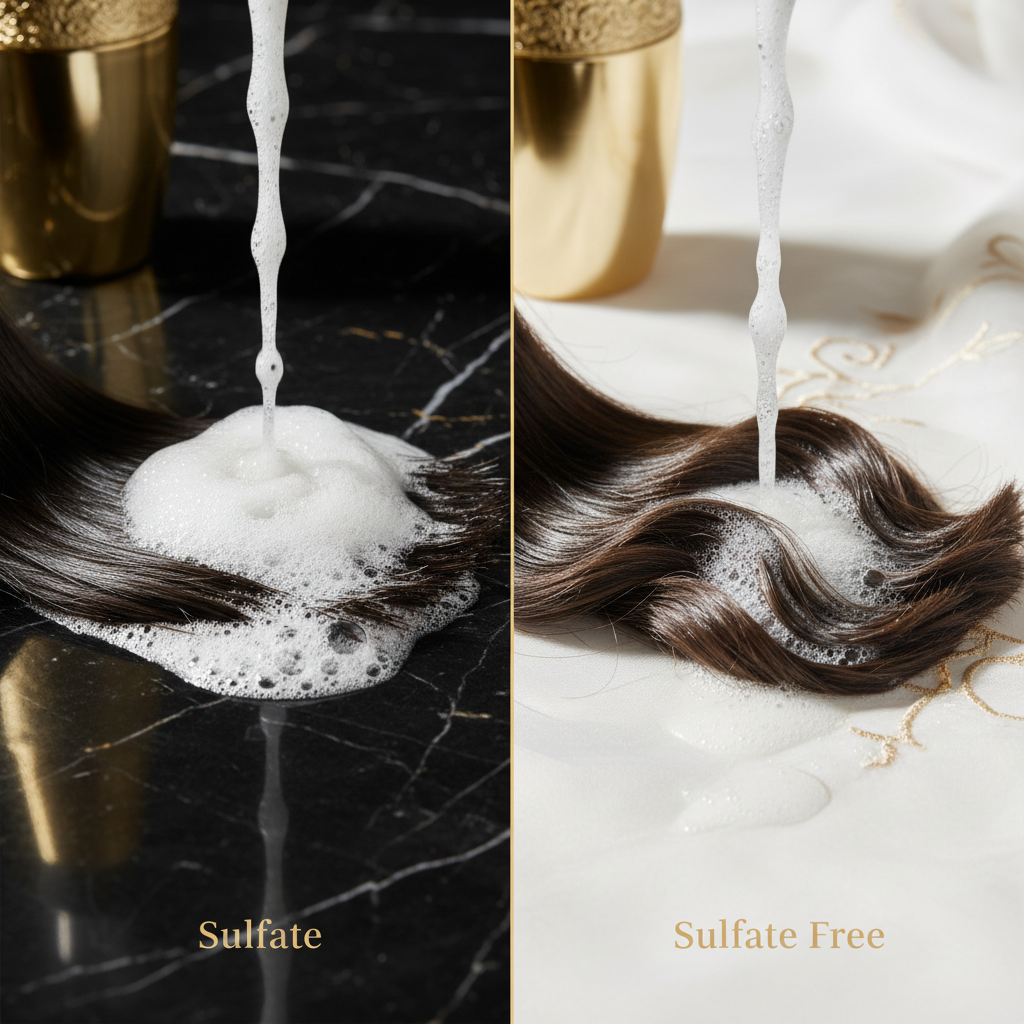
Peer-reviewed dermatological evaluations demonstrate that SLS has a significant capacity to disrupt the stratum corneum. It inserts itself into the lipid bilayers of the scalp skin, solubilising ceramides, cholesterol, and free fatty acids. This action temporarily raises transepidermal water loss (TEWL) and can induce skin erythema in sensitive individuals. SLES is chemically modified through ethoxylation to introduce ether chains, making the molecule bulkier and noticeably less irritating to human skin, yet it remains an exceptionally thorough detergent.
In contrast, sulfate-free shampoos replace these aggressive anionic agents with milder options, including alkyl polyglucosides (such as Coco-Glucoside), acyl isethionates (such as Sodium Cocoyl Isethionate), and amphoteric surfactants (such as Cocamidopropyl Betaine). These alternatives have larger, more complex molecular geometries. They form larger micelles in aqueous solutions, preventing the surfactant from penetrating deeply into the stratum corneum or the internal cortex of the hair strand. As a result, hair washed with sulfate-free formulas retains more of its 18-methyleicosanoic acid (18-MEA), the integral surface lipid layer that keeps cuticles flat, hydrophobic, and smooth.
The biochemical mechanism: cleansing vs stripping
Surfactants work by concentrating at the interface between oil and water. The hydrophobic tail binds to sebum, dirt, and styling polymers, while the hydrophilic head aligns with rinse water. When you rinse your hair, these micelles roll away from the scalp and hair shaft, suspending the debris in water.
Because the hair fibre is composed of dead, non-regenerative keratinised protein cells, it cannot repair itself from within once its protective coating is damaged. The outermost surface of an undamaged hair cuticle is naturally hydrophobic, repelling water while holding interior moisture intact.
When you use a high-pH or highly concentrated sulfate wash, the surfactant lifts the cuticular scales. It dissolves not only exogenous grime, but also the structural cell membrane complex (CMC) and endogenous intercellular lipids. Over repeated wash cycles, this removal of natural fats leaves the cuticular edges jagged. Friction between neighbouring strands increases, leading directly to mechanical breakage, tangles, split ends, and accelerated colour leaching.
Sulfate-free surfactants operate on the same micellar principles but exhibit a much lower critical micelle concentration (CMC) and a gentler charge profile. They selectively loosen surface grease without leaching out the structural lipids tucked between the overlapping cuticular layers.
Comparison: Sulfate vs Sulfate Free Shampoo
| Feature | Sulfate Shampoo (e.g., SLS, SLES, ALS) | Sulfate-Free Shampoo (e.g., Glucosides, Isethionates) |
|---|---|---|
| Primary Surfactants | Sodium Lauryl Sulfate, Sodium Laureth Sulfate, Ammonium Lauryl Sulfate | Sodium Cocoyl Isethionate, Coco-Glucoside, Decyl Glucoside, Sodium Lauroyl Sarcosinate |
| Cleansing Power | Very high; fully dissolves mineral oils, waxes, and heavy sebum | Moderate to high; cleanses physiological oils while leaving protective lipids intact |
| Lather Profile | Dense, instantaneous, highly stable micro-foam | Variable; creamy lather or lighter macro-foam depending on secondary surfactants |
| Impact on Hair Cuticle | High swelling; can strip the 18-MEA lipid layer and elevate cuticular friction | Low swelling; preserves the protective cuticle seal and minimises friction |
| Colour Retention | Accelerates dye molecule loss through expanded cuticular scales | Prolongs artificial colour vibrancy by keeping cuticle scales compressed |
| Scalp Tolerance | Can trigger TEWL, irritation, and dryness in sensitive or reactive scalps | Well-tolerated by dry, sensitive, eczema-prone, or post-procedure scalps |
| Risk of Build-up | Negligible; leaves virtually no organic residue behind | Low to moderate if paired with water-insoluble silicones and soft water |
What the evidence does not show: myths versus scientific reality
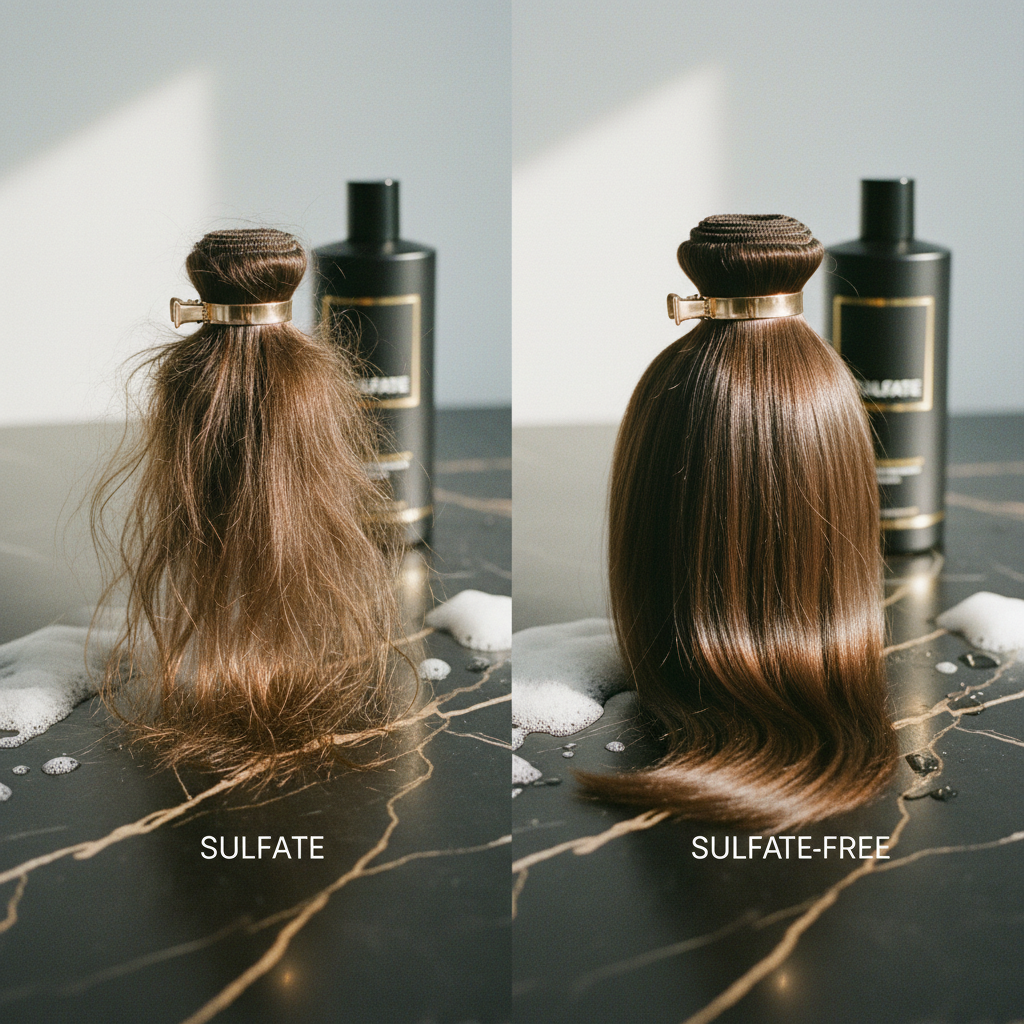
A widespread misconception across salon culture and online media is that sulfates cause true hair loss (alopecia). There is no controlled clinical evidence demonstrating that sulfates miniaturise hair follicles, cause androgenetic alopecia, or trigger telogen effluvium. The primary risk of harsh sulfate formulas on the hair fibre is physical breakage along the shaft caused by extreme moisture depletion and increased surface roughness, which is fundamentally distinct from follicular shedding.
Another myth is that sulfates are toxic or carcinogenic when applied topically in personal care products. Comprehensive safety reviews conducted by the Cosmetic Ingredient Review (CIR) Expert Panel and the Scientific Committee on Consumer Safety (SCCS) have repeatedly deemed SLES and SLS safe for rinse-off applications at typical consumer concentrations (usually between 5% and 15%). The concern with sulfates is not systemic toxicity, but rather local dermatological barrier disruption and cosmetic hair weathering.
Conversely, marketing teams often present sulfate-free formulations as intrinsically hypoallergenic or natural. This is scientifically inaccurate. Milder surfactants such as Cocamidopropyl Betaine and various alkyl glucosides can still provoke contact dermatitis in sensitised individuals. The term "sulfate-free" simply denotes the absence of specific sulfuric acid salts, not the total absence of allergens or synthetic processing.
Assessing your hair and scalp needs
Choosing where you stand in the Sulfate vs Sulfate Free Shampoo decision depends on three variables: your scalp profile, your hair's structural integrity, and your styling habits.
Scalp conditions
- Seborrheic dermatitis or hyper-seborrhea: Individuals producing heavy sebum (characterised by oily roots within 12 to 24 hours of washing) often benefit from the stronger detergency of sulfates. Malassezia yeast feeds on unremoved sebum lipids, which can aggravate flaking and inflammation.
- Sensitive, dry, or irritated scalps: If your skin is prone to tightness, itching, contact dermatitis, or psoriasis, sulfate-free cleansers help safeguard your fragile epidermal moisture barrier.
Hair fibre state
- Bleached, coloured, or chemically straightened hair: The bleaching and lifting process already strips up to 80% of hair's natural 18-MEA. Using sulfates on porous, chemically treated fibres leads to rapid colour fading and brittle breakage. Sulfate-free formulations protect internal moisture in these fragile strands.
- Curly, coily, and afro-textured hair: Natural sebum travels slowly down spiralled and textured hair shafts, leaving the mid-lengths and ends inherently dry. Sulfate-free formulas cleanse without draining these fibres of essential moisture.
- Fine, straight, virgin hair: Virgin hair with intact cuticles is mechanically resilient and may become weighed down quickly by the gentler emollients found in some sulfate-free products. A mild sulfate shampoo may deliver preferred volume and lightness.
Practical steps for balancing cleansing performance
You do not necessarily have to commit exclusively to one cleansing method. Many hair professionals advocate for an intentional hybrid approach based on hair cycling:
- Adopt sulfate-free cleansing for daily or regular washes: Use a rich, sulfate-free shampoo as your default wash. Massage the formula directly into your scalp with your fingertips for at least 60 seconds. Because sulfate-free surfactants possess lower cleansing power, mechanical friction is necessary to dislodge trapped dirt and sebum.
- Introduce an occasional clarifying wash: If you regularly use styling clays, heavy waxes, or water-insoluble silicones (such as Dimethicone), a clarifying shampoo containing sulfates once every 10 to 14 days will purge stubborn residue and prevent occlusive build-up.
- Optimise your water temperature: Wash your hair with lukewarm water (roughly 37°C to 38°C). Excessively hot water swells the hair fibre and strips lipids regardless of surfactant choice, whereas cold water prevents surfactants from properly emulsifying sebum.
- Follow with balanced conditioning: Conditioners replenish lost external lipids, flatten the cuticle scales with cationic surfactants, and restore the fibre to an optimal acidic pH (between 4.5 and 5.5).
Supporting hair health with Watermans
If you decide that a milder, non-stripping approach suits your hair routine, Watermans provides carefully balanced options designed to respect both hair structure and scalp comfort. Watermans GrowMe Shampoo is formulated without harsh sulfates, relying instead on gentler cleansing agents combined with functional cosmetic ingredients such as biotin, rosemary extract, caffeine, and argan oil.
This profile allows you to cleanse the scalp thoroughly without stripping the natural lipid barrier or accelerating cuticular friction. The formula creates an ideal cosmetic environment for stronger-feeling strands, improved hair density appearance, and reduced mechanical breakage during washing and styling.
When to seek medical advice
While switching shampoos can improve dry, brittle lengths and ease mild scalp tightness, cosmetic surfactants cannot cure medical skin conditions or treat hair thinning.
Consult a GP or registered trichologist if you encounter:
- Severe, persistent scalp erythema (redness), scaling, or thick, crusty plaques that do not respond to over-the-counter care.
- Sudden, patchy hair loss (such as coin-shaped bare spots indicative of alopecia areata).
- Diffuse, widespread shedding where more than 100 to 150 hairs fall out daily for longer than two months.
- Intense burning, pain, or fluid-filled pustules along the hairline or crown.
Surfactant formulations alter hair hygiene and cosmetic texture, but persistent medical signs require clinical diagnosis, prescription anti-fungal treatments, or dermatological intervention.
Frequently asked questions about Sulfate vs Sulfate Free Shampoo
Does a sulfate-free shampoo lather as well as a regular shampoo?
Generally, no. Sulfate-free shampoos produce a softer, less voluminous lather because their surfactants create larger micellar clusters. However, lather volume is merely a sensory indicator, not a measure of cleansing effectiveness. Modern sulfate-free formulas clean the hair thoroughly through mechanical massage and gentle surfactant dispersion, without needing a towering wall of bubbles.
When comparing Sulfate vs Sulfate Free Shampoo, which is better for hair colour?
Sulfate-free shampoo is substantially better for colour-treated hair. Sulfates raise the cuticular scales of the hair shaft and solubilise the surface lipids, allowing water-soluble artificial dye molecules to escape easily during rinsing. Sulfate-free alternatives maintain a tighter, flatter cuticle, which preserves colour vibrancy and extends the life of salon tints.
Can using a sulfate-free shampoo cause product build-up?
Yes, it can. Some gentle surfactants struggle to dissolve heavy styling resins, natural waxes, and water-insoluble silicones. Over several weeks, these residues can form an occlusive film on the hair shaft, making lengths look limp and dull. If you use styling products heavily, an occasional clarifying wash will clear this accumulation.
Why does my hair feel greasy after switching to sulfate-free shampoo?
This common transition period occurs because your scalp is accustomed to high-detergency stripping and may continue producing normal sebum levels. Additionally, sulfate-free shampoos require more mechanical scalp massage and water to disperse effectively. Spending an extra minute massaging the roots with warm water usually resolves any lingering greasy feeling.
Choosing the right balance for your hair
Navigating the choice between Sulfate vs Sulfate Free Shampoo ultimately comes down to diagnosing your specific scalp chemistry and styling demands. Sulfates remain safe, useful cosmetic detergents when you need high-power degreasing or clarifying to clear heavy cosmetic residues and stubborn sebum. However, for everyday cleansing, delicate colour-treated strands, dry textures, and vulnerable scalp barriers, sulfate-free cleansers provide a protective, low-friction wash that supports long-term fibre integrity. Tailoring your wash routine to your personal hair biology ensures you keep your scalp refreshed without compromising the health of your lengths.
Sources and references
- Cosmetic Ingredient Review (CIR) Expert Panel. (2010). Final Report on the Safety Assessment of Sodium Laureth Sulfate and Related Salts of Sulfated Ethoxylated Alcohols. International Journal of Toxicology.
- Scientific Committee on Consumer Safety (SCCS). (2012). Opinion on Sodium Lauryl Sulfate. European Commission Directorate-General for Health and Consumers.
- Robbins, C. R. (2012). Chemical and Physical Behavior of Human Hair (5th ed.). Springer-Verlag.
- Draelos, Z. D. (2010). Essentials of Hair Care often Neglected: Hair Cleansing and Conditioning. Dermatologic Clinics, 28(3), 479-486.
- Gavazzoni Dias, M. F. (2015). Hair Cosmetics: An Overview. International Journal of Trichology, 7(1), 2-15.
Find these ingredients in Watermans products
- Biotin: you will find this ingredient in our Hair Growth Shampoo.