The Structure of Human Hair Keratin: Architecture, Chemistry, and Resilience
9 min read ·
Explore the structure of human hair keratin, from alpha-helical intermediate filaments to disulphide bonds, and learn how to protect your hair's strength.
Quick answer: The Structure of Human Hair Keratin refers to the complex arrangement of fibrous, insoluble proteins that make up roughly 65% to 95% of the hair fibre's total weight. At its core, it consists of alpha-helical protein chains organised into intermediate filaments, embedded within an amorphous, sulphur-rich matrix. While this architecture gives hair remarkable tensile strength, elasticity, and chemical resilience, topically applied keratin products cannot biologically regenerate or permanently rebuild fractured alpha-helices once internal bonds are destroyed.
Key takeaways
- Keratin proteins account for up to 90% of dry hair weight, held together by chemical bonds including disulphide bridges, salt linkages, and hydrogen bonds.
- The fundamental structural unit is the alpha-helix, which coils into coiled coils, protofilaments, and eventually intermediate filaments (microfibrils).
- Hair keratin falls into two distinct biochemical groups: low-sulphur intermediate filament proteins (which provide tensile elasticity) and high-sulphur matrix proteins (which act as a rigid cement).
- Cystine content is uniquely high in hair, providing the covalent disulphide bonds that dictate mechanical durability and chemical resistance.
- Surface treatments with hydrolysed proteins temporarily patch damaged cuticle gaps, but they cannot reconstruct the internal intermediate filament matrix.
The Structure of Human Hair Keratin: what the evidence shows
Biochemical analysis confirms that human hair keratin is not a single protein, but a family of fibrous proteins classified under the intermediate filament superfamily. Within the hair follicle, epithelial cells synthesise two main types of keratin: type I (acidic) and type II (basic to neutral). These proteins combine in strictly equimolar ratios to form heterodimers, the primary building blocks of the cortex.
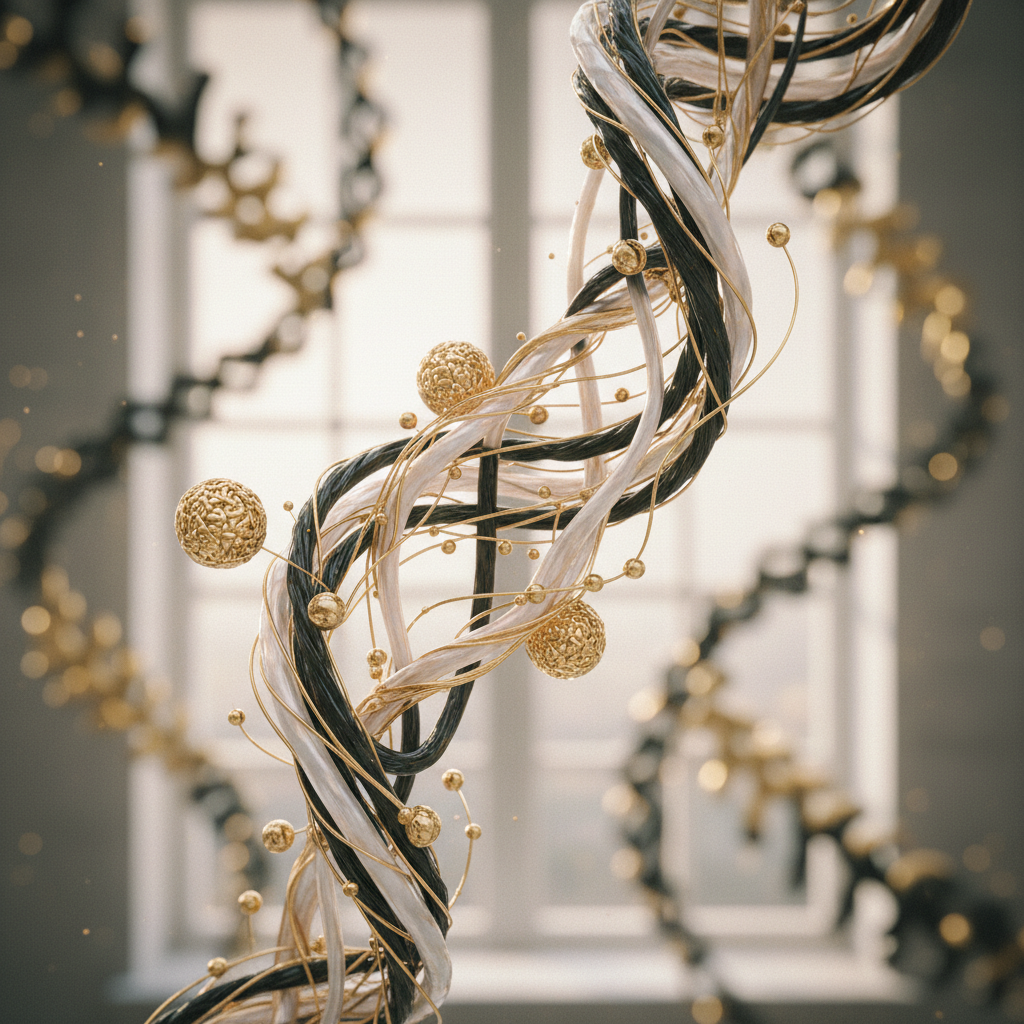
The cortex makes up approximately 80% to 90% of the hair shaft's volume. Electron microscopy and X-ray diffraction reveal that inside cortical cells, alpha-keratin chains twist together in a right-handed alpha-helix. Two of these helices twist into a left-handed coiled-coil dimer. Pairs of dimers align head-to-tail and side-by-side to produce protofilaments (roughly 2 nanometres in diameter). Finally, eight protofilaments assemble into an intermediate filament (formerly termed a microfibril), measuring about 7 to 8 nanometres across.
These ordered filaments do not float freely. They are embedded inside an amorphous, non-filamentous ground substance known as the interfilamentous matrix. This matrix consists of keratin-associated proteins (KAPs), which are extraordinarily rich in the amino acid cysteine, alongside glycine and tyrosine. The combination creates a composite material comparable to steel rods embedded in reinforced concrete.
Amino acid composition of hair keratin
Hair keratin contains 18 different amino acids. Unlike structural proteins such as collagen, which rely heavily on glycine and proline, human hair keratin is defined by an unusually high concentration of cysteine, typically between 14% and 18% of total amino acid content.
When two cysteine molecules oxidise during keratinisation in the follicle, they form a covalent bond known as cystine. This disulphide cross-link is exceptionally stable. It resists degradation by heat, water, and mild acids, giving hair fibres the physical strength required to withstand everyday mechanical grooming.
| Structural Component | Protein Type | Primary Function | Key Chemical Characteristic |
|---|---|---|---|
| Intermediate Filaments (Microfibrils) | Type I (acidic) and Type II (basic) keratin | Elasticity, elongation, tensile strength | Low sulphur, high alpha-helical content |
| Interfilamentous Matrix | Keratin-Associated Proteins (KAPs) | Rigidity, torsional stability, matrix density | High sulphur (cysteine) and high glycine-tyrosine |
| Cuticle Beta-Layer | Keratin and lipid-rich membrane | Barrier protection, hydrophobic surface | Contains 18-methyleicosanoic acid (18-MEA) |
| Macrofibrils | Aggregated intermediate filaments | Structural bulk of the hair cortex | Bundled arrays packed into cortical cells |
What the evidence does not show: myths about rebuilding keratin
Laboratory evidence clearly demonstrates that mature hair is non-living, biologically dead tissue. Once a hair emerges from the scalp, cellular synthesis of keratin stops. Despite pervasive commercial claims, topical haircare products cannot "rebuild" or "regrow" missing keratin chains within the cortex.
Hydrolysed keratin proteins found in conditioners and masks have molecular weights typically ranging from 500 to 3,000 Daltons. While small peptides can penetrate the upper cuticle layers and temporarily swell the outer shaft, they cannot align into the precise crystallographic lattice of native alpha-helical intermediate filaments. They act as temporary conditioning agents, reducing porosity and improving combing forces, rather than biological cures for internal breakage.
Furthermore, thermal keratin smoothing treatments do not restore natural protein architecture. Most salon smoothing processes rely on breaking disulphide bonds chemically, coating the hair in reactive aldehydes or glyoxylic acid derivatives, and sealing the surface flat using high heat (often 200°C to 230°C). While the hair appears glossy and aligned, the internal structural integrity of the natural keratin is often weakened by the intense thermal processing.
The mechanical and chemical bonds within hair keratin
Understanding the behaviour of hair under stress requires looking at the three types of chemical bonds that stabilise keratin:
- Disulphide bonds: Strong, covalent chemical bonds formed between sulphur atoms on adjacent cystine residues. They account for roughly one-third of the fibre's overall strength and cannot be broken by water. Only alkaline reducing agents (such as ammonium thioglycolate in perms) or strong oxidisers (such as hydrogen peroxide in bleaching) sever them.
- Salt linkages (ionic bonds): Formed between the positive amino groups and negative carboxylic acid groups of neighbouring amino acid side chains. These bonds depend directly on pH. Normal hair maintains maximum stability at its isoelectric point, which lies between pH 3.67 and pH 5.6. Extreme alkaline or acidic conditions dissociate salt bonds, causing the fibre to swell and soften.
- Hydrogen bonds: Weak physical bonds formed between polar groups, such as the hydrogen atom of an amine group and the oxygen of a carbonyl group. Individually weak, but vastly numerous, hydrogen bonds account for the remaining structural stability. Water easily breaks hydrogen bonds, which is why wet hair stretches up to 30% without snapping and can be temporarily reshaped when heat-dried into a new style.
Signs of keratin breakdown and structural damage
When the keratin network degrades, hair displays predictable physical and visual symptoms:
- Loss of wet elasticity: Healthy hair stretches smoothly and snaps back to its original length when dry. When disulphide bonds are heavily depleted by bleaching, hair stretches excessively when wet, feels mushy or gummy, and fails to return to shape.
- Transverse fracturing (breakage): When internal matrix proteins lose structural continuity, mechanical friction causes the fibre to snap along the shaft rather than shedding cleanly from the bulb.
- Increased porosity and moisture retention: A degraded keratin matrix allows water to flood cortical voids rapidly, leading to prolonged drying times and immediate frizz in humid air.
- Split ends (trichoptilosis): As the protective cuticle scales erode, the cortical macrofibrils unravel longitudinally, visible as split or frayed ends.
Caring for hair keratin: practical routine adjustments
You cannot regenerate lost alpha-helices, but you can prevent premature degradation of existing keratin networks with targeted daily habits:
- Respect the isoelectric point: Wash and condition with products formulated between pH 4.5 and 5.5. This keeps the cuticle flattened and protects internal salt bonds from osmotic swelling.
- Minimise oxidative stress: Bleaching and high-lift tinting permanently convert cystine into cystic acid, stripping disulphide strength. Keep chemical processing intervals conservative and work with experienced colourists.
- Manage heat thresholds: Thermal styling above 185°C can cause alpha-keratin to denature into non-reversible beta-keratin configurations. Always apply a thermal protectant containing film-forming polymers before blow-drying or straightening.
- Reduce wet manipulation: Wet hair has disconnected hydrogen bonds, making the intermediate filaments vulnerable to stretching beyond their yield point. Detangle gently using wide-tooth combs or flexible brushes, working strictly from ends to roots.
When the issue is not structural breakage
It is crucial to distinguish between keratin degradation and actual follicle-based hair shedding. If you notice full-length hair strands on your pillow or in the shower drain with a tiny white bulb attached at the tip, this is follicular shedding (such as telogen effluvium or androgenetic alopecia), not keratin failure. Keratin damage presents as shorter, snapped fragments without a root bulb, split tips, and uneven thinning across mid-lengths.
If you experience sudden diffuse thinning, bald patches, or scalp irritation, consult an NHS general practitioner, dermatologist, or qualified trichologist. These issues reflect follicle signalling and biological health rather than external protein degradation.
Supporting hair health with Watermans
Maintaining the appearance of healthy, strong-feeling hair requires both careful surface management and consistent scalp support. While the internal structure of the dead fibre must be shielded from thermal and chemical erosion, newly emerging hair relies on an optimal scalp environment.
Watermans Grow Me Shampoo and Conditioner provide a balanced, cosmetic approach for individuals looking to maintain fuller-looking, resilient hair. Formulated with hydrolysed lupin protein, biotin, caffeine, and rosemary extract, these products support the scalp environment while coating fragile fibres to reduce surface friction. By shielding the cuticle and keeping hair feeling conditioned, you reduce the mechanical friction that causes vulnerable keratin fibres to snap prematurely.
Frequently asked questions about The Structure of Human Hair Keratin
What is the primary protein composition in The Structure of Human Hair Keratin?
The Structure of Human Hair Keratin is composed primarily of two distinct protein types: low-sulphur intermediate filament proteins (which form alpha-helices) and high-sulphur keratin-associated proteins (which form the surrounding matrix). Together, these proteins make up between 65% and 95% of the total dry mass of the hair fibre, with the remainder consisting of lipids, water, trace elements, and melanin pigment.
Can salon treatments permanently repair broken keratin chains?
No. Once the alpha-helical intermediate filaments or disulphide bonds within the cortex are physically broken by bleaching or extreme heat, cosmetic treatments cannot permanently reform the native biological lattice. Bonding treatments and hydrolysed protein treatments can temporarily link fragmented chains or fill porous gaps, but these treatments wash out over time and do not return the hair to its virgin state.
How does water affect the structural stability of hair keratin?
Water readily disrupts the abundant hydrogen bonds that link adjacent keratin spirals. When wet, the keratin matrix softens and swells, allowing the fibre to stretch up to 30% beyond its resting length. Because wet keratin is mechanically weaker, pulling or roughly brushing wet hair risks permanently deforming the intermediate filaments and snapping the fibre.
What is the difference between alpha-keratin and beta-keratin in hair?
Alpha-keratin is the natural, unstretched state of hair protein, characterised by a coiled, spring-like helical geometry. When hair is heated or stretched under tension, these coiled alpha-helices pull open into extended, pleated sheet formations known as beta-keratin. While mild stretching is reversible, excessive heat can cause permanent transition into disordered protein forms, causing irreversible damage.
Summary
The Structure of Human Hair Keratin is an evolutionary marvel of bio-engineering, uniting coiled alpha-helical intermediate filaments with a densely cross-linked, sulphur-rich matrix to create an exceptionally durable natural fibre. Because the shaft is non-living once it emerges from the follicle, this intricate protein architecture cannot be biologically regenerated when broken. Long-term hair resilience depends entirely on minimising chemical disruption to disulphide bonds, managing thermal exposure, maintaining proper pH balance, and treating the delicate cuticle with care.
Sources and references
- Robbins, C.R. (2012). Chemical and Physical Behavior of Human Hair. 5th ed. Springer-Verlag New York.
- Popescu, C., & Höcker, H. (2007). Hair, the most sophisticated biological composite material. Chemical Society Reviews, 36(8), 1282-1291.
- Plowman, J.E., Harland, D.P., & Deb-Choudhury, S. (2018). The Hair Fibre: Proteins, Structure and Development. Springer Singapore.
- Feughelman, M. (1997). Mechanical Properties and Structure of Alpha-keratin Fibres: Wool, Human Hair and Related Fibres. UNSW Press.
- Cruz, C.F., et al. (2016). Human hair characteristics and methods to determine hair strength: An overview. International Journal of Trichology, 8(3), 115-123.