The Science of Hair Porosity and Moisture Retention: An Evidence-Based Guide
9 min read ·
Discover the science of hair porosity and moisture retention, exploring how cuticle structures, surface lipids, and formulation pH govern hair hydration.
Quick answer: The Science of Hair Porosity and Moisture Retention explains how your hair cuticle architecture governs water movement into and out of the cortex. Porosity describes the density, alignment, and integrity of these outer cuticle layers. Low porosity hair resists water entry, whereas high porosity hair absorbs water rapidly yet loses it just as fast. The main limitation is that topical products cannot permanently rebuild missing cuticle tiles; they can only temporarily seal gaps or hydrate the inner structure.
Key takeaways
- Hair porosity is primarily determined by the physical condition of the protective cuticle layer and its lipid barrier, 18-methyleicosanoic acid (18-MEA).
- Water alone does not keep hair conditioned; without a healthy lipid layer, excessive water absorption causes hygral fatigue, leading to fibre swelling and breakage.
- Low porosity fibres repel moisture because their cuticle scales lie flat and tightly overlapping, requiring gentle heat or alkaline shifts to swell.
- High porosity fibres absorb water instantly through cuticle gaps and cracks, but lose hydration rapidly due to an absence of surface lipids.
- Cosmetic formulations adjust pH, hydrolysed proteins, and film-forming emollients to manage moisture flow, but they cannot permanently cure structural cuticle degradation.
The Science of Hair Porosity and Moisture Retention: what the evidence shows
When cosmetic scientists study The Science of Hair Porosity and Moisture Retention, they examine the physical and chemical barriers that govern hydration within the hair shaft. Hair is naturally hygroscopic, meaning it absorbs water vapour directly from surrounding air. Human hair fibres can hold roughly 30% of their dry weight in water at 100% relative humidity.

Moisture retention does not simply mean packing as much water as possible into the cortex. Unchecked water movement damages keratin bonds. In virgin, undamaged hair, the outermost surface is covered by a covalently bound fatty acid monolayer known as 18-methyleicosanoic acid (18-MEA). This creates an exceptionally hydrophobic (water-repellent) surface.
Cosmetic research demonstrates that chemical processing (such as bleaching, permanent dyeing, and chemical relaxing), heat styling above 180 degrees Celsius, and UV radiation strip this protective lipid layer away. Once 18-MEA is lost, the cuticle scales lift, chip, and break off. This fundamentally shifts the fibre from low or medium porosity to high porosity, leaving the inner cortex vulnerable to environmental swings and friction.
+--------------------------------------------------------------+
| HAIR CUTICLE CROSS-SECTION |
+--------------------------------------------------------------+
| |
| LOW POROSITY: |
| [18-MEA Lipid Layer] ~~~~~~~~~~~~~~~~~~~~~~~~~~~~~~~~~~~~~~~ |
| [Tightly Sealed Cuticles] === === === === === === === === == |
| [Cortex] (Hydration shielded; slow to absorb, slow to dry) |
| |
| HIGH POROSITY: |
| [Stripped Lipid Layer] _ _ _ _ _ _ _ _ _ _ _ _ _ _ |
| [Lifted / Broken Cuticles] / / \ \ / / \ \ / / \ \ |
| [Cortex] (Vulnerable to hygral fatigue; rapid in, rapid out) |
+--------------------------------------------------------------+
The biological mechanism of moisture movement
Hair hydration is governed by three primary anatomical components: the cuticle, the cell membrane complex (CMC), and the cortex.
- The Cuticle Scales: Hair contains between 5 and 10 overlapping cuticle layers. In low porosity hair, these scales remain tightly packed with narrow intercellular spaces. Water molecules must navigate these dense layers, meaning wetting takes considerable time.
- The Cell Membrane Complex (CMC): The CMC acts as the biological mortar cementing cuticle cells together and binding cuticles to the cortex. It contains non-polar lipids and proteins that regulate permeability. When the CMC degrades through chemical exposure or wear, pathways open up, allowing moisture to flood the shaft unchecked.
- The Cortex and Keratin Matrix: The cortex constitutes roughly 85% to 90% of the total hair weight and holds moisture within intermediate keratin filaments. When water enters, it forms weak hydrogen bonds with these protein chains. If hair absorbs water too rapidly and repeatedly dries, this constant swelling and contracting cycles the fibre through hygral fatigue, degrading protein architecture and causing breakage along the shaft.
Signs of different hair porosity levels
Determining porosity requires observing how hair behaves under normal washing and styling conditions, rather than relying on unreliable home tests like the popular "glass of water float test" (which is frequently skewed by water surface tension and oil residues).
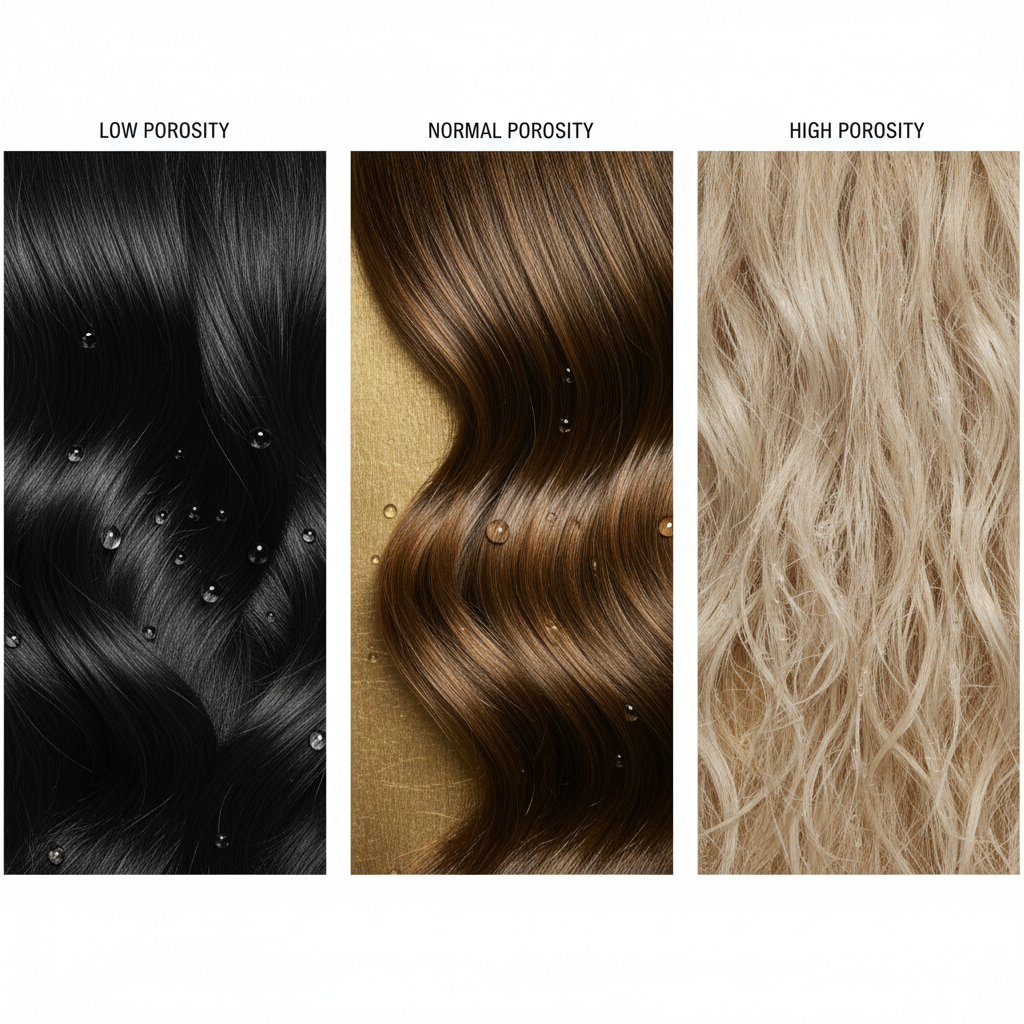
Low porosity characteristics
- Water beads up on the surface of dry hair before soaking in.
- Hair takes several minutes under running water to become fully saturated.
- Blow-drying or air-drying takes an extended time, often upwards of several hours.
- Heavy butter- or oil-based conditioning products sit visibly on the surface, causing buildup and a greasy feel rather than absorbing.
Medium (balanced) porosity characteristics
- Hair wets easily within a minute under the shower head.
- Holds styles and accepts colour treatments evenly without rapid fading.
- Dries at a predictable rate without excessive frizz or dullness.
- Cuticles remain aligned, creating natural shine and elasticity.
High porosity characteristics
- Hair absorbs water instantly upon contact with moisture.
- Tangles easily, especially when wet, due to rough, raised cuticle edges catching against neighbouring strands.
- Absorbs conditioning products almost immediately but feels dry, rough, and brittle shortly afterwards.
- Dries very quickly because moisture evaporates out through cuticle fractures just as fast as it entered.
| Metric / Trait | Low Porosity | Medium Porosity | High Porosity |
|---|---|---|---|
| Cuticle Condition | Tightly packed, flat scales | Uniform, intact alignment | Lifted, fractured, or absent scales |
| 18-MEA Lipid Layer | Intact and hydrophobic | Mostly intact | Stripped or heavily compromised |
| Water Absorption Rate | Very slow (beads on surface) | Moderate, predictable | Instantaneous |
| Drying Time | Very long (hours) | Normal | Rapid |
| Product Tolerance | Prefers light humectants, hates heavy waxes | Balanced | Needs rich emollients, sealants, and proteins |
| Primary Risk | Product buildup and stiffness | Minimal risk | Hygral fatigue and shaft breakage |
What the evidence does not show
There is no scientific backing for the idea that hair porosity is an absolute, permanent genetic stamp that cannot change along the strand. Porosity is a gradient. The new growth at your roots generally displays lower porosity, whereas the ends, which may have endured years of shampooing, friction, sunlight, and heat, naturally possess higher porosity.
Furthermore, products marketed to "cure" or "reverse" high porosity cannot restore biological structures. Once cuticle cells shear off or chemical processes dissolve the 18-MEA layer, the body cannot regenerate dead keratinocytes. Topical treatments act as cosmetic patches. They coat the shaft, fill voids with hydrolysed proteins or silicones, and mimic the missing lipid barrier until your next shampoo washes them away.
Practical care strategies for your porosity type
Understanding how cuticles respond to temperature, pH, and formulation chemistries allows you to tailor your routine effectively.
Managing low porosity hair
- Use gentle warmth: Moderate heat, such as wrapping your head in a warm, damp towel over a shower cap, slightly swells the cuticle layers, creating temporary entry points for conditioning agents.
- Keep formulations lightweight: Choose products featuring humectants like glycerin or panthenol, balanced with light carrier oils like jojoba or argan, rather than heavy petrolatum or unrefined shea butter that form occlusive barriers on top of sealed scales.
- Incorporate clarifying cleansers: Because low porosity hair is prone to surface accumulation, use an effective clarifying shampoo every two to three weeks to strip away residual conditioning agents that block hydration.
Managing high porosity hair
- Support with hydrolysed proteins: Small-chain peptides and hydrolysed wheat, silk, or oat proteins can temporarily settle into microscopic fissures in the cuticle and cortex, adding tensile strength and slowing water loss.
- Seal with film-forming emollients: High porosity strands lack natural 18-MEA lipids. After applying hydrating water-based leave-in conditioners, seal the moisture into the cortex with heavier plant butters, oils, or smoothing silicones to cap the raised cuticle gaps.
- Maintain an acidic pH balance: The natural pH of hair and the scalp sits between 4.5 and 5.5. Applying acidic rinses or products formulated around pH 4.0 to 5.0 helps contract the cuticle scales, reducing mechanical snagging and moisture loss.
When the cause may be something else
If your hair appears dull, dry, or breaks easily, do not assume high porosity is the sole culprit. Several environmental and physiological factors produce identical physical symptoms:
- Hard water buildup: High concentrations of dissolved calcium and magnesium ions in domestic tap water bind to hair proteins, forming an insoluble crust that mimics the rough texture and dryness of high porosity cuticles.
- Protein over-saturation: Applying intensive protein treatments to hair that only requires moisture leads to stiff, brittle strands that snap under light tension.
- Follicular shedding vs. breakage: If you notice hair gathering in your brush, inspect the ends. Strands with a small white bulb at the root indicate natural shedding (telogen effluvium or cyclical shed). Strands without a bulb that are short and jagged represent fibre breakage, which is a common consequence of high porosity and structural wear.
Supporting hair condition with Watermans
Cosmetic routines that protect hair shafts from mechanical stress benefit from well-formulated, scalp-friendly cleansers. The Watermans range, including Grow Me Shampoo and Condition Me Conditioner, focuses on supporting your hair's overall cosmetic environment. Formulated with ingredients such as biotin, rosemary, caffeine, and hydrolysed lupin protein, these products help improve surface smoothness, reduce combing friction, and leave strands feeling stronger, fuller, and resilient against everyday breakage without disrupting cuticle balance.
Frequently asked questions about The Science of Hair Porosity and Moisture Retention
What is the scientific definition of hair porosity?
In hair biology, porosity is the measure of the hair shaft's capacity to absorb and retain fluids and chemical solutions. It is governed directly by the integrity of the external cuticle layers, the health of the cell membrane complex, and the presence of the hydrophobic 18-MEA lipid layer coating the outer surface of the keratin fibre.
Can cold water close cuticles to lower hair porosity?
No. Hair cuticles are non-living biological structures that lack muscles, meaning they cannot physically open and close in response to water temperature. While extreme alkaline solutions swell cuticles and acidic solutions contract them, cold water does not meaningfully flatten cuticles. Applying products formulated at an optimal physiological pH (4.5 to 5.5) is what smooths the cuticle layer.
How does The Science of Hair Porosity and Moisture Retention affect chemical treatments?
Porosity dictates how quickly chemical agents, such as bleach or permanent dyes, penetrate the cortex. High porosity hair processes colour rapidly because alkaline agents access the interior with zero resistance, but it also sheds colour molecules just as fast, leading to premature fading. Low porosity hair requires extended processing times or alkaline swelling to allow pigments to penetrate the tightly sealed outer layers.
Why does high porosity hair break more easily than low porosity hair?
High porosity hair typically lacks its protective 18-MEA lipid barrier and displays cracked, missing, or raised cuticle tiles. Without these intact outer sheaths, the inner keratin matrix experiences friction from neighbouring strands, tool damage, and hygral fatigue from rapid water expansion. This structural loss reduces tensile strength, making the fibre snap under normal tension.
A balanced view of hair porosity
Mastering The Science of Hair Porosity and Moisture Retention requires moving away from quick-fix marketing claims and understanding the biological reality of the hair fibre. Your hair is an intricate arrangement of dead keratin cells protected by a fragile, non-renewable shield of cuticles and surface lipids. By matching your wash and conditioning routines to your hair's specific porosity, using pH-balanced products, and shielding fragile cuticles from thermal and mechanical wear, you can effectively manage moisture flow and protect your strands against unnecessary breakage.
Sources and references
- Robbins, C. R. (2012). Chemical and Physical Behavior of Human Hair (5th ed.). Springer-Verlag.
- Ruetsch, S. B., Kamath, Y. K., & Rele, A. S. (2001). "Photodamage of human hair: An examination of the morphological changes by AFM." Journal of Cosmetic Science, 52(3), 169-182.
- Evans, T., & Wickett, R. R. (2012). Practical Modern Hair Science. Allured Business Media.
- International Journal of Cosmetic Science (2008). "The effect of chemical treatments on the hydrophobic properties of human hair."
- Society of Cosmetic Chemists (SCC) Monograph Series: Hair Mechanics and Moisture Diffusion.
Find these ingredients in Watermans products
- Panthenol (Provitamin B5): you will find this ingredient in our Heat Protection Spray.
- Shea Butter: you will find this ingredient in our Curly Hair Conditioner.