Scalp Micro-Needling for Hair Growth: The Science, Benefits, and Clinical Reality
9 min read ·
Explore the evidence behind Scalp Micro-Needling for Hair Growth, including clinical mechanisms, needle depths, safety protocols, and realistic results.
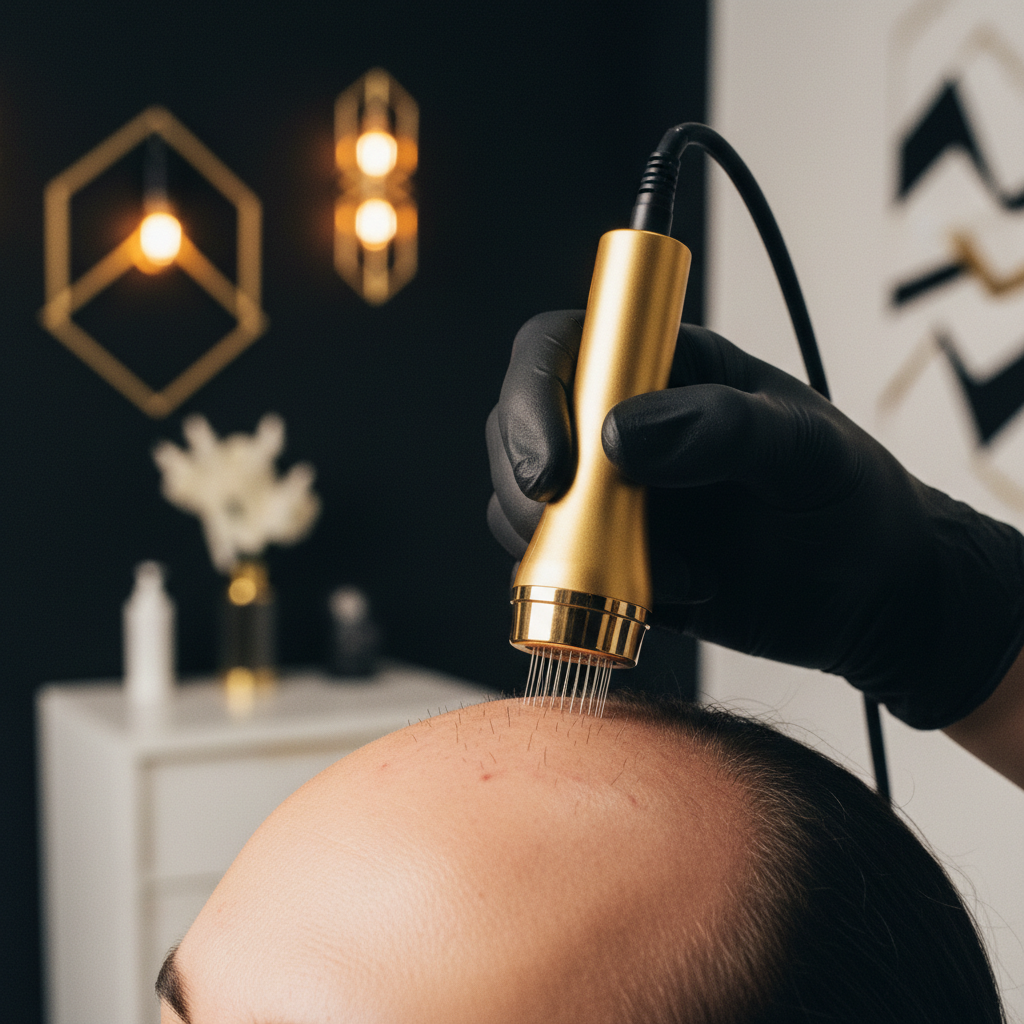
Quick answer: Scalp Micro-Needling for Hair Growth is a minimally invasive technique that uses tiny, sterile needles to puncture the upper dermis of the scalp. This controlled micro-injury triggers a wound-healing cascade, stimulates blood circulation, and upregulates platelet-derived growth factors around miniaturised hair follicles. While clinical trials show it can significantly improve hair count, density, and follicular diameter (especially when paired with medical topicals), its main limitation is that it cannot revive completely fibrosed, long-dead follicles or cure underlying genetic androgenetic alopecia.
Key takeaways
- Scalp micro-needling creates controlled micro-trauma in the scalp dermis, typically at depths of 0.5 mm to 1.5 mm.
- The physical punctures trigger collagen synthesis, angiogenesis (new blood vessel formation), and release of growth factors like PDGF and VEGF.
- Clinical studies show micro-needling works most effectively as an adjunct therapy alongside topical treatments, dramatically increasing active ingredient absorption.
- Excessive needle depth, improper pressure, or aggressive frequency can cause scalp scarring, infection, and mechanical damage to existing follicle bulbs.
- At-home rolling requires strict sanitation protocols to avoid bacterial folliculitis, with in-clinic electronic microneedling pens offering far greater depth precision.
Scalp Micro-Needling for Hair Growth: what the evidence shows
Scalp Micro-Needling for Hair Growth has shifted from an experimental salon treatment into a well-documented dermatological intervention over the last decade. Research into this modality focuses primarily on androgenetic alopecia (pattern hair loss) in both men and women.
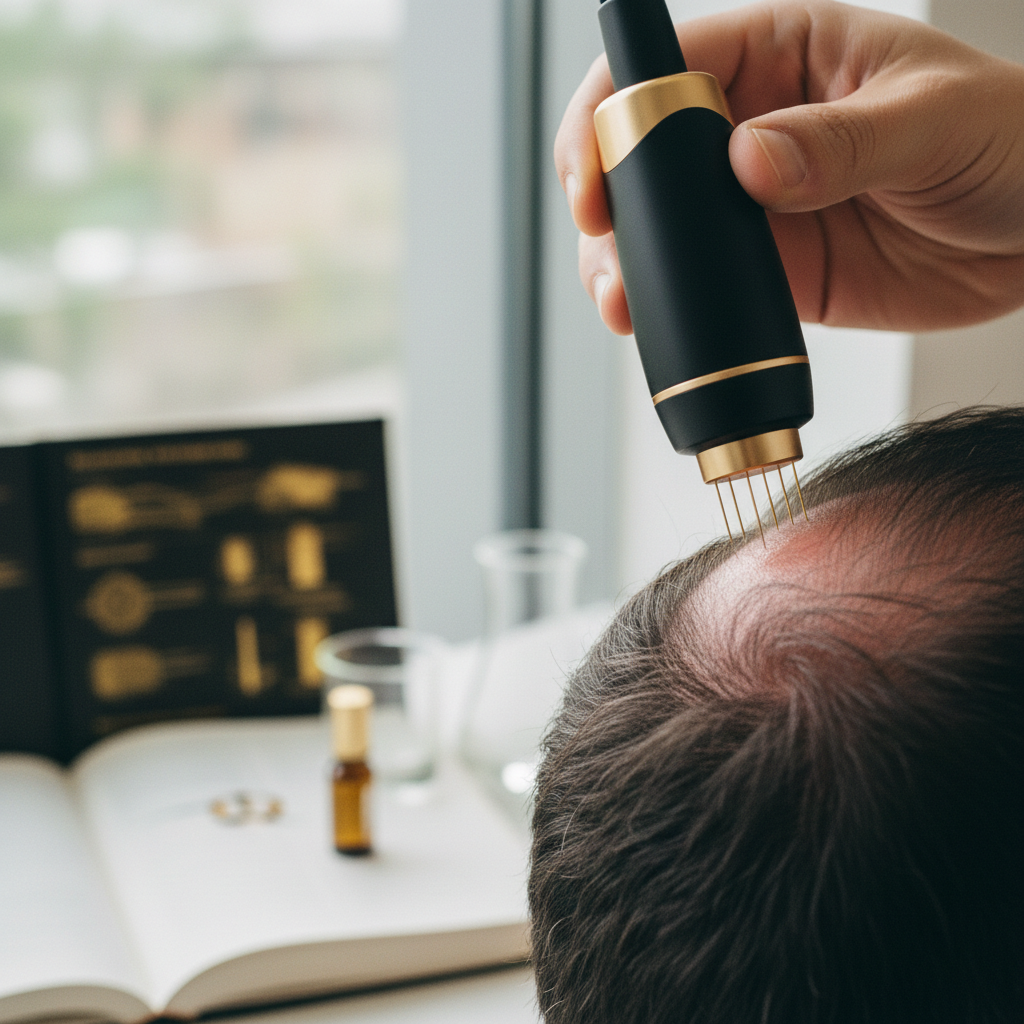
The landmark trial by Dhurat et al. (2013) published in the International Journal of Trichology evaluated 100 men with mild to moderate androgenetic alopecia. One group received a standard 5% minoxidil lotion twice daily, while the second group received 5% minoxidil combined with weekly scalp micro-needling using a 1.5 mm device. At the 12-week mark, the micro-needling cohort achieved an average increase of 91.4 hairs per square centimetre, compared to just 22.2 hairs in the minoxidil-only group. Independent evaluators noted visible aesthetic improvements in 82% of the micro-needling group compared to 4.5% of the topical-only group.
Subsequent trials and systematic reviews, including meta-analyses in the Journal of Cosmetic Dermatology, have confirmed these findings across varying demographics. Researchers observed that the physical creation of thousands of micro-conduits bypasses the scalp's primary barrier layer, the stratum corneum. This allows topicals to reach the dermal papilla at concentrations up to five times higher than passive surface application.
Furthermore, standalone micro-needling without active drugs has shown modest benefits. Studies demonstrate that mechanical injury alone can activate the Wnt/beta-catenin signalling pathway, which is essential for initiating the anagen (growth) phase of the hair cycle.
Biological mechanisms: how the needles influence the follicle
Hair follicles reside in the dermal layer of the scalp, surrounded by a complex microvascular network and mesenchymal cells known as the dermal papilla. Scalp micro-needling activates three distinct physiological responses:
- The wound-healing cascade: Puncturing the skin triggers platelets to release critical growth factors, including Platelet-Derived Growth Factor (PDGF), Vascular Endothelial Growth Factor (VEGF), and Fibroblast Growth Factor (FGF). These signalling proteins encourage new capillary formation, bringing oxygen and micronutrients directly to sluggish follicles.
- Follicular stem cell activation: The transient trauma stimulates stem cells located in the hair follicle bulge. When cellular repair pathways activate, dormant telogen (resting) follicles are nudged to re-enter the anagen (growth) phase.
- Gene expression alterations: Biopsies taken after micro-needling sessions reveal transient upregulation of hair-growth-related genes, particularly Wnt10b and LEF1, while temporarily downregulating local inflammatory cytokines that drive follicular miniaturisation.
What the evidence does not show
Despite promising data, micro-needling is not a universal cure for all types of hair shedding or follicular loss.
It does not create new hair follicles from bare skin where none previously existed. Humans are born with roughly 100,000 scalp follicles, and that number only declines with age. Micro-needling can help enlarge miniaturised follicles that are still biologically functional, but it cannot reverse scarring alopecias such as lichen planopilaris or frontal fibrosing alopecia. In fact, mechanical trauma on active scarring conditions can trigger the Koebner phenomenon, accelerating permanent hair loss.
Additionally, micro-needling will not resolve hair loss caused by internal metabolic triggers, such as severe iron deficiency (ferritin below 30 ug/L), thyroid dysfunction, high systemic prolactin, or acute telogen effluvium triggered by illness or crash dieting. In these cases, physical scalp trauma does nothing to address the root internal disruption.
Treatment modalities: dermarollers versus automated microneedling pens
Choosing the correct equipment significantly influences both treatment safety and clinical efficacy.
| Feature | Manual Dermaroller | Automated Microneedling Pen |
|---|---|---|
| Needle Entry Angle | Enters and exits at an angle (creates trenching/shearing) | Enters and exits perpendicular at 90 degrees |
| Depth Control | Fixed depth (cannot adjust between crown and temples) | Adjustable on the fly (0.25 mm to 2.5 mm) |
| Epidermal Trauma | Higher risk of micro-tears and scratching | Clean vertical punctures with minimal lateral tearing |
| Sterility | Reusable barrel (high risk of bacterial accumulation) | Single-use, disposable sterile needle cartridges |
| Cost | Low initial cost (£10 to £25) | Moderate to high (£80 to £300+ for clinical units) |
| Recommended Setting | Home maintenance (under 0.5 mm only) | Clinical treatments or advanced supervised home care |
Automated pens are widely preferred by dermatologists and trichologists. Because the scalp curves and varies in thickness across the scalp (the frontal hairline is thinner than the occipital scalp), an adjustable vertical needle prevents the "trenching" effect that occurs when a rolling barrel pulls needles out of the skin at an angle.
Best practices and treatment protocols
To achieve positive outcomes without inducing scalp fibrosis or chronic inflammation, adhere to conservative, evidence-supported parameters.
- Needle depth: For enhancing the absorption of non-irritating topical solutions, 0.25 mm to 0.5 mm is sufficient. For stimulating collagen and dermal papilla growth factors directly, 0.75 mm to 1.25 mm is the standard therapeutic window. Depths exceeding 1.5 mm on the scalp carry a substantial risk of damaging the hair bulb itself, which often sits 2.0 mm to 4.0 mm below the surface.
- Frequency: More is not better. Dermal remodelling and wound healing take time. Deeper treatments (1.0 mm to 1.25 mm) should be spaced 2 to 4 weeks apart. Light superficial rolling (0.25 mm to 0.3 mm for topical absorption) can be performed once or twice weekly.
- Sanitation: Before rolling, wash the scalp thoroughly. If using an at-home roller, soak the instrument in 70% isopropyl alcohol for at least 15 minutes before and after every use. Never use a device with bent, dull, or corroded needles.
- Topical application timing: Avoid applying harsh alcohol-based topicals, retinoids, or fragranced formulas immediately after a 1.0 mm session. High systemic absorption of ingredients not intended for intravenous or intradermal delivery can cause severe contact dermatitis, burning, or systemic side effects like sudden blood pressure drops. Wait 12 to 24 hours before resuming potent medical lotions.
When to seek professional dermatological advice
Always consult a doctor, trichologist, or board-certified dermatologist before beginning micro-needling if you experience any of the following:
- Rapid, patchy shedding, or circular bare patches (symptoms of alopecia areata).
- Scalp tenderness, burning, redness, or visible scaling and pustules.
- Active scalp acne, eczema, psoriasis, or open lesions.
- You take prescription blood thinners or have a history of keloid scar formation.
- You are unsure whether your hair thinning is caused by genetic pattern loss, nutritional deficiencies, or traction damage.
A professional can perform dermoscopy (trichoscopy) to check for follicular peripilar signs, verify that follicles are still viable, and calibrate needle depths safely for your specific scalp thickness.
Supporting the scalp environment: the Watermans approach
Micro-needling focuses on mechanical stimulation, but long-term hair quality requires a clean, well-nourished scalp environment between sessions. This is where topical cosmetic care plays a valuable supportive role.
Watermans Grow Me Shampoo and Condition Me Conditioner are formulated to cleanse buildup, excess sebum, and everyday debris from the scalp without stripping essential barrier lipids. Combining natural botanical extracts like caffeine, rosemary, biotin, and lupin protein, these formulations refresh and invigorate the scalp surface. By keeping the follicular ostia clear of oxidative waste and conditioning the hair shaft against breakage, they provide an ideal cosmetic companion to a proactive scalp care routine.
Frequently asked questions about Scalp Micro-Needling for Hair Growth
Can Scalp Micro-Needling for Hair Growth cause hair shedding?
Yes, a temporary increase in hair shedding is common during the first 2 to 6 weeks of treatment. This phenomenon, known as an induced telogen effluvium, happens when miniaturised follicles in the resting phase are prompted to shed their weak hairs prematurely to make way for new, thicker anagen strands. If shedding persists beyond 8 weeks, stop treatment and speak to a specialist.
What needle size is best for hair growth?
Clinical studies point to a depth of 0.5 mm to 1.25 mm as the sweet spot for scalp treatments. Needles under 0.5 mm primarily improve product absorption across the stratum corneum. Depths around 1.0 mm stimulate dermal growth factors without reaching the deeper vascular subcutaneous layer where follicle bulbs live, preventing permanent mechanical damage.
How often should you micro-needle your scalp?
Dermatological protocols recommend deep sessions (1.0 mm to 1.25 mm) once every 2 to 4 weeks. The collagen synthesis and tissue regeneration cycle requires rest; needling too frequently creates persistent subclinical inflammation that can damage follicles. Mild micro-needling (0.25 mm to 0.5 mm) for cosmetic product absorption can be performed once weekly.
Does micro-needling work for receding hairlines?
It can help if the receding hairline still contains visible miniaturised hairs, also known as vellus or intermediate hairs. Micro-needling triggers blood supply and growth factors that can thicken these struggling follicles. However, if the frontal hairline has been completely bare and shiny for several years, those follicles have likely fibrosed, meaning needles cannot restore growth.
Summary
Scalp Micro-Needling for Hair Growth stands out as an evidence-based, scientifically plausible method for improving hair density and slowing pattern thinning. By leveraging the body's natural wound-healing cascade and dramatically improving the absorption of topical treatments, it offers real clinical utility for men and women dealing with androgenetic alopecia.
Success with micro-needling relies on consistency, restraint, and strict hygiene. Avoid the temptation to use excessive pressure, overly long needles, or daily sessions. When applied sensibly, either under clinical guidance or using careful at-home protocols alongside balanced topical scalp care, micro-needling provides a powerful, multi-target tool for supporting healthier, fuller-looking hair.
Sources and references
- Dhurat, R., et al. (2013). "A randomized evaluator blinded study of effect of microneedling in androgenetic alopecia: A pilot study." International Journal of Trichology, 5(1), 6-11.
- Starace, M., et al. (2020). "Microneedling in hair loss disorders: A systematic review." Dermatologic Therapy, 33(2), e13268.
- Fertig, R. M., et al. (2018). "Microneedling for the treatment of hair loss?" Journal of the European Academy of Dermatology and Venereology, 32(4), 564-569.
- British Association of Dermatologists (BAD). "Androgenetic Alopecia Guidelines and Patient Resources."
- Kumar, M. K., et al. (2021). "Efficacy of microneedling with topical therapies in androgenetic alopecia: A systematic review and meta-analysis." Journal of Cosmetic Dermatology, 20(9), 2704-2713.