The Role of Hair pH in Cuticle Health: Science and Practical Care
9 min read ·
Explore the critical role of hair pH in cuticle health, showing how acidic balance seals hair scales, prevents mechanical breakage, and enhances shine.
Quick answer: The Role of Hair pH in Cuticle Health centres on keeping the outer protective layer of the hair fibre flat, compact, and resilient. Hair fibre has an acidic isoelectric point around pH 3.67, while the scalp acid mantle sits near pH 5.5. When hair encounters alkaline products above pH 7.0, the cuticle scales swell and lift, causing friction, tangles, and structural vulnerability. However, balancing pH cannot rebuild severed keratin bonds; it protects existing surface integrity rather than reversing deep internal chemical destruction.
Key takeaways
- Natural hair fibre is naturally acidic, with an isoelectric point of approximately pH 3.67.
- The scalp maintains an acid mantle usually between pH 4.5 and 5.5 to discourage microbial overgrowth.
- Alkaline formulations (pH above 7.0) increase negative electrical surface charge, causing cuticle scales to swell, lift, and chip.
- Mildly acidic products (pH 4.0 to 5.5) contract cuticle layers, reduce wet combing friction, and preserve shine.
- pH balance directly manages mechanical hair breakage along the shaft, but it does not stop genetic or inflammatory hair loss at the follicle level.
Role of Hair pH in Cuticle Health: what the evidence shows
Peer-reviewed cosmetic dermatology confirms that the Role of Hair pH in Cuticle Health governs surface friction, electrical static, and cortex protection. Hair is a non-living biological composite composed primarily of keratinised proteins. The cuticle, which consists of six to ten overlapping layers of flattened, dead cells, shields the softer interior cortex from mechanical abrasion and environmental damage.
A foundational study published in the International Journal of Trichology (2014) analysed 123 commercial shampoos and observed that over 60 percent had a pH higher than 5.5. The researchers demonstrated that alkaline solutions increase the net negative electrical charge on the hair surface. This charge creates electrostatic repulsion between neighbouring cuticle scales. As the scales repel one another, they lift away from the hair shaft.
Lifted cuticle scales dramatically increase friction between adjacent strands. Increased friction leads directly to knots, snagging during detangling, and progressive chipping of the scale edges. When products match the physiological acidity of the hair and scalp (between pH 4.5 and 5.5), cuticle swelling is minimised, leaving the fibre smoother, less porous, and substantially less prone to wash-day snapping.
 Cuticle Swelling vs. Solution pH

 High | * (Alkaline lift / damage)
Cuticle | *
Swelling| *
 | *
 Low | * * * (Compact, closed cuticle)
 +-----------------------------------
 3.0 4.5 6.0 7.5 9.0
 Solution pH
The biological mechanism: why hair reacts to pH
To understand how acidity and alkalinity manipulate hair fibres, you have to look at keratin's isoelectric point and chemical bonding.
The isoelectric point of hair
The isoelectric point is the pH value at which a protein carries zero net electrical charge. For human hair keratin, this neutral charge state occurs at roughly pH 3.67.
When hair rests in an environment with a pH above 3.67, the acidic carboxyl groups (-COOH) in its amino acid chains begin to ionise into negatively charged carboxylate ions (-COO⁻). In tap water (often pH 7.0 to 8.5) or alkaline soap (pH 9.0 to 10.0), the hair surface acquires a strong negative charge. This electrical repulsion forces the cellular cuticle shingles to open upwards, exposing the delicate endocuticle and inner cortex.
Water absorption and hygral fatigue
Lifted cuticles allow water to flood freely into the cortex. Hair can absorb up to 30 percent of its own dry weight in water under normal conditions, expanding in diameter. Under alkaline conditions, this swelling is exaggerated. Repeated swelling when wet followed by contraction during drying puts mechanical stress on the cell membrane complex, a phenomenon known as hygral fatigue. Keeping the hair near its acidic resting state limits unnecessary water influx.
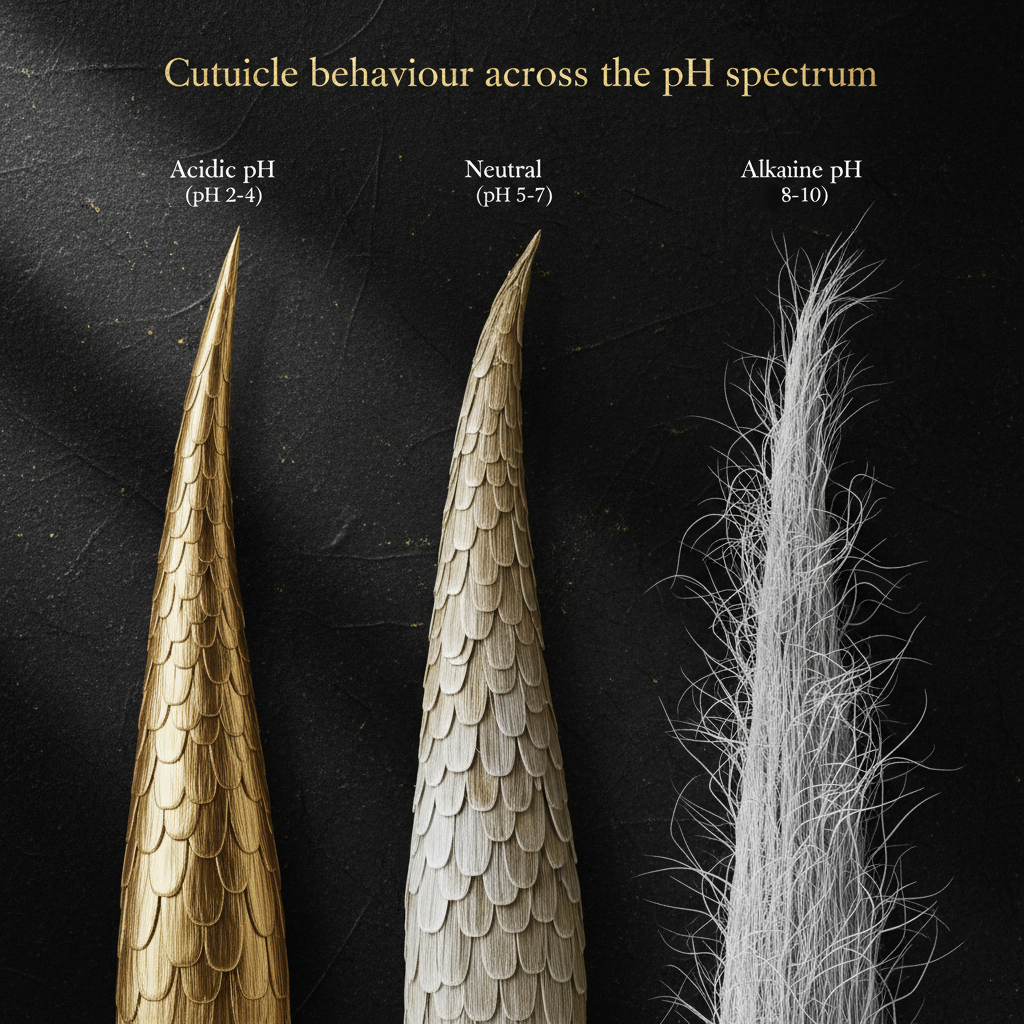
Cuticle behaviour across the pH spectrum
The following table demonstrates how various pH ranges alter cuticle geometry, surface friction, and structural safety:
| pH Range | Classification | Cuticle Behaviour | Practical Consequences |
|---|---|---|---|
| 1.0 to 3.0 | Strongly Acidic | Extreme compaction; risks protein hydrolysis if sustained | Hair feels rigid; potential chemical brittle fatigue over time |
| 3.5 to 5.5 | Physiologically Balanced | Scales lie flat, sealed, and compact; isoelectric neutrality | Minimal friction, high light reflectance (shine), reduced breakage |
| 6.0 to 7.0 | Neutral to Mildly Alkaline | Slight cuticle lifting; mild surface charge accumulation | Increased drag during brushing; mild dullness |
| 7.5 to 9.0 | Moderately Alkaline | Noticeable scale swelling; disruption of epicuticle lipids | High wet friction, severe tangling, cuticle chipping |
| 9.5 to 12.0 | Strongly Alkaline | Dramatic lifting; cortex exposed; bond dissolution | Essential for chemical relaxers/bleach; leaves permanent structural voids |
What the evidence does not show
While managing pH is vital for cuticle preservation, marketing claims frequently overstep the biological facts.
- pH does not stop follicular hair shedding: A low pH shampoo cannot prevent genetic androgenetic alopecia, autoimmune alopecia areata, or stress-induced telogen effluvium. The hair follicle bulb sits three to four millimetres below the skin surface, governed by hormones, genetics, and vascular supply, not topical pH alone.
- pH cannot rebuild severed disulphide bonds: Once internal cystine linkages are permanently destroyed by bleach, perm salts, or high thermal tools (temperatures exceeding 185°C), an acidic rinse will merely flatten the remaining surface scales. It will not knit the underlying broken protein chains back together.
- "More acidic" is not automatically better: Dropping below pH 3.0 does not double your hair's strength. Excessively low pH can harden the fibre excessively, leading to acid brittleness, or irritate sensitive epidermal scalp tissue.
Recognising pH-disrupted hair: signs to look for
You do not need a laboratory meter to spot hair suffering from alkaline surface disruption. Common physical indicators include:
- Sudden loss of shine: A flat cuticle reflects light uniformly like a clean mirror. A lifted, ruffled cuticle scatters light in all directions, making the hair look matte and chalky.
- Persistent wet tangling: If your hair feels like wet wool or velcro immediately after rinsing out shampoo, the cuticles are lifted and catching against each other.
- High porosity: Strands soak up moisture instantly but dry out just as fast, feeling constantly parched.
- Mid-shaft snapping: When combing wet hair, short fragments of fibre snap off without a white root bulb attached. This is mechanical breakage, driven by high inter-fibre friction.
Practical steps to maintain cuticle-safe pH
You can protect your hair's surface geometry through simple, deliberate habits:
1. Choose shampoo formulated between pH 4.5 and 5.5
Look for cleansers that explicitly state their pH or are marketed as pH-balanced. Avoid traditional cold-process bar soaps on the hair; saponified vegetable oils are inherently alkaline, typically measuring pH 9.0 to 10.0, which guarantees immediate cuticle swelling.
2. Never skip acidic conditioning
Conditioners are almost universally formulated at an acidic pH (between 3.5 and 4.5). They neutralise negative charges left by water and detergents, deposit lubricating fatty alcohols, and flatten the cuticle shingles back down before you begin mechanical styling.
3. Account for hard tap water
Municipal tap water in many regions is treated to an alkaline pH (frequently 7.5 to 8.5) to protect lead and copper pipes from corrosion. Prolonged rinsing in alkaline water swells the hair fibre. Using an acidic leave-in mist or final rinse helps reset the cuticle plane after washing.
When the issue is not pH
If your hair remains fragile despite meticulous pH management, the root cause often lies elsewhere:
- Mechanical abuse: Aggressive backcombing, using fine-toothed plastic combs with rough mould seams, or detangling dry, brittle hair can rip cuticles off mechanically, regardless of product acidity.
- Thermal caramelisation: Heat styling above 200°C degrades keratin proteins directly and melts the internal structural fats of the fibre.
- Severe chemical processing: Bleach oxidises melanin by stripping away the 18-methyleicosanoic acid (18-MEA) lipid layer that naturally coats the cuticle. Once 18-MEA is gone, the cuticle remains hydrophobic-deficient even in acidic environments.
If you notice rapid thinning, visible widening of your part line, patchy circular bald spots, or burning and flaking on your scalp, consult a qualified trichologist or dermatologist. These are signs of scalp pathologies or follicular hair loss disorders that topical pH alterations cannot fix.
Supporting the hair and scalp ecosystem
A complete hair care routine addresses both the physical cuticle surface and the biological scalp environment. Watermans focuses on comprehensive, everyday scalp and strand care by formulating gentle, performance-oriented products. Their cleansers and conditioners are thoughtfully developed to respect the natural physiological balance of your hair and scalp, helping to smooth cuticle roughness, curb wash-day breakage, and keep strands looking thick, vibrant, and thoroughly nourished.
Frequently asked questions about Role of Hair pH in Cuticle Health
How does the Role of Hair pH in Cuticle Health impact colour retention?
When hair pH rises above 6.0, the cuticle scales lift. This gap allows artificial dye molecules trapped in the cortex to wash out rapidly during bathing. By maintaining an acidic environment between pH 4.5 and 5.5, the cuticle layers remain tightly sealed, locking pigment inside the shaft and substantially extending your colour's vibrancy.
Can apple cider vinegar safely restore cuticle pH?
Raw apple cider vinegar has a very low pH, typically between 2.0 and 3.0. If applied undiluted, it is far too acidic and can cause scalp irritation or hair stiffness. If you choose to use it, dilute it heavily (such as one tablespoon in 250 millilitres of water) to bring the solution safely into the 4.0 to 5.0 range.
Does hard water change hair cuticle pH?
Hard water typically has an alkaline pH between 7.5 and 8.5, alongside dissolved calcium and magnesium ions. This alkalinity encourages cuticle scales to flare, while the mineral ions bind to exposed keratin surfaces. The combination leaves hair feeling rough, stiff, and prone to tangling until neutralised by an acidic conditioner.
Why do chemical perms and relaxers use high pH?
Permanent waves, relaxers, and lighteners deliberately use alkaline chemicals (pH 9.0 to 12.0) to blast open the tight cuticle shield. This allows active reducing agents to penetrate deeply into the cortex to break disulphide bonds. Afterwards, an acidic neutraliser must be applied to bring the cuticle down and re-establish surface stability.
A balanced approach to cuticle care
Understanding the Role of Hair pH in Cuticle Health gives you direct control over hair friction, shine, and preventable fibre breakage. By choosing cleansers and conditioners that mirror the natural acidity of your hair and scalp, you keep the outer cuticle layers flat, resilient, and protective. Respecting this fundamental biological boundary safeguards the hair fibre against daily styling wear and preserves its natural integrity for the long term.
Sources and references
- Gavazzoni Dias, M. F. Et al. (2014) 'The Shampoo pH Can Affect the Hair: Myth or Reality? A Novel Analysis of Counterfeit Shampoos', International Journal of Trichology, 6(3), pp. 95 to 99.
- Robbins, C. R. (2012) Chemical and Physical Behavior of Human Hair. 5th edn. Berlin: Springer-Verlag.
- Draelos, Z. D. (2010) 'Essentials of Hair Care often Neglected: Hair Cleansing', International Journal of Trichology, 2(1), pp. 24 to 29.
- Swift, J. A. (1999) 'The mechanics of human hair', International Journal of Cosmetic Science, 21(4), pp. 227 to 239.
Find these ingredients in Watermans products
- Copper: you will find this ingredient in our Hair Vitamins.