Repairing Severely Damaged Hair: An Evidence-Based Guide
8 min read ·
Discover the science of repairing severely damaged hair. Learn what can be restored, what cannot, and the proven protocols to rebuild strength and stop breakage.

Quick answer: With repairing severely damaged hair, biological regeneration is impossible because hair fibre is non-living tissue made of keratinised cells. True structural repair cannot restore original virgin protein bonds once they are dissolved by bleach, chemical relaxers, or excessive heat. However, cosmetic and functional repair is achievable. Targeted bond builders, hydrolysed proteins, and biomimetic lipids can bridge broken cystine bonds, temporarily fill cortical voids, smooth the cuticle, and stop mechanical breakage until healthy new growth emerges from the scalp.
Key takeaways
- Hair is non-living material with no biological ability to heal or regenerate once damaged.
- Severe damage occurs primarily through the cleavage of internal disulphide bonds, depletion of the 18-MEA protective lipid layer, and loss of cuticle scales.
- Functional repair relies on three mechanisms: bond multiplying, structural protein deposition, and external lipid replenishment.
- Distinguish between hair breakage along the shaft and hair shedding from the follicle. Damaged hair snaps; it does not cause root-level hair loss.
- In cases of extreme mechanical failure, such as gummy or mushy wet hair (known as bubble hair or total cortical collapse), a structural trim is the only permanent remedy.
Repairing Severely Damaged Hair: what the evidence shows
When scientists talk about repairing severely damaged hair, they refer to restoring tensile strength, elasticity, and hydrophobicity rather than cellular regeneration. Hair is composed of roughly 65% to 95% protein (chiefly keratin), up to 32% water, and trace lipids. These protein chains are held together by strong covalent disulphide bonds, alongside weaker hydrogen and ionic (salt) bonds.
Peer-reviewed cosmetic dermatology demonstrates that chemical processing (bleaching, permanent waves, sodium hydroxide relaxers) breaks these disulphide bonds, oxidising cystine into cysteic acid. Once cysteic acid levels rise, hair loses its tensile strength and structural integrity.
Independent research published in cosmetic science literature confirms that specific low-molecular-weight multi-acid technologies (such as bis-aminopropyl diglycol dimaleate and maleic acid complexes) cross-link broken disulphide bonds to a measurable degree. Furthermore, hydrolysed wheat and keratin proteins (with molecular weights between 500 and 1,500 Daltons) can penetrate past lifted cuticles to temporarily reinforce weakened cortical microfibrils. These treatments improve elasticity and significantly reduce breakage under mechanical stress, though they wash out over time and require consistent reapplication.
What the evidence does not show
The haircare market frequently overpromises on structural recovery. Scientific evidence does not support claims that any serum, mask, or treatment can "permanently reverse" severe chemical damage or fuse split ends back into whole fibres.
Adhesive styling polymers can temporarily glue split ends together through surface tension and film formation, but this effect disappears upon washing. Additionally, topical cosmetic treatments applied to the hair shaft do not accelerate follicular growth rates or influence the biology of the dermal papilla. Applying heavy bonding treatments to your scalp will not repair the dead fibre down the length, and leaving hydrolysed proteins on without balanced conditioning can lead to protein overload, making brittle hair snap even faster.
The biological mechanisms of hair fibre damage
To address severe degradation, you must understand the three distinct zones of fibre architecture that fail:
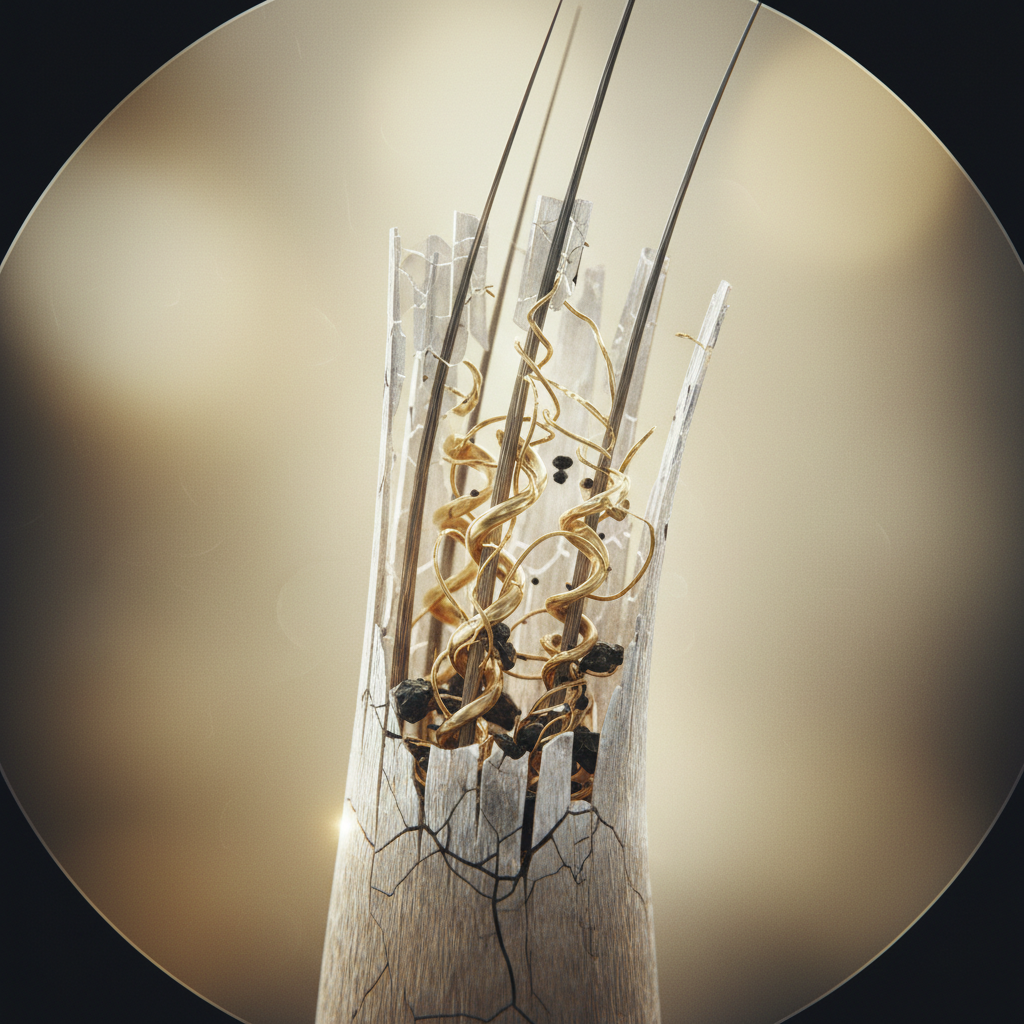
- The F-layer and cuticular scales: In virgin hair, an outermost monolayer of 18-methyleicosanoic acid (18-MEA) acts as a hydrophobic barrier, repelling water and protecting the cuticle cells. A single bleaching or oxidative colouring session strips this lipid layer entirely. The surface turns hydrophilic, meaning it rapidly absorbs ambient moisture, swells, lifts, and creates severe friction between strands.
- The cortex and disulphide bonds: The cortex accounts for roughly 90% of hair's dry weight and provides tensile strength. High heat (above 215°C) denatures the alpha-keratin helix, converting it into fragile beta-sheet structures. Chemical processing breaks the cross-linking disulphide bonds. When these bonds vanish, hair stretches abnormally when wet, turning gummy and snapping under minimal tension.
- The cell membrane complex (CMC): The lipid-rich cement holding individual cuticle and cortical cells together degrades over repeated mechanical brushing and ultraviolet exposure. Once the CMC erodes, cuticle scales shed permanently, leaving the naked cortex exposed to environmental decay.
Identifying the signs: damage versus shedding
A common clinical mistake is confusing fibre breakage with follicular shedding.
When hair breaks, you will find short, uneven fragments on your shoulders, pillowcase, or bathroom floor without a white bulb at the tip. These fragments indicate severe mechanical or chemical degradation along the hair shaft.
Conversely, hair shedding (telogen effluvium) or alopecia involves full-length strands coming out directly from the scalp, identifiable by a distinct, rounded bulb at the root. Chemical treatments cause shaft breakage; they rarely trigger root-level alopecia unless the chemical causes a severe chemical burn on the scalp skin itself.
| Characteristic | Mild to Moderate Damage | Severe Chemical / Heat Damage |
|---|---|---|
| Wet elasticity | Stretches slightly and returns to original length | Stretches excessively, feels mushy/gummy, then snaps |
| Cuticle condition | Raised scales, minor surface roughness | Stripped cuticle, exposed cortex, high porosity |
| Hydrophobicity | Repels water droplets initially | Absorbs water instantly; takes hours to dry naturally |
| Tangle severity | Knots at the ends, detangles with conditioner | Severe matting throughout lengths, even when conditioned |
| Effective remedy | Standard conditioning, lipid masks, light trims | Bond builders, micro-proteins, deep lipids, cut of dead ends |
Practical protocol for managing severely compromised fibres
If you are dealing with structural collapse, follow a structured, multi-step regimen designed to prevent further mechanical breakage while depositing functional ingredients.
1. Rebuild internal cross-links
Use active bond-building complexes before shampooing. These small molecules penetrate into the cortex to bridge cleaved sulphur atoms. Apply to damp, clean hair according to formulation timings (usually 10 to 45 minutes) to stabilise the internal framework.
2. Balance protein and moisture
Alternate between hydrolysed protein treatments and emollient-rich lipid conditioners. Low-molecular-weight proteins fill micro-fissures in the cortex, while high-molecular-weight proteins form an elastic film over stripped patches. Always follow protein applications with fatty alcohols (such as cetyl or stearyl alcohol), ceramides, or plant oils to maintain flexibility and avoid brittle snapping.
3. Maintain an optimal pH range
Severely damaged hair is vulnerable to hygral fatigue, which is the repeated swelling and deswelling of the cortex from water absorption. Keep your cleansing and conditioning products in an acidic pH window of 4.5 to 5.5. Acidic formulations contract the cuticle layers, reducing friction and limiting water intake.
4. Minimise mechanical shear
Wet damaged hair has virtually no tensile resistance. Never brush compromised hair roughly when wet. Use a wide-tooth comb or flexible detangling brush coated in slip-inducing silicones or natural oils, working upwards from the ends to the roots. Dry hair with a microfibre towel or smooth cotton t-shirt by gently pressing rather than rubbing.
5. Eliminate thermal tools
Put heated styling irons and curling wands away entirely. With the protective 18-MEA layer gone and the keratin matrix already destabilised, temperatures above 150°C cause rapid thermal bubbling within the cortex, known clinically as trichorrhexis nodosa. If blow-drying is necessary, use the cool or low-heat setting alongside an effective heat protectant.
The role of scalp health and Watermans support
While you manage compromised lengths, ensuring healthy, resilient growth from the follicle is paramount. Watermans GrowMe Shampoo and ConditionMe Conditioner offer a salon-developed, cosmetic approach focused on the emerging fibre and scalp environment.
Formulated with hydrolysed lupin protein, biotin, caffeine, and argan oil, the range helps keep the scalp clean and primed while strengthening the appearance of fragile strands. While no shampoo can re-fuse sheared keratin bonds in dead lengths, maintaining a clean, balanced scalp environment ensures that new growth emerges with maximum structural strength, replacing damaged hair over time with resilient, healthier-looking fibres.
When to seek professional salon assistance
If hair exhibits severe elasticity failure, feeling like wet chewing gum or disintegrating between your fingers, consumer-grade treatments will not be enough to prevent catastrophic snapping.
Consult an experienced professional colourist or trichologist. Salons have access to professional-strength bonding systems and can perform an in-depth elasticity and porosity assessment. In cases of extreme chemical melting, the most effective, honest solution is a progressive blunt cut or significant trim to remove irreversibly denatured hair before splits travel further up the shaft.
Frequently asked questions about Repairing Severely Damaged Hair
Can severely damaged hair ever be permanently repaired?
No. Because hair fibres are dead tissue, biological healing is impossible. In the context of repairing severely damaged hair, interventions are functional and cosmetic. They cross-link broken bonds, deposit protein, and smooth the cuticle to prevent snapping, but these treatments wear off and require regular maintenance until fresh hair grows in.
What causes hair to feel gummy and stretchy when wet?
Gummy hair occurs when extensive chemical processing (especially overlapping bleach or relaxers) breaks a high percentage of internal disulphide bonds in the cortex. Without these rigid cross-links, the keratin structure loses its elasticity and structural resilience, causing the fibre to stretch like elastic and break under minimal tension.
How often should you use protein treatments on fragile hair?
Use low-molecular-weight protein treatments once every one to two weeks, followed immediately by an intensive lipid-based conditioner. Using pure protein products too frequently without adequate moisturising emollients causes protein stiffness, which makes brittle hair snap even faster.
Will regular trims help repair damaged hair lengths?
Trimming does not chemically repair the remaining hair shaft, but it stops split ends from migrating upward into healthier areas of the fibre. Removing the weakest, frayed ends immediately reduces friction, prevents catastrophic tangling, and protects the integrity of the hair that remains.
Summary
Successfully repairing severely damaged hair requires realistic expectations and scientifically grounded habits. Because the hair shaft cannot biologically heal itself, your focus must stay on preventing mechanical stress, cross-linking broken disulphide bonds, and reinforcing the depleted lipid barrier. Pair gentle, low-pH cleansing with targeted bonding treatments, minimise heat, and remove dead ends with regular trims. With consistent care and a healthy scalp environment supporting fresh growth, you can protect your hair's functional strength and transition back to healthy, resilient lengths.
Sources and references
- Journal of Cosmetic Science, "Chemical and Physical Changes of Human Hair Caused by Bleaching", 2008.
- International Journal of Cosmetic Science, "Hair damage and treatment: Mechanisms of chemical, thermal and environmental stress", 2015.
- Dermatology and Therapy, "A Review of Hair Damage: Physical, Chemical, and Photochemical", 2022.
- Clinical, Cosmetic and Investigational Dermatology, "Hair breakage: Mechanisms, testing methods, and prevention", 2019.
- British Association of Dermatologists, "Hair Structure and Disorders Reference Guide", 2021.