Protein Treatments and Hair Elasticity: Science, Balance, and Care
9 min read ·
Discover the biomechanics of Protein Treatments and Hair Elasticity: how hydrolysed proteins reinforce damaged fibres, avoid breakage, and maintain optimal bounce.
Quick answer: The relationship between Protein Treatments and Hair Elasticity centres on structural reinforcement. Hydrolysed proteins temporarily bind to defects in the hair cuticle and outer cortex, helping damaged strands regain tensile strength and bounce back after stretching. However, protein treatments cannot permanently repair broken disulphide bonds or turn back severe chemical erosion. If applied excessively to low-porosity or healthy hair without balanced hydration, they can leave strands feeling stiff, brittle, and prone to snapping.
Key takeaways
- Hair elasticity relies on intact cortical alpha-keratin coils and balanced moisture content, allowing healthy wet strands to stretch up to 30 percent without snapping.
- Chemical bleaching, colouring, heat styling, and UV radiation strip protective lipids and degrade cortical proteins, leading to flaccid, over-stretching, or brittle hair.
- Hydrolysed proteins (molecular weight 150 to 5,000 Daltons) temporarily patch surface voids and diffuse into the outer cortex to reduce fibre fatigue.
- Protein overload is a functional imbalance, not a permanent disease; it occurs when excess protein coats the fibre, blocks moisture uptake, and causes severe stiffness.
- A balanced haircare regimen pairs protein reconstructors with humectants and conditioning emollients to maintain flexible, resilient hair.
Protein Treatments and Hair Elasticity: what the evidence shows
Understanding Protein Treatments and Hair Elasticity requires looking into the biomechanical design of human hair. Normal, undamaged hair fibres consist of roughly 85 to 90 percent keratin protein, 3 to 5 percent structural lipids (primarily 18-methyleicosanoic acid or 18-MEA), and trace minerals, with water making up the remainder.

Healthy hair displays remarkable viscoelastic behaviour. When hair is wet, water temporarily disrupts weak hydrogen bonds between keratin chains. This transition lets a healthy wet strand stretch by 20 to 30 percent of its original length before returning to its baseline resting length without breaking.
When hair undergoes chemical processing, such as alkaline bleaching, perming, or high-pH relaxing, the alkaline solution lifts the cuticle scales and degrades the internal keratin matrix. Cystine bonds oxidise into cysteic acid, and the 18-MEA lipid layer is stripped away. This structural breakdown severely impairs elasticity:
- Low elasticity with high plasticity (gummy hair): Hair stretches excessively when wet, fails to snap back, feels mushy, and eventually snaps under minor tension.
- Brittle rigidity: Hair snaps instantly upon gentle stretching without giving way at all, usually due to heavy thermal dehydration combined with structural degradation.
Research in cosmetic chemistry demonstrates that hydrolysed proteins (such as hydrolysed wheat, silk, keratin, and collagen proteins) help counteract this degradation. When formulated between pH 4.0 and 6.0, these amphoteric, positively charged peptides attract electrostatically to the negative charges on damaged hair surfaces. Small peptide fragments (molecular weight under 1,000 Daltons) can penetrate past lifted cuticle edges into the outer cortex, while larger proteins (2,000 to 5,000 Daltons) form an elastic, protective film along the cuticle. This combined action restores tensile strength and improves elastic recovery.
What the evidence does not show
Protein treatments are effective cosmetic agents, but scientific literature makes several clear boundaries:
- No permanent bond reconstruction: Hydrolysed proteins deposit via hydrogen bonding and electrostatic interactions. They wash out gradually over several shampoo cycles. They do not cross-link broken disulphide bonds in the way that specific active bond builders do.
- No follicle-level impact on growth: Topically applied protein masks and reconstructors act strictly on the non-living hair shaft. They do not stimulate hair follicles, alter the anagen growth phase, or treat follicular alopecia. Hair breakage along the shaft is completely distinct from hair shedding from the scalp.
- More is not better: Higher protein concentrations do not yield higher elasticity. Controlled studies show that excessive application of high-molecular-weight proteins forms a rigid, desiccating shell around the hair fibre. This shell prevents atmospheric moisture absorption, causing rapid mechanical failure under tension.
+-----------------------------------------------------------------------------------------+
| HAIR ELASTICITY SPECTRUM |
| |
| [ Gummy / Mushy ] <------- [ Optimal Elastic Balance ] -------> [ Rigid / Stiff ] |
| Stretches excessively Stretches 20-30% wet, returns Snaps with zero stretch |
| Lacks structural protein Balanced cortex & moisture Excess protein/dryness |
| Needs: Hydrolysed protein Needs: Maintenance routine Needs: Deep moisture |
+-----------------------------------------------------------------------------------------+
How protein treatments interact with hair structure
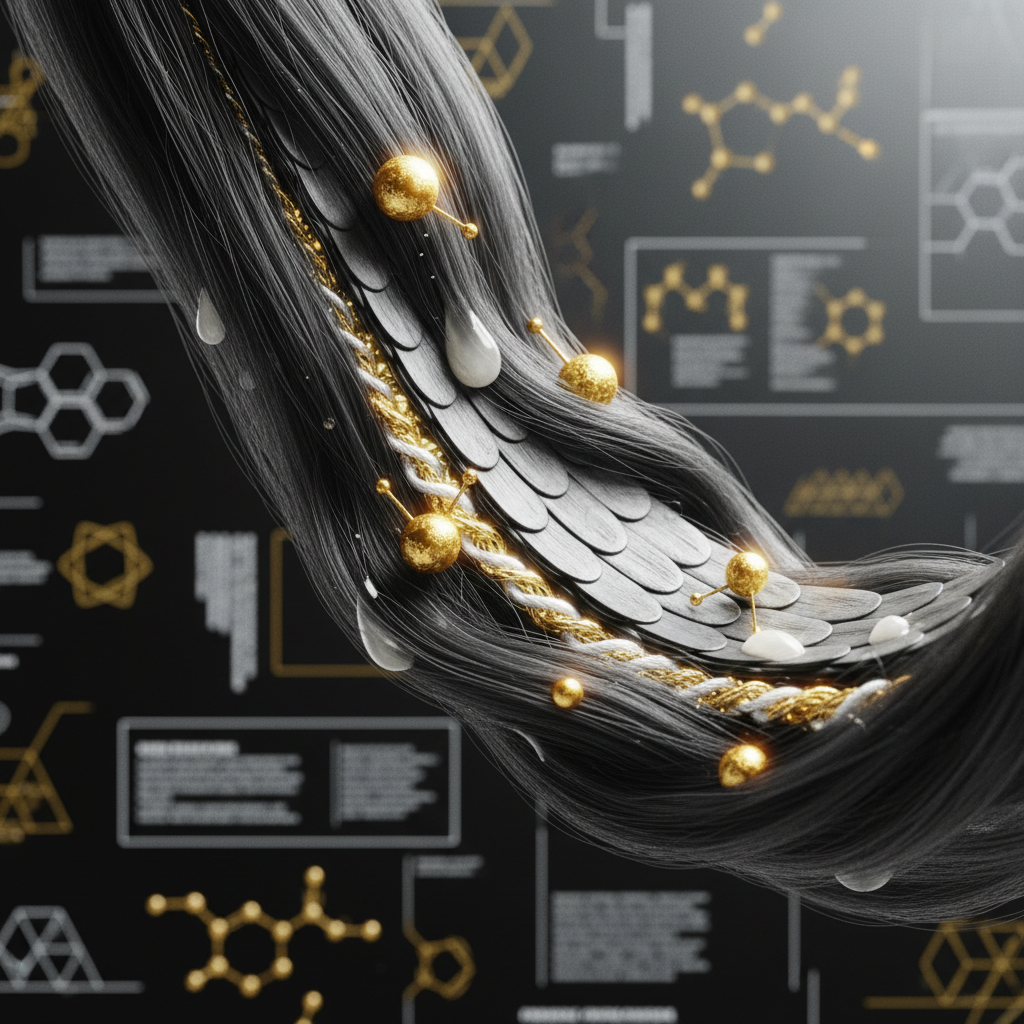
The biomechanics of elasticity depend on the alpha-helical coils of keratin residing within the cortex. When you pull a hair fibre, these spring-like coils uncoil into beta-sheet structures. As you release tension, the natural cross-links pull the structure back into its coiled formation.
Hydrolysed proteins interact with this mechanism in three specific ways:
1. Cuticle smoothing and lipid imitation
The loss of the 18-MEA lipid layer exposes the underlying hydrophilic keratin, creating porous pockets across the surface. Formulated proteins settle into these microscopic voids. By smoothing cuticle gaps, the treatment reduces inter-fibre friction and mechanical abrasion during brushing, which protects elasticity during routine handling.
2. Moisture buffering
Hydrolysed proteins are natural humectants. They contain polar amino acid side chains (such as glutamic acid, aspartic acid, and arginine) that hold water molecules close to the shaft. By regulating how quickly water enters and leaves the cortex, proteins prevent severe hygral fatigue, the repeated swelling and shrinking of the hair fibre that fractures the internal cell membrane complex.
3. Reinforcing mechanical strength
While proteins cannot rebuild deep cortical architecture, superficial cortical diffusion reinforces the fibre's resistance to tensile deformation. The added mass distributes stretching stresses across a wider cross-sectional area, raising the minimum force required to break the fibre.
Protein vs moisture: matching treatment to hair condition
Achieving balanced hair elasticity requires identifying whether your hair lacks structural protein or plasticising moisture.
| Diagnostic Marker | Protein-Deficient Fibre | Moisture-Deficient Fibre | Balanced Fibre |
|---|---|---|---|
| Wet Stretch Test | Stretches past 30%, feels mushy or gummy, does not spring back | Snaps almost immediately when pulled, zero stretch | Stretches up to 30%, returns smoothly to initial length |
| Dry Feel | Limp, flat, excessively soft, lacks bounce and body | Rough, brittle, straw-like, frizzy, velcro-like ends | Pliant, smooth, responsive to light manipulation |
| Primary Causes | Bleaching, high-pH chemical services, intense heat damage | Low humidity, high-sulfate cleansers, absence of conditioning | Balanced cleansing, regular conditioning, low heat |
| Corrective Action | Concentrated hydrolysed protein reconstructor followed by light conditioner | Deep conditioning mask rich in humectants (glycerin, aloe) and fatty alcohols | Maintenance wash and conditioning routine |
| Frequency | Every 2 to 4 weeks until tensile strength normalises | Weekly or bi-weekly conditioning sessions | Once weekly or as needed |
How to test and restore hair elasticity at home
You do not need a professional tensile laboratory to assess your hair fibre health. A simple manual stretch test gives reliable insight into whether a protein treatment is warranted.
- Cleanse thoroughly: Wash a small section of hair with a gentle clarifying cleanser to remove silicones, oils, and styling polyquats that mask true fibre properties.
- Perform the wet stretch test: Take a single shed strand or isolate an intact strand near your crown while the hair is damp. Hold the strand firmly between the thumb and forefinger of both hands, leaving approximately 3 to 5 cm of exposed hair in the middle.
- Apply gentle, steady tension: Pull outward slowly. Observe the strand:
- If it stretches easily without resistance, feels stringy, and fails to rebound, your hair lacks tensile integrity. A hydrolysed protein treatment is appropriate.
- If it snaps instantly with little to no resistance, the strand lacks elasticity due to dryness or protein stiffness. Do not apply protein; apply a deep hydrating mask with emollient lipids.
- If it extends slightly, offers resistance, and bounces back to shape when released, your elasticity is balanced.
- Application guidelines: If using a protein reconstructor, apply it to clean, damp hair and leave it on for 10 to 20 minutes (or as directed by the product instructions). Always follow protein-dense treatments with an emollient-rich conditioner (containing cetyl alcohol, stearyl alcohol, or natural plant oils) to prevent surface stiffness.
When the cause may be something else
If your hair is breaking along the shaft despite diligent elasticity management, protein levels might not be the problem. Other causes of mechanical fragility include:
- Hard water mineral deposits: Elevated concentrations of calcium and magnesium salts (above 180 mg/L) can crystallise on the cuticle surface, causing extreme brittleness that mimics protein overload. A chelating wash is necessary to dissolve these mineral coats.
- Heat tool abuse: Styling with irons heated above 185°C produces structural voids inside the cortex that no cosmetic protein can patch. The solution is lowering thermal tool temperatures and applying a verified heat protectant.
- Underlying medical and nutritional issues: Weak, fine, or friable new hair growth can stem from iron deficiency, thyroid dysfunction, or severe protein malnutrition. If you notice diffuse shedding at the root rather than mid-shaft snapping, consult a GP or trichologist.
Supporting resilient hair with Watermans
Maintaining the balance between hair elasticity and tensile strength starts with a clean, stimulated scalp and fortified fibres. Watermans GrowMe Shampoo is formulated to support thinning or fragile strands by incorporating targeted peptides and revitalising ingredients like hydrolysed lupin protein, biotin, caffeine, rosemary extract, and niacinamide.
Following with Watermans ConditionMe Conditioner provides the necessary slip, hydration, and lipid conditioning agents to ensure that revitalised fibres remain pliable, smooth, and resistant to mechanical snapping during daily styling.
Frequently asked questions about Protein Treatments and Hair Elasticity
What is the exact role of Protein Treatments and Hair Elasticity?
In the discussion of Protein Treatments and Hair Elasticity, protein treatments serve as structural reinforcements. Hydrolysed proteins adhere to damaged cuticles and outer cortical regions via electrostatic bonding, helping restore tensile strength to over-stretched, gummy hair so it can resist snapping under normal mechanical stress.
Can a protein treatment cure split ends permanently?
No. Protein treatments cannot weld split ends back together permanently. While hydrolysed proteins and conditioning polymers can temporarily cement split fibres down for a smoother appearance across one or two wash cycles, physical trimming remains the only definitive cure for fractured ends.
What causes protein overload, and how do you fix it?
Protein overload happens when high concentrations of hydrolysed protein are applied too frequently without adequate humectants and conditioning emollients. The excess protein forms a brittle, unyielding layer on the shaft, preventing moisture absorption. To fix it, pause all protein-containing products and use a clarifying shampoo followed by multiple deep moisturising treatments.
How often should I apply a protein reconstructor?
For moderately damaged or chemically processed hair, using a protein reconstructor once every 2 to 4 weeks is generally sufficient. Undamaged or low-porosity hair rarely requires intensive protein treatments; using them once every 6 to 8 weeks, or relying solely on lightly balanced regular conditioners, prevents fibre stiffness.
How do I know if my hair needs protein or moisture?
Perform a gentle wet stretch test on an isolated, clean strand. If the strand stretches out like chewing gum, feels soft, and snaps without returning to length, it requires protein. If the strand feels stiff, snaps immediately with no stretch, or feels dry and coarse, it needs moisture.
Balancing Protein Treatments and Hair Elasticity
Managing Protein Treatments and Hair Elasticity is an ongoing balancing act between mechanical strength and flexible moisture. Hair is a dynamic biomaterial that responds directly to chemical, thermal, and environmental stress. By monitoring how your hair stretches, feels, and responds to manipulation, you can tailor your use of hydrolysed proteins to reinforce fragile areas while avoiding the brittleness of over-application. Pair targeted protein treatments with rich, emollient conditioning to keep your hair resilient, shiny, and structurally sound.
Sources and references
- Robbins, C. R. (2012). Chemical and Physical Behavior of Human Hair (5th ed.). Springer-Verlag.
- Dawber, R. (1996). Hair: Its structure and response to cosmetic preparations. Clinics in Dermatology, 14(1), 105-112.
- Barba, C., et al. (2010). Water content influence on mechanical properties of human hair. Thermochimica Acta, 503, 33-39.
- Cruz, C. F., et al. (2016). Human hair characteristics and methods of evaluation: A review. International Journal of Cosmetic Science, 38(5), 443-449.
- Cosmetic Ingredient Review (CIR) Expert Panel. (2014). Safety Assessment of Hydrolyzed Proteins as Used in Cosmetics. International Journal of Toxicology.