The Complete Guide to Protein-Moisture Balance in Haircare
9 min read ·
Learn what Protein-Moisture Balance means for hair strength, how to spot protein overload versus hygral fatigue, and how to restore fibre elasticity.
Quick answer: The concept of Protein-Moisture Balance describes the functional relationship between the structural keratin matrix of the hair shaft and its internal water content. Hair requires cortical proteins to provide tensile strength and elasticity, alongside lipids and water to maintain flexibility and softness. When hair has too much hydrolysed protein relative to conditioning agents, it becomes brittle and snaps. When over-hydrated without sufficient structure, it becomes mushy and weak. Restoring balance involves adjusting topical treatments to match fibre porosity.
Key takeaways
- Healthy hair relies on an equilibrium between internal keratin cross-links (strength) and water retention within the cortex (suppleness).
- True moisture in hair refers to bound water, regulated by the cuticle layer and cortical lipids, not superficial wetness.
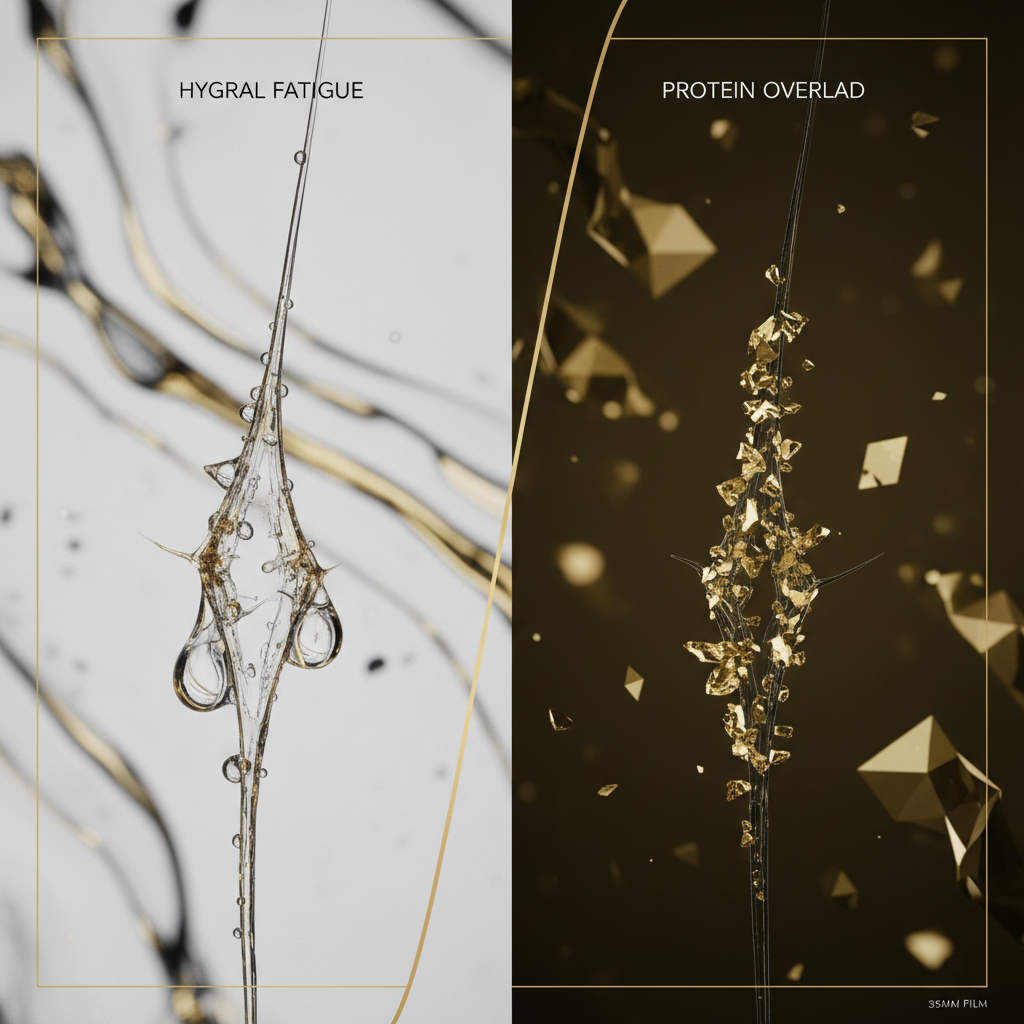
- Protein overload causes hair to feel stiff, straw-like, and snap under tension due to an over-accumulation of film-forming proteins.
- Hygral fatigue (moisture overload) happens when the fibre repeatedly swells and contracts with water, weakening cell membrane complexes.
- Porosity determines how rapidly hair absorbs and loses both water and cosmetic proteins.
Protein-Moisture Balance: what the evidence shows
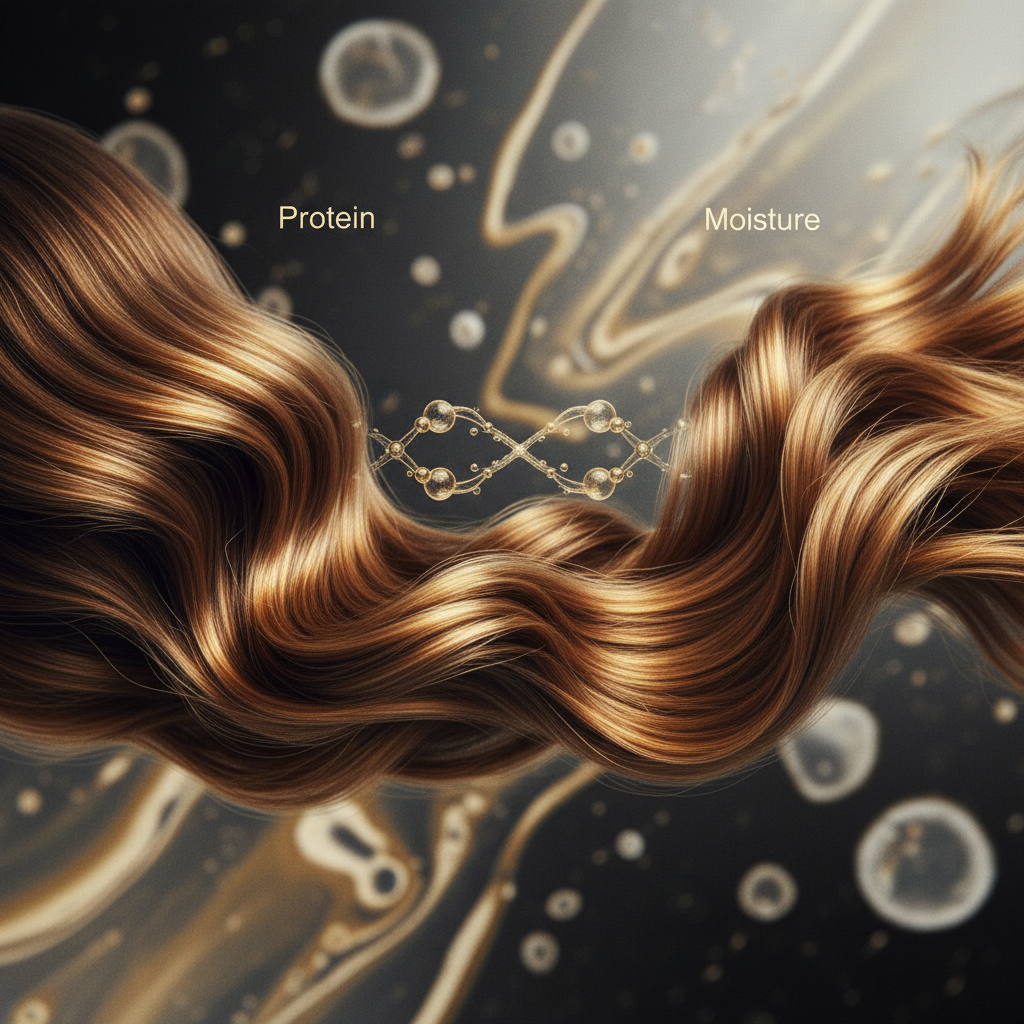
The term Protein-Moisture Balance is primarily a cosmetic and trichological framework rather than a clinical diagnosis, but it is rooted firmly in fibre biophysics. Human hair is composed of roughly 85% to 90% keratin proteins, 10% to 15% water (depending on ambient relative humidity), and small amounts of lipids, trace minerals, and melanin.
Cosmetic science demonstrates that hair fibre mechanical properties depend directly on this relationship:
- Tensile strength: Derived from the cortex, where keratin intermediate filaments are embedded in an amorphous, cystine-rich protein matrix. Disulphide bonds and hydrogen bonds give hair the ability to stretch up to 30% of its dry length before breaking.
- Elasticity and plasticisation: Water acts as a natural plasticiser inside the hair fibre. Bound water softens the keratin matrix, allowing hydrogen bonds to slide, yield, and reform under physical movement without fibre fracture.
- Cuticle integrity: The protective 18-methyleicosanoic acid (18-MEA) lipid layer on the epicuticle repels excess water while keeping endogenous moisture sealed inside.
When external stressors like bleaching, thermal styling, or UV radiation strip the protective lipid layer and break internal disulphide bonds, the fibre becomes porous. Hydrolysed proteins applied via cosmetics temporarily patch these micro-defects in the cuticle and cortex, while emollients and humectants regulate water exchange. Achieving balance means providing enough protein to reinforce compromised structures without crowding out the water molecules needed for flexibility.
What the evidence does not show
Popular hair forums often oversimplify hair mechanics into a strict 50/50 ratio. Current trichological research highlights several misconceptions:
- Shampoo cannot permanently repair split ends: Hydrolysed wheat, soy, or keratin proteins adsorb to the hair surface via ionic attraction and hydrogen bonding. They wash away over repeated cleanses and do not physically rebuild permanent disulphide bonds.
- Water alone does not "moisturise": Submerging dry hair in plain water actually increases swelling stress. Without conditioning agents (cationic surfactants, fatty alcohols, and oils) to control water movement, repeated wetting dehydrates the cortex further as unbound water evaporates.
- Not all proteins act identically: Low molecular weight proteins (under 1,000 Daltons) can penetrate past the cuticle into the cortex to reinforce tensile properties. High molecular weight proteins remain on the surface, acting as film-formers that increase stiffness and shine.
| Condition | Primary Cause | Fibre Texture | Wet Elasticity Test | Primary Remedy |
|---|---|---|---|---|
| Protein Overload | Excessive use of hydrolysed protein treatments, keratin masks, or styling polymers. | Stiff, dry, coarse, snagging, straw-like feel. | Snaps immediately when stretched wet with zero give. | Clarify hair, pause protein products, use deep conditioning emollients. |
| Hygral Fatigue (Moisture Overload) | Over-conditioning, excessive soaking, leaving damp hair in protective styles, loss of structural proteins. | Limp, mushy, spongy, gummy, lifeless feel. | Stretches far beyond normal length, fails to bounce back, then breaks. | Apply structural protein treatments, reduce wet time, use light oils. |
| Balanced Fibre | Balanced routine matched to individual hair porosity and chemical history. | Smooth cuticle, pliable, soft yet strong. | Stretches roughly 20% to 30% when wet and springs back to original length. | Maintain current routine; alternating conditioning and strengthening formulas. |
The physical mechanisms: hygral fatigue vs protein overload
Understanding why hair misbehaves requires looking at how water and proteins alter the hair shaft at a microscopic level.
The mechanism of moisture overload (hygral fatigue)
When hair absorbs water, the diameter of the fibre swells by up to 14% to 16%, while its length increases by only 1% to 2%. In healthy hair with an intact cuticle and natural hydrophobic lipid barrier, this swelling is controlled.
In porous or over-conditioned hair, water rapidly floods the cortex. This repeated swelling and deswelling weakens the cell membrane complex (CMC), the intercellular "cement" that holds cortical cells and cuticle scales together. Over time, the fibre loses internal resilience, resulting in hygral fatigue. The hair feels soft when dry but turns gummy and weak when wet, breaking under minimal friction.
The mechanism of protein overload
Hydrolysed proteins adhere to negative charges on damaged hair fibres. In moderate amounts, they seal rough cuticle gaps and improve stiffness. However, frequent application of concentrated protein treatments creates a rigid, dense film over the cuticle layer.
This surface coating prevents environmental ambient moisture and conditioning emollients from penetrating the cortex. Without sufficient water to act as a plasticiser, the keratin chains cannot yield smoothly during combing or styling. The fibre loses its elasticity, becomes brittle, and suffers transverse fracturing (snapping cleanly across the shaft).
How to assess your hair at home
You do not need a laboratory tensile tester to evaluate your hair. Trichologists use simple tactile and mechanical assessments:
- The Wet Elasticity Test: Take a single strand of freshly washed, wet hair that has naturally shed (do not pluck live hairs). Hold it securely between the thumbs and forefingers of both hands. Gently pull the ends apart.
- If it snaps almost immediately with no stretch, your hair is showing signs of protein overload or severe dryness.
- If it stretches endlessly like wet chewing gum, feels mushy, and does not bounce back, your hair suffers from moisture overload.
- If it stretches slightly (about 20% to 30% of its length) and returns cleanly to its resting shape without breaking, your balance is optimal.
- The Tactile Dry Assessment: Run your fingers from root to tip down dry hair. Balanced hair feels pliable, soft, and consistent. Protein-heavy hair feels rough, crunchy, and wire-like. Over-moisturised hair feels excessively soft, limp, and lacks the structural body to hold a curl or wave pattern.
Practical steps to restore balance
Adjusting your hair regimen depends on which side of the spectrum your hair currently occupies.
If your hair has protein overload:
- Clarify the fibre: Use a chelating or clarifying shampoo containing gentle anionic surfactants to strip accumulated surface polymers and protein films.
- Halt protein treatments: Scan ingredient labels for terms like "hydrolysed keratin", "hydrolysed wheat protein", "amino acids", "collagen", or "silk protein". Set these products aside for 3 to 4 weeks.
- Introduce pure emollients: Apply rinse-off conditioners and masks rich in fatty alcohols (cetyl alcohol, stearyl alcohol), shea butter, argan oil, or panthenol.
- Use heat during conditioning: Gentle warmth (a warm towel or conditioning cap) helps open the cuticle scales slightly, allowing moisture to reach the rigid cortex.
If your hair has moisture overload:
- Incorporate hydrolysed proteins: Use a reconstructive leave-in spray or deep treatment containing small-chain amino acids and hydrolysed proteins to reinforce the internal matrix.
- Cut down on soaking: Avoid overnight conditioning masks or walking around with wet hair for hours. Blow-dry on a medium, controlled heat setting using a heat protectant to minimise time spent in a swollen, vulnerable state.
- Strengthen with film-forming humectants: Use lightweight formulations containing aloe vera, pectin, or light hydrolysed rice proteins that provide hold without waterlogging the shaft.
When breakage is not a balance issue
A change in fibre texture or increased snapping does not always stem from topical product ratios. Consider alternative causes:
- Chemical processing damage: Bleaching and permanent relaxers physically dissolve disulphide bonds. When these structural bonds are broken, no amount of balanced conditioning can restore the original fibre integrity; targeted bond builders or trimming damaged ends is required.
- Telogen effluvium: If you notice hair collecting in the shower drain with small white bulbs attached to the root, this is shedding from the follicle, not shaft breakage. Topical protein treatments will not resolve hormonal, nutritional, or stress-induced shedding.
- Hard water buildup: High concentrations of calcium and magnesium in domestic tap water bind to the cuticle, making hair feel brittle and straw-like, perfectly mimicking protein overload. A chelating wash or shower filter is needed in this scenario.
The Watermans perspective on fibre conditioning
Maintaining a healthy hair shaft starts with an environment that respects both the scalp microbiome and the structural needs of the fibre. Watermans formulations, such as the GrowMe shampoo and ConditionMe conditioner, incorporate balanced, hydrolysed proteins alongside nutrient-dense botanicals, caffeine, and rosemary.
Rather than overloading hair with heavy cosmetic polymers, ConditionMe delivers moisture alongside microscopic hydrolysed lupin and vegetable proteins that work across diverse hair types. This approach prevents excessive surface buildup, helping hair maintain natural pliability and tensile resilience without swinging into protein stiffness or hygral fatigue.
Frequently asked questions about Protein-Moisture Balance
What is the simplest test for Protein-Moisture Balance?
The wet elasticity test is the most reliable home assessment. Take a damp, shed hair strand and stretch it gently between your fingers. If it snaps instantly, it needs moisture and emollients. If it stretches excessively without springing back, it requires structural protein. Balanced hair stretches modestly and returns to its original length.
Can low-porosity hair experience protein overload faster?
Yes. Low-porosity hair has tightly overlapping, flat cuticle scales with minimal surface gaps. When heavy hydrolysed protein treatments are applied to low-porosity hair, the molecules cannot penetrate the cortex. Instead, they quickly form a stiff coating on the cuticle exterior, making low-porosity hair especially prone to brittleness and protein overload.
How often should I use protein treatments to maintain balance?
Frequency depends on your hair's processing history. Virgin, unprocessed hair rarely needs concentrated protein treatments more than once every 6 to 8 weeks. Chemically treated, bleached, or heat-styled hair benefits from gentle hydrolysed protein products every 2 to 3 weeks to reinforce damaged cuticle areas alongside regular emollient conditioning.
Does hygral fatigue cause permanent hair loss?
No. Hygral fatigue causes shaft breakage, not hair loss at the follicle. The condition weakens the hair shaft until it snaps mid-fibre. It does not damage the dermal papilla or interfere with hair growth cycles. Trimming fragile ends and adjusting washing routines resolves the issue as new hair emerges.
Maintaining optimal Protein-Moisture Balance
Achieving long-term Protein-Moisture Balance is an active process of reading your hair's physical cues and adjusting your routine to environmental and styling changes. Hair is a dead biological fibre once it emerges from the scalp; it cannot heal itself biologically, so its mechanical longevity relies on topical maintenance. By understanding the distinction between internal tensile strength and protective flexibility, you can tailor your routine to prevent breakage and keep your hair performing at its natural best.
Sources and references
- Robbins, C. R. (2012). Chemical and Physical Behavior of Human Hair (5th ed.). Springer Science & Business Media.
- Cruz, C. F., et al. (2016). "Human hair characteristics and methods to investigate hair properties." International Journal of Trichology, 8(3), 110 to 121.
- Dawber, R. (1996). "Hair: Its structure and response to cosmetic preparations." Clinics in Dermatology, 14(1), 105 to 112.
- Evans, T., & Wickett, R. R. (Eds.). (2012). Practical Modern Hair Science. Allured Business Media.
- National Institute for Health and Care Excellence (NICE). (2022). Alopecia - non-scarring: Scenario: Management of telogen effluvium. Clinical Knowledge Summaries.
Find these ingredients in Watermans products
- Aloe Vera: you will find this ingredient in our Curly Hair Conditioner.