Protecting Bleached Hair from Snapping: The Definitive Guide
9 min read ·
Learn the science of protecting bleached hair from snapping. Discover how chemical lightening weakens hair bonds and how to prevent mechanical breakage.
Quick answer: Protecting bleached hair from snapping requires restoring tensile strength, minimising wet friction, and preserving the lipid barrier of the fibre. Bleaching strips melanin by oxidising disulphide bonds in keratin, leaving hair porous, structurally compromised, and prone to mechanical fracture. Effective care relies on gentle cleansing, low-friction handling, conditioning agents that reduce combing forces, and thermal restraint. While protective routines significantly reduce breakage rates, cosmetic products cannot permanently rebuild severed covalent bonds, meaning badly degraded hair must eventually grow out.
Key takeaways
- Bleaching chemically oxidises the disulphide bonds (cystine) that give hair its core tensile strength, leaving the cortex fragile.
- Hair is weakest when wet. The fibre can stretch up to 30 to 50 percent of its length before snapping, but bleached hair breaks at much lower strain thresholds.
- The protective 18-methyl eicosanoic acid (18-MEA) lipid layer is stripped during lightening, dramatically increasing cuticle friction and static.
- Protecting bleached hair from snapping involves a combination of hydrolysed proteins, film-forming conditioning agents, and strict mechanical caution.
- Hair snapping is physical fibre fracture (breakage) along the shaft, distinctly separate from follicular hair shedding or alopecia.
Protecting Bleached Hair from Snapping: what the evidence shows
Protecting bleached hair from snapping centres on managing the physical consequences of oxidative damage. Bleaching relies on alkaline agents (such as ammonium hydroxide, pH 9.0 to 11.0) and hydrogen peroxide to swell the cuticles and degrade melanin granules inside the hair cortex.
During this chemical reaction, the oxidiser does not discriminate between melanin and the structural proteins of the hair. Research published in the International Journal of Cosmetic Science demonstrates that bleaching converts cystine (a crucial amino acid containing disulphide bonds) into cysteic acid. Disulphide cross-links act as internal structural anchors; their loss decreases tensile strength by up to 20 to 50 percent, depending on the volume of developer used and the duration of processing.
Furthermore, bleaching removes the f-layer, a microscopic layer of fatty acids (predominantly 18-MEA) bound to the outer cuticle surface. Without this hydrophobic shield, the hair becomes intensely hydrophilic (water-absorbing). Hydrophilic hair absorbs ambient moisture rapidly, leading to cuticle swelling, lifted scales, and severe surface friction. When you run a comb through bleached hair, the inter-fibre friction is up to four times higher than in virgin hair, which is the primary mechanical trigger for mid-shaft snapping.
What the evidence does not show
Marketing claims surrounding bleached hair recovery often outpace cosmetic science. Controlled research shows:
- No product permanently "glues" snapped ends back together. Once a hair fibre snaps completely or splits down the cortex, the structural continuity is lost. Formulations containing silicones, polyquaterniums, or plant oils can temporarily seal cuticles and smooth edges, but the fix washes away.
- Bond-building ingredients do not make hair invincible. While dicarboxylic acids and maleic acid derivatives cross-link with free amine groups to reduce breakage during bleaching, they do not return lightened hair to virgin strength. Excessive heat styling or rough brushing can easily overpower this synthetic support.
- Protein treatments do not work universally. Applying excessive high-molecular-weight protein to highly porous, dry hair can cause surface stiffness. Without sufficient plasticising conditioning agents (such as fatty alcohols), this stiffness actually increases brittleness, leading to more snapping rather than less.
The physical signs of hair snapping
It is critical to distinguish between natural hair shedding and mechanical snapping. When hair sheds normally via the telogen phase, you will see a tiny white bulb (the keratinised root sheath) at the end of the full-length strand.
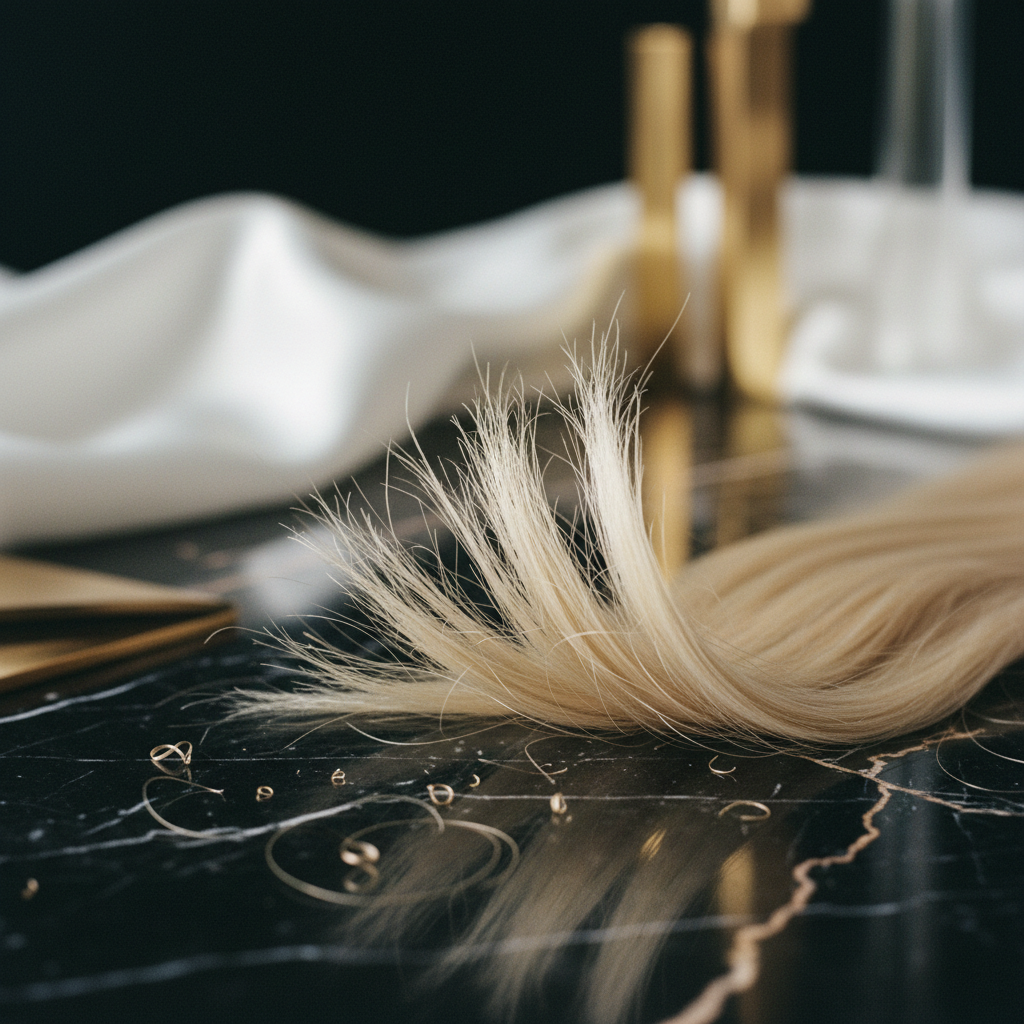
Snapping presents very differently:
- Short, jagged fragments of hair found on your clothes, pillows, or bathroom counter.
- White speckling along the hair shaft (trichorrhexis nodosa), where the cortical cells have fractured internally before snapping completely.
- A "chewy" or gummy texture when the hair is wet, stretching like elastic without springing back, followed by an immediate snap.
- Uneven, thinning ends around the crown, hairline, or nape where friction from brushing, tying, or sleeping is concentrated.
| Metric / Characteristic | Virgin Hair | Bleached Hair Prone to Snapping |
|---|---|---|
| Surface Nature | Hydrophobic (repels excess water) | Hydrophilic (absorbs excess water quickly) |
| Cuticle Condition | Flat, overlapping, tightly bound | Lifted, jagged, missing fragments |
| 18-MEA Lipid Layer | Intact | Largely or entirely removed |
| Cystine Content | High (strong disulphide cross-links) | Low (oxidised into cysteic acid) |
| Wet Tensile Strength | High elasticity and resilience | Extremely fragile; low break threshold |
| Combing Friction | Low baseline resistance | Up to 300 to 400% higher resistance |
What you can do to prevent bleached hair from snapping
Protecting bleached hair from snapping requires a systematic shift in how you wash, detangle, dry, and style your hair. Because chemical structural loss cannot be undone, your goal is to reduce physical stress below the lowered breaking threshold of the fibre.
1. Minimise wet manipulation
Hair fibres swell by up to 16 percent in diameter when submerged in water, and bleached hair swells even more due to high porosity. In this state, hydrogen bonds are temporarily dissociated, leaving the depleted disulphide bonds to bear mechanical strain alone.
- Never brush bleached hair while it is soaking wet without a high-slip conditioner or detangling spray.
- Use a wide-toothed seamless comb or a flexible-bristle detangling brush, starting from the tips and working upward in small sections.
- Blot gently with a microfibre towel or cotton cloth. Rubbing hair aggressively with a standard terrycloth towel creates shear stress that snaps weakened cuticles instantly.
2. Lower surface friction with conditioning lipids
Because bleaching strips the natural 18-MEA lipid layer, you must artificially restore slip. Use rinse-out conditioners and leave-in products rich in fatty alcohols (cetyl alcohol, stearyl alcohol) and conditioning polymers (such as polyquaternium compounds). These ingredients deposit a thin, lubricating film over the cuticles, lowering wet and dry combing friction by more than 60 percent and directly preventing mid-shaft fractures.
3. Balance moisture with hydrolysed micro-proteins
While high-molecular proteins can make hair stiff, hydrolysed wheat, soy, or keratin proteins (with molecular weights under 1,500 Daltons) can penetrate past lifted cuticles into the cortex. Here, they temporarily fill structural voids, support moisture retention, and increase the force required to snap the fibre. Alternate protein treatments with deep, emollient conditioning masks to keep the hair pliable.
4. Impose strict thermal boundaries
Excessive heat accelerates the denaturation of remaining keratin proteins. If you must use heated tools:
- Keep blow-dryers moving on medium heat, finishing with a cool shot to settle cuticles.
- Restrict flat irons and curling wands to temperatures below 160°C.
- Always apply a heat protectant containing polymers (like dimethicone or PVP/DMAPA acrylates copolymer), which slow heat transfer and reduce cuticle cracking.
Watermans: cosmetic support for fragile hair
When managing fragile, bleached lengths, a healthy scalp and a gentle wash routine remain fundamental. Watermans GrowMe Shampoo and ConditionMe Conditioner offer a balanced, cosmetic approach for hair under stress. Formulated without harsh sulphates that can aggressively strip compromised cuticles, GrowMe delivers gentle cleansing alongside ingredients like biotin, rosemary, caffeine, and hydrolysed lupin protein to support a healthy-looking scalp environment.
Paired with ConditionMe, which features cholesterol, niacinamide, and softening conditioning agents, this routine helps smooth the outer shaft, improve manageability, and reduce the friction that leads to mechanical snapping. While no topical wash can reverse chemical oxidation, supporting the hair fibre with balanced slip and mild surfactants helps preserve fragile lengths as healthy new growth emerges.
When the cause may be something else
If you notice significant shedding alongside hair snapping, bleaching may not be the sole contributor.
- Telogen effluvium: A temporary shedding disorder triggered by high fevers, systemic illness, surgery, nutritional deficiencies (such as ferritin or vitamin D), or acute psychological stress. This causes hair to shed from the root, not snap along the shaft.
- Traction alopecia: Persistent physical tension from tight ponytails, braids, or heavy extensions pulls the hair follicle itself, leading to inflammation and eventual loss around the hairline.
- Chemical over-processing versus thermal burning: If hair snaps immediately at the scalp line after salon treatment, this usually indicates an acute chemical burn or severe over-processing (relaxer or bleach left on too long), requiring immediate neutralisation rather than home conditioning routines.
When to seek professional advice
Visit a dermatologist, trichologist, or experienced hair professional if:
- Hair is breaking in large clumps close to the scalp, leaving visible bald patches.
- The scalp shows signs of chemical burns, persistent erythema (redness), weeping, crusting, or burning sensations following a bleaching service.
- You are unsure whether you are experiencing root shedding or shaft breakage, as treatments for follicular conditions differ completely from cosmetic fibre repair.
Frequently asked questions about Protecting Bleached Hair from Snapping
How long does it take to stop bleached hair from snapping?
You can reduce mechanical snapping almost immediately by adopting low-friction detangling, applying leave-in conditioning agents, and ceasing direct heat styling. However, because bleached hair has sustained permanent internal oxidation, the fragile sections will remain vulnerable until healthy, unbleached hair grows out to replace them, which takes several months based on average growth rates of 1 to 1.25 cm per month.
Can coconut oil stop bleached hair from snapping?
Pure coconut oil contains lauric acid, which can penetrate the hair cortex and reduce protein loss during washing. However, it cannot repair broken disulphide bonds. When used alone on brittle, bleached hair without humectants or conditioning detanglers, coconut oil can leave strands feeling stiff, which sometimes increases snapping during brushing.
What is the most critical step in protecting bleached hair from snapping?
The most critical step in protecting bleached hair from snapping is eliminating aggressive mechanical force when the hair is wet. Bleached hair has significantly degraded tensile strength, meaning vigorous towel-rubbing, rough combing without slip, or aggressive blow-drying will fracture the cuticles and snap the weakened cortex far more easily than when hair is dry.
Does Olaplex or similar bond builders permanently fix bleached hair?
No. Bond builders create synthetic cross-links that temporarily reinforce the internal structure of the fibre during and after lightening. While they dramatically reduce breakage when formulated correctly, these links are cosmetic and can degrade over time with repeated washing, mechanical manipulation, and environmental exposure. They do not permanently restore virgin hair architecture.
Managing bleached hair over time
Protecting bleached hair from snapping requires patience, realistic expectations, and an evidence-based approach to cosmetic maintenance. Chemical lightening fundamentally alters hair chemistry by stripping protective surface lipids and oxidising internal disulphide bonds. While you cannot permanently reverse this chemical modification, you can dramatically lower breakage rates by using high-slip conditioners, hydrolysed proteins, gentle microfibre drying, and conservative heat settings. By minimising physical friction and shielding vulnerable lengths, you give fragile hair the protection it needs to remain intact while healthy new growth emerges.
Sources and references
- International Journal of Cosmetic Science, "Chemical and physical changes in hair caused by bleaching", 2008.
- Journal of Cosmetic Dermatology, "Hair breakage: A review of etiology, evaluation, and prevention", 2020.
- Robbins, C. R., "Chemical and Physical Behavior of Human Hair", 5th Edition, Springer, 2012.
- British Association of Dermatologists, "Hair loss and hair breakage guidelines", 2021.
Find these ingredients in Watermans products
- Vitamin D: you will find this ingredient in our Hair Vitamins.
- Niacinamide: you will find this ingredient in our Hair Mask.