Preventing Hygral Fatigue in Hair: Scientific Causes, Signs, and Solutions
9 min read ·
Learn the science of preventing hygral fatigue in hair. Discover how water swelling damages the hair cortex, key signs of fatigue, and proven wash-day routines.
Quick answer: Preventing Hygral Fatigue in Hair requires minimising the repetitive swelling and contracting of the hair cortex caused by excessive water absorption. You can achieve this by limiting prolonged soaking, using penetrating hydrophobic oils like coconut oil as pre-shampoo treatments, balancing moisture with hydrolysed proteins, and keeping cuticle scales flat using pH-balanced products around pH 4.5 to 5.5. However, prevention cannot fully reconstruct already fractured internal keratin bonds; severely weakened fibres must eventually be trimmed as new growth emerges.
Key takeaways
- Hygral fatigue is structural fibre damage caused by repeated cycles of water sorption and desorption, not follicular hair loss.
- High-porosity, bleached, and chemically treated hair absorbs water faster and swells more intensely, putting it at the highest risk.
- Penetrating oils with high lauric acid content can reduce water absorption into the cortex when applied prior to washing.
- Leaving conditioning masks or water-based treatments on the hair overnight accelerates cuticle buckling and cellular membrane complex breakdown.
- Maintaining an acidic product pH (4.5 to 5.5) protects the lipid barrier and reduces excess cuticular swelling.
Preventing Hygral Fatigue in Hair: what the evidence shows
Preventing Hygral Fatigue in Hair centres on controlling how water interacts with the structural layers of the hair shaft. Hair is naturally hygroscopic, meaning it absorbs moisture from its surrounding environment. When dry hair is immersed in water, it can absorb up to 30% of its dry weight in water, expanding its radial diameter by roughly 14% to 16% while increasing in length by only about 1% to 2%.
When water repeatedly floods the hair cortex and subsequently evaporates, the interior structures expand and contract. Over time, this constant mechanical movement loosens cuticular scales, degrades the cell membrane complex (CMC), and leads to longitudinal cracking along the hair fibre.
Cosmetic science demonstrates that hair does not need endless soaking to stay healthy. In fact, prolonged water saturation disrupts hydrogen bonding within the keratin matrix. True moisture retention in cosmetic chemistry does not mean saturating the fibre with pure water; it means preserving natural elasticity, protecting structural lipids (especially 18-methyleicosanoic acid, or 18-MEA), and regulating moisture flux.
What the evidence does not show
The term hygral fatigue is frequently misunderstood online. Clarifying these scientific boundaries prevents counterproductive routines:
- It does not cause follicular hair loss: Hygral fatigue happens along the fibre. It causes hair breakage, chipping cuticles, and split ends. It does not cause hairs to shed prematurely from the dermal papilla, nor does it trigger telogen effluvium or pattern baldness.
- Water is not an absolute enemy: Hair requires a small baseline water content (roughly 10% to 15% at normal ambient relative humidity) to retain elasticity. Complete waterproofing is neither possible nor desirable.
- Protein treatments do not permanently fuse hair: Hydrolysed vegetable or wheat proteins temporarily adsorb to damaged gaps on the cuticle and penetrate outer layers to impart tensile strength, but they rinse away over subsequent washes. They are structural band-aids, not permanent cures.
The biological and physical mechanism
To understand how to protect your hair, you must understand the architecture of the fibre. The outer layer, the cuticle, consists of flattened, overlapping cells pointing towards the hair tip. These cells are sealed together by the cell membrane complex, a lipid-rich mortar composed of ceramides, free fatty acids, and cholesterol.
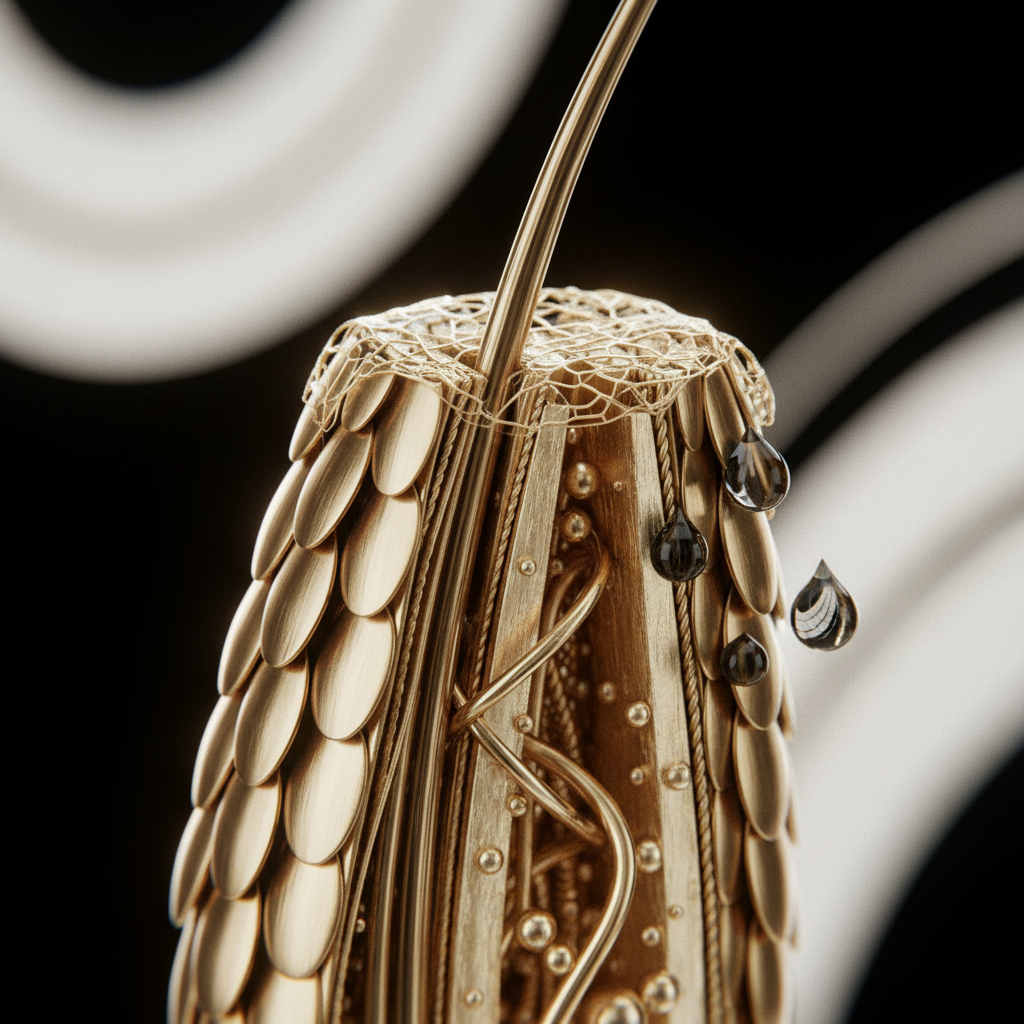
Beneath the cuticle lies the cortex, composed of parallel bundles of keratin microfibrils embedded in an amorphous, sulfur-rich matrix. The matrix contains hydrophilic proteins that greedily bind water molecules through hydrogen bonds.
When hair is submerged:
- Water breaks the secondary hydrogen bonds that stabilise the keratin chains.
- The amorphous matrix absorbs water and swells laterally.
- This swelling exerts severe outward pressure against the overlying cuticle scales.
- As the hair dries, the cortex shrinks back down, but the cuticle does not always return to its original flat configuration.
- With repeated cycles, the cell membrane complex fatigues, leading to delamination, lifting scales, and brittle failure under normal mechanical styling.
Bleached or heavily dyed hair is especially vulnerable. Chemical processing strips away the protective 18-MEA lipid layer, turning hydrophobic hair into a hydrophilic sponge that absorbs water rapidly and experiences intense dimensional strain.
Signs of hygral fatigue
Because hygral fatigue mimics other types of structural hair damage, watch for this distinct clinical presentation:
- Loss of mechanical elasticity: Hair feels overly soft, mushy, or gummy when wet. It stretches far past its resting state without snapping back, or snaps under minimal tension.
- Excessive tangling when wet: As cuticular scales fail to lie flat, opposing strands snag on each other, creating stubborn friction knots.
- Dull, matte appearance: Fractured cuticles scatter light erratically rather than reflecting it evenly.
- Puffiness that resists styling: As the cortex swells inconsistently along the shaft, the hair appears frizzy and cannot hold a smooth set.
| Characteristic | Hygral Fatigue | Protein Overload / True Dryness | Healthy Hair |
|---|---|---|---|
| Feel when wet | Gummy, limp, stretches excessively | Stiff, rough, snaps immediately | Smooth, firm, gentle natural spring |
| Porosity state | Excessively high, absorbs water instantly | Highly variable; often feels coated | Balanced porosity, absorbs water steadily |
| Cuticle condition | Eroded, chipped, raised | Often coated or rigid | Intact, laying flat, reflective |
| Response to moisture | Worsens; becomes mushier | Temporarily softens fibre | Maintains elasticity |
| Primary solution | Hydrophobic lipids, mild protein, fast drying | Emollient conditioners, clarifying, skipping protein | Consistent gentle cleansing and conditioning |
Actionable steps for preventing hygral fatigue in hair
Implementing targeted wash-day interventions can protect fragile hair fibres from destructive water cycles.
1. Apply a penetrating pre-shampoo oil
Non-penetrating mineral oils merely coat the surface, but triglycerides with short-to-medium chain fatty acids (such as pure coconut oil) possess a low molecular weight and linear structure that allow them to penetrate through the cuticle into the cortex.
Applying coconut oil 30 to 60 minutes before washing reduces the amount of water the cortex can absorb. This dramatically limits internal swelling while shielding the cell membrane complex from leaching out during surfactant exposure.
2. Avoid prolonged soaking and overnight conditioning
Leaving deep conditioning treatments, wet wraps, or leave-in mixtures on your head overnight under a plastic cap creates an extended high-humidity environment. This keeps the hair swollen for eight hours or more. Deep treatments achieve peak cosmetic deposition within 15 to 30 minutes. Extended contact provides no extra benefit and accelerates matrix fatigue.
3. Balance your regimen with hydrolysed proteins
Formulas containing hydrolysed wheat protein, keratin, or amino acids help reinforce the outer layers of the hair shaft. These small peptides temporarily occupy voids left by lifted cuticles, reducing porosity and moderating the speed of water ingress. Alternate protein-containing conditioners with simple emollient rinses based on your hair's current elasticity.
4. Respect the natural isoelectric point
Hair has an isoelectric point around pH 3.67. At this acidic pH, the net surface electrical charge of the hair is zero, cuticles remain tightly closed, and water uptake is lowest. Use shampoos and conditioners formulated within the pH 4.5 to 5.5 range. Strongly alkaline cleansers (such as bar soaps or clarifying shampoos above pH 7.0) force the cuticle open, leaving the cortex completely exposed to rapid fluid uptake.
5. Shorten drying time safely
Letting high-porosity hair air-dry for eight to ten hours keeps the fibre in a vulnerable, swollen state. Instead, gently squeeze excess water out with a smooth microfibre towel (never rub aggressively with terry cloth). Follow with a blow-dryer on a low-to-medium heat setting held at least 15 centimetres away. Moving air steadily dries the cortex efficiently without causing thermal flash-boiling.
When the cause is something else
If you notice significant shedding from your scalp, clumps in your shower drain, or patches where the scalp is visible, hygral fatigue is not the cause. Hygral damage manifests as snapped fragments along the shaft, often without the tiny white bulb (the root sheath) attached to the end.
If hairs possess a bulb, you may be experiencing telogen effluvium (diffuse shedding triggered by physiological stress, illness, hormonal shifts, or nutritional deficits) or androgenetic alopecia (gradual follicle miniaturisation). These conditions operate within the hair follicle under the scalp surface and cannot be caused by water swelling or prevented by pre-poo oils.
When to seek professional guidance
If you cannot correct mushy, snapping hair after adjusting your wash routine for four to six weeks, consult a qualified trichologist or an experienced salon professional. They can examine your hair under a trichoscope to evaluate cuticular erosion, confirm whether the issue is hygral fatigue or chemical over-processing, and recommend whether damaged ends must be trimmed to stop mechanical split ends from traveling upward.
If you notice sudden scalp inflammation, pain, or shedding exceeding 100 hairs daily, consult your GP or a dermatologist to screen for underlying medical triggers.
Supporting hair condition with Watermans
When managing hair that is vulnerable to mechanical stress and breakage, structural fibre care works hand in hand with scalp nutrition. Watermans focuses on non-invasive cosmetic formulas designed to support the appearance of stronger, fuller-looking hair.
Using gentle, balancing cleansers like Watermans GrowMe Shampoo helps remove debris and buildup without relying on harsh alkaline mechanics that rip open the hair cuticle. Paired with conditioning routines that supply lightweight moisture and strengthen fragile lengths against daily styling, supporting your hair's resilience from the root to the tip ensures that each strand is primed to withstand everyday handling.
Frequently asked questions about Preventing Hygral Fatigue in Hair
Can low-porosity hair experience hygral fatigue?
It is rare, but possible. Low-porosity hair has tightly overlapping cuticles that naturally resist rapid water entry. However, if low-porosity hair is repeatedly soaked for hours, subjected to intense heat steaming that forces cuticles open, or left in wet protective styles for days, it can still suffer cellular membrane damage.
How often should I apply a pre-wash treatment for Preventing Hygral Fatigue in Hair?
If you have bleached, relaxed, or highly porous hair, applying a penetrating pre-shampoo treatment before every major wash day is usually safe and effective. If your hair is untreated or normal porosity, using a pre-wash oil once every two to three weeks is sufficient to protect lipid reserves without causing buildup.
Does hygral fatigue make hair permanently unfixable?
Cosmetic products cannot permanently re-weld shattered cortex bonds or re-glue detached cuticles. Conditioners, acidic rinses, and hydrolysed proteins can temporarily patch damage, preserve moisture balance, and stop further snapping, but severely compromised ends must ultimately be trimmed away as healthier hair grows in.
Is air-drying better than blow-drying to avoid hygral fatigue?
Not necessarily. While high heat causes direct thermal damage, leaving porous hair wet for long periods keeps the cortex swollen and mechanically weak for hours. The optimal approach is gently blotting with a microfibre towel, applying a heat protectant, and blow-drying on a warm, low setting to return hair to its dry, stable state quickly.
Conclusion
Understanding the structural mechanics of your hair is the foundation of preventing hygral fatigue in hair. Hair fibres require a delicate equilibrium: enough hydration to maintain elasticity, but sufficient lipid protection to prevent uncontrolled swelling and matrix fatigue. By curtailing extended water exposure, avoiding overnight soaking, maintaining an acidic pH, and employing penetrating pre-shampoo oils, you can protect your hair cuticle and keep your lengths resilient against premature breakage.
Sources and references
- Journal of Cosmetic Science: "Secondary ion mass spectrometric investigation of penetration of coconut and mineral oils into human hair fibres" (2001).
- International Journal of Cosmetic Science: "Hair breakage in normal and weathered hair: focus on the impact of water and treatments" (2009).
- British Association of Dermatologists: "Hair structure, weathering, and cosmetic damage guidelines" (2020).
- Journal of the Society of Cosmetic Chemists: "The effect of water on the mechanical properties of human hair" (1993).
- Clinics in Dermatology: "Hair cosmetics: An overview" (2015).