Preventing Hair Breakage and Mechanical Stress: An Evidence-Based Guide
9 min read ·
Learn the science of Preventing Hair Breakage and Mechanical Stress. Discover how tension, friction, and detangling habits impact fibre integrity and tensile strength.
Quick answer: Preventing Hair Breakage and Mechanical Stress requires reducing external friction, moderating tension from styling tools, and preserving the hair fibre's protective cuticle layer. Hair breakage occurs when mechanical forces exceed the tensile strength of the hair shaft, causing it to snap rather than shed from the root. While conditioning agents and gentle handling practices dramatically lower friction and improve fibre elasticity, they cannot permanently fuse or biologically repair a cortex that has already fractured across its diameter.
Key takeaways
- Mechanical stress strips the lipid-rich F-layer and lifts outer cuticle scales, exposing the fibrous cortex to fractures.
- Wet hair swells and weakens, dropping its yield point and making it twice as vulnerable to stretching and snapping during detangling.
- Traction from tight ponytails, elastic bands, rough towel drying, and fine-toothed combs represents the most common source of physical damage.
- Conditioning agents lubricate the shaft, cutting combing forces by up to 50 percent and preventing friction-induced breakage.
- Hair breakage must be distinguished from hair shedding (telogen effluvium) and hair loss (alopecia), as physical fibre fracture requires mechanical solutions rather than follicle-focused treatments.
Preventing Hair Breakage and Mechanical Stress: what the evidence shows
Preventing Hair Breakage and Mechanical Stress starts with understanding how external physical forces degrade the structural integrity of the hair fibre. Research published in cosmetic dermatology and textile science demonstrates that repeated combing, brushing, tension styling, and fabric friction wear down the external cuticle scales. The human hair fibre can typically withstand substantial tensile strain when healthy, tolerating an elongation of roughly 30 percent in dry conditions before irreversible structural deformation occurs. However, repeated sub-lethal forces gradually cause fatigue stress.
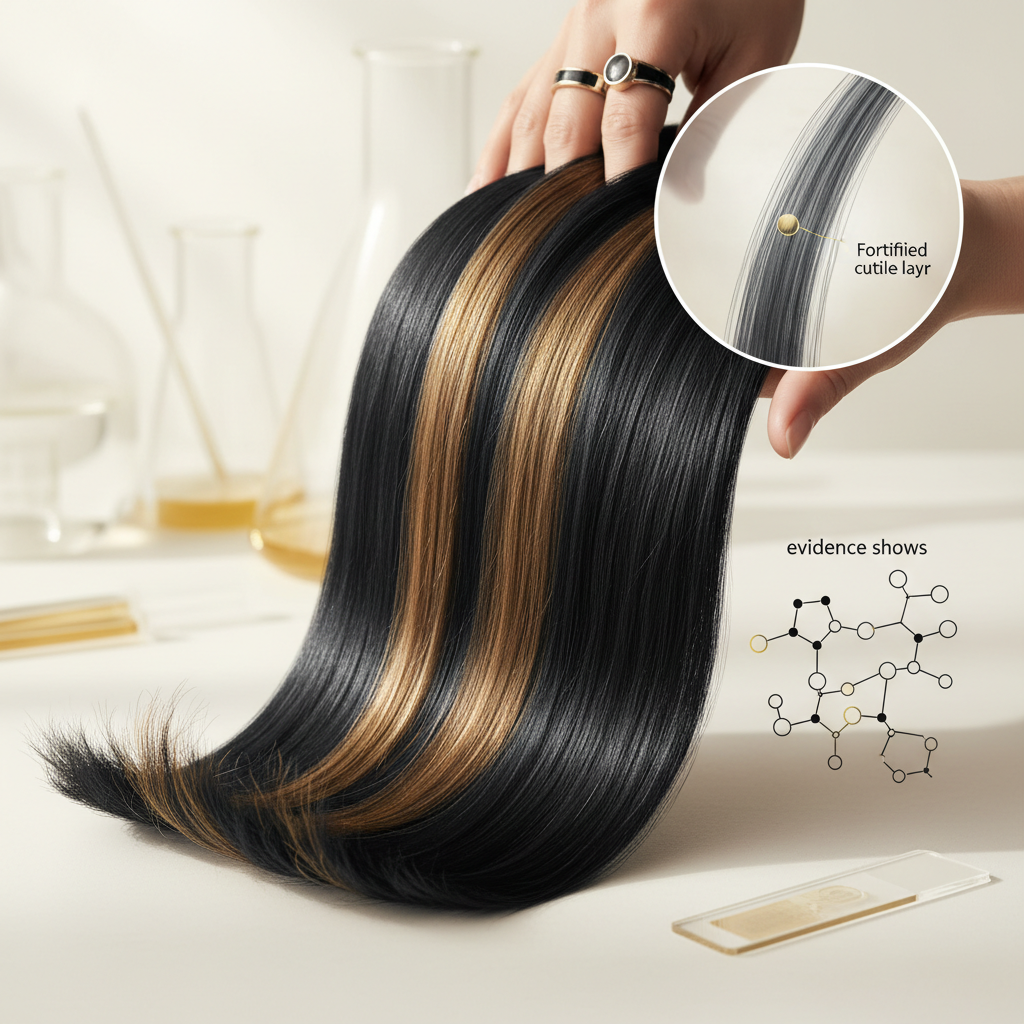
When you drag a comb through knotted hair, friction strips the 18-methyleicosanoic acid (18-MEA) monolayer, which is the natural lipid barrier providing surface lubricity. Once this barrier erodes, the friction coefficient between adjacent hair fibres spikes dramatically. Controlled tribology measurements show that untreated, damaged hair requires significantly higher combing force to separate strands. This force concentrates along points of mechanical resistance, leading to longitudinal fissures, split ends (trichoptilosis), and transverse fractures along the cortex.
The mechanical forces that cause hair breakage
Physical hair damage does not occur in a vacuum. It results from three primary mechanical forces interacting with the hair shaft:
Friction and shear stress
Friction occurs whenever an object moves across the surface of the hair shaft. Brushing, backcombing, rubbing with rough cotton towels, and tossing against abrasive pillowcases generate shear stress. This lifts the edges of the 6 to 10 overlapping cuticle layers that encase the cortex. Once lifted, these scales chip away, leaving raw cortical cells exposed to atmospheric humidity, ultraviolet radiation, and everyday friction.
Tensile strain and stretching
Tensile stress refers to the pulling force applied down the length of the strand. Hair behaves as a viscoelastic material: it stretches under force and recovers its original length if the force remains below its yield point. When subjected to excessive tension, such as tight braiding, firm ponytails, or aggressive detangling of stubborn knots, the alpha-helical keratin proteins within the cortex unfold into beta-pleated sheets. If the force exceeds roughly 30 to 40 percent elongation, the internal matrix fractures permanently, causing immediate snapping.
Torsion and twisting
Torsion occurs during twisting, curling, and tight plaiting. Twisting puts uneven strain on opposite sides of the hair shaft. When combined with dry fibre conditions or chemical processing, torsion readily generates structural flaws along the shaft known as trichorrhexis nodosa, where the fibre blows out sideways like two paintbrushes pressed together.
| Type of Mechanical Stress | Common Everyday Causes | Structural Impact on Fibre | Visible Result |
|---|---|---|---|
| Friction / Abrasion | Vigorous towel rubbing, cotton pillowcases, plastic bristle brushes | Cuticle scale chipping, loss of surface 18-MEA lipid layer | Dullness, surface frizz, rough texture |
| Tensile Force | Tight hair elastics, pulling through knots, extensions | Cortical keratin chain deformation, yield point failure | Mid-shaft snapping, white dots at snap points |
| Torsion / Twisting | Tight twists, aggressive round-brush blow drying, backcombing | Longitudinal fissures, split ends, cell-membrane complex separation | Trichoptilosis, frayed ends, uneven lengths |
| Hydrothermal Stress | Brushing saturated hair under hot blow-dryer tension | Weakened hydrogen bonding, cortex softening, tensile drop | Stretched strands that fail to spring back |
Wet hair versus dry hair: the structural difference
Hair behaviour alters completely when exposed to water, which fundamentally changes how you must approach mechanical handling. The keratin structure of dry hair is stabilised by three types of chemical bonds: disulfide bonds, salt bridges, and hydrogen bonds. While disulfide bonds are strong covalent links, hydrogen bonds are weak and easily broken by water molecules.
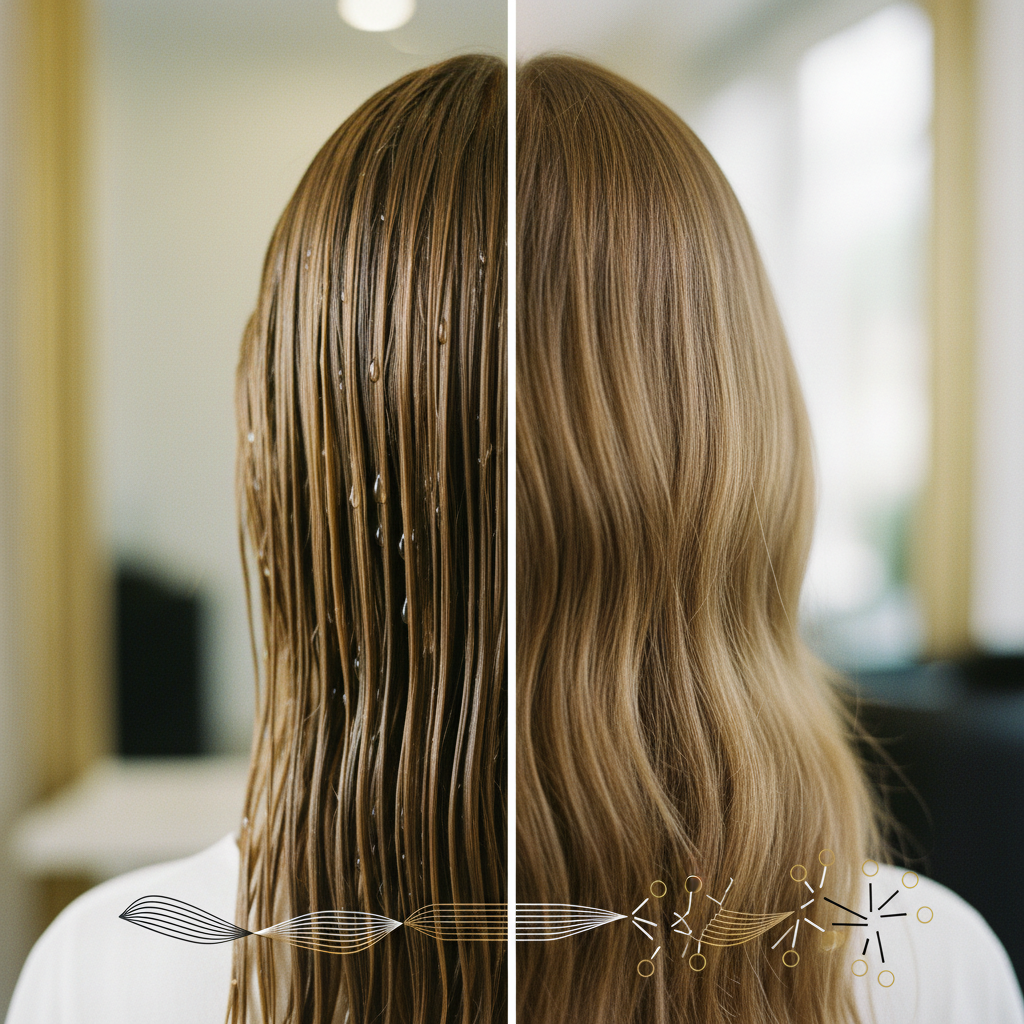
When hair absorbs water, it can hold up to 30 percent of its dry weight in moisture. This intake causes the hair shaft to swell radially by roughly 14 to 16 percent. The influx of water disrupts millions of hydrogen bonds, temporarily plasticising the cortex. Consequently, wet hair requires far less force to stretch, meaning its yield point is significantly lower than that of dry hair.
However, wet hair also possesses a higher friction coefficient because the swollen cuticle scales do not glide smoothly against one another. If you comb wet hair without adequate slip or conditioning lubricants, you combine elevated surface friction with a weakened internal cortex. This combination is a primary recipe for immediate mechanical snapping.
What the evidence does not show
There is no evidence that cosmetic products, botanical oils, or protein masks can biologically heal, regenerate, or permanently re-weld snapped hair fibres. Hair is a non-living, biologically dead filament once it exits the scalp follicle. The cortex contains no living cells, vascular supply, or nerve endings capable of biological repair.
Furthermore, physical stress cannot be blamed for internal metabolic hair shedding. Mechanical breakage must never be confused with telogen effluvium, anagen effluvium, or androgenetic alopecia. If your hair is falling out with a small white keratin bulb at the tip, that hair has completed a biological shedding cycle from the follicle base. Mechanical breakage produces fractured fragments of varying lengths, usually without a bulb at the root.
Practical steps for reducing mechanical stress
Protecting your hair from mechanical damage relies on reducing friction, maintaining moisture balance, and choosing appropriate tools:
- Detangle from ends to roots: Never drag a comb from the scalp downwards. Working in small sections from the tips upwards relieves knots without compounding tension down the shaft.
- Use wide-toothed, seamless tools: Avoid cheap plastic combs with rough mould seams down the centre of each tooth, as these act like micro-saws against the cuticle. Choose seamless combs or flexible-bristle detangling brushes.
- Ditch rough cotton towels: Standard terry-cloth cotton loops snag cuticles. Blot gently with a smooth microfibre towel or a soft cotton t-shirt to remove excess water without abrasive rubbing.
- Incorporate leave-in conditioning slip: Applying a water-in-oil emulsion or conditioning spray creates a microscopic lipid film over the hair shaft, reducing combing force by smoothing down cuticle edges.
- Switch to low-friction sleep surfaces: Silk or satin pillowcases cut shear friction while you sleep, preventing the tangles that prompt aggressive morning brushing.
- Select snag-free hair ties: Replace uncovered rubber bands and metal-clasped elastics with silk scrunchies or spiral telephone-cord ties that distribute tension across a broader surface area.
The role of targeted haircare: Watermans
When managing hair that feels fragile and prone to snapping, everyday washing routines play an important supporting role. Watermans formulates products designed to clean effectively while respecting the hair's surface integrity. Using balanced cleansers avoids stripping essential surface lipids, which in turn keeps cuticle friction low during the wash cycle. Combining gentle washing with Watermans conditioners helps deliver lightweight conditioning agents that coat the fibre, making detangling smoother and reducing the mechanical pulling forces that lead to breakage. While no wash product replaces careful mechanical handling, supporting strand lubricity helps hair feel stronger and look noticeably healthier.
When the cause may be something else
Sometimes, hair snaps despite meticulous physical care. When breakage occurs under minimal mechanical force, an underlying internal or chemical vulnerability is usually responsible:
- Chemical over-processing: Bleaching, high-lift colouring, permanent waves, and chemical relaxers break disulfide bonds within the cortex. If too many of these bonds are permanently cleaved, the tensile strength collapses, and even gentle brushing causes widespread breakage.
- Thermal degradation: Using curling wands, flat irons, or blow dryers at temperatures exceeding 180 degrees Celsius degrades structural keratin proteins and boils free moisture within the fibre, creating internal steam bubbles known as "bubble hair."
- Nutritional deficiencies: Severe protein-energy malnutrition, iron deficiency anaemia, or extreme zinc depletion can compromise the quality of keratin during initial matrix formation in the follicle.
- Underlying medical conditions: Thyroid disorders (hypothyroidism in particular) alter hair fibre diameter, producing brittle, dry shafts that snap under regular handling.
Frequently asked questions about Preventing Hair Breakage and Mechanical Stress
How does Preventing Hair Breakage and Mechanical Stress differ from treating hair loss?
Preventing Hair Breakage and Mechanical Stress addresses physical trauma to the non-living fibre along the shaft, whereas treating hair loss involves biological interventions at the dermal papilla within the follicle. Breakage results in short, snapped strands with blunt or frayed ends, while follicular hair loss involves the entire hair strand shedding with its root bulb intact.
Is it better to brush hair wet or dry?
It depends on your hair pattern. Straight and wavy hair is strongest when dry, so detangling before washing or when fully dry reduces tensile failure. Conversely, tight curls and afro hair have high natural inter-fibre friction and dry knotting; these patterns are best detangled damp or wet with generous conditioner to provide necessary slip.
Can split ends ever be repaired without cutting?
No. Split ends represent a complete structural fracture of the cuticle and cortical cell bundles. While cosmetic serums containing polymers or silicones can temporarily glue the split fibres together until the next wash, the mechanical damage remains. Trimming the split ends is the only permanent solution to stop fissures travelling upward.
How much combing force can hair safely take?
Hair can tolerate mild stretching up to 20 to 30 percent of its length before sustaining permanent deformation. However, when combs catch on tangled knots, the force applied locally can instantly exceed the fibre's tensile threshold of approximately 150 to 200 MPa, resulting in an immediate snap.
Protecting your hair structure over time
Successfully Preventing Hair Breakage and Mechanical Stress comes down to consistent, daily habits rather than overnight cosmetic fixes. The outer cuticle serves as the sole physical shield for the internal keratin core; once damaged, the fragile cortex remains exposed to friction and environmental wear. By moderating styling tension, using smooth tools, detangling with care, and supplying adequate conditioning slip, you preserve the structural integrity of every strand. Treat the hair fibre like a delicate natural textile, minimise the physical demands placed upon it, and you will maintain stronger, longer, and visibly resilient hair.
Sources and references
- British Journal of Dermatology: Mechanical properties of human hair fibres and cuticle abrasion, 2019.
- Journal of Cosmetic Science: Combing forces and surface friction measurements on damaged hair, 2017.
- International Journal of Trichology: Hair shaft damage from styling tools and heat appliances, 2020.
- NHS: Hair loss and common hair shaft conditions overview, 2023.
Find these ingredients in Watermans products
- Zinc: you will find this ingredient in our Hair Vitamins.