Preventing Chemical Hair Breakage: A Science-Backed Guide
8 min read ·
Learn evidence-based methods for preventing chemical hair breakage. Discover how to protect disulphide bonds, balance pH, and stop hair snapping after salon services.
Quick answer: Preventing chemical hair breakage requires controlling the intensity and frequency of structural treatments such as bleaching, permanent colouring, perming, and chemical relaxing. Chemical processing breaks the fibre's internal disulphide bonds and strips the protective lipid barrier. You can protect your hair by spacing appointments 8 to 10 weeks apart, lowering developer strength, using bond-building active ingredients, and maintaining strict pH balance. While these measures dramatically increase tensile strength, they cannot completely reverse structural protein degradation once hair reaches its elastic breaking point.
Key takeaways
- Chemical treatments break the cystine disulphide bonds that give hair fibres their tensile strength and elasticity.
- Bleach and high-lift colours strip the 18-methyleicosanoic acid (18-MEA) lipid layer, driving cuticles open and causing extreme porosity.
- Preventing chemical hair breakage hinges on lowering oxidant volumes, avoiding product overlapping on previously processed lengths, and applying bond-protecting chemistry.
- Post-service restoration demands acidic pH balancing (around pH 4.5 to 5.5) to seal cuticles and prevent progressive mechanical snapping during styling.
- Hair snapping differs entirely from follicular shedding. If hair snaps mid-shaft without a white bulb, you are dealing with structural breakage rather than hair loss.
Preventing Chemical Hair Breakage: what the evidence shows
Preventing chemical hair breakage begins with understanding how alkaline agents alter the keratin cortex. In healthy human hair, keratin intermediate filaments are cross-linked by cystine disulphide bonds, creating an extraordinarily resilient composite material.
When hair is exposed to chemical relaxers (such as sodium hydroxide or guanidine hydroxide), bleaching powders (ammonium or potassium persulphate), or permanent dyes, the formulation must breach the outer epicuticle. These formulations operate at high alkaline levels, typically ranging from pH 9.0 to 13.0.
Under alkaline swelling, cuticles flare outwards, allowing active chemicals to penetrate the cortex:
- Bleaching oxidises melanin pigments while simultaneously oxidising cystine into cysteic acid, permanently weakening the hair's internal structural bridges.
- Relaxing converts cystine into lanthionine (a process known as lanthionisation), stripping the hair of roughly a third of its original cross-link integrity.
- Permanent waving reduces disulphide bonds using thioglycolic acid, which are then reformed using an oxidising neutraliser. Incomplete neutralisation leaves unbound keratins vulnerable to snapping.
Studies published in the International Journal of Cosmetic Science reveal that repeated bleaching cycles can reduce hair fibre tensile strength by more than 30 to 50 percent. When wet, heavily bleached hair can stretch excessively without snapping back, indicating irreversible loss of the cortex's alpha-helical coil structure.
Virgin Hair Cortex: [Keratin] == (Disulphide Bond) == [Keratin] -> Resilient
Processed Cortex: [Keratin] -- (Cysteic Acid / Weak) -- [Keratin] -> Snaps easily
Common signs of chemical degradation
Catching structural breakdown before total mechanical failure occurs allows you to modify your routine quickly. Watch for these distinct signs:
- The wet stretch test: Take a single wet strand between two fingers and gently stretch it. If it stretches like chewing gum and does not return to its original length, or breaks instantly under minimal tension, the internal matrix is severely degraded.
- Micro-fragments during brushing: You see short, 1 to 3 centimetre fragments without bulbs on your clothes or counter after styling, rather than full-length shed hairs.
- Extreme water retention: Porous, chemically damaged hair holds excessive amounts of water, taking hours to air dry because the hydrophobic 18-MEA barrier has been stripped away.
- Velcro-like tangling: The cuticles remain permanently propped open, causing individual strands to lock against neighbouring fibres and knot spontaneously.
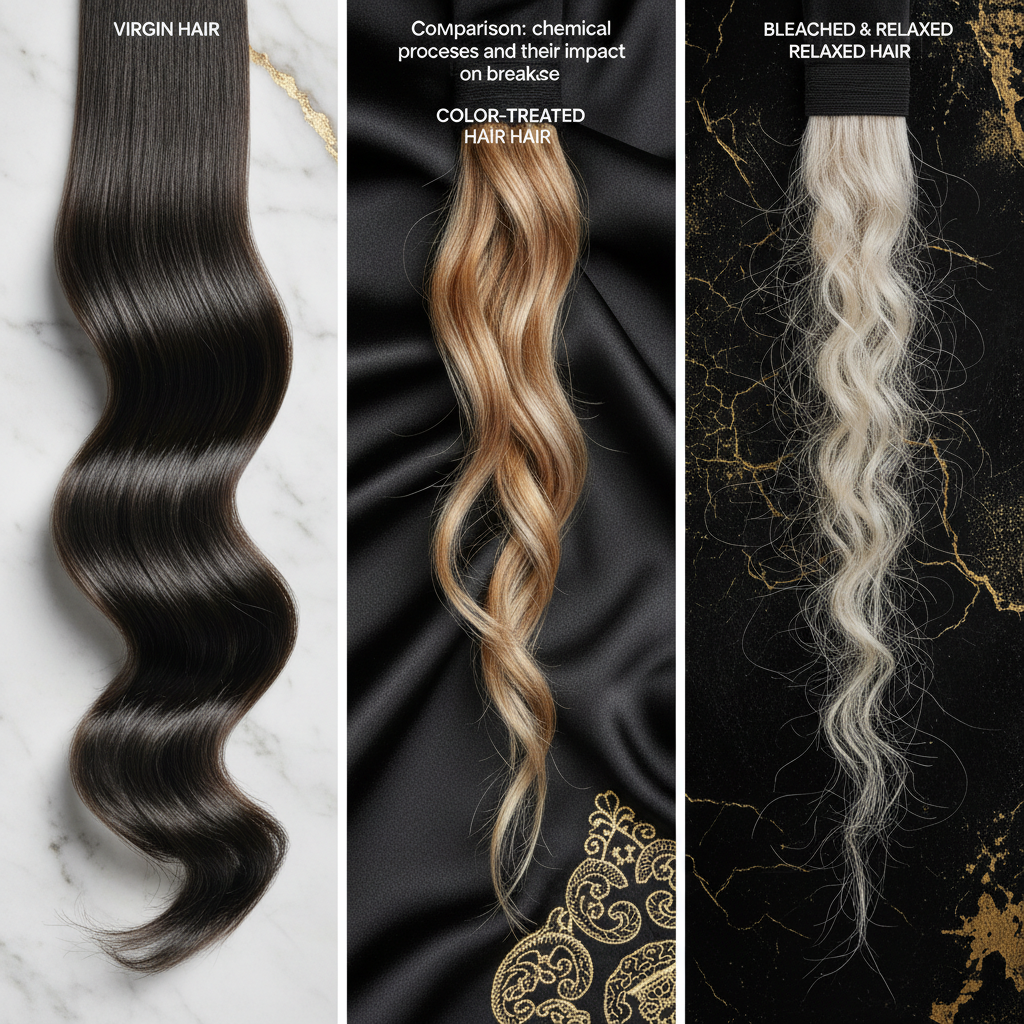
Comparison: chemical processes and their impact on breakage
The level of mechanical risk depends directly on the chemistry applied to the hair shaft:
| Chemical Process | Typical Working pH | Mechanism of Action | Risk Factor for Fibre Snapping | Primary Structural Impact |
|---|---|---|---|---|
| High-Lift Bleach | pH 10.0 to 11.5 | Persulphates oxidise melanin and cystine | Very High | Converts cystine to cysteic acid; destroys 18-MEA layer |
| Lye Relaxers | pH 12.0 to 13.5 | Sodium hydroxide breaks disulphide bonds via lanthionisation | Very High | Irreversible cross-link loss; extreme elasticity drop |
| No-Lye Relaxers | pH 11.5 to 12.5 | Guanidine hydroxide breaks disulphide bonds | High | Leaves calcium residue; creates brittle fibre shafts |
| Permanent Hair Dye | pH 9.0 to 10.5 | Ammonia or MEA swells cuticle; peroxide deposits pigment | Moderate to High | Cumulative protein loss over repeated applications |
| Acid Perms | pH 6.5 to 7.0 | Glyceryl monothioglycolate reduces cystine | Moderate | Mild cuticle swelling; risks snapping if under-neutralised |
Practical strategies for protecting treated hair
Safeguarding hair against chemical stress requires intervention before, during, and after salon services.
1. Enforce strict processing boundaries
Never overlap high-lift bleach or chemical relaxers over previously treated lengths. Overlapping creates a point of mechanical failure right at the demarcation line between virgin new growth and pre-processed fibre. Stylists must apply protective barriers (such as petroleum jelly or heavy lipid cremes) onto pre-lightened borders before touching up roots.
2. Lower the oxidant concentration
Speed should never take priority over fibre preservation. Using a 20-volume (6 percent) developer for 45 minutes yields clearer, more uniform lift with significantly less cortical erosion than rushing the service using a 40-volume (12 percent) developer for 20 minutes. High concentrations of hydrogen peroxide boil the internal moisture of the fibre and aggressively oxidise cystine.
3. Re-establish hair pH immediately
Cosmetic alkaline swelling must be reversed promptly. Following any chemical service, rinse thoroughly and apply an acidic neutralising or post-service conditioning treatment formulated at pH 4.0 to 5.0. This flattens the imbricated cuticle scales, locks moisture within the cortex, and restores the hair's natural isoelectric point (around pH 3.67), where it is most resistant to environmental and physical friction.
4. Balance hydrolysed proteins with functional lipids
Damaged hair requires both internal reinforcement and surface slip. Hydrolysed vegetable proteins, wheat proteins, and low-molecular-weight amino acids can temporarily slip into cortical micro-fissures to provide tensile support. However, protein alone makes the hair stiff and brittle. Pair protein applications with emollient fatty acids (such as cetyl alcohol, behentrimonium methosulphate, and natural plant oils) to restore hydrophobicity and flex.
5. Minimise secondary mechanical stress
Chemically fragile hair breaks easily during everyday grooming.
- Switch to a wide-tooth seamless comb or flexible detangling brush.
- Never brush hair roughly while it is soaking wet, as water breaks weak hydrogen bonds, leaving the already compromised disulphide network to bear all the strain.
- Discontinue direct thermal styling above 160°C. High heat crystallises damaged keratin, transforming minor cuticle lift into permanent fractures.
When breakage is mistaken for hair loss
A common clinical mistake is confusing chemical hair breakage with telogen effluvium or androgenetic alopecia. If your hair is coming out in the shower, inspect the ends carefully.
True shedding (hair loss from the root) displays a solid, tiny white keratin bulb at the tip. This means the follicle has completed its natural telogen phase and released the hair.
Chemical breakage, by contrast, features blunt, jagged, or split ends without any root bulb. You may notice thinning around the crown or hairline where relaxer or bleach was applied first, yet the scalp itself shows active, healthy follicular openings. Addressing chemical breakage requires topical conditioning and mechanical gentleness, whereas genuine hair loss requires evaluation of systemic health, nutrition, or follicular genetics.
Supporting compromised hair with Watermans
When chemical processing leaves your hair brittle and prone to snapping, everyday haircare must pivot toward reducing scalp stress and fortifying the lengths. Watermans GrowMe Shampoo and ConditionMe Conditioner offer a gentle, targeted daily regimen.
Formulated without harsh sulphates that strip fragile lipids, GrowMe gently cleanses the scalp while delivering biotin, rosemary extract, niacinamide, and hydrolysed lupin protein to support the appearance of density.
Pairing it with ConditionMe delivers essential structural conditioning. Featuring cholesterol, caffeine, and softening emollients, this treatment smooths frayed cuticles, improves elasticity, and dramatically cuts down on detangling friction. This dual approach protects vulnerable, over-processed fibres from everyday mechanical snapping.
Frequently asked questions about Preventing Chemical Hair Breakage
How often can I colour my hair without causing severe breakage?
You should wait at least 6 to 8 weeks between permanent colouring sessions. This window gives your hair cuticles time to recover and allows enough natural regrowth (approximately 2 centimetres) so your colourist can touch up roots without overlapping dye onto previously lifted strands.
Can a bond-building product completely stop chemical damage?
No bond builder can prevent 100 percent of chemical degradation. While active ingredients like bis-aminopropyl diglycol dimaleate or maleic acid cross-link some broken disulphide bonds during bleaching, persulphates still dissolve protective surface lipids and weaken structural proteins. They minimise damage, but they do not make hair invincible.
Does deep conditioning assist in Preventing Chemical Hair Breakage?
Yes, consistent deep conditioning plays a vital role in Preventing Chemical Hair Breakage by restoring the lipid envelope and smoothing cuticles. Treatments containing fatty alcohols, ceramides, and hydrolysed proteins reduce wet comb friction by up to 60 percent, preventing snapping during styling.
Why does relaxed hair break at the line of demarcation?
The line of demarcation is the exact border where unprocessed natural new growth meets chemically relaxed hair. The relaxed section has lost roughly a third of its tensile strength, while the virgin root has a full, coiled structure. This drastic difference in elasticity creates a sharp hinge that snaps under minor mechanical tension.
Will trimming my hair stop chemical breakage from moving upward?
Yes. Once chemical damage causes a split end, physical friction causes the tear to propagate upwards along the hair shaft like a run in a stocking. Trimming split ends every 6 to 8 weeks cuts off fractured tips before they travel higher up the fibre.
Summary
Successfully Preventing Chemical Hair Breakage comes down to respecting the biological limits of the hair fibre. Bleaching, waving, and relaxing deliberately dismantle the cortex's natural defence systems to reshape or recolour the strand. By avoiding chemical overlaps, maintaining conservative processing times, replenishing natural lipids, and supporting fragile ends with acidic conditioners, you can enjoy chemical styling without sacrificing the length, strength, and integrity of your hair.
Sources and references
- Robbins, C. R. (2012). Chemical and Physical Behavior of Human Hair. 5th Edition, Springer-Verlag.
- International Journal of Cosmetic Science (2009). "Investigation of the effects of chemical treatments on hair tensile properties."
- Dawber, R. (1996). "Hair: Its structure and response to cosmetic preparations." Clinics in Dermatology, 14(1), 105-112.
- Cruz, C. F., et al. (2016). "Human Hair Keratin after Chemical Treatments: A Review." Journal of Applied Cosmetology.
Find these ingredients in Watermans products
- Niacinamide: you will find this ingredient in our Hair Mask.