The Definitive Guide to Post Bleach Hair Repair
8 min read ·
Discover the science of post bleach hair repair. Learn how chemical lightening impacts the cortex and cuticles, and how to effectively rebuild strength and stop breakage.
Quick answer: Effective post bleach hair repair focuses on restoring structural strength, smoothing disrupted cuticle scales, and replenishing lost surface lipids. Because hair fibre is non-living tissue, post bleach hair repair cannot biologically regenerate damaged keratin. Instead, targeted cosmetic regimens rely on low molecular weight proteins to patch internal voids, bonding agents to reinforce weakened cross-links, and acid-balanced sealants (pH 3.5 to 5.0) to prevent breakage, reduce porosity, and temporarily protect the vulnerable cortex from mechanical snapping.
Key takeaways
- Bleaching chemically oxidises natural melanin while dissolving 18-methyl eicosanoic acid (18-MEA), the hair shaft's primary protective lipid layer.
- Disulphide bonds break during lightening, which reduces wet and dry tensile strength and makes the fibre prone to fracture.
- Cosmetic repair cannot regenerate dead cells; it rebuilds structural integrity through cross-linking agents, proteins, and biomimetic conditioning agents.
- Acidic formulations with a pH of 3.5 to 5.0 help contract lifted cuticle shingles, which reduces moisture evaporation and swelling.
- Snapping along the fibre is structural hair breakage, not scalp hair loss, though scalp burns from misapplied bleach can cause temporary shedding.
Post Bleach Hair Repair: what the evidence shows
Scientific research into post bleach hair repair demonstrates that while you cannot reverse chemical oxidation permanently, you can dramatically improve the mechanical properties of lightened hair.
Bleaching agents use an alkaline medium (typically ammonium hydroxide, pH 9.0 to 11.0) paired with an oxidising agent, usually hydrogen peroxide. This mixture swells the cuticular envelope, degrades melanin granules, and strips the protective lipid layer known as 18-methyl eicosanoic acid (18-MEA). When 18-MEA vanishes, hair shifts from being naturally hydrophobic (water-repelling) to hydrophilic (water-absorbing). As a result, wet hair swells excessively, weakens, and becomes susceptible to snapping under standard tension.
Peer-reviewed cosmetic studies show that hydrolysed proteins (such as keratin, wheat, and pea proteins) with molecular weights between 150 and 1,500 Daltons can penetrate through cracked cuticles into the cortex. Larger proteins sit on the surface to fill gaps along the shaft. Alongside proteins, dicarboxylic acids (like maleic acid or citric acid) create ionic or hydrogen bridges across broken polypeptide chains. This temporarily increases the force required to break the fibre.
Intact Hair Surface:
[Hydrophobic Lipid Layer (18-MEA)] -> [Flat Cuticle Scales] -> [Protected Cortex]

Bleached Hair Surface:
[Stripped Lipids / Hydrophilic] -> [Flared, Fractured Cuticles] -> [Exposed, Weakened Cortex]
What the evidence does not show
The science of post bleach hair repair is often clouded by exaggerated marketing claims. It is essential to separate physical improvements from biological myths:
- Living regeneration: Hair is composed of dead, non-living keratinised filaments. Topical treatments cannot "heal" or biologically regenerate split ends or snapped shafts.
- Permanent restoration: Synthetic bond-building complexes improve tensile strength, but their structural benefits wash out gradually under the influence of harsh surfactant cleansing and thermal styling.
- Follicle reactivation: Bleach applied correctly to the hair lengths has zero contact with follicular stem cells. Post bleach treatments applied to hair lengths will not accelerate scalp hair growth rates or resolve genetic alopecia.
- Total immunity to future heat: Applying restorative serums does not make bleached hair impervious to hot styling tools. Bleached keratin degrades at significantly lower thermal thresholds (often below 160°C) than virgin hair.
The mechanism: what bleaching does to hair anatomy
Understanding post bleach hair repair requires looking closely at three distinct structural layers of the hair shaft:
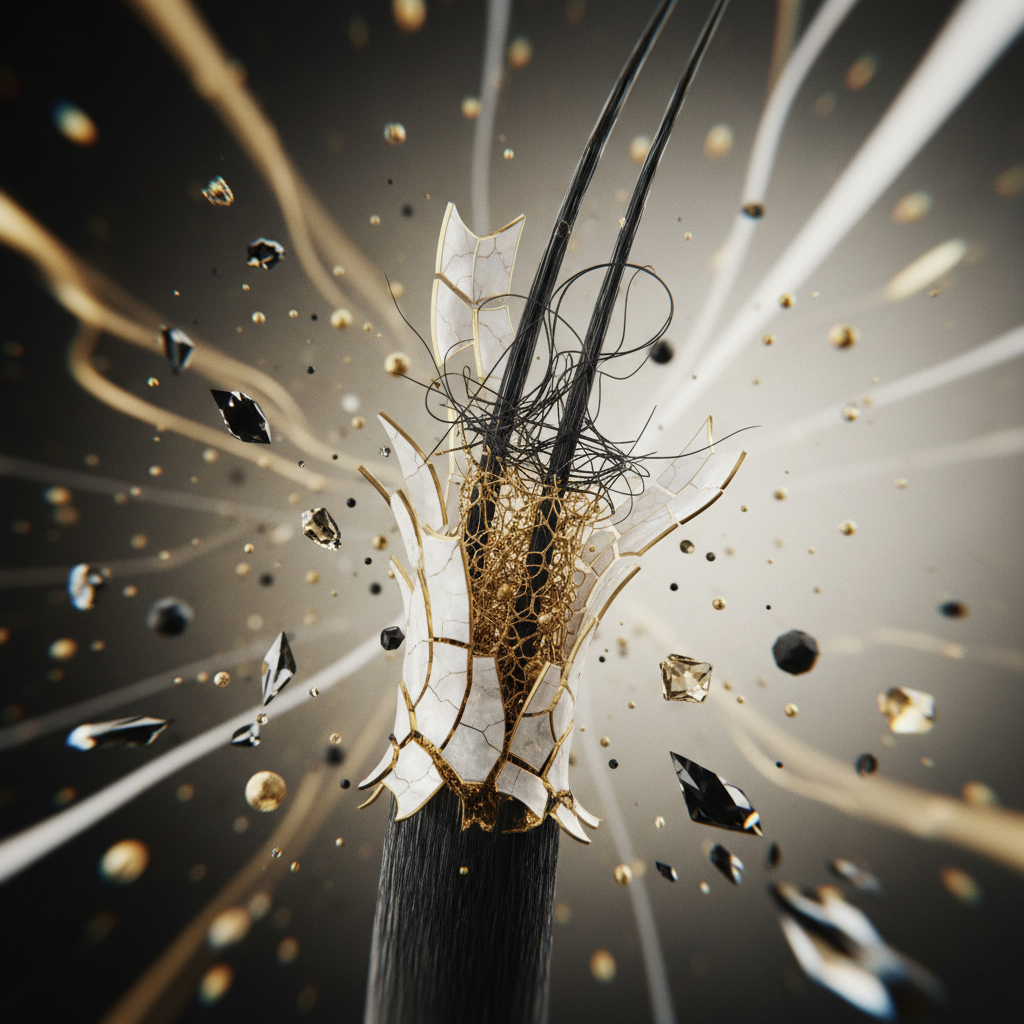
1. The F-Layer and cuticular scales
The exterior of healthy hair is sealed by the F-layer, a mono-molecular fatty acid sheath bonded to the cuticles. Peroxide and persulphate salts hydrolyse these lipids completely within minutes of application. Cuticle scales lift, detach, and fray. This leaves high porosity gaps that let water rush straight into the interior, causing extreme hygral fatigue (the repeated swelling and drying that leads to cracks).
2. Disulphide bonds and the cortex
The cortex accounts for roughly 80% to 85% of hair's total tensile strength. Inside, microfibrils are anchored by disulphide bonds formed between cysteine amino acids. Persulphates oxidise these disulphide bonds, turning them into cysteic acid residues. Because cysteic acid cannot form stable cross-links, the hair loses elasticity, transforming into a gummy, over-stretching strand when wet.
3. Melanin degradation and colour voids
Lightening oxidises eumelanin (brown-black pigments) and pheomelanin (red-yellow pigments). This process hollows out portions of the protein matrix, leaving structural voids that make the core fragile and brittle.
| Hair Metric | Virgin Hair | Bleached Hair (Single Lift) | Severely Compromised (Over-Processed) |
|---|---|---|---|
| Surface Nature | Hydrophobic (repels water) | Moderately hydrophilic | Highly hydrophilic |
| Porosity | Low to normal | High | Extreme |
| Cuticle Condition | Smooth, imbricated, intact | Raised, frayed edges | Missing, heavily eroded |
| Elastic Recovery | Returns to original length | Stretches with partial recovery | Stretches, deforms, or snaps instantly |
| Isoelectric Point | Approximately pH 3.67 | Shifts lower (cysteic acid accumulation) | Markedly acidic surface charge |
| Optimal Washing pH | 4.5 to 5.5 | 3.5 to 4.5 | 3.5 to 4.0 |
Structural hair breakage vs scalp shedding
A critical distinction must be made between snapping along the shaft and shedding from the follicle.
- Hair breakage: The physical fracturing of the hair shaft caused by chemical erosion and mechanical stress. The root remains intact inside the scalp follicle. The broken pieces are often short and lack a white bulb at the tip.
- Telogen effluvium / shedding: The shedding of whole strands from the root, identifiable by a small, white keratinised bulb.
Bleaching products cause breakage. They do not cause shedding unless a chemical burn occurs on the scalp. If high-volume bleach comes into contact with the epidermis, it can trigger acute contact dermatitis, chemical burns, and reactive shedding.
What you can do: a clinical post-bleach regimen
Restoring bleached hair requires balancing tensile reinforcement with external lubrication:
- Lower the washing pH: Use shampoos and conditioners formulated at pH 3.5 to 4.5. An acidic environment neutralises residual alkalinity from bleach, contracts the cuticle scales, and restores hair toward its isoelectric equilibrium.
- Deposit film-forming polymers: Apply cationic surfactants (like behentrimonium chloride or amodimethicone). These bind electrostatically to the negative charges of damaged cysteic acid, mimicking the lost 18-MEA lipid layer and cutting combing friction by over 50%.
- Use hydrolysed micro-proteins: Weekly treatments with hydrolysed keratin or vegetable proteins reinforce the internal cortex, plugging voids left by oxidized melanin.
- Minimise thermal exposure: Keep heated styling tools below 150°C and always apply a thermal protectant. Bleached hair has lost its protective moisture buffer, meaning high heat rapidly chars the exposed cortex.
- Eliminate friction: Switch to silk or satin pillowcases and detangle using a wide-tooth comb, starting from the ends and moving upward only when hair is coated with a conditioning slip.
The Watermans approach to hair vitality
While post bleach hair repair directly targets the structural integrity of compromised fibres, maintaining overall strand resilience requires a healthy follicular environment. Watermans focuses on scalp and hair vitality through carefully balanced, nutrient-rich formulations.
Watermans GrowMe Shampoo delivers a blend of biotin, caffeine, argan oil, rosemary extract, and allantoin. This combination gently cleanses the hair without stripping away critical surface moisture. When paired with conditioners that improve detangling slip, it reduces the mechanical pulling that causes bleached, weakened lengths to fracture during washing. By keeping the scalp clean, balanced, and free from buildup, hair emerges into an optimal growth environment.
Frequently asked questions about Post Bleach Hair Repair
Can Olaplex or bond builders permanently fix bleached hair?
No cosmetic bond builder permanently repairs bleached hair. These complexes form temporary cross-links across damaged polypeptide chains, which reinforces tensile strength while the product remains deposited. However, environmental friction, mechanical brushing, and regular cleansing gradually break these bonds down, which is why you must reapply them regularly.
How often should I apply protein treatments during post bleach hair repair?
Apply hydrolysed protein treatments once every 7 to 14 days during post bleach hair repair. Using protein too frequently without enough moisture can saturate the cortex, making the hair feel stiff, brittle, and more prone to snapping. Always follow protein applications with an emollient-rich moisturising mask.
Is hair breakage after bleaching the same as hair loss?
No. Bleach damage causes structural hair breakage, which happens when the weakened shaft snaps along its length. Hair loss, or alopecia, occurs inside the scalp follicle. Unless the bleach caused a severe chemical burn to the skin, post-bleaching breakage leaves the root healthy and capable of growing new hair.
How long does post bleach hair repair take to show results?
Cosmetic improvements in smoothness, detangling, and shine appear immediately after applying targeted bonding treatments and acidic sealants. However, real mechanical stability requires consistent care over 4 to 8 weeks. Remember that damaged sections must eventually be trimmed away as new, healthy hair grows from the roots.
Summary
Successful post bleach hair repair depends on accepting the biological limits of non-living keratin while using smart cosmetic chemistry to your advantage. Bleaching permanently oxidises disulphide bonds and strips away protective surface lipids. Even so, using acidic rinses, biomimetic lipids, micro-proteins, and gentle detangling techniques can dramatically reduce breakage. Treat lightened hair as a delicate, fine textile: protect it from aggressive heat, reinforce its structure systematically, and keep your scalp supported to ensure healthy growth over the long term.
Sources and references
- British Journal of Dermatology: "The effects of chemical treatments on the physical and cosmetic properties of hair" (PubMed Central, 2018).
- International Journal of Cosmetic Science: "Chemical and physical changes in bleached human hair: A study on tensile and surface properties" (2020, DOI: 10.1111/ics.12610).
- Journal of the Society of Cosmetic Chemists: "The structural lipids of human hair: Analysis and functions of 18-methyleicosanoic acid" (1998).
- National Health Service (NHS): "Hair loss and chemical damage causes" (2022).
- Society of Cosmetic Scientists: "Cosmetic science of hair bleaching and hair repair mechanisms" (Monograph series, 2021).