The Science of the pH Balance of Hair and Scalp
11 min read ·
Understand the science behind the pH balance of hair and scalp. Learn how physiological acidity protects the cuticle, supports the microbiome, and prevents fibre breakage.
Quick answer: The natural pH balance of hair and scalp is acidic, sitting between 4.5 and 5.5 for the scalp and roughly 3.67 for the hair fibre shaft. Maintaining this acidic environment keeps the cuticle flat, prevents excessive moisture loss, suppresses pathogenic microbes like Malassezia, and reduces electrostatic friction. However, topical pH correction cannot cure internal hair loss disorders such as androgenetic alopecia, nor can it physically rebuild a cortex that has already suffered severe mechanical snapping.
Key takeaways
- The scalp skin surface maintains an acid mantle with a normal pH of 4.5 to 5.5, while the hair shaft fibre is even more acidic at roughly 3.67.
- Alkaline products (pH above 7.0) cause the hair shaft to swell, open the protective cuticle scales, and increase negative electrical charge, leading to frizz and breakage.
- An elevated scalp pH alters the microflora balance, encouraging the proliferation of yeast organisms that trigger dandruff, seborrhoeic dermatitis, and irritation.
- Most alkaline cosmetic damage causes mechanical fibre breakage along the shaft; it does not shut down follicular growth cycles or cause medical hair loss.
- Acid-balanced haircare (pH 4.5 to 5.5) helps seal the cuticle layer, preserve tensile strength, and support the epidermal barrier.
pH Balance of Hair and Scalp: what the evidence shows
Understanding the pH balance of hair and scalp begins with basic biochemistry. The pH scale measures the concentration of hydrogen ions in an aqueous solution, ranging from 0 (highly acidic) to 14 (highly alkaline), with 7.0 representing neutral water at room temperature.
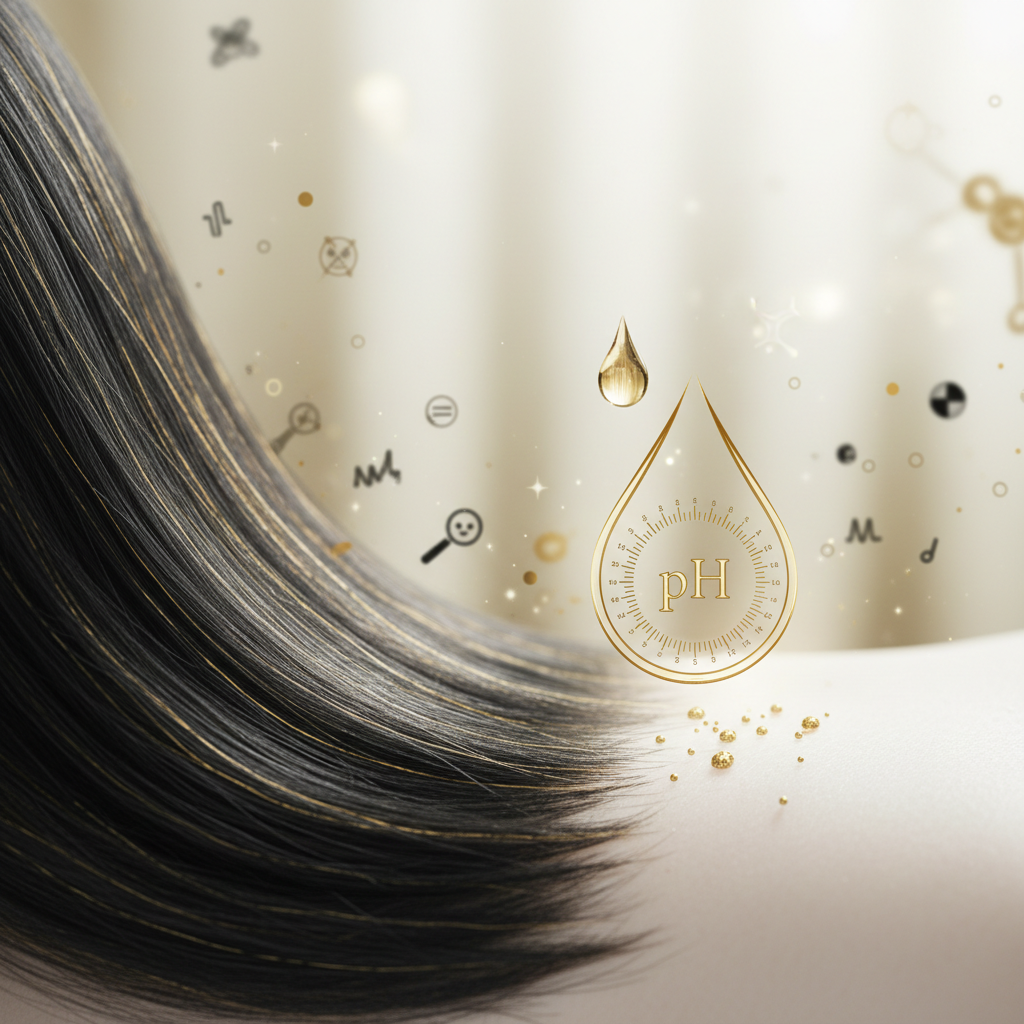
Human scalp skin is protected by a fine, hydrolipidic film known as the acid mantle. Generated by a combination of sebum, sweat, and lactic acid produced by benign resident microbes, the scalp surface typically tests between pH 4.5 and 5.5. In contrast, the hair fibre does not produce sebum or sweat. Once it emerges from the follicle, the hair fibre is biologically non-living protein (predominantly alpha-keratin) with an isoelectric point of roughly pH 3.67. At this acidic isoelectric point, the net electrical charge of the hair keratin is zero, meaning the cuticle scales lie flat, compact, and smooth against the cortex.
Peer-reviewed studies, including landmark cosmetic dermatological research published in the International Journal of Trichology (2014), revealed that a significant majority of commercial shampoos operate at an alkaline pH (greater than 5.5), and many sit above 7.0. The researchers demonstrated that washing hair with alkaline formulations increases cuticle friction, induces cuticle chipping, and elevates the negative electrical charge of the fibre surface. This directly increases tangling, mechanical comb resistance, and subsequent fibre breakage.
Conversely, keeping the scalp at its physiological pH preserves the barrier lipids (ceramides, cholesterol, and free fatty acids). Research in the British Journal of Dermatology confirms that epidermal barrier disruption occurs rapidly when skin surface pH shifts towards alkaline territory. An elevated pH activates degradative serine proteases while simultaneously slowing the synthesis of lipid-processing enzymes.
The biological and physical mechanisms
When cosmetic solutions disrupt the pH balance of hair and scalp, distinct physical and biological cascades occur across both the living skin and non-living fibre.
Cuticle swelling and the isoelectric point
The outermost layer of the hair shaft consists of 5 to 10 overlapping layers of flat, keratinised cells known as the cuticle. In an acidic environment near the hair's isoelectric point (around pH 3.67), the hydrogen and salt bonds within the keratin remain stable.
When you apply a formulation with an alkaline pH (above 7.0), the keratin absorbs hydroxide ions. This creates an overall negative electrical charge along the hair shaft. Because like charges repel, the cuticle scales flare outward and lift away from the shaft. Water penetrates deeply into the cortex, causing the fibre to swell by up to 15 to 20 percent of its dry diameter. Lifted cuticles dramatically increase surface friction between adjacent strands, exposing the inner cortex to environmental moisture loss, UV degradation, and mechanical snapping during brushing.
The scalp acid mantle and the microbiome
On the living scalp, the acid mantle acts as a critical antimicrobial barrier. Beneficial bacteria, such as Staphylococcus epidermidis, thrive in an environment between pH 4.5 and 5.5.
When you wash your scalp with alkaline cleansers, such as traditional lye-based bar soaps (which often measure between pH 9.0 and 10.0), the surface pH spikes immediately. While a healthy skin barrier can restore its baseline acidity within 2 to 6 hours, repeated exposure impairs this recovery mechanism.
An alkaline shift triggers two major complications:
- It reduces the activity of acid-dependent enzymes responsible for assembling the protective lipid matrix between skin cells.
- It creates an ideal growth environment for opportunistic pathogens, particularly Malassezia restricta and Malassezia globosa. These lipophilic yeasts metabolise sebum triglycerides into irritating oleic and free fatty acids, sparking epidermal inflammation, pruritus (itching), and flaking.
| Parameter | Hair Shaft (Keratin Fibre) | Scalp (Epidermal Skin) |
|---|---|---|
| Normal Physiological pH | 3.67 (isoelectric point) | 4.5 to 5.5 (acid mantle) |
| Primary Structural Component | Insoluble alpha-keratin | Stratum corneum (keratinocytes and lipids) |
| Biological Status | Non-living, cannot self-repair | Living tissue, actively regenerates |
| Impact of Alkaline pH (>7.0) | Cuticle scales lift, hair swells, friction increases | Barrier lipids degrade, moisture evaporates |
| Impact of Extreme Acidity (<3.0) | Keratin tightens; excessive acid weakens bonds | Chemical burning, irritation, barrier disruption |
| Microbiome Involvement | Negligible (inert surface) | High (Malassezia, Cutibacterium, Staphylococcus) |
What the evidence does not show
It is critical to separate established fibre physics and dermal physiology from marketing mythology:
- Alkaline products do not cause medical hair loss (alopecia): An alkaline shampoo will lift the cuticle and cause hair breakage along the shaft. It does not cause hair shedding from the root (telogen effluvium) nor does it miniaturise the dermal papilla (androgenetic alopecia). Breakage is structural snapping, not follicular hair loss.
- Acids cannot permanently "heal" split ends: While acidic conditioners (pH 3.5 to 4.5) compress cuticle cells and temporarily improve shine and slip, they cannot chemically fuse a split cortex back together. Once the fibre is split, trimming is the only permanent solution.
- "Natural" ingredients are not automatically pH-balanced: Pure household apple cider vinegar has a raw pH of roughly 2.0 to 3.0. Applying undiluted vinegar can cause scalp burns, protein denaturing, and skin irritation. Just because an ingredient is kitchen-derived does not mean it matches the biological pH of human tissue.
Signs of a disrupted pH balance
How do you know if your hair and scalp are suffering from a pH imbalance? Look for these distinct physical indicators:
- High friction and matting: Hair that tangles instantly when wet, feels rough like straw, and resists wide-tooth combs often indicates an open, alkaline-swollen cuticle.
- Dullness and lack of shine: When cuticle scales lift and chip under alkaline conditions, they scatter light rather than reflecting it uniformly, making hair look flat and lifeless.
- Increased fibre breakage: You find short, snapped pieces of hair (without a white follicular bulb at the end) on your clothing, sink, or brush.
- Persistent scalp tightness and itching: An elevated scalp pH impairs ceramide synthesis, leading to trans-epidermal water loss (TEWL). This leaves the scalp dry, taut, and irritable.
- Sudden flare-up of flakes: If changing to a new, highly alkaline cleanser leads to white or greasy yellow flakes within days, an altered pH has likely allowed scalp yeast populations to surge.
What you can do to maintain balance
Restoring and maintaining physiological acidity is straightforward when you adopt an evidence-led routine.
1. Choose pH-adjusted cleansers
Check whether your shampoo explicitly states that it is pH-balanced (ideally between 4.5 and 5.5). Avoid traditional bar soaps on the scalp, as true saponified soaps are inherently alkaline (pH 9.0 to 10.0) due to their fatty acid and alkali salt chemistry. Synthetic detergent (syndet) bars or liquid cleansers formulated with gentle surfactants can be buffered easily to pH 5.0.
2. Always follow cleansing with a conditioner
Conditioners are formulated at an acidic pH, typically between 3.5 and 4.5. This low pH neutralises the negative surface charge introduced during washing, tightens the cuticle tiles back down against the cortex, and deposits cationic conditioning agents to minimise comb friction.
3. Be cautious with home remedies
If using an apple cider vinegar rinse, always dilute it heavily. A safe, evidence-backed dilution ratio is 1 part vinegar to 8 to 10 parts clean water, bringing the solution closer to a mild pH of 4.5. Never apply concentrated acids to irritated or broken skin.
4. Buffer chemical salon processes
Permanent colour, lighteners, and chemical relaxers rely on high alkalinity (pH 9.0 to 12.0) using ammonia or ethanolamine to swell the cortex and deposit or strip pigment. After any chemical service, the hair must be thoroughly treated with an acid-balancing post-chemical treatment (pH 3.5 to 4.5) to halt swelling, re-contract the cuticle, and stabilise the fibre.
When the cause may be something else
If you have transitioned to a pH-balanced regimen (pH 4.5 to 5.5) for at least four to six weeks and continue to experience severe flaking, scalp erythema, or diffuse hair thinning, a simple pH issue is unlikely to be the primary cause:
- Androgenetic alopecia: If you notice gradual thinning at the temples, crown, or an widening central parting, this is driven by genetic sensitivity to dihydrotestosterone (DHT), not cosmetic pH.
- Telogen effluvium: Sudden, excessive shedding from the root (characterised by white bulbs on fallen hairs) across the entire scalp is usually triggered by physiological shock, high fevers, hormonal shifts, nutritional deficiencies (such as ferritin or vitamin D), or extreme stress 2 to 3 months prior.
- Scalp psoriasis: Thick, silvery, adherent plaques on red, inflamed skin represent an autoimmune condition marked by hyperkeratosis, not a topical cleanser reaction.
- Contact dermatitis: An allergy to a specific fragrance, preservative (such as methylisothiazolinone), or surfactant can trigger intense swelling, blistering, and weeping, irrespective of the formula's pH.
When to seek professional advice
Consult a GP, dermatologist, or registered trichologist if you experience:
- Persistent itching accompanied by intense burning, weeping, or bleeding sores.
- Hair falling out in discrete, circular patches (a hallmark of alopecia areata or fungal tinea capitis).
- Scalp flaking that fails to respond to over-the-counter anti-dandruff shampoos containing zinc pyrithione, piroctone olamine, or ketoconazole after 4 weeks.
- Rapid, unexplained shedding exceeding 100 to 150 hairs daily for more than 6 weeks.
The Watermans approach to balanced care
Watermans formulations are engineered around dermal and trichological science. Understanding that the hair shaft requires a closed, smooth cuticle and the scalp demands an intact acid mantle, Watermans products are formulated within the optimal physiological pH range of 5.0 to 5.5.
Watermans GrowMe Shampoo and ConditionMe Conditioner avoid aggressive alkaline surfactants and harsh stripping agents. Instead, they deliver a balanced wash that respects the scalp's microbiome while utilising caffeine, biotin, rosemary extract, and hydrolysed lupin protein to support a healthy scalp environment and improve fibre resilience. By preserving the natural acid mantle, these formulations protect fragile, chemically treated, or ageing strands from unnecessary mechanical breakage, promoting fuller, thicker-looking hair.
Balancing hair and scalp chemistry
Managing the pH balance of hair and scalp is one of the most effective, science-backed ways to maintain cosmetic hair strength, minimise breakage, and ensure scalp comfort. Human hair fibre reaches its most resilient, frictionless state at an acidic isoelectric point, and the scalp's delicate acid mantle requires an environment between pH 4.5 and 5.5 to defend against pathogenic microbes and moisture loss. By selecting products buffered to this physiological window, avoiding harsh alkaline soaps, and buffering after chemical services, you protect the structural integrity of your hair and cultivate the ideal foundation for healthy hair growth.
Frequently asked questions about pH Balance of Hair and Scalp
What is the ideal pH balance of hair and scalp?
The ideal pH for the scalp skin surface is between 4.5 and 5.5, which sustains its protective acid mantle and beneficial microflora. The hair shaft itself has an isoelectric point of roughly pH 3.67. At this acidic level, the hair cuticles remain flat, electrostatic charges are minimised, and the fibre resists swelling and friction.
Can an incorrect pH cause hair loss?
A disrupted pH causes hair breakage, not follicular hair loss. High-pH products lift cuticle scales and weaken keratin, leading to snapping along the hair fibre. They do not cause the follicle to shut down or shed from the root, which is typically driven by genetics, hormones, or systemic health factors.
How do I know if my shampoo is pH-balanced?
Look for products labelled as "pH-balanced" or specifying a pH of 4.5 to 5.5. Quality formulations typically state this on the bottle. You can also test your liquid products at home using calibrated, narrow-range laboratory pH indicator strips, dipping them into a small amount of diluted shampoo.
Why is alkaline shampoo bad for curly or afro-textured hair?
Afro and curly hair types naturally have elliptical shafts with irregular cuticle distribution, making them inherently more prone to dryness and friction. Alkaline shampoos exacerbate this by lifting the cuticles, increasing negative electrical charges, causing severe tangling, and leading to high rates of mechanical breakage during detangling.
Does hard water disrupt the pH balance of hair and scalp?
Yes. Hard water contains dissolved calcium and magnesium carbonates, which generally possess an alkaline pH between 7.5 and 8.5. Over time, these alkaline minerals can leave insoluble deposits on the hair shaft, lift cuticles, and temporarily elevate scalp pH, contributing to dullness, stiffness, and increased tangling.
Sources and references
- Gavazzoni Dias, M. F., et al. (2014). The Shampoo pH can Affect the Hair: Myth or Reality? International Journal of Trichology, 6(3), 88 to 99.
- Ali, S. M., & Yosipovitch, G. (2013). Skin pH: From Basic Science to Basic Skin Care. Acta Dermato-Venereologica, 93(3), 261 to 267.
- Proksch, E. (2018). PH in nature, humans and skin. The Journal of Dermatology, 45(9), 1044 to 1052.
- Robbins, C. R. (2012). Chemical and Physical Behavior of Human Hair (5th ed.). Springer-Verlag.
- Schmid-Wendtner, M. H., & Korting, H. C. (2006). The pH of the Skin Surface and Its Impact on the Barrier Function. Skin Pharmacology and Physiology, 19(6), 296 to 302.
Find these ingredients in Watermans products
- Biotin: you will find this ingredient in our Hair Growth Shampoo.
- Zinc: you will find this ingredient in our Hair Vitamins.