Niacinamide in Scalp Care: The Evidence-Based Guide
8 min read ·
Explore how Niacinamide in Scalp Care fortifies the skin barrier, balances excess oil, and calms redness, supporting optimal conditions for strong hair growth.

Quick answer: Using Niacinamide in Scalp Care involves applying topical vitamin B3 (nicotinamide) to soothe irritation, reinforce the skin lipid barrier, and balance excessive sebum production. Clinical dermatology studies show it reduces inflammation and supports microcirculation in human skin tissue. However, while niacinamide fosters an optimal environment for follicle function, it is not a standalone medical cure for genetic miniaturisation conditions like androgenetic alopecia, nor does it repair hair fibre that has already broken.
Key takeaways
- Niacinamide (vitamin B3) boosts synthesis of epidermal ceramides, fortifying the scalp barrier against irritation and moisture loss.
- It exhibits well-documented anti-inflammatory properties, making it useful for flaking, redness, and itching linked to mild seborrhoeic dermatitis.
- Topical applications between 2% and 5% help regulate sebum excretion without dehydrating the surrounding tissue.
- By boosting cellular adenosine triphosphate (ATP) levels, niacinamide supports metabolic activity in the dermis.
- While it supports scalp vitality and reduces breakage-inducing inflammation, it does not directly alter hormonal hair loss pathways.
Niacinamide in Scalp Care: what the evidence shows
Research into niacinamide in scalp care builds upon decades of dermatological data regarding facial skin physiology. The scalp is simply an extension of the skin, containing a much higher density of hair follicles, sebaceous glands, and microvascular networks. Topical niacinamide operates primarily as a precursor to nicotinamide adenine dinucleotide (NAD) and nicotinamide adenine dinucleotide phosphate (NADP), two essential coenzymes found in living human cells.
Clinical research published in the British Journal of Dermatology demonstrated that topical niacinamide significantly increases the synthesis of ceramides, free fatty acids, and cholesterol in the stratum corneum. In scalp tissue, this strengthened lipid barrier prevents trans-epidermal water loss (TEWL) and keeps environmental irritants from penetrating the follicular ostium.
Furthermore, a study by Draelos et al. Demonstrated that a 2% topical formulation of niacinamide significantly lowers sebum production rates over several weeks. On the scalp, hyperactive sebum production often feeds lipophilic yeasts such as Malassezia, provoking inflammation, pruritus, and follicular clogging. By moderating sebum excretion and calming inflammatory cytokine cascades (such as IL-6 and TNF-alpha), niacinamide creates a balanced, clear scalp environment that allows follicles to function without the burden of ongoing oxidative stress.
Another important finding comes from research exploring derivative compounds, such as octyl nicotinate or combinations of niacinamide and caffeine. A double-blind clinical trial published in the Journal of Cosmetic Dermatology demonstrated that topical niacin derivatives applied to the scalp improved microcirculation and significantly increased hair fullness across a six-month evaluation period in women experiencing thinning.
What the evidence does not show
It is vital to distinguish between a healthy follicle environment and the reversal of medical hair loss disorders. The evidence does not show that niacinamide blocks 5-alpha reductase or stops dihydrotestosterone (DHT) from binding to androgen receptors. It will not reverse advanced androgenetic alopecia on its own.
Similarly, cosmetic topical formulations cannot cure autoimmune forms of hair loss, such as alopecia areata or frontal fibrosing alopecia. Niacinamide does not directly fuse split ends or chemically rebuild fractured keratin inside the hair shaft. While it prevents future breakage by curbing the inflammation that weakens hair emerging from the scalp, hair breakage along the mid-lengths requires conditioned lubrication and gentle mechanical handling rather than scalp actives.
Biological mechanisms on the scalp
To understand why this B vitamin is so versatile, look at how it works within the scalp epidermis and the hair bulb:
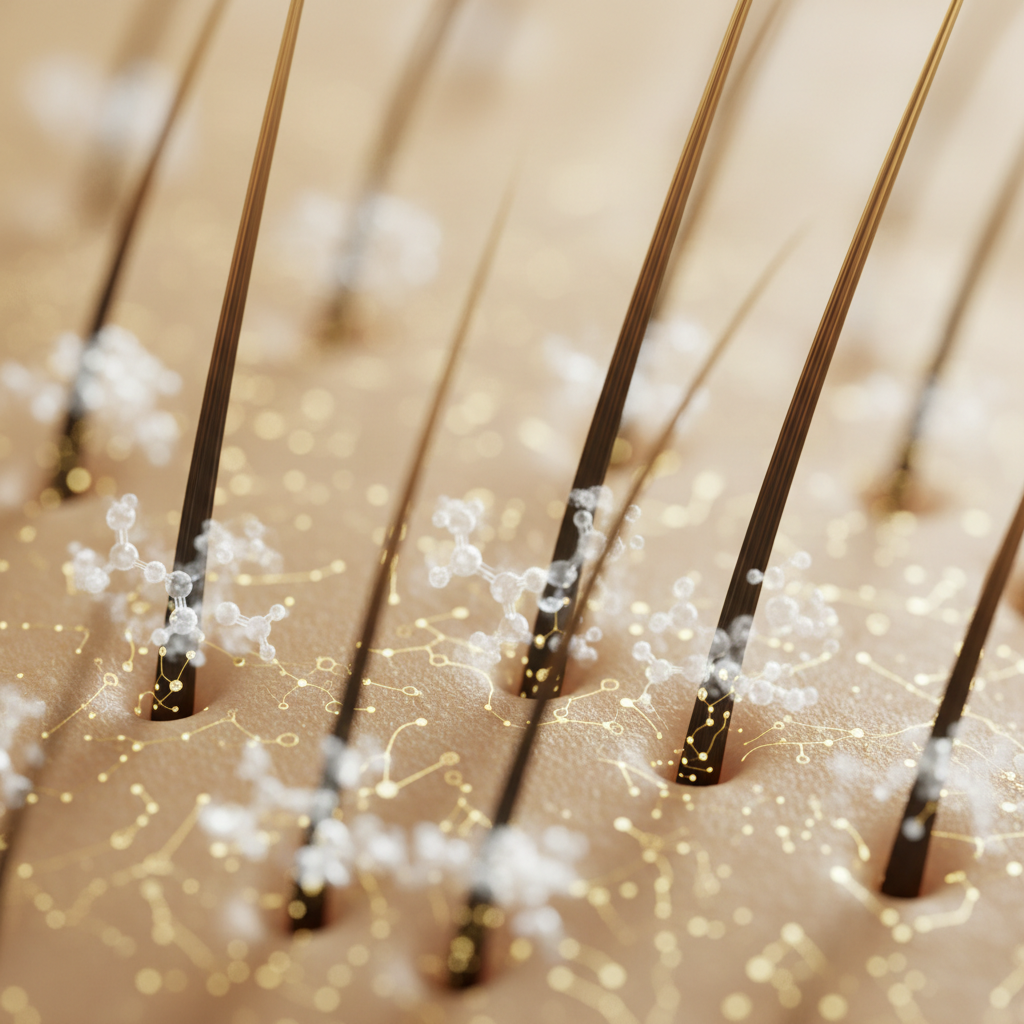
- Cellular energy and ATP production: Cell division in the hair matrix is among the fastest metabolic processes in the human body. Keratinocytes require substantial amounts of energy to multiply and build the hair shaft. Niacinamide fuels the salvage pathway for NAD+ synthesis, which maintains high mitochondrial energy generation during the anagen (growth) phase.
- Ceramide generation and barrier repair: Dry, irritated scalps permit penetration of allergens and microbes. Niacinamide upregulates the enzymes involved in sphingolipid synthesis, leading to higher natural ceramide levels that seal the scalp surface against dehydration.
- Regulation of microcirculation: Niacin derivatives act as mild vasodilators, stimulating blood flow around the follicular capillary loops. Increased local perfusion delivers oxygen, amino acids, and essential micronutrients straight to the dermal papilla.
- Reduction of oxidative stress: Niacinamide suppresses the generation of reactive oxygen species (ROS) caused by ultraviolet light, urban pollution, and harsh surfactant exposure.
Comparing scalp actives: Niacinamide vs. alternatives
| Active Ingredient | Primary Mechanism | Best For | Typical Effective Concentration |
|---|---|---|---|
| Niacinamide (Vitamin B3) | Barrier repair, sebum balance, anti-inflammatory, cellular ATP | Oily scalps, flaking, redness, general follicle support | 2% to 5% |
| Salicylic Acid | Keratolytic (exfoliates dead surface cells), dissolves sebum plugs | Heavy scaling, thick dandruff, severe product build-up | 0.5% to 2% |
| Caffeine | Follicular penetration, phosphodiesterase inhibition, microcirculation | Sluggish follicles, thinning hair, barrier stimulation | 0.1% to 1% |
| Ketoconazole | Disrupts fungal cell membranes (Malassezia eradication) | Pathological dandruff, diagnosed seborrhoeic dermatitis | 1% to 2% |
| Peptides (e.g., Copper Peptides) | Extracellular matrix remodelling, collagen support | Ageing scalp tissue, hair diameter enhancement | Variable (ppm levels) |
Signs your scalp may benefit from Niacinamide
Because niacinamide tackles multiple skin complaints simultaneously, it suits a wide variety of scalp profiles:
- Greasy roots with dry ends: Your scalp overproduces oil within 24 hours of washing, yet your scalp barrier feels sensitive or tight.
- Persistent itching and redness: You experience recurring scalp irritation that is not accompanied by thick, fungal plaques.
- Urban exposure: You spend significant time in polluted city environments where particulate matter deposits on the scalp, triggering follicular inflammation.
- Thinning hair appearance: You notice early hair shedding or fine texture where the scalp looks tired, stressed, and poorly nourished.
What you can do: application and practical use
To gain the benefits of niacinamide in scalp care, consistency and concentration are what matter most:
- Look for leave-on tonics and serums: Rinse-off shampoos deliver some soothing contact, but leave-on formulations (such as watery scalp tonics) permit prolonged contact time with the stratum corneum and follicle openings.
- Aim for 2% to 5%: Concentrations within this window achieve the best balance between barrier restoration, sebum control, and skin tolerance. Higher levels (above 10%) offer diminishing returns and can trigger temporary flushing or irritation.
- Pair with complementary actives: Niacinamide functions exceptionally well alongside caffeine, rosemary extract, and biotin. It is also safe to use alongside traditional minoxidil treatments, often reducing the dryness and scaling that alcohol-based carriers cause.
- Apply to damp or clean skin: Part the hair into sections and place drops directly on the scalp tissue. Massage with your fingertips using circular motions for 60 to 90 seconds to distribute the liquid evenly and encourage blood circulation.
When the cause may be something else
A problematic scalp or thinning hair does not always stem from simple barrier dysfunction or excess sebum:
- Nutritional deficiencies: Diffuse hair shedding (telogen effluvium) frequently stems from low serum ferritin, severe zinc deficiency, rapid weight loss, or thyroid irregularities.
- Fungal overgrowth: If you have thick, adherent, yellowish crusts accompanied by intense itching, you are likely dealing with active seborrhoeic dermatitis requiring targeted antimycotic agents, rather than simple cosmetic nourishment.
- Autoimmune scarring: Conditions such as lichen planopilaris cause permanent scarring and follicle destruction. If you see bald patches with loss of follicular openings, severe burning, or pustules, seek immediate specialist care.
When to seek professional advice
Consult a GP, dermatologist, or registered trichologist if you notice sudden, patchy hair loss, sudden escalation in daily shedding (over 100 to 150 hairs daily for more than six weeks), bleeding, crusting, or persistent scalp tenderness. Cosmetic ingredients support scalp health, but they must never delay an accurate medical diagnosis for progressive scalp disorders.
Supporting hair health with Watermans
If you want to introduce this ingredient into a straightforward daily routine, consider the botanical formulations engineered by Watermans. Watermans blends niacinamide alongside rosemary extract, caffeine, biotin, and argan oil in their Grow More Elixir and signature hair products. Rather than relying on a single compound, this approach targets follicular vitality, strengthens the hair feel, and promotes a clean, balanced scalp environment suitable for men and women dealing with fragile, thinning, or stressed hair.
Frequently asked questions about Niacinamide in Scalp Care
Can Niacinamide in Scalp Care cause hair shedding?
No, topical niacinamide does not trigger follicular telogen shifts or induce shedding cycles. If you notice increased hair shedding shortly after starting a scalp product containing niacinamide, it is likely coincidental, related to underlying seasonal changes, telogen effluvium, or vigorous mechanical friction during application. Niacinamide itself calms the inflammation that often prompts premature shedding.
Can I use niacinamide on my scalp every day?
Yes, water-based serums containing between 2% and 5% niacinamide are gentle enough for daily application. Unlike strong acids or high-strength retinoids, niacinamide does not thin the skin barrier or increase photosensitivity. Daily leave-on application maintains steady cellular coenzyme levels and consistently regulates sebum production.
Does niacinamide help with scalp dandruff?
It helps with the symptoms that surround dandruff, such as itching, surface redness, and an impaired skin barrier. It also curbs excess sebum, which feeds the yeast that causes flaking. However, for severe, recurrent dandruff, you should pair niacinamide with an active anti-fungal agent to clear the underlying fungal driver.
How long does it take to see results on the scalp?
Barrier repair and reductions in irritation or redness often become apparent within two to three weeks of consistent daily use. Regulation of oil production generally takes four to six weeks. If you are monitoring changes in hair density, feel, or thickness, allow three to six months to match the natural biological hair growth cycle.
Niacinamide in Scalp Care: Final thoughts
Optimising the scalp environment is essential for anyone who wants resilient, healthy-looking hair. Incorporating Niacinamide in Scalp Care delivers a scientifically proven method to reinforce the epidermal barrier, calm persistent irritation, and harmonise sebum output. While it will not override the genetic mechanics of male or female pattern hair loss, its ability to support cellular metabolism and defend against environmental stressors makes it an exceptionally valuable staple in any long-term haircare regimen.
Sources and references
- British Journal of Dermatology: "Nicotinic acid/niacinamide and the skin" (2006).
- Journal of Cosmetic Dermatology: "A review of the range of effects of niacinamide in human skin" (2005).
- Journal of Cosmetic Dermatology: "Evaluation of the effect of topical nicotinates on hair growth in female pattern alopecia" (2005).
- Draelos, Z. D., et al.: "The effect of 2% niacinamide on facial sebum production" (Journal of Cosmetic and Laser Therapy, 2006).
- International Journal of Toxicology: "Final Report of the Safety Assessment of Niacinamide and Niacin" (2005).
Find these ingredients in Watermans products
- Biotin: you will find this ingredient in our Hair Growth Shampoo.
- Zinc: you will find this ingredient in our Hair Vitamins.
- Niacinamide: you will find this ingredient in our Hair Mask.