Natural Moisturising Factor for Hair: The Science of Fibre Hydration
9 min read ·
Discover how Natural Moisturising Factor for Hair works. Learn the science of humectants, amino acids, and scalp hydration to prevent breakage and boost elasticity.
Quick answer: The concept of Natural Moisturising Factor for Hair refers to water-soluble, hygroscopic compounds found in the scalp's stratum corneum and mimicked along the hair shaft to maintain hydration, suppleness, and structural elasticity. While skin naturally synthesises these compounds via filaggrin degradation, hair fibres are non-living biological structures that cannot regenerate them once depleted. Cosmetic products can deposit humectants, amino acids, and minerals to replicate these moisture-binding properties, but they cannot permanently alter fibre biology or repair broken keratin chains.
Key takeaways
- Natural Moisturising Factor (NMF) originates in the epidermis, consisting of amino acids, pyrrolidone carboxylic acid (PCA), lactic acid, urea, and electrolytes.
- The hair shaft does not actively produce its own NMF because hair fibre is non-living keratinised tissue.
- Applying topical humectants and amino acids replicates the action of NMF on the hair fibre, boosting internal water retention and reducing brittleness.
- Environmental stress, chemical bleaching, and alkaline detergents strip water-soluble moisture components from both the scalp and the cuticle layer.
- True hair dehydration manifests as stiffness, loss of elasticity, and surface friction, which leads to physical breakage rather than follicular hair shedding.
- Proper replenishment requires balancing hygroscopic humectants with protective lipid sealants to prevent moisture loss in low-humidity environments.
Natural Moisturising Factor for Hair: what the evidence shows
Understanding Natural Moisturising Factor for Hair requires distinguishing between epidermal biology and hair fibre structure. In dermatology, NMF describes a naturally occurring mixture of low-molecular-weight, water-soluble compounds inside stratum corneum cells. This mixture consists of approximately 40 percent free amino acids, 12 percent pyrrolidone carboxylic acid (PCA), 12 percent lactate, 7 percent urea, alongside sugars, organic acids, and inorganic ions like sodium, potassium, calcium, and chloride.
Together, these compounds act as powerful humectants. They absorb ambient moisture and bind water within the cell structure. This bound water ensures enzymatic activity, maintains skin elasticity, and facilitates proper desquamation (the shedding of dead skin cells).
Because hair develops from the hair follicle, the living cells of the matrix initially contain similar water-binding compounds. However, as matrix cells differentiate and move upward through the follicle zone, they undergo terminal differentiation and extensive cornification. By the time the hair shaft emerges past the scalp surface, it consists of non-living, cross-linked keratin proteins surrounded by an outer cuticle layer and a fine lipid sheath known as the 18-methyleicosanoic acid (18-MEA) layer.
Hair does not generate its own cellular NMF after leaving the scalp. Instead, the hair shaft relies on residual water-binding components, trace lipids, and externally applied formulations that supply these same low-molecular-weight humectants. Cosmetic science uses the term Natural Moisturising Factor for Hair to describe formulas enriched with amino acids, sodium PCA, urea, and lactic acid that mimic the hydrating functions naturally present in human skin.
+--------------------------------------------------------------------------+
| COMPONENTS OF CLASSICAL NMF |
| |
| [ Free Amino Acids ] ~40% -> Provides structural water-binding |
| [ Pyrrolidone Carboxylic Acid ] ~12% -> High-capacity hygroscopic agent |
| [ Lactates ] ~12% -> Buffering agent & moisture retainer |
| [ Urea ] ~7% -> Natural humectant & mild keratolytic |
| [ Minerals & Electrolytes ] ~18.5% -> Ionic balance (Na+, K+, Ca2+) |
| [ Organic Acids & Sugars ] ~8.5% -> Osmotic stability |
+--------------------------------------------------------------------------+
Biological mechanisms: how moisture behaves in hair fibres
The hair shaft is naturally hygroscopic. Water accounts for roughly 10 to 15 percent of a healthy hair fibre's weight at normal room temperature and moderate relative humidity (around 50 to 60 percent). This water exists in three states: strongly bound water (chemically attached to keratin), weakly bound water (associated with side chains and polar groups), and free capillary water.
When you supply topically formulated Natural Moisturising Factor for Hair, several physical processes take place:
- Diffusion through the cuticle: Low-molecular-weight amino acids (such as glycine, alanine, and serine) and humectants (such as sodium PCA) are small enough to penetrate past lifted or porous cuticle scales into the cortex.
- Polar bonding: Once inside the cortex, these molecules form hydrogen bonds with the hydrophilic regions of keratin intermediate filaments. They act as molecular spacers that hold onto water molecules.
- Restoring plasticisation: Bound water acts as a plasticiser for keratin. Without sufficient moisture, keratin fibres become rigid, stiff, and fragile. Adequate hydration lowers the fibre's modulus of rigidity, allowing hair to bend and stretch without snapping.
- Scalp barrier support: On the scalp, these identical compounds replenish the depleted stratum corneum. A well-hydrated stratum corneum keeps the acid mantle intact (maintaining a healthy pH between 4.5 and 5.5) and prevents micro-inflammation around follicular openings.
Scalp NMF versus hair fibre hydration
While marketing often conflates the two, the mechanism of hydration differs fundamentally between the scalp and the hair shaft.
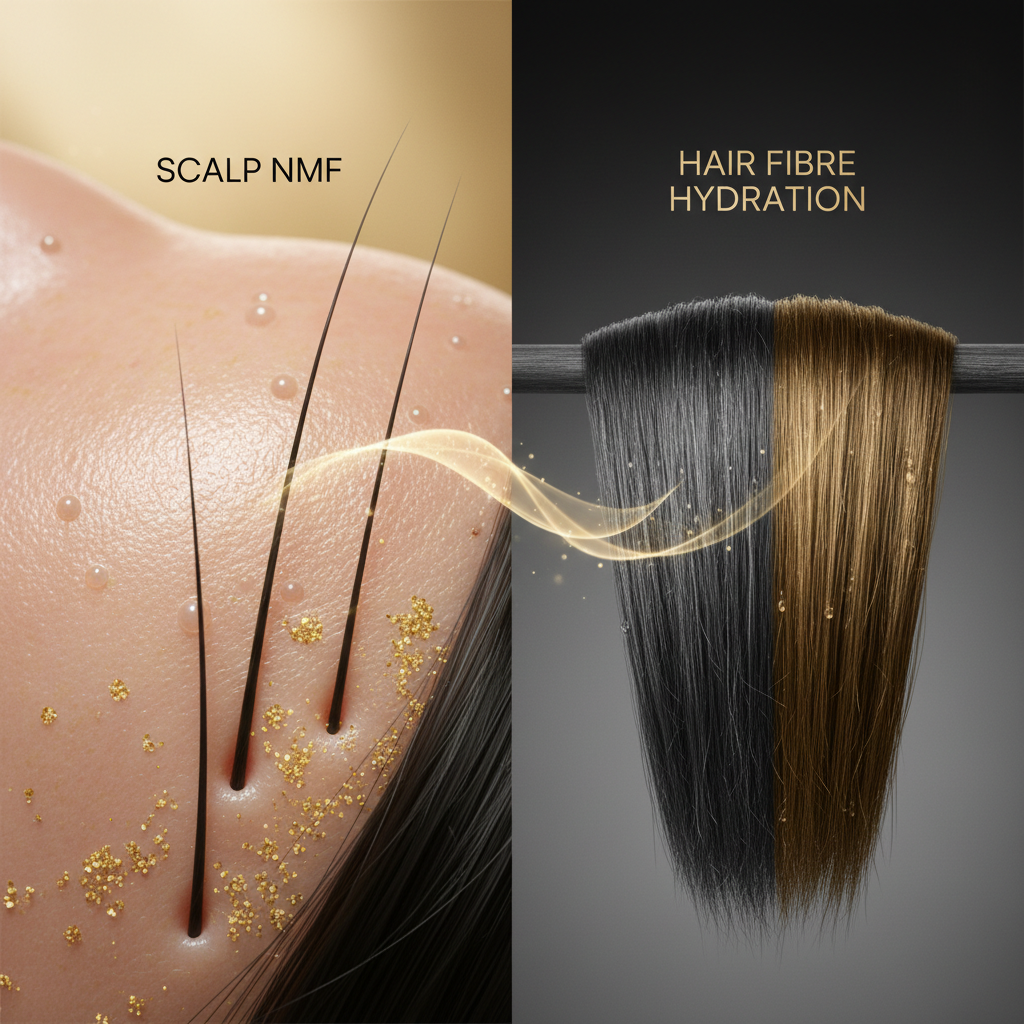
| Characteristic | Scalp Stratum Corneum | Hair Shaft (Cuticle and Cortex) |
|---|---|---|
| Living / Non-living | Cellular layer of living tissue | Non-living, non-cellular keratin structure |
| Source of NMF | Endogenous (filaggrin proteolysis) | Exogenous (cosmetics, sebum, rinse residues) |
| Primary Composition | Free amino acids, PCA, urea, lactic acid | Keratin (85-90%), water (10-15%), lipids (1-3%) |
| Impact of Moisture Loss | Scaling, pruritus, flaking, tight sensation | Brittleness, friction, loss of elasticity, snapping |
| Replenishment Method | Natural regeneration + barrier creams | Topical humectants, conditioning agents, lipids |
| Ideal pH Level | 4.5 to 5.5 | 4.0 to 5.5 |
What the evidence does not show
It is critical to separate established cosmetic chemistry from common misconceptions surrounding Natural Moisturising Factor for Hair:
- It does not cure or treat follicular hair loss: NMF components do not influence androgenetic alopecia, alopecia areata, or telogen effluvium. Hair shedding happens deep within the dermal papilla, far beyond the reach of topical surface humectants.
- It cannot permanently repair broken disulphide bonds: Bleaching and perming destroy covalent disulphide bonds within the cortex. Amino acids and PCA improve moisture retention, but they do not re-link severed cystine bridges.
- It is not an oily sealant: NMF constituents are entirely water-soluble. They pull water into the fibre, but without an emollient or occlusive barrier (such as fatty alcohols, ceramides, or plant oils), this moisture evaporates rapidly in dry environments.
- More water does not always mean healthier hair: Over-saturating hair with pure water leads to hygral fatigue, where the hair shaft repeatedly swells and contracts, degrading the cell membrane complex. NMF components regulate bound water rather than promoting unconstrained free water absorption.
Recognising depleted moisture in hair and scalp
When the natural balance of humectants and barrier lipids is compromised, the signs appear quickly across the hair shaft and scalp:
- Reduced tensile elasticity: The hair fibre snaps immediately when stretched gently, showing minimal flexibility or spring-back.
- Rough cuticle texture: Individual strands feel coarse, raspy, or uneven when sliding fingers from tip to root.
- Dullness and light scattering: Without an even distribution of moisture and intact cuticle scales, light reflects unevenly, stripping the hair of natural shine.
- Increased static flyaways: Dry hair fibres accumulate negative electrostatic charges easily, causing strands to repel one another.
- Scalp tightness and superficial flaking: A dehydrated scalp presents with fine, dry white flakes (distinct from oily, yellowish seborrhoeic dandruff) and uncomfortable itching.
Restoring moisture balance: practical steps
To effectively support and replenish moisture levels across the hair fibre, follow a structured approach based on hair science:
1. Cleanse with mild, pH-balanced formulations
Strong alkaline surfactants (such as unbuffered sodium lauryl sulphate) strip both sebum and water-soluble natural humectants from the cuticle and scalp. Use cleansers formulated at pH 4.5 to 5.5 that preserve the lipid barrier while lifting debris.
2. Apply biomimetic humectant complexes
Look for leave-in conditioners and treatments containing components that mirror natural moisturising factor:
- Sodium PCA: Highly hygroscopic, binding several times its weight in water.
- Amino acid cocktails: Glycine, arginine, proline, and serine to penetrate damaged cuticles.
- Lactic acid: Helps adjust the formulation pH to flatten cuticle scales while providing moisture.
- Glycerol and panthenol: Proven humectants that enhance fibre flexibility.
3. Seal with lipid-rich emollients
Humectants draw moisture in, but they need an occlusive or semi-occlusive layer to keep it there. Follow humectant-rich products with fatty alcohols (cetyl or stearyl alcohol) or lightweight plant oils to seal the cuticle surface, especially in environments where the relative humidity drops below 40 percent.
4. Protect against thermal degradation
Blow dryers and straighteners operated above 150 degrees Celsius boil off both free and bound water within seconds, creating structural voids in the cortex. Always apply heat protectants containing thermal polymers before styling.
The Watermans approach to hair vitality
Maintaining a balanced environment across the scalp and hair fibre requires products that respect natural biological barriers. Watermans incorporates targeted botanical and cosmetic science to support hair strength and visual vitality. Products like Watermans Grow Me Shampoo and Condition Me Conditioner blend amino acids, hydrolysed lupin protein, niacinamide, and natural extracts designed to hydrate the scalp surface and reinforce the hair shaft. While cosmetic formulations cannot replace systemic biological processes or cure medical alopecia, providing the scalp and hair with essential conditioning agents reduces breakage and improves overall manageability.
When to seek professional advice
Distinguishing between cosmetic dehydration and clinical conditions is essential for proper care.
If your hair snaps easily during normal brushing, you are dealing with fibre breakage, which responds well to humectants, protein conditioners, and gentler handling.
However, if you observe sudden, diffuse hair shedding (more than 100 to 150 hairs daily leaving the root bulb), patchy bald spots, scalp redness, burning, or persistent thick crusts, consult a registered trichologist or dermatologist. These signs indicate follicular hair loss or inflammatory dermatoses, such as telogen effluvium, alopecia areata, or seborrhoeic dermatitis, which require clinical diagnosis rather than cosmetic moisturising regimens.
Frequently asked questions about Natural Moisturising Factor for Hair
What is the purpose of Natural Moisturising Factor for Hair?
The primary purpose of Natural Moisturising Factor for Hair is to bind and retain water within the hair fibre and scalp stratum corneum. By delivering small, water-soluble humectants like amino acids, sodium PCA, and lactic acid, these treatments improve fibre elasticity, reduce brittleness, smooth the cuticle, and prevent surface dryness.
Can Natural Moisturising Factor for Hair stop hair loss?
No, it cannot stop hair loss. True hair loss originates within the living follicle beneath the skin, driven by genetics, hormones, or systemic health issues. NMF components operate strictly on the surface of the scalp and along the non-living hair fibre, helping reduce physical snapping rather than follicular shedding.
How does hair lose its natural moisture?
Hair loses moisture through environmental exposure (sunlight, dry air, wind), thermal styling tools, and chemical processing (bleaching, relaxing, colouring). Harsh alkaline shampoos also wash away water-soluble amino acids, trace lipids, and the protective 18-MEA cuticle layer, leaving the cortex unable to retain bound water.
What ingredients indicate NMF in haircare formulations?
Look for free amino acids (such as arginine, glycine, serine, valine, and alanine), sodium PCA, pyrrolidone carboxylic acid, urea, sodium lactate, lactic acid, and panthenol. These ingredients directly mimic the natural moisture-binding complex found within healthy stratum corneum tissue.
Can using too much humectant damage hair?
Yes, under certain environmental conditions. In extremely dry climates (relative humidity below 30 percent), humectants without occlusives can draw moisture out from the deeper cortex toward the dry air, increasing brittleness. Conversely, in very high humidity, excess water absorption causes frizz and cuticle lifting.
A holistic perspective on Natural Moisturising Factor for Hair
Understanding how Natural Moisturising Factor for Hair works allows you to approach hair hydration with scientific clarity rather than marketing hype. While hair cannot biologically generate its own natural moisturising factors once it leaves the follicle, delivering topical amino acids, PCA, and gentle humectants restores elasticity, smooths the cuticle, and guards against mechanical breakage. Pair these humectants with protective lipid sealers and a balanced scalp routine to achieve resilient, soft, and healthy-looking hair.
Sources and references
- Rawlings, A. V., & Harding, C. R. (2004). Moisturization and skin barrier function. Dermatologic Therapy, 17(s1), 43-48.
- Robbins, C. R. (2012). Chemical and Physical Behavior of Human Hair (5th ed.). Springer-Verlag.
- Draelos, Z. D. (2010). Hair cosmetics. Dermatologic Clinics, 28(1), 197-204.
- Gavazzoni Dias, M. F. (2015). Hair cosmetics: An overview. International Journal of Trichology, 7(1), 2-15.
- American Academy of Dermatology. (2022). How to care for your hair to prevent damage. AAD.org.
Find these ingredients in Watermans products
- Niacinamide: you will find this ingredient in our Hair Mask.
- Panthenol (Provitamin B5): you will find this ingredient in our Heat Protection Spray.