Moisture vs Protein Balance: The Complete Hair Science Guide
7 min read ·
Understand Moisture vs Protein Balance in hair: learn the science of tensile strength, elasticity, hygral fatigue, and how to stop brittle breakage.
Quick answer: Achieving the right Moisture vs Protein Balance means managing the structural integrity and flexibility of the hair shaft. Hair fibres rely on internal keratin proteins for tensile strength and water-binding lipids and humectants for elasticity. When hair receives too much protein without hydration, it turns brittle and snaps; when over-hydrated without sufficient structural support, it becomes limp and mushy (hygral fatigue). The main limitation is that hair is non-living tissue, so you cannot permanently "heal" it, only manage its physical properties topically.
Key takeaways
- Human hair fibres are roughly 65 to 95 percent keratin protein by weight, with water content typically fluctuating between 10 and 15 percent depending on relative humidity.
- The concept of balance refers to pairing structural tensile strength with adequate fibre elasticity.
- Too much protein causes stiffness, rigidity, and mechanical breakage along the shaft.
- Excess water uptake without adequate lipid or protein structure leads to hygral fatigue, leaving strands gummy, overly stretchy, and weak.
- Breakage is cosmetic fibre fracture, distinct from follicular hair shedding or medical alopecia.
Moisture vs Protein Balance: what the evidence shows
The cosmetic industry often discusses Moisture vs Protein Balance as if hair requires equal parts of two opposing forces. In reality, hair chemistry is more nuanced. Hair is composed primarily of keratinised proteins linked by disulphide, salt, and hydrogen bonds. Lipids, melanin, and trace elements make up the remainder, while water constantly moves in and out of the porous cortex.
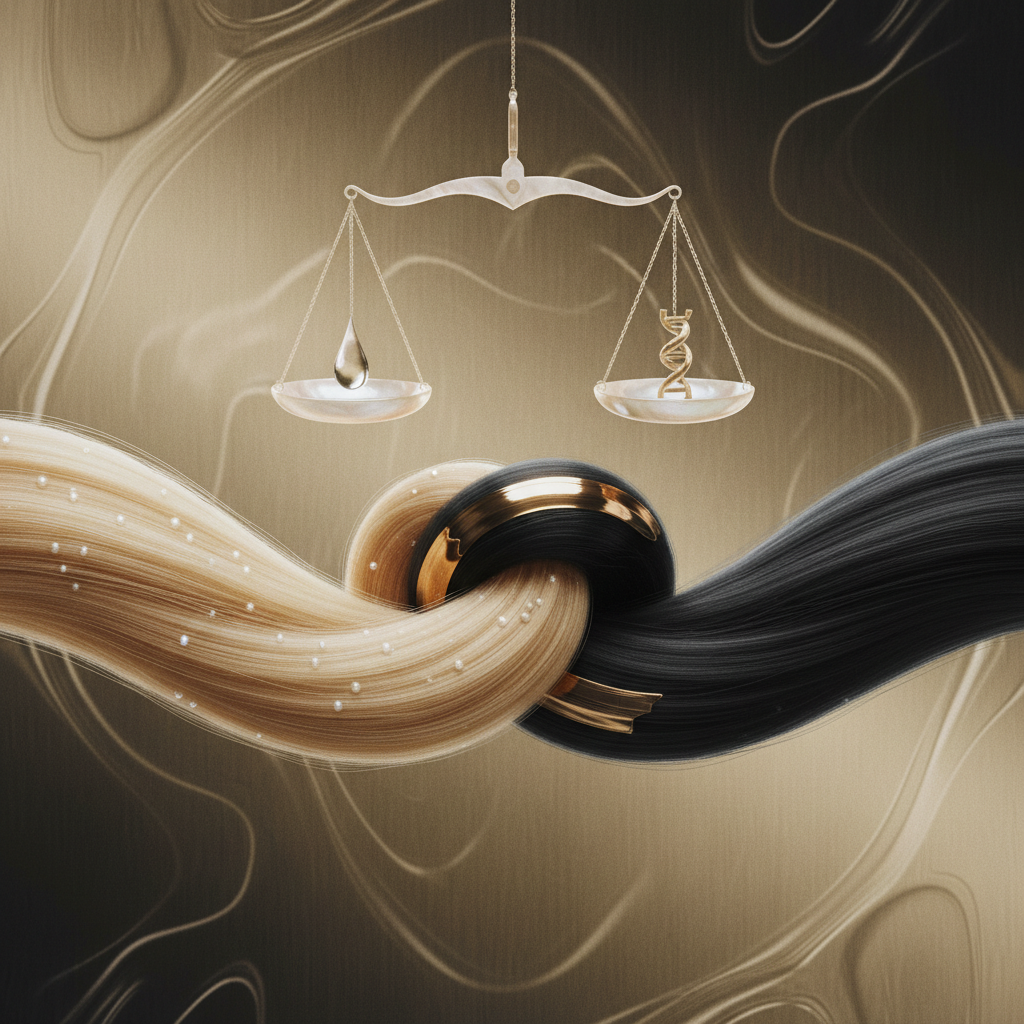
Tensile strength (the ability of a strand to withstand tension without snapping) comes from the keratin matrix and intact cortex. Elasticity (the ability of a strand to stretch and return to its original length) depends on water acting as a plasticiser within that protein framework.
When you apply hydrolysed proteins, they temporarily adhere to defects in the cuticle and outer cortex through electrostatic attraction. This bolsters the fibre's mechanical resistance. Conversely, conditioning agents such as fatty alcohols, cationic surfactants, and plant oils slow down water evaporation and lubricate the outer surface. Evidence demonstrates that healthy hair requires both: sufficient protein framework to resist deformation, and balanced moisture retention to allow normal flexing during styling.
 [ Intact Cuticle & Keratin Matrix ]
 |
 +--------------+--------------+
 | |
 Protein Excess Moisture Excess
 (Over-stiff fibre) (Hygral fatigue / limp)
 | |
Rigid, snaps under Overly elastic, gummy
 low elongation lacks rebound & volume
What the evidence does not show
Controlled cosmetic chemistry does not support the idea that hair "drinks" water like a plant. In fact, excessive water absorption is structurally damaging. When water penetrates deeply into the cortex, the hair shaft swells up to 15 percent in diameter. Repeated swelling and deswelling weakens the cell membrane complex, a phenomenon known as hygral fatigue.
Furthermore, products cannot permanently repair broken disulphide bonds simply by depositing hydrolysed protein. These treatments provide temporary reinforcement that washes away over successive wash cycles. Protein cannot cure follicular hair loss, nor can moisturising masks alter your natural genetic growth rate.
The biological and chemical mechanism
The balance between protein integrity and moisture absorption centres on the cuticle layer and cortical keratin.
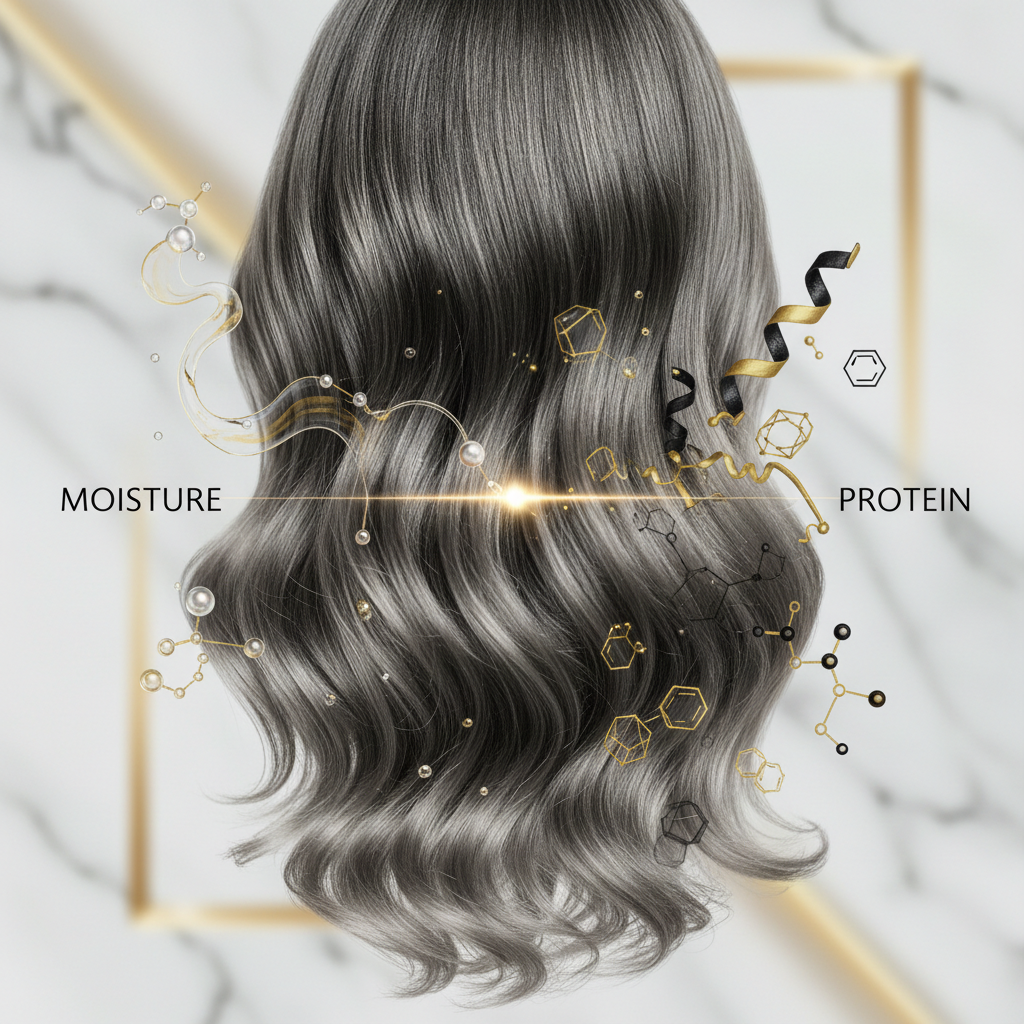
- Cuticle integrity and porosity: The cuticle consists of overlapping scales coated by the 18-methyleicosanoic acid (18-MEA) lipid layer. Bleaching, chemical relaxing, heat tools, and alkaline shampoos strip this lipid layer and chip the cuticle scales. High porosity allows water to enter and exit too rapidly, destabilising the cortex.
- Protein action: Hydrolysed wheat, soy, keratin, and silk proteins have low molecular weights (often between 500 and 2,000 Daltons). This size allows them to diffuse into slight fissures in damaged cuticle layers. They form a protective film, improving stiffness and surface smoothness. However, if used excessively on low-porosity or undamaged hair, they accumulate, preventing flexible deformation and causing brittleness.
- Moisture dynamics: Water binds to hydrophilic sites along keratin chains. Water plasticises the protein network, allowing alpha-keratin helices to temporarily stretch into beta-keratin configurations. Without lipids to seal that moisture, or in the presence of harsh surfactants, the fibre dries out, leaving hydrogen bonds locked in rigid, misshapen positions.
Identifying the signs: Protein overload vs moisture overload
Assessing whether hair leans too far toward protein rigidity or moisture fatigue requires observing how the wet fibre behaves under gentle tension.
| Physical Characteristic | Protein Overload | Moisture Overload (Hygral Fatigue) | Balanced Hair |
|---|---|---|---|
| Feel when dry | Straw-like, stiff, rough, tangles easily | Excessively soft, fluffy, lacks definition, dull | Smooth, soft, pliable, holds shape |
| Feel when wet | Hard, brittle, lacks slip | Gummy, limp, spongy, sticky | Clean, elastic, smooth |
| Elasticity test | Snaps almost immediately with minimal stretch | Stretches far beyond normal length, fails to bounce back, then snaps | Stretches approximately 20 to 30 percent when wet, returns to original length |
| Common cause | Frequent keratin treatments, heavy reconstructors without hydration | Constant wet styling, overnight conditioning, lack of protein reconstructors | Balanced wash routine matching hair porosity |
What you can do to restore equilibrium
Adjusting your routine depends on which end of the spectrum your hair currently sits.
Resolving protein overload
If your hair feels brittle, stiff, and snaps readily:
- Clarify the hair using a chelating or clarifying shampoo to strip excess cationic protein films from the cuticle.
- Temporarily pause products containing words like "hydrolysed keratin", "collagen", "amino acids", or "vegetable protein" in their top five ingredients.
- Introduce deep conditioning masks rich in emollients (such as cetyl alcohol, stearyl alcohol, and natural triglycerides) to improve flexibility.
- Apply light heat (a warm towel or hooded dryer) during conditioning to help conditioning agents soften the outer shaft.
Resolving moisture overload
If your hair feels mushy, stretches endlessly without bouncing back, and lacks body:
- Use a gentle, sulphate-free clarifying shampoo to remove heavy conditioning build-up.
- Apply a targeted hydrolysed protein reconstructor or amino acid treatment. Leave it on for the time specified by the manufacturer.
- Cut back on overnight masking and avoid leaving hair wet for extended periods. Dry hair promptly using a diffuser or medium-heat blow dryer.
- Introduce leave-in sprays formulated with low-molecular-weight amino acids to re-establish fibre tensile strength.
When the cause is something else
Brittle or thinning hair is not always an issue of cosmetic balance. It is vital to separate hair breakage along the fibre from true hair shedding or follicular loss.
- Breakage: Characterised by short, jagged fragments of hair without a white bulb at the root. This is caused by mechanical, chemical, or heat damage, or an imbalance in protein and moisture.
- Telogen effluvium: Diffuse shedding where hairs fall out from the follicle, displaying a small white keratin bulb at one end. This typically follows acute stress, illness, dietary shifts, or hormonal changes.
- Alopecia: Patterned hair loss, patchy bald spots (alopecia areata), or scalp inflammation stem from autoimmune, genetic, or endocrine factors. No protein treatment or moisturising mask can treat these conditions.
If you notice rapid, diffuse shedding from the scalp or persistent bald patches, consult a GP or registered trichologist for proper medical evaluation.
Supporting hair condition with Watermans
Cosmetic routines benefit from balanced formulations that support both hair feel and scalp cleanliness. Watermans Grow Me Shampoo and Conditioner are designed to cleanse gently while delivering a supportive blend of ingredients, including biotin, rosemary, and natural proteins, without weighing hair down. Using balanced systems helps keep the hair fibre manageable, reducing mechanical breakage caused by rough brushing or excessive friction during styling.
Frequently asked questions about Moisture vs Protein Balance
How often should I do a protein treatment?
For chemically treated, bleached, or high-porosity hair, a targeted protein treatment every 4 to 6 weeks is usually sufficient. Virgin or low-porosity hair rarely needs intensive protein treatments; a balanced monthly conditioner will maintain strength without causing rigidity.
Can low-porosity hair experience protein overload faster?
Yes. Low-porosity hair possesses tightly bound, overlapping cuticles that resist product penetration. Large hydrolysed proteins settle directly on the outer surface instead of integrating into structural micro-gaps. This surface accumulation quickly makes low-porosity strands feel dry, stiff, and prone to mechanical snapping.
Does the wet stretch test accurately show Moisture vs Protein Balance?
The wet stretch test provides a practical cosmetic indicator, though it is not a laboratory-grade test. By gently pulling a wet strand between two fingers, you can assess elasticity. Snapping immediately indicates protein excess or dehydration; stretching indefinitely before breaking suggests moisture overload.
Can leave-in conditioners cause hygral fatigue?
Leave-in conditioners alone rarely cause hygral fatigue unless used alongside prolonged wetness. Keeping hair wet for hours, such as sleeping with soaking-wet deep conditioning treatments under a shower cap, swells the cortex for too long, degrading the internal cell membrane complex.
Achieving long-term fibre resilience
Maintaining optimal Moisture vs Protein Balance is an ongoing management strategy rather than a one-time fix. Because hair fibres cannot biologically regenerate, everyday styling, environmental UV exposure, and heat tools will continuously alter porosity. Pay attention to how your hair behaves under tension: introduce hydrolysed proteins when strands feel limp, and switch to emollient-rich hydrators when fibres turn stiff. Balancing structural tensile strength with supple elasticity keeps your hair resilient against everyday mechanical stress.
Sources and references
- Robbins, C. R. (2012). Chemical and Physical Behavior of Human Hair. 5th ed. Springer-Verlag New York.
- Cruz, C. F., et al. (2016). Human hair characteristics: A review on the cellular and molecular mechanisms. International Journal of Cosmetic Science, 38(5), 444-454.
- Evans, T., & Wickett, R. R. (2012). Practical Modern Hair Science. Allured Business Media.
- British Association of Dermatologists. (2021). Telogen Effluvium Guidelines and Patient Information.
- Swift, J. A. (1999). The mechanics of human hair. International Journal of Cosmetic Science, 21(4), 227-239.