Moisture Protein Balance in Hair: The Definitive Guide
10 min read ·
Master the science of Moisture Protein Balance to stop hair breakage. Learn to diagnose protein overload, treat hygral fatigue, and restore fibre elasticity.
Quick answer: Moisture Protein Balance describes the equilibrium between structural keratin integrity and internal water content within the hair shaft, governing elasticity and tensile strength. Achieving this state ensures hair can stretch without snapping and return to its original shape without going limp. However, moisture cannot permanently stay inside damaged hair without an intact hydrophobic lipid barrier, and excess cosmetic proteins can cause rigidity. Achieving this balance requires matching your hair porosity and mechanical needs to the right humectants and conditioning agents.
Key takeaways
- Hair is roughly 65 to 90 percent protein by dry weight, while water content naturally fluctuates between 8 and 15 percent depending on ambient relative humidity.
- The concept of balance is mechanical: proteins provide tensile strength and structural rigidity, whereas water coupled with natural lipids provides pliability and elasticity.
- Too much cosmetic protein deposition can make low-porosity hair stiff, brittle, and prone to mechanical breakage.
- Hygral fatigue occurs when weakened cuticles let hair swell with water and contract repeatedly, causing cortex degradation rather than healthy hydration.
- A simple wet stretch test can help determine whether hair fibres require hydrolysed protein reinforcement or softening emollient conditioning.
Moisture Protein Balance: what the evidence shows
Textile and cosmetic science validates that the mechanical behaviour of human hair relies on two primary physical components: alpha-keratin polypeptide chains and bound water molecules. Moisture Protein Balance refers to the functional state where hair maintains enough structural integrity to resist tension while retaining enough plasticising water to bend without fracturing.
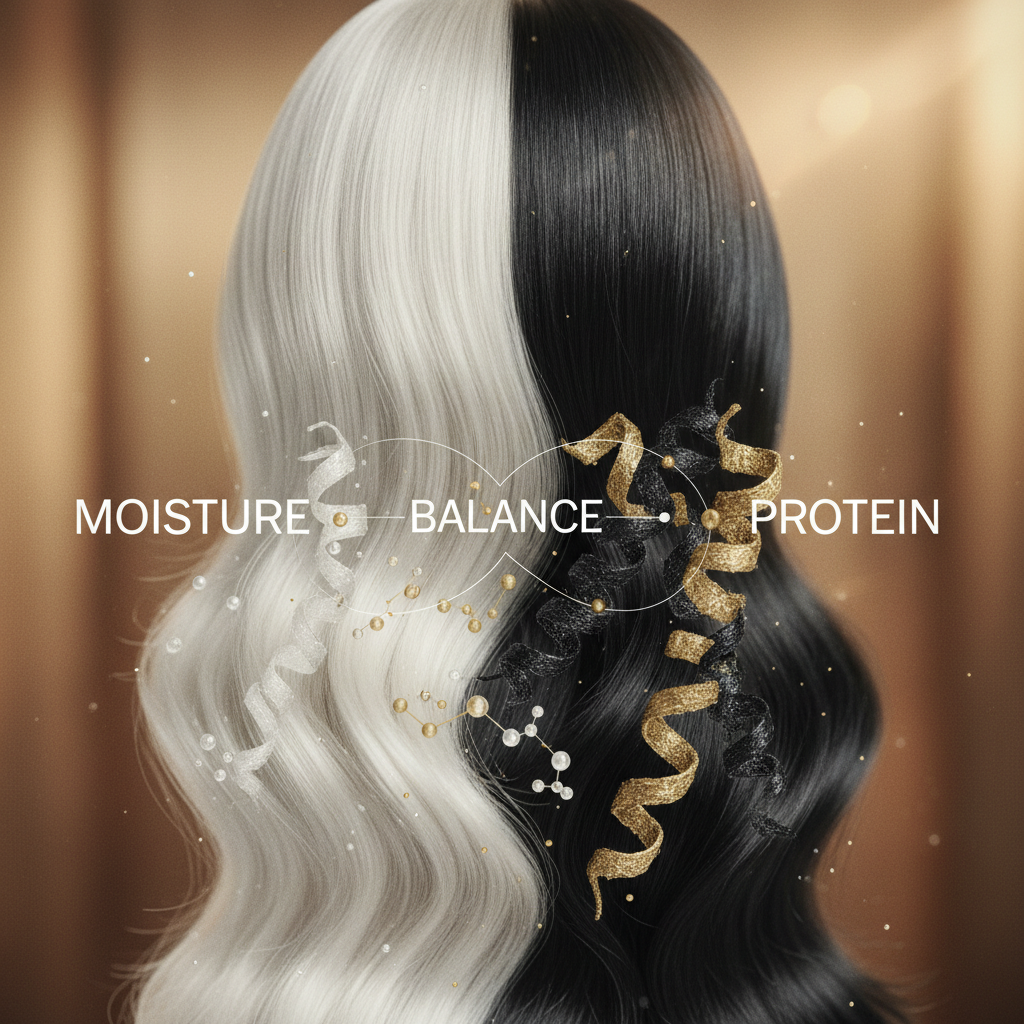
In cosmetic chemistry, hair strength is measured using tensile testing. Keratin intermediate filaments, rich in cystine cross-links (disulphide bonds), give the fibre its high tensile strength. When healthy hair is dry, it can withstand significant pulling forces.
However, water acts as a natural plasticiser inside the cortex. As water molecules penetrate the fibre, they temporarily break weak hydrogen bonds between keratin chains. This permits the protein chains to slide past one another under strain, allowing hair to stretch up to 30 percent of its original length when wet without breaking. When hair lacks water or the cuticles are sealed too rigidly, it becomes stiff and brittle. Conversely, when internal keratin bonds are chemically destroyed (such as through bleaching, high-pH relaxers, or excessive thermal styling), hair loses its internal spring, stretching excessively and failing to bounce back.
+--------------------------------------------------------------------------+
| THE ELASTICITY SPECTRUM |
+--------------------------------------------------------------------------+
| Rigid / Brittle Balanced Elasticity Gummy / Limp |
| (Excess protein / (Optimal tensile strength (Excess water /|
| low plasticisation) and water retention) cortex damage)|
| |
| Stretches < 10% Stretches 20-30% Stretches > 30%|
| Snaps instantly Returns to shape Fails to return|
+--------------------------------------------------------------------------+
What the evidence does not show
The salon industry often speaks of hair "drinking up moisture" like a houseplant, but cosmetic biology reveals a different reality:
- Hair cannot be permanently "hydrated" by soaking it in water. Excessive water absorption (swelling beyond 15 percent fibre diameter) actually weakens hair by putting lateral stress on cuticle cells.
- Topical proteins cannot rebuild broken disulphide bonds. Hydrolysed wheat, soy, or keratin proteins temporarily patch gaps in the cuticle and outer cortex via hydrogen bonding and electrostatic attraction. They do not permanently regenerate the hair's original biological architecture.
- Dry hair is rarely deficient in environmental water. Instead, it is usually deficient in protective surface lipids, notably 18-methyleicosanoic acid (18-MEA). When this protective lipid layer is stripped by chemical processing, the fibre can no longer regulate its internal moisture levels against dry ambient air.
The mechanism: proteins, lipids, and hygral dynamics
To understand the balance, you must look at how water and proteins interact within the hair's composite structure.
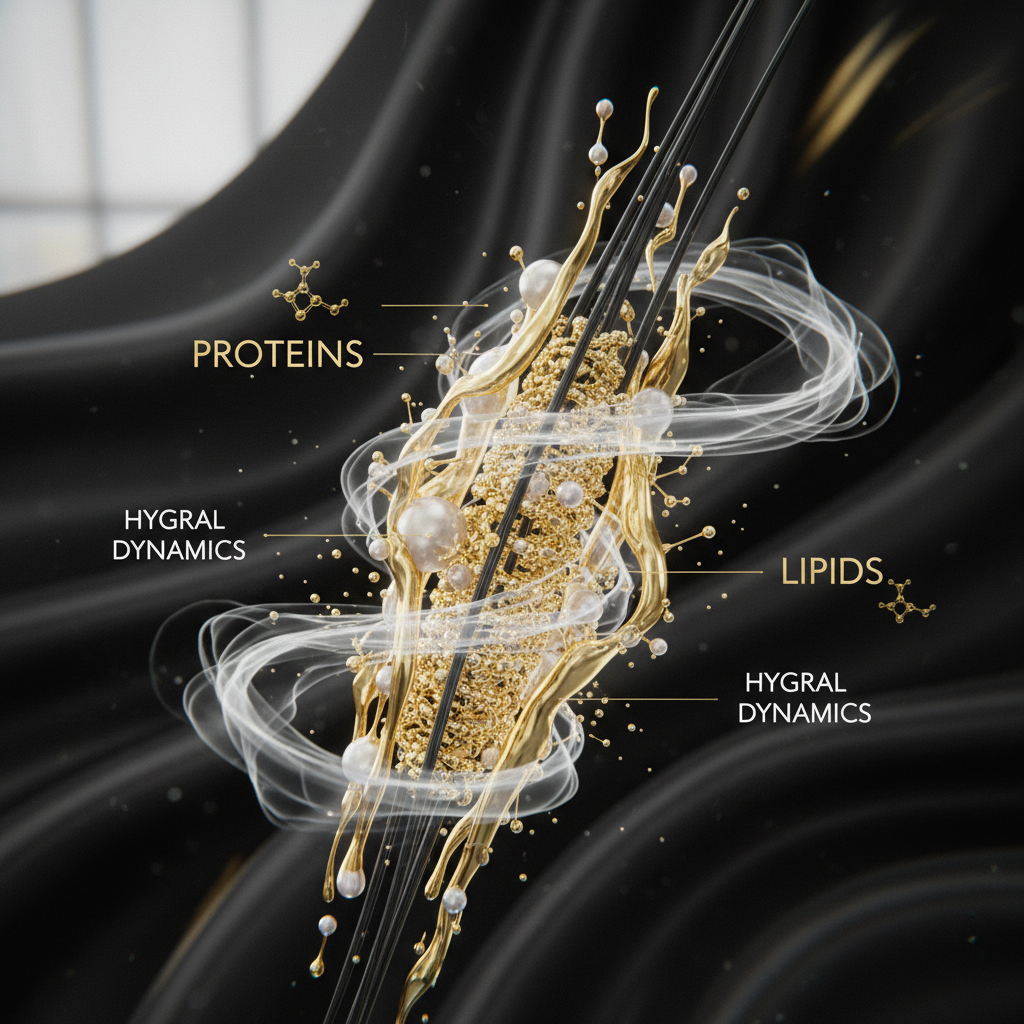
 [ Cuticle Layer: Hydrophobic 18-MEA Lipids ]
 |
 [ Matrix: Amorphous, High-Sulphur Proteins ]
 |
 [ Microfibrils: Crystalline Alpha-Keratin ]
The cortex contains two main regions: crystalline microfibrils (organised alpha-keratin chains that provide longitudinal strength) and an amorphous protein matrix that surrounds them. The matrix absorbs water readily, which softens the fibre.
When your hair's protective F-layer (the 18-MEA lipid coating) is intact, the cuticle remains hydrophobic. It repels bulk water while allowing a steady 8 to 15 percent moisture equilibrium inside. If you strip this layer through bleach, alkaline dyes, or harsh surfactants, cuticles lift. Hair becomes hydrophilic (water-loving) and porous.
In this damaged state, hair absorbs water too rapidly in the shower, causing the cortex to swell and stretch the cuticle margins. As the hair dries, it loses that water just as quickly to dry room air. This constant cycle of swelling and shrinking is called hygral fatigue. It causes micro-fractures along the shaft.
Hydrolysed proteins help interrupt this cycle. Because intact keratin molecules are far too large (over 10,000 Daltons) to penetrate the hair shaft, cosmetic chemists use enzymatic hydrolysis to break them down into smaller peptides (typically 500 to 2,000 Daltons). Peptides under 1,000 Daltons can diffuse into the porous cortex to reinforce compromised matrix areas, while larger peptides form a temporary protective film on the cuticle surface.
Signs of imbalance: protein overload vs moisture overload
Assessing whether hair leans toward protein overload or moisture overload requires evaluating feel, movement, and elasticity.
| Diagnostic Marker | Protein Overload (Brittleness) | Moisture Overload / Hygral Fatigue | Balanced Hair |
|---|---|---|---|
| Tactile Feel | Stiff, dry, straw-like, raspy | Mushy, gummy, excessively soft | Smooth, pliable, silky |
| Wet Stretch Test | Snaps immediately with little to no stretch | Stretches past 30%, does not bounce back; feels spongy | Stretches roughly 20 to 30%, returns to original length |
| Fibre Behaviour | Tangles easily, sheds small broken pieces | Limp, lifeless, curl pattern falls flat | Defined curls or waves, holds styling well |
| Typical Causes | Frequent use of keratin treatments, bond builders, or amino acid masks | Prolonged wet styling, deep conditioning overnight, lack of structural protein | Routine alternating of hydrators, light proteins, and emollients |
How to perform the wet stretch test
You can assess your hair's internal balance using a simple physical assessment at home or in the salon:
- Select a clean strand of shed hair while it is wet (or isolate a small, single hair on your head).
- Hold the strand firmly between the thumb and forefinger of both hands, leaving roughly two inches of hair between your fingers.
- Gently pull your hands apart, applying slow, steady tension.
- Observe the result:
- If it snaps instantly with zero give, the fibre is rigid and needs plasticising emollients and humectants (moisture).
- If it stretches endlessly like wet chewing gum, feels mushy, and breaks without springing back, the internal matrix is compromised and needs hydrolysed protein reinforcement.
- If it stretches slightly, resists the pull, and snaps back to its starting length when released, the fibre has healthy elasticity.
Corrective actions: re-establishing equilibrium
Restoring functional balance requires adjusting your product selection based on the current state of your hair.
For protein-heavy, brittle hair
- Clarify: Use a gentle chelating or clarifying shampoo to strip away cosmetic protein deposits clinging to the cuticle.
- Stop protein products: Check product ingredient labels for terms like hydrolysed keratin, hydrolysed wheat protein, amino acids, collagen, or silk protein. Set these aside for 3 to 4 weeks.
- Use penetrating emollients and humectants: Use conditioners containing panthenol, glycerin, propylene glycol, cetyl alcohol, and natural plant oils (like argan or jojoba oil) to lubricate the cuticle and soften the cortex.
- Add heat to conditioning: Use a thermal cap or warm towel during deep conditioning to temporarily lift stubborn cuticles and let plasticising agents enter the shaft.
For moisture-heavy, gummy hair
- Apply hydrolysed proteins: Introduce a targeted protein treatment containing low-molecular-weight peptides that can enter porous gaps in the cortex.
- Reduce prolonged wetting: Never sleep with wet hair or leave deep conditioning treatments on for hours. Cut soaking time to minimise cortex swelling.
- Incorporate film formers: Use leave-in conditioners containing polyquaternium compounds or light silicones (like amodimethicone) to create a barrier against ambient humidity.
- Balance your wash routine: Follow protein treatments with an acidic rinse or conditioner (pH 4.0 to 5.0) to contract the cuticle scale and lock the reinforcing peptides in place.
When the cause may be something else
Before assuming poor elasticity is strictly a cosmetic product imbalance, consider non-cosmetic factors:
- Internal nutritional deficiencies: Insufficient dietary protein, low ferritin (iron stores), or severe zinc deficiencies reduce the quality of keratin produced in the hair follicle matrix during the anagen growth phase. Cosmetic treatments cannot fix hair that emerges structurally weak from the root.
- Thermal degradation: Using curling wands or flat irons above 200 degrees Celsius physically melts keratin from alpha-helices into beta-sheet structures. This damage is permanent and cannot be reversed by either protein or moisture products.
- Endocrine conditions: Thyroid dysfunction (both hypothyroidism and hyperthyroidism) alters the metabolic output of hair matrix cells, frequently producing rough, brittle, and dry hair shafts that mimic severe protein overload.
If your hair is shedding excessively from the root (characterised by white bulbs at the base of fallen hairs) rather than snapping along the shaft, this is hair shedding or hair loss, not hair breakage. Cosmetic moisture or protein adjustments will not stop follicular shedding.
Professional support and when to consult a specialist
If your hair fails to respond to routine adjustments within four to six weeks, consult a professional:
- Consult a qualified trichologist or dermatologist if you notice diffuse thinning across the scalp, widening part lines, or tender patches. They can run blood panels, perform trichoscopy, and diagnose underlying conditions like telogen effluvium or androgenetic alopecia.
- Consult an experienced colourist or stylist if you are planning major chemical alterations (such as going from dark to platinum blonde, or applying relaxers). A professional can run a strand test to determine if your cortex has the tensile strength to survive the service.
Supporting strong hair condition with Watermans
When managing hair condition, gentle external care and scalp vitality work together. While cosmetic protein and conditioning products address the hair shaft itself, healthy-looking hair begins at the follicle. The Watermans Grow Me range delivers scalp-stimulating botanical blends, biotin, and rosemary extract designed to invigorate the scalp surface. Pairing balanced topical fibre maintenance with targeted scalp support helps ensure hair looks thicker, stronger, and more resilient from root to tip.
Frequently asked questions about Moisture Protein Balance
What is the ideal Moisture Protein Balance for bleached hair?
Bleached hair has lost significant natural protein through the oxidation of disulphide bonds. It requires regular doses of low-molecular-weight hydrolysed proteins to patch the porous cortex, followed immediately by rich emollients and occlusive lipids to prevent high moisture loss and hygral fatigue.
Can low-porosity hair experience protein overload quickly?
Yes. Low-porosity hair has tightly overlapping cuticle scales. Large cosmetic protein molecules cannot penetrate into the cortex and instead accumulate on the cuticle surface. This surface build-up blocks ambient moisture, causing the hair to become stiff, rough, and prone to snap breakage within just a few applications.
How often should you use protein treatments to maintain balance?
Healthy, untreated hair generally needs a dedicated protein treatment only once every 4 to 6 weeks. Chemically treated, fine, or highly porous hair may benefit from gentle hydrolysed proteins every 1 to 2 weeks, balanced with moisturising conditioners at every wash.
Does hygral fatigue mean hair has too much moisture?
Hygral fatigue does not mean hair is over-hydrated in a healthy way. It means the hair cuticle is too weak to control water movement, causing the cortex to repeatedly swell when wet and contract when dry. This continuous stress weakens the keratin structure, making hair feel limp, gummy, and weak.
Can drinking more water fix dry hair?
Drinking adequate water supports overall health and active cellular division in the hair follicle, but it does not directly hydrate dry hair shafts. Once hair grows beyond the scalp, it is non-living tissue. Its hydration depends on ambient humidity and surface lipids that lock water inside the fibre.
Maintaining your hair equilibrium
Achieving the right Moisture Protein Balance comes down to understanding your hair's structural needs. Hair is neither a living sponge that thrives on constant soaking nor an inanimate wire that needs continuous hardening. By monitoring your hair's elasticity, matching hydrolysed proteins to your chemical history, and using emollients to seal the cuticle, you can maintain strong, flexible hair that resists breakage.
Sources and references
- Robbins, C. R. (2012). Chemical and Physical Behavior of Human Hair. 5th ed. Springer-Verlag New York.
- Cruz, C. F., et al. (2016). 'Human Hair Keratin After Chemical and Physical Alterations: An Overview.' Biophysical Reviews, 8(4), pp. 381 to 396.
- Dawber, R. (1996). 'Hair: Its Structure and Response to Cosmetic Preparations.' Clinics in Dermatology, 14(1), pp. 105 to 112.
- Evans, T., & Wickett, R. R. (2012). Practical Modern Hair Science. Allured Business Media.
- National Center for Biotechnology Information (NCBI). PubChem Annotation: Hydrolyzed Keratin. U.S. National Library of Medicine.
Find these ingredients in Watermans products
- Zinc: you will find this ingredient in our Hair Vitamins.
- Panthenol (Provitamin B5): you will find this ingredient in our Heat Protection Spray.