Managing Heat Damage: The Science and Practice of Restoring Compromised Hair
8 min read ·
Learn the science of Managing Heat Damage. Discover how heat degrades keratin, why breakage is not hair loss, and proven steps to protect and strengthen your hair.
Quick answer: Managing Heat Damage requires a two-pronged strategy: preventing further structural breakdown of the hair shaft and cosmetically reinforcing the compromised fibre. Because hair fibre is non-living keratinised tissue, true biological repair of thermally degraded protein is impossible. Managing Heat Damage centres on lowering tool temperatures below 180°C, applying heat protectants to reduce thermal conduction, smoothing fractured cuticles with hydrolysed proteins and conditioning lipids, and trimming severely weakened ends to halt fibre breakage.
Key takeaways
- Thermal tools alter hair keratin at temperatures above 140°C and cause severe, irreversible structural degradation above 190°C.
- True biological repair is impossible because the hair shaft contains no living cells to synthesise new structural protein.
- Heat damage causes hair breakage along the fibre, which must never be confused with follicular hair loss or shedding.
- Silicones and film-forming polymers reduce thermal conductivity and buffer moisture loss during styling.
- Regular micro-trims remain the only permanent solution for split ends and deep longitudinal cortex fractures.
Managing Heat Damage: what the evidence shows
Managing Heat Damage starts with understanding how thermal energy interacts with keratin. Hair fibre consists of an outer protective cuticle, an inner protein-dense cortex, and, in thicker hairs, a central medulla. The cortex is packed with alpha-keratin filaments stabilised by disulphide bonds, hydrogen bonds, and salt linkages.
Peer-reviewed cosmetic dermatology studies show that elevated temperatures alter these bonds progressively:
- At 100°C to 140°C: Free and bound moisture within the hair shaft vaporises. If styling wet or damp hair rapidly, steam can expand within the cortex, causing rapid internal pressure that leads to "bubble hair", an irreversible deformation marked by brittle hollows along the shaft.
- At 140°C to 160°C: The alpha-keratin helix begins to denature, uncoiling into a disordered beta-sheet configuration. This transition permanently reduces the elasticity and tensile strength of the fibre.
- At 180°C to 200°C: Tryptophan and other aromatic amino acids oxidise. This reaction causes yellowing in light hair and degrades the melanin granules responsible for natural pigmentation.
- Above 200°C: The lipid-rich cell membrane complex (CMC) melts, cuticle scales lift and crack, and disulphide bonds decompose into cysteic acid residues. The hair becomes porous, fragile, and prone to immediate mechanical snap.
Managing Heat Damage therefore relies on intervention before protein degradation occurs, alongside cosmetic management once the cortex has sustained thermal stress.
| Styling Temperature | Internal Fibre Effect | Visible Hair Impact | Evidence-Based Mitigation |
|---|---|---|---|
| Below 140°C | Temporary moisture evaporation, hydrogen bond shifting | Mild dryness, temporary shape change | Leave-in conditioners, standard hydration |
| 140°C to 175°C | Cuticle lifting, partial alpha-to-beta keratin denaturation | Loss of shine, increased friction, slight frizz | Film-forming polymers, heat protectants |
| 180°C to 200°C | Amino acid oxidation, lipid depletion in the cell membrane complex | Dullness, altered colour, split ends, loss of curl pattern | Lower tool heat, hydrolysed proteins, silicones |
| Above 200°C | Severe cuticle stripping, disulphide bond fracture, cortex melting | High porosity, severe breakage, irreversible snapping | Professional trimming, structural cessation |
What the evidence does not show
Controlled research does not support the claim that any cosmetic mask, bond builder, or oil can permanently restore heat-denatured keratin to its virgin state. While chemical treatments can link some broken chemical bonds or coat the hair with smoothing polymers, they do not reconstitute the original organised alpha-helix structure.
Furthermore, thermal exposure does not directly cause follicular hair loss (alopecia) or hair shedding from the scalp. If you notice hairs snapping midway down the shaft with no white bulb at the root, you are experiencing hair breakage due to compromised tensile strength. Heat does not shut down the follicle unless an extreme styling tool burns the living scalp tissue itself.
Signs of thermal damage to watch for
Thermal stress shows distinct physical signs. Recognising them early prevents minor surface friction from becoming catastrophic breakage:
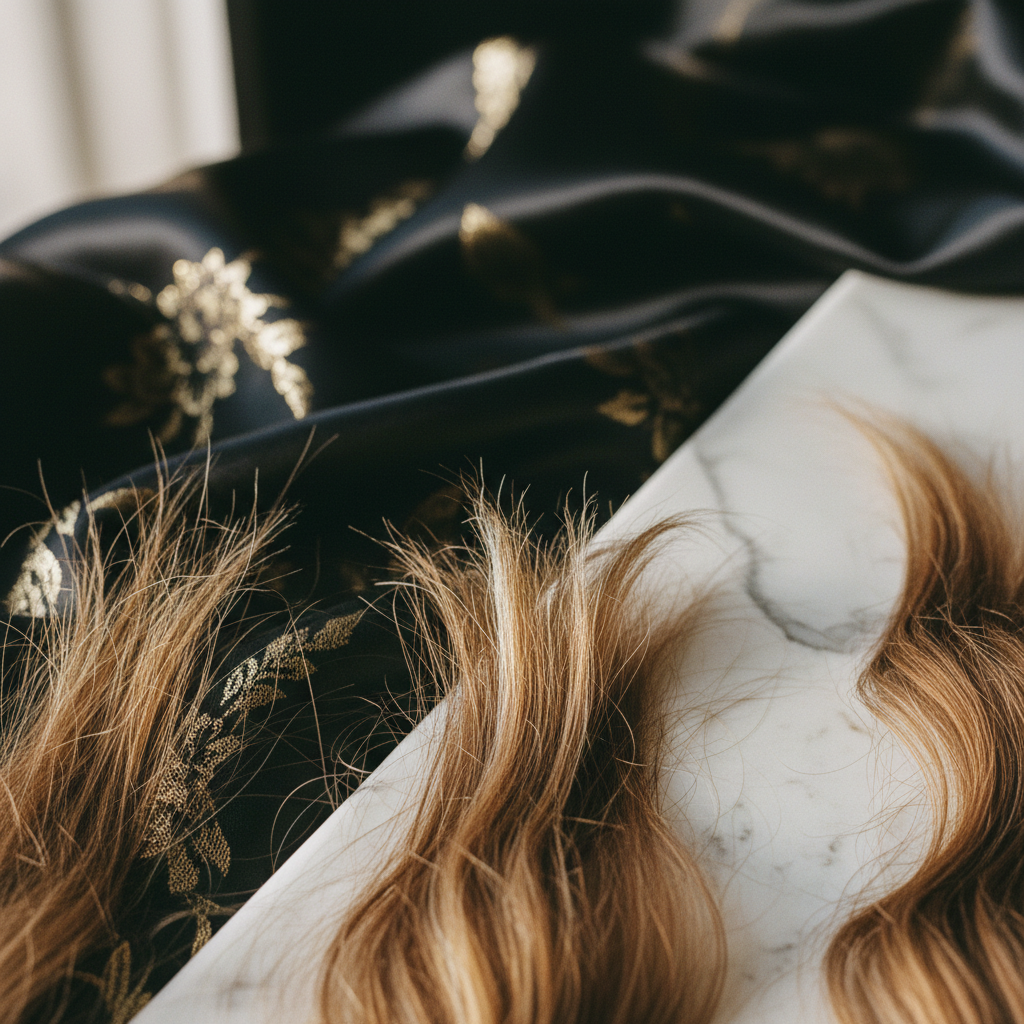
- Altered curl patterns: Curly and coily hair textures often lose their natural spring, presenting limp or completely straight patches where heat has permanently rearranged the cortex structure.
- Split ends (trichoptilosis): Heat strips the protective F-layer (a natural surface lipid layer of 18-methyleicosanoic acid), leaving the exposed cuticle to peel back and split into multi-pronged fractures.
- White nodules (trichorrhexis nodosa): Microscopic nodes or tiny white dots appear along the shaft where the cortex has collapsed. The hair snaps easily at these points under mild tension.
- Extreme porosity and water absorption: Damaged hair absorbs water rapidly because the protective lipid barrier is stripped, but it struggles to retain moisture once dry, leaving it brittle and straw-like.
- Loss of natural elasticity: Healthy hair stretches up to 30% of its dry length before breaking. Thermally altered hair snaps almost instantly with minimal stretch.
Practical steps for managing heat-damaged hair
Managing Heat Damage requires a calculated routine that combines mechanical protection, temperature limits, and cosmetic reinforcement.
Adjust tool temperature and technique
Never exceed 185°C when using flat irons or curling wands. Fine, bleached, or chemically treated hair should remain below 150°C. Work in single, smooth, continuous passes. Clamping an iron in one spot for several seconds concentrates heat energy and scorches the cuticle. Ensure hair is completely dry before introducing hot irons to avoid steam-induced cavitation (bubble hair).
Deploy high-performance heat protectants
Heat protectants work by lowering thermal conductivity and distributing heat more evenly across the surface of the fibre. Look for formulations containing dimethicone, amodimethicone, polyquaternium-55, or hydrolysed vegetable proteins. These ingredients create a temporary barrier that slows the transfer of peak heat into the internal cortex.
Rebuild surface lubricity with lipids and proteins
When the natural 18-MEA lipid layer is stripped, the cuticle scales flare, dramatically increasing friction during brushing. Use deep conditioning formulations rich in fatty alcohols (cetyl and stearyl alcohol), ceramides, and light plant oils. Hydrolysed keratin and wheat proteins can temporarily fill microscopic voids along the cuticle edge, reducing snagging and masking roughness until the hair is washed.
Incorporate regular structural trims
Because split ends travel upward along the fibre via mechanical friction, leaving them unaddressed leads to greater length loss over time. Schedule a micro-trim every 6 to 8 weeks to remove frayed tips before they split the cortex further up the shaft.
When breakage is mistaken for something else
It is vital to distinguish between hair breakage caused by heat and genuine hair loss. Hair loss involves conditions like androgenetic alopecia, alopecia areata, or telogen effluvium, where hairs shed directly from the follicle, complete with a tiny white keratin bulb at the tip.
If you find shorter pieces of hair without a bulb on your shoulders, in your brush, or on the floor, you are dealing with structural fibre breakage. While aggressive blow-drying near the scalp can irritate epidermal skin, standard heat damage is exclusively a fibre-shaft problem. If you observe patchy thinning across your scalp, widening part lines, or sudden heavy shedding from the root, consult a trichologist or dermatologist, as thermal styling is unlikely to be the cause.
The role of targeted haircare: Watermans
When managing hair rendered fragile by heat tools, protecting the existing fibre and supporting the scalp environment is essential. Watermans focuses on evidence-based cosmetic support for stressed hair. Formulations like Watermans GrowMe Shampoo and ConditionMe Conditioner deliver hydrolysed proteins, biotin, and nourishing lipids that help strengthen brittle strands, improve surface combability, and reduce mechanical breakage during everyday washing and styling. While cosmetic products cannot fuse dead protein cells back into their pristine biological state, quality formulations can smooth the cuticle, boost shine, and help hair withstand everyday wear and tear.
Frequently asked questions about Managing Heat Damage
Can you reverse heat damage without cutting your hair?
No. Hair is non-living biological tissue and cannot regenerate denatured keratin. Cosmetic treatments, oils, and protein masks can coat the shaft, smooth raised cuticles, and temporarily reduce friction, but they do not reverse the internal structural destruction. The only permanent fix for split, broken ends is trimming them away.
What is the safest temperature for heat styling?
Research suggests keeping styling tools below 180°C (356°F) for normal hair, and below 150°C (300°F) for fine, bleached, or chemically altered hair. Temperatures at or above 190°C cause irreversible breakdown of the alpha-keratin helix, strip natural surface lipids, and rapidly accelerate fibre breakage.
How does heat protection actually work?
Heat protectants contain film-forming polymers and silicones that have low thermal conductivity. They create a protective barrier over the cuticle, distributing the iron's heat evenly and slowing the rate at which thermal energy penetrates into the internal cortex. They also reduce water loss from the fibre during styling.
Is hair breakage from heat considered hair loss?
No. Managing Heat Damage involves addressing hair breakage along the shaft, not follicular hair loss. Breakage occurs when heat weakens the hair fibre until it snaps under tension. Hair loss (or shedding) occurs when the follicle releases the entire hair strand from the scalp, typically showing a small white bulb at its base.
A balanced approach to thermal recovery
Successfully Managing Heat Damage requires managing expectations alongside your styling habits. While cosmetic chemistry provides effective tools to seal cuticles, restore temporary slip, and buffer against future thermal stress, it cannot resurrect thermally degraded keratin. Prioritise prevention: lower your styling temperatures, always apply protective barriers, keep hair moisturised, and remove split ends before they travel. By adopting a methodical approach to thermal care, you can preserve the structural integrity of your hair and enjoy healthy, resilient styling for years to come.
Sources and references
- Journal of Cosmetic Dermatology: "Thermal degradation of hair keratin: A review of the mechanical and structural changes," 2011.
- International Journal of Trichology: "Bubble hair: A unique heat-induced hair shaft deformity," 2010.
- Cosmetics & Toiletries: "The Chemistry of Thermal Protection for Hair," 2015.
- British Association of Dermatologists: "Hair shaft disorders and structural fragility," 2020.
- Journal of Investigative Dermatology: "The effects of heat and environmental stress on the hair cuticular surface," 2017.
Find these ingredients in Watermans products
- Biotin: you will find this ingredient in our Hair Growth Shampoo.