Managing Hair Porosity: A Practical Guide to Cuticle Health and Moisture Balance
8 min read ·
Discover how managing hair porosity can transform your routine. Learn the science of cuticle architecture, hygral fatigue, and proven strategies for stronger hair.
Quick answer: Managing Hair Porosity involves adjusting your cleansing, conditioning, and styling habits to match your hair fibre's ability to absorb and hold moisture. Whether cuticles are tightly sealed, naturally balanced, or lifted from chemical or mechanical damage, hair porosity dictates how proteins, water, and lipids interact with the shaft. While targeted treatments can temporarily smooth the cuticle or seal gaps, cosmetic products cannot permanently alter genetically determined porosity or regenerate destroyed cuticle layers, making ongoing structural management essential.
Key takeaways
- Porosity describes the cuticle architecture of the hair shaft and how easily water and cosmetic agents enter and exit the cortex.
- Low porosity hair has tightly packed cuticle scales that resist moisture entry, requiring lightweight formulations, gentle heat during conditioning, and clarifying agents.
- High porosity hair features lifted, chipped, or missing cuticles that absorb water rapidly but lose it just as fast, benefiting from protein reconstructors, film-forming humectants, and sealing lipids.
- Medium (normal) porosity hair balances moisture absorption and retention with minimal mechanical intervention.
- The popular "float test" in a glass of water is scientifically unreliable due to surface tension and sebum residues; tactile and diagnostic assessment provides far more accurate information.
- Cosmetic treatments temporarily fill cuticle voids and coat the fibre; they do not permanently restructure damaged keratin.
Managing Hair Porosity: what the evidence shows
Managing Hair Porosity requires understanding the physical state of the outermost layer of the hair fibre: the cuticle. The cuticle consists of 5 to 10 overlapping layers of flat, scale-like cells secured by the cell membrane complex (CMC) and coated by 18-methyleicosanoic acid (18-MEA), a protective hydrophobic lipid layer.

Peer-reviewed cosmetic dermatology studies demonstrate that hair porosity is directly correlated with cuticle integrity. In virgin, undamaged hair, the cuticle lays flat, creating a hydrophobic barrier that repels water and prevents structural lipids from washing away. When cuticles are chemically processed (bleaching, permanent dyeing, relaxing) or thermally degraded, the 18-MEA layer is stripped away and the scales lift, break, or dissolve. This turns the hair hydrophilic, porous, and prone to rapid water uptake and rapid dehydration. Managing your hair according to its specific level of porosity optimises tensile strength, reduces mechanical friction, and minimises fibre breakage.
+------------------+-----------------------------+-----------------------------+-----------------------------+
| Characteristic | Low Porosity | Medium (Normal) Porosity | High Porosity |
+------------------+-----------------------------+-----------------------------+-----------------------------+
| Cuticle State | Tightly bound, overlapping | Smooth, intact, moderately | Raised, chipped, or missing |
| | scales | flexible scales | scale fragments |
+------------------+-----------------------------+-----------------------------+-----------------------------+
| Water Absorption | Very slow; water beads on | Balanced; absorbs water | Extremely fast; saturates |
| | surface | steadily | instantly |
+------------------+-----------------------------+-----------------------------+-----------------------------+
| Drying Time | Prolonged (often hours to | Moderate, predictable | Rapid air-drying, but holds |
| | air-dry completely) | | water internally if swollen |
+------------------+-----------------------------+-----------------------------+-----------------------------+
| Product Response | Prone to surface buildup; | Responds well to standard | Absorbs heavy creams easily;|
| | dislikes heavy butters | conditioning treatments | loses moisture quickly |
+------------------+-----------------------------+-----------------------------+-----------------------------+
| Primary Risk | Product accumulation, dull | Mechanical wear over time | Breakage, hygral fatigue, |
| | appearance, limpness | | severe tangling |
+------------------+-----------------------------+-----------------------------+-----------------------------+
The biological mechanism of hair porosity
Hair porosity is governed by surface energy, charge, and physical micro-fissures along the shaft.
Hair keratin naturally carries an isoelectric point around pH 3.67. At standard water pH (typically 6.5 to 8.0), hair carries a net negative electrical charge. When the protective outer lipid barrier is compromised, this negative charge increases dramatically due to exposed cysteic acid groups generated during oxidative damage.
High porosity hair swells excessively when wet, a condition that repeatedly stretches and weakens the cell membrane complex. This repeated expansion and contraction is known as hygral fatigue, leading to macro-fibril fracturing and eventual breakage along the shaft. Conversely, low porosity hair features a closed cuticle with intact hydrophobic lipids, creating a barrier that resists polar water molecules and large cosmetic polymers from entering the cortex.
Diagnostic signs: assessing your porosity level
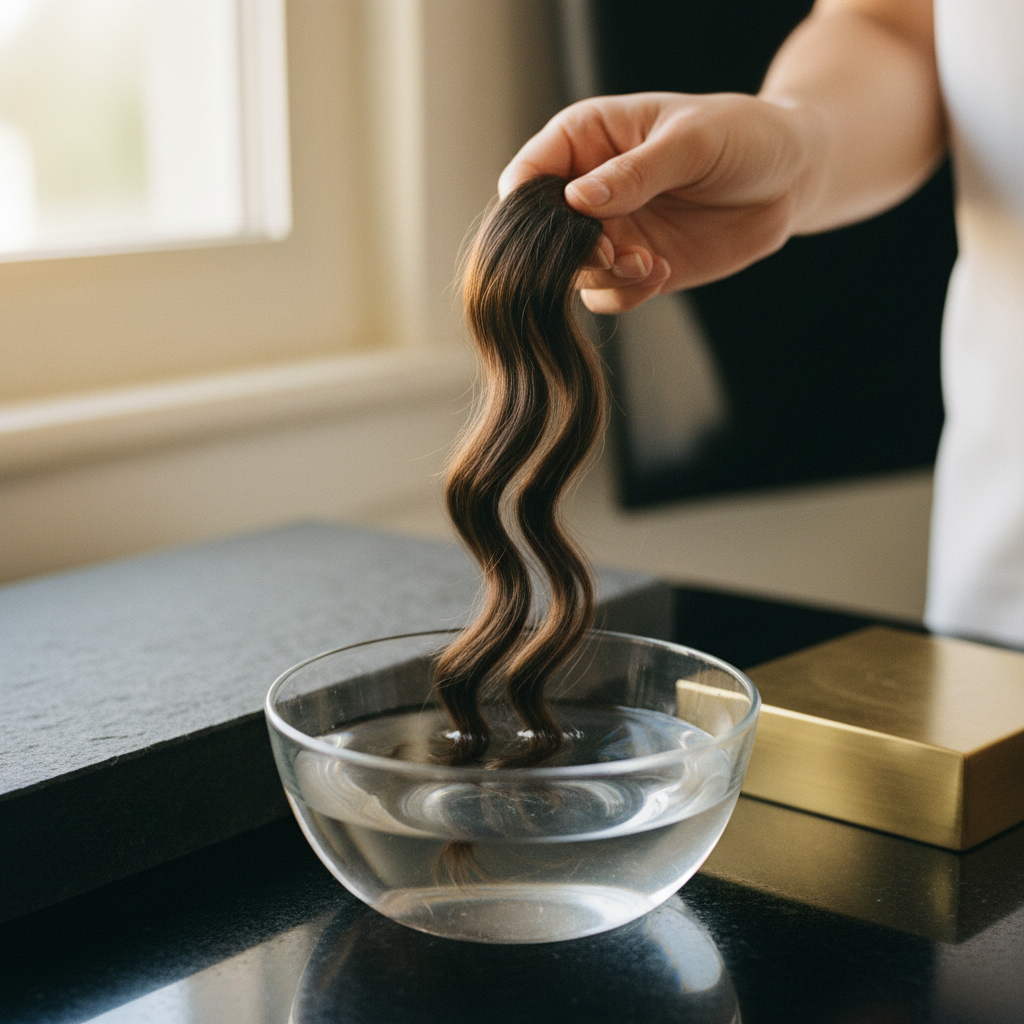
Accurate assessment prevents misdiagnosing dry hair as high porosity when it may simply be suffering from product buildup. Professional trichologists avoid the home "glass of water test" because surface tension, water temperature, and residual styling oils routinely cause false readings. Instead, look for these functional indicators:
Signs of low porosity
- Water beads up on dry strands for several seconds before soaking in during washing.
- Clarifying shampoos produce noticeable volume, while rich conditioners leave a greasy, coated film.
- Hair takes a remarkably long time to dry naturally, sometimes remaining damp inside dense sections for over six hours.
- Chemical treatments (colour, perms) take longer to process or yield uneven results.
Signs of high porosity
- Hair becomes drenched immediately upon contact with water.
- Strands feel rough, velcro-like, or snag against each other when slid between your thumb and forefinger from tip to root.
- Products disappear into the fibre quickly, yet hair feels brittle, straw-like, and dry again within hours.
- Prone to extreme frizz in high humidity as moisture from the atmosphere rapidly enters the porous cortex.
What the evidence does not show
There is no scientific evidence that cosmetic products can permanently "fix" high porosity hair or rebuild natural 18-MEA once it is oxidised away. Marketing terms claiming to "weld cuticles shut forever" or "turn high porosity hair into low porosity hair" do not reflect biological reality.
Additionally, porosity is not an indicator of follicular health. High porosity does not cause alopecia, follicle miniaturisation, or telogen effluvium. It is purely a structural condition of the dead hair fibre shaft. A person can have robust hair growth from healthy follicles while exhibiting highly porous lengths due to bleaching or heat styling.
Actionable strategies for each porosity type
Successful haircare relies on selecting ingredients with the right molecular size, charge, and formulation pH.
Practical care for low porosity hair
- Use gentle warmth: Apply deep conditioning treatments under a warm towel or heat cap. Mild heat temporarily expands the cuticle architecture, allowing conditioning agents to penetrate the cortex.
- Select smaller molecular weights: Avoid heavy, occlusive plant butters (like pure shea or cocoa butter) that sit on the surface. Opt for lighter plant oils (such as jojoba or argan oil) and hydrolysed proteins that penetrate small intercellular pathways.
- Clarify periodically: Use an anionic clarifying shampoo every 2 to 3 weeks to strip away stubborn product residue that accumulates on tightly closed cuticles.
- Work at neutral to mild pH: Slightly acidic to neutral products prevent excessive cuticle tightening during washing, making hydration easier.
Practical care for high porosity hair
- Incorporate hydrolysed proteins: Formulations containing hydrolysed keratin, wheat, or silk proteins temporarily bind via electrostatic attraction to negatively charged, damaged sites along the fibre, reinforcing structural integrity.
- Layer with film-forming sealants: Apply the leave-in conditioner, oil, and cream (LOC) technique. Water-based hydrators provide internal flexibility, while rich lipids seal cuticles and slow down water evaporation.
- Minimise hygral fatigue: Pre-shampoo treatments using penetrating oils (such as coconut oil) saturate the cortex before washing. Research published in the Journal of Cosmetic Science confirms that coconut oil reduces protein loss and curbs excessive fibre swelling during wet cycles.
- Rinse with low-pH formulations: Acidic conditioning rinses (pH 3.5 to 4.5) help contract the cuticle layers, reducing friction and tangling.
When the issue is not porosity
Before altering your routine, rule out environmental and physiological factors that mimic porosity issues:
- Hard water buildup: Mineral deposits (calcium, magnesium, copper) coat the cuticle, mimicking the rough, straw-like feel of high porosity hair while blocking moisture like low porosity hair. Chelating washes resolve this.
- Seborrheic dermatitis or scalp imbalance: Flaking and irritation can alter how sebum travels down the shaft, creating irregular moisture distribution.
- Telogen effluvium or follicular thinning: If you notice diffuse shedding across the scalp (hairs coming out by the white bulb), this is a follicle-cycling event, not a porosity or shaft-breakage issue.
If hair exhibits severe snapping, extensive split ends extending several inches up the shaft, or sudden patchy hair loss, consult a registered trichologist or dermatologist for clinical assessment.
Supporting hair fibre strength with Watermans
When managing hair that has become porous, fragile, or prone to mechanical breakage, targeted daily care helps maintain surface resilience. Watermans products are formulated to support fibre vitality and scalp balance without weighing strands down.
Watermans GrowMe Shampoo delivers a balanced cleanse that clears away product accumulation without stripping the delicate lipid layer of the cuticle. Its blend of hydrolysed lupin protein, biotin, niacinamide, and rosemary extract supports hair strength, making it an excellent addition for both porous strands needing structural reinforcement and low-porosity hair prone to residue.
Paired with Watermans ConditionMe Conditioner, which contains hydrolysed keratin, cholesterol, and natural seed oils, it provides restorative conditioning. Hydrolysed proteins temporarily settle into cuticle micro-fissures, smoothing rough high-porosity surfaces while offering lightweight, balanced moisture that will not leave low-porosity fibres limp or greasy.
Frequently asked questions about Managing Hair Porosity
Can Managing Hair Porosity stop hair shedding?
Managing Hair Porosity addresses the hair shaft, reducing fibre snapping and mechanical breakage. It does not stop follicular hair shedding (telogen effluvium) or genetic hair thinning, as porosity relates strictly to the condition of the external dead hair shaft rather than follicle cycling within the dermis.
Does colouring your hair always increase porosity?
Yes, chemical processes like permanent colouring and bleaching inevitably increase porosity. These treatments rely on alkaline agents to force open the cuticle scales and oxidative chemicals to break down natural melanin, which strips the hair's protective 18-MEA lipids and creates permanent microscopic gaps in the cuticle.
Why is the water float test inaccurate for determining porosity?
The float test places shed strands in water to see if they sink. It is scientifically unreliable because natural surface tension prevents hair from sinking regardless of porosity. Furthermore, residual styling products or natural sebum can repel water, causing high porosity hair to float falsely.
How often should high porosity hair receive protein treatments?
High porosity hair typically benefits from hydrolysed protein treatments every 2 to 4 weeks, depending on the severity of chemical damage. Overusing concentrated proteins without adequate humectants can make fibres stiff and brittle, so always balance protein with moisturising conditioning agents.
Strategic hair care for long-term fibre health
Managing Hair Porosity is a foundational aspect of scientific haircare that shifts your routine from guesswork to precision. By identifying your hair fibre's cuticle condition, you can select the correct balance of hydrolysed proteins, humectants, and sealing emollients. While cosmetic products cannot permanently rebuild lost cuticles, adopting consistent techniques protects the internal cortex, minimises breakage, and keeps your hair looking smooth, resilient, and manageable.
Sources and references
- Robbins, C. R. (2012). Chemical and Physical Behavior of Human Hair (5th ed.). Springer-Verlag.
- Ruetsch, S. B., et al. (2001). "Investigation of penetration of coconut oil into human hair fibres." Journal of Cosmetic Science, 52(3), 169-184.
- Gavazzoni Dias, M. F. (2015). "Hair cosmetics: an overview." International Journal of Trichology, 7(1), 2-15.
- Evans, T., & Wickett, R. R. (2012). Practical Modern Hair Science. Allured Business Media.
- Cruz, C. F., et al. (2016). "Human hair characteristics and methods to evaluate hair physical and chemical properties." International Journal of Cosmetic Science, 38(5), 446-459.
Find these ingredients in Watermans products
- Copper: you will find this ingredient in our Hair Vitamins.
- Niacinamide: you will find this ingredient in our Hair Mask.