Managing Bleached Hair Breakage: The Scientific Guide to Fibre Repair
8 min read ·
Learn evidence-based methods for managing bleached hair breakage. Discover the chemical causes of fibre damage, how to restore elasticity, and how to stop snapping.
Quick answer: Successfully managing bleached hair breakage requires halting destructive chemical lifting and rebuilding the mechanical resilience of chemically oxidised hair fibres. Bleaching strips the protective lipid layer (18-MEA) and degrades structural cystine bonds, causing hair to snap under everyday tension. While cosmetic treatments cannot biologically regenerate dead keratin cells, a strict regimen of targeted protein treatments, film-forming conditioning agents, acidic pH balancers, and reduced mechanical friction will drastically minimise snapping and preserve remaining length until healthy hair grows down.
Key takeaways
- Bleaching oxidises natural melanin while simultaneously cleaving disulfide bonds within the cortex, drastically reducing the hair fibre's tensile strength.
- Chemical lightening permanently strips 18-methyleicosanoic acid (18-MEA), the cuticle's native lipid barrier, causing chronic porosity and moisture loss.
- Breakage along the shaft is completely distinct from follicular hair shedding (telogen effluvium) or alopecia; treatments must target mechanical fibre integrity.
- Effective intervention relies on acidic formulations (pH 3.5 to 5.5), hydrolysed proteins, biomimetic lipids, and zero wet combing.
- Severely compromised hair requires structural maintenance and regular micro-trims; chemical oxidisation cannot be reversed, only mechanically supported.
Managing Bleached Hair Breakage: what the evidence shows
When dealing with bleached strands, managing bleached hair breakage requires an understanding of structural polymer degradation. Research published in the Journal of Cosmetic Science confirms that alkaline bleaching formulations (typically pH 9.0 to 11.0, utilising hydrogen peroxide and persulfate salts) do not merely dissolve melanin granules. They oxidise the amino acid cystine into cysteic acid. Cystine forms the critical disulfide cross-links that give human hair its elastic recovery. When these bonds break, hair loses up to 50% of its wet tensile strength, causing it to snap under minimal tension.

Cosmetic science demonstrates that while severed disulfide bonds cannot biologically self-repair, topical interventions alter the fibre's physical properties. Hydrolysed proteins (molecular weight between 150 and 1,500 Daltons) penetrate the porous cortex to reinforce structural integrity temporarily. Simultaneously, high molecular weight polymers and cationic surfactants coat the cuticle scales, reducing wet and dry combing forces by up to 80%. This reduction in friction is the single most effective barrier against everyday mechanical snapping.
What the evidence does not show
Controlled cosmetic studies consistently disprove several widespread salon and consumer assumptions:
- Topical products cannot permanently fuse split or snapped fibres: No cosmetic mask, oil, or salon treatment restores severed hair to virgin status. Bond-building agents reform select chemical bridges, but they do not eliminate existing micro-fractures in the hair shaft.
- Moisture alone does not stop breakage: Applying heavy plant oils to bleached, snapping hair often worsens the issue. Oils provide lubrication and seal the cuticle, but they do not replace missing tensile strength. Bleached fibres primarily lack protein structure, not just surface slip.
- Shampoos cannot repair chemical oxidation: While gentle, low-pH shampoos prevent additional cuticle swelling, cleansing products rinse down the drain and cannot deposit sufficient structural polymers to halt active breakage on their own.
The biological mechanism: why bleached hair snaps
To master managing bleached hair breakage, one must examine the fibre's three layers: the cuticle, the cortex, and the cell membrane complex (CMC).
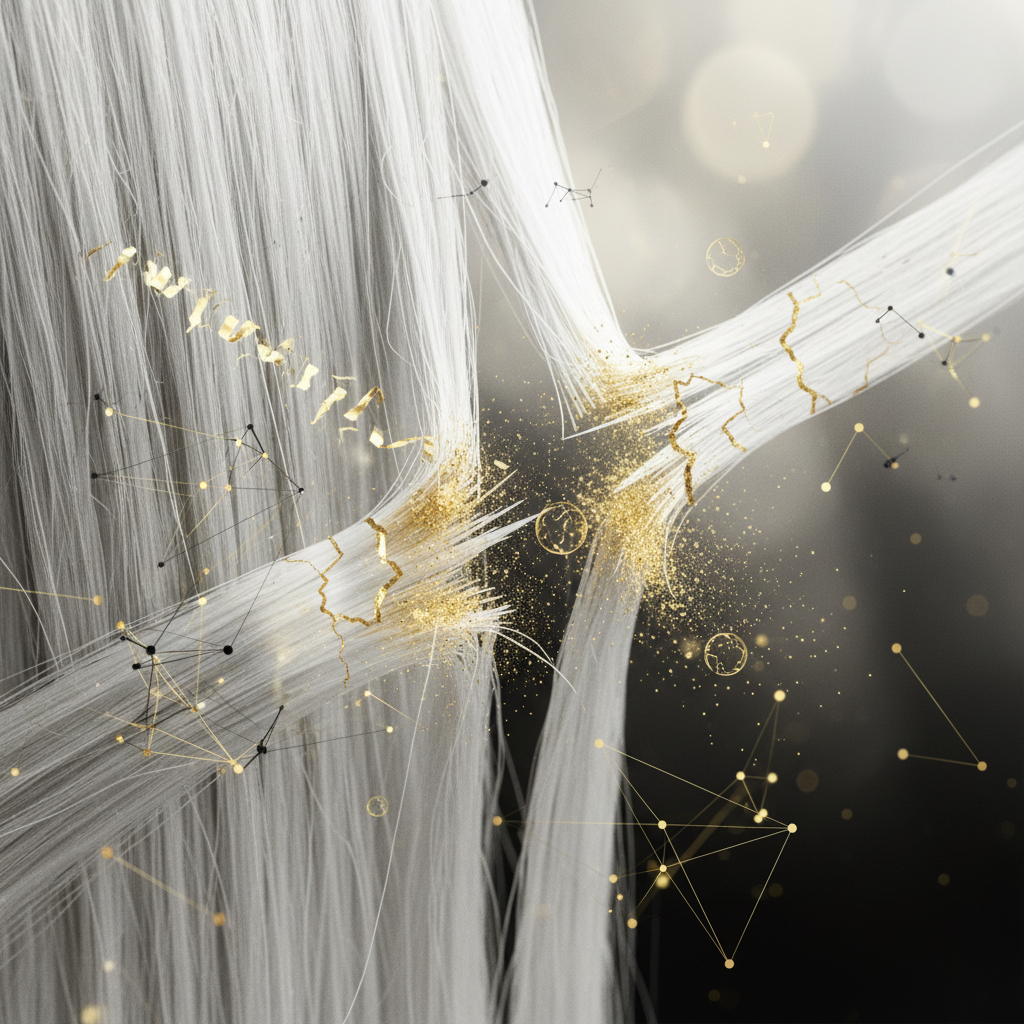
Healthy Fibre: [18-MEA Lipid Layer] -> [Intact Flat Cuticle] -> [Dense Disulfide Cortex]
Bleached Fibre: [Stripped Lipids] -> [Lifted/Broken Cuticle] -> [Oxidised Cysteic Acid Core]
Human hair is naturally hydrophobic, repelling water thanks to a monolayer of fatty acids (predominantly 18-MEA) covalently bound to the outer epicuticle. The alkaline pH of bleach strips this protective lipid layer in a single session. Once depleted:
- Cuticle flaking and uplift: The cuticle scales lift, exposing the delicate cortex beneath. When dry, these lifted scales catch against neighbouring strands, causing friction, tangling, and fractures.
- Cortex oxidation: Persulfates penetrate the cortex to oxidise melanin pigments. In doing so, they convert strong disulfide bonds (-S-S-) into weak cysteic acid groups (-SO3H).
- Severe hygroscopic swelling: Without 18-MEA, the hair becomes profoundly hydrophilic. When wet, it absorbs up to 45% of its weight in water (compared to roughly 30% for healthy hair). This swelling weakens the internal hydrogen bonds, leaving the strand vulnerable to snapping like wet paper when brushed.
Identifying the signs: breakage versus shedding
It is critical to distinguish between follicular hair shedding and structural breakage. Conflating the two leads to incorrect treatments and wasted time.
| Characteristic | Structural Breakage (Bleach Damage) | Telogen Shedding / Alopecia |
|---|---|---|
| Primary Location | Mid-shaft, ends, or crown surface | Detaches cleanly from the scalp |
| Visible Root Bulb | Absent (ends appear frayed, jagged, or blunt) | Present (small, white keratin bulb visible) |
| Hair Fibre Length | Irregular, short fragments (1 to 10 cm) | Full-length strands matching growth cycle |
| Fibre Texture | Gummy or stretchy when wet; brittle when dry | Normal elasticity and smooth cuticle feel |
| Primary Driver | Chemical oxidation and mechanical strain | Hormonal shifts, stress, nutritional deficit |
| Corrective Action | Low-pH treatments, protein, reduced friction | Scalp support, medical review, blood work |
What you can do: an evidence-based repair protocol
Halting chemical breakage requires a strict, calculated adjustment to your hair routine. Each step must reduce mechanical stress and reinforce fibre integrity.
1. Acidify your routine (pH 3.5 to 5.0)
Alkaline lifting leaves the cuticle swollen. Use products formulated within an acidic pH range of 3.5 to 5.0. Acidic environments contract the cuticle scales, flattening them against the shaft. This dramatically reduces friction, locks in conditioning agents, and limits excess water entry during washing.
2. Alternate hydrolysed protein with emollient conditioners
Bleached hair needs both structural reinforcement and surface slip:
- Proteins: Look for hydrolysed keratin, wheat, or silk proteins. Small molecules enter the cortex to improve structural integrity; larger ones form a protective sacrificial film on the surface. Apply once every 7 to 14 days.
- Emollients: Quaternary ammonium compounds (such as behentrimonium chloride) and fatty alcohols neutralise the negative electrostatic charge of bleached fibres, allowing combs to glide without snagging.
3. Eliminate wet mechanical tension
Hair is at its weakest when wet. Discontinue all brushing directly out of the shower. Instead, press excess water out using a smooth microfibre towel (never rub with coarse cotton terrycloth). Apply a leave-in detangling spray rich in slip-inducing polymers, and gently work through knots from ends to roots using only your fingers or a wide-toothed, seamless comb once the hair is partially dry.
4. Cease direct high heat
Keratin denatures rapidly at high temperatures. In oxidised hair, thermal tools accelerate protein degradation. Discontinue flat irons and curling wands entirely while managing severe breakage. If blow-drying, use the cool or medium setting and keep the nozzle at least 15 cm away from the surface of the hair.
5. Incorporate micro-trims
Micro-fractures travel upward along the shaft. Removing 5 to 10 mm of frayed ends every 6 to 8 weeks stops transverse splits from splitting the entire hair shaft upwards toward the scalp.
Supporting the hair foundation: Watermans cosmetic care
While damaged fibres require immediate topical lubrication and acid-balanced care, long-term recovery depends on the health of new growth emerging from the follicles.
Watermans Grow Me Shampoo and Condition Me Conditioner provide a complementary approach for those rehabbing bleach-weakened hair. The formulas are engineered to cleanse the scalp without harsh drying effects, creating an optimal environment for future growth. Condition Me features hydrolysed lupin protein alongside cholesterol, niacinamide, and caffeine, delivering biomimetic moisture and surface slip that helps smooth damaged cuticle layers, minimise mechanical snagging, and reduce daily comb-induced breakage.
When to get professional advice
If hair continues to snap excessively despite several weeks of low-friction, protein-balanced care, consult a qualified trichologist or an experienced colour correction specialist.
A professional can perform an elasticity and porosity test under magnification to determine whether the internal cross-linking is exhausted beyond cosmetic salvation. In cases of severe "chemical haircuts" (where hair snaps at the root line due to overlapping bleach), a specialist can establish a gradual transition plan, blending the damage with safe styling techniques while protecting the scalp from chemical irritation or contact dermatitis.
Frequently asked questions about Managing Bleached Hair Breakage
How long does managing bleached hair breakage take before snapping stops?
With immediate cessation of heat styling and the introduction of acidic, protein-enriched conditioning, noticeable snapping decreases within two to three weeks. However, because bleached hair is permanently altered, managing bleached hair breakage requires continuous, gentle care until the damaged fibre is completely replaced by new growth over 12 to 24 months.
Can coconut oil stop bleached hair from breaking?
Coconut oil can penetrate the hair fibre and reduce protein loss during washing, but it does not restore broken disulfide bonds. Overusing pure oils on high-porosity bleached hair without balanced moisturising agents can make strands feel stiff and brittle, potentially worsening breakage when combed.
Does Olaplex or bond repair cure bleach breakage?
Bond builders re-link some broken disulfide bonds via chemical cross-linking, providing genuine mechanical reinforcement. However, they do not "cure" breakage. They cannot rebuild lost cuticle scales or restore stripped 18-MEA lipids. They must be used alongside acidic conditioning agents and gentle handling.
Why is my bleached hair breaking off near the scalp?
Snapping close to the scalp usually results from overlapping bleach onto previously lightened hair during a root touch-up, or leaving high-volume developer on delicate baby hairs for too long. If you see white bulbs on the ends of the fallen strands, it is follicular shedding, not breakage.
Effective recovery for damaged hair
Successfully managing bleached hair breakage is a discipline of damage mitigation, mechanical preservation, and scientific product selection. Chemical lightening alters the fundamental architecture of human hair, stripping lipids, breaking disulfide bonds, and leaving the cortex exposed to the elements. By adopting an acidic haircare routine, treating hair with hydrolysed proteins, eliminating aggressive wet brushing, and protecting new growth as it emerges, you can stop the cycle of snapping and maintain strong, beautiful hair.
Sources and references
- Journal of Cosmetic Science: "Chemical and physical changes in hair caused by bleaching" (2008)
- International Journal of Cosmetic Science: "Effect of bleach and dye treatments on the mechanical properties of human hair" (2014)
- Dermatology Research and Practice: "Hair Cosmetics: An Overview" (2015)
- Robbins, C. R.: Chemical and Physical Behavior of Human Hair, 5th Edition, Springer (2012)
- Cosmetics: "Protective Effects of Hydrolyzed Proteins on Chemically Damaged Hair" (2018)