Lipid Layer and 18-MEA: The Science of Hair's Natural Barrier
10 min read ·
Discover how the lipid layer and 18-MEA protect hair from friction, porosity, and damage, plus how to mimic this natural shield once it is lost.
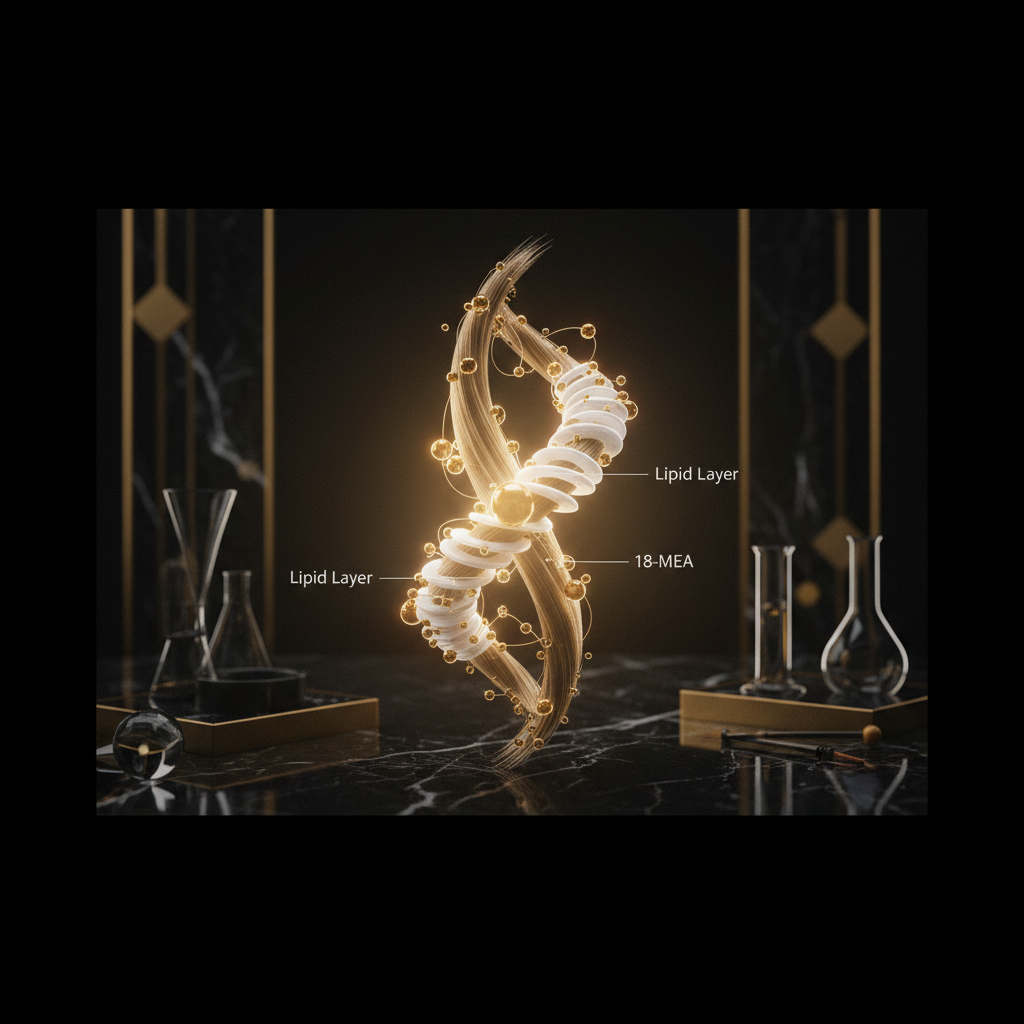
Quick answer: The hair's natural lipid layer and 18-MEA (18-methyleicosanoic acid) form an ultra-thin, covalently bound fatty barrier on the surface of the cuticle. This protective shield makes the hair fibre hydrophobic, repelling moisture to prevent swelling, friction, and environmental damage. The main limitation is that 18-MEA cannot naturally regenerate once lost. Chemical treatments like bleaching, permanent colouring, and alkaline relaxers chemically strip this lipid layer permanently, requiring topical conditioning agents to mimic its protective properties.
Understanding the interaction between the lipid layer and 18-MEA is essential for anyone dealing with dryness, chronic tangling, or chemical damage. Hair fibres rely on this microscopic lipid sheath to maintain smoothness, retain internal moisture balance, and resist everyday mechanical wear.
Key takeaways
- The primary lipid on the hair cuticle is 18-methyleicosanoic acid (18-MEA), which accounts for roughly 40 to 50 percent of all surface-bound lipids.
- 18-MEA is covalently bonded via thioester linkages to cysteine residues on the external face of the epicuticle (the f-layer).
- A healthy lipid coating keeps virgin hair hydrophobic (water-repelling), maintaining a water contact angle above 95 to 100 degrees.
- Single alkaline chemical services, such as bleaching or permanent dyeing, can strip away up to 80 percent or more of native 18-MEA.
- Once lost, the follicle cannot replace 18-MEA on existing hair lengths; you must use biomimetic lipids and quaternary conditioners to restore surface slip and protect the inner cortex.
Lipid Layer and 18-MEA: what the evidence shows
Research published in cosmetic dermatology and textile chemistry confirms that human hair possesses an external lipid envelope known as the f-layer. The lipid layer and 18-MEA together constitute the hair shaft's first line of physical and chemical defence.
The fatty acid 18-MEA is a branched, 21-carbon saturated fatty acid. Unlike free surface oils secreted by the sebaceous glands (sebum), 18-MEA is an integral component of the hair fibre's architecture. It is chemically anchored directly to the underlying structural proteins.
Because of its methyl branch at the 18th carbon position, 18-MEA cannot pack tightly into a rigid crystalline lattice. Instead, it forms a mobile, fluid, hydrophobic monolayer pointing outward into the environment. This specific biochemical structure gives virgin hair its signature lubricity, silky feel, and resistance to static electricity.
Measurements using contact angle goniometry show that undamaged virgin hair is intensely hydrophobic, registering water contact angles between 95 and 105 degrees. When a water droplet lands on a healthy fibre, it beads up rather than soaking in immediately. This natural barrier prevents rapid moisture diffusion into the cortex, protecting the delicate hydrogen bonds that give hair its elasticity and shape.
The biological mechanism of the f-layer
The hair shaft consists of three primary regions: the medulla (central core), cortex (bulk structural keratin), and cuticle (overlapping scale-like cells). The cuticle itself contains several distinct sub-layers:
- The epicuticle: A semi-permeable membrane roughly 5 to 7 nanometres thick, rich in cystine (around 12 percent).
- The f-layer: The outermost mono-molecular boundary of the epicuticle, consisting primarily of 18-MEA molecules.
- The exocuticle: A rigid, heavily cross-linked protein layer containing roughly 30 percent cystine.
- The endocuticle: A softer, mechanically weaker layer with low cystine content (roughly 3 percent).
The 18-MEA molecules are attached to cysteine amino acids in the epicuticle via covalent thioester bonds. This chemical attachment means 18-MEA cannot simply be washed off with normal water or gentle surfactant cleansing. It acts as a permanent, non-washable biological wax.
Underneath this covalently bound layer sits a pool of non-covalently bound (free) lipids, including ceramides, cholesterol, and free fatty acids like palmitic and stearic acid. These internal lipids form the cell membrane complex (CMC), which acts as the biological mortar holding cuticle cells and cortical cells together.
Hair Surface Structure:
[ Outer World ]
 |
[ 18-MEA Hydrophobic Tails ] <- Repels water, provides low friction
 |
[ Thioester Bonds (-S-CO-) ] <- Cleaved by alkaline oxidation (bleach/dye)
 |
[ Epicuticle Protein Matrix ] <- Cross-linked cystine structural foundation
What causes the depletion of 18-MEA?
Because 18-MEA is bound by thioester bonds, it is extraordinarily sensitive to alkaline oxidation. The chemical bond linking the lipid tail to the protein base is unstable at elevated pH levels in the presence of oxidising agents.
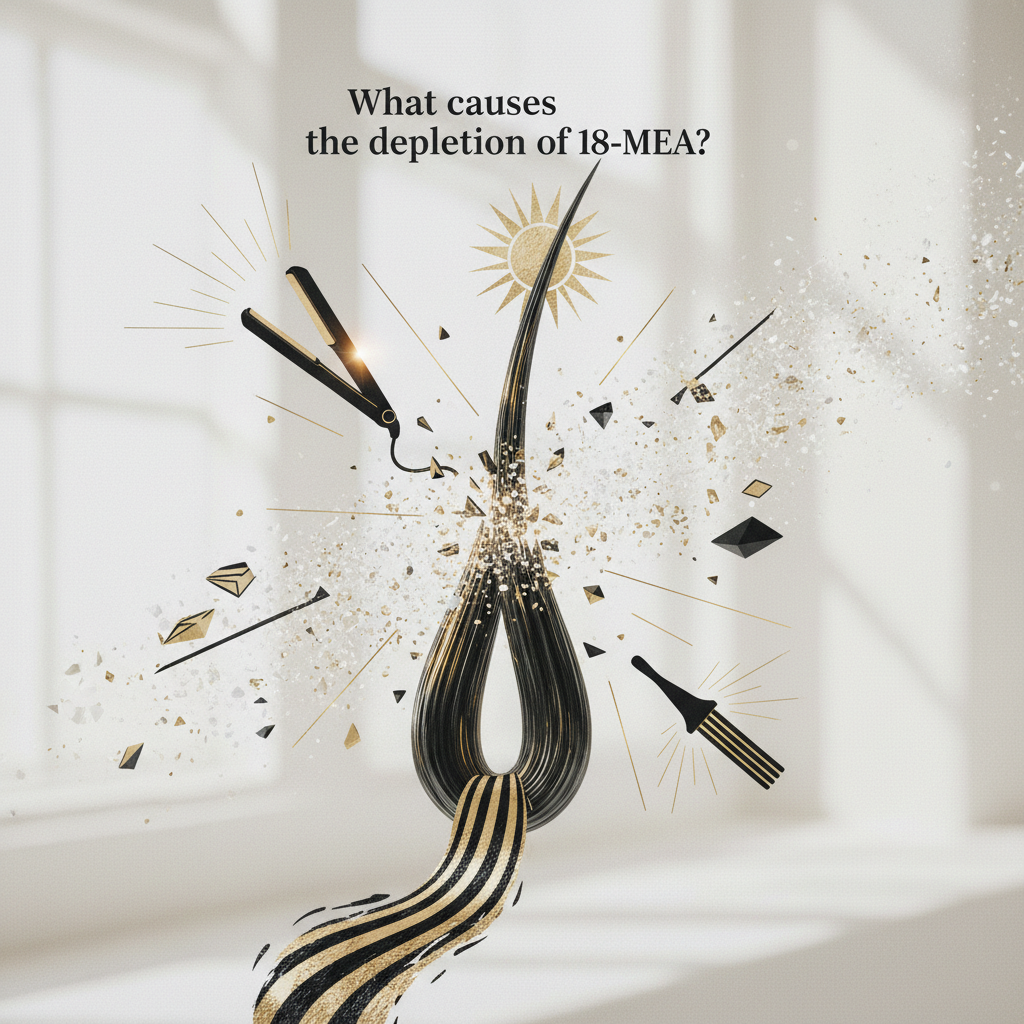
- Bleaching and alkaline hair colour: Hydrogen peroxide combined with ammonium hydroxide or ethanolamine (pH 9.0 to 10.5) hydrolyses the thioester bonds. Studies indicate that a single full bleaching process removes roughly 70 to 90 percent of bound 18-MEA.
- Chemical relaxers and perms: High-pH lye or non-lye relaxers (pH 12.0 to 13.5) rapidly dissolve the f-layer, stripping surface lipids within minutes.
- Ultraviolet radiation (UVA and UVB): Sun exposure generates free radicals that trigger photo-oxidation, progressively breaking down the lipid layer over months of outdoor exposure.
- Thermal styling tools: Flat irons and curling wands running above 180 degrees Celsius degrade surface lipids and can melt protective cuticle margins.
When 18-MEA is stripped away, the underlying cysteine proteins are oxidised into cysteic acid groups. These newly exposed groups carry a strong negative electrical charge (anionic).
The hair transforms from hydrophobic (water-repelling) to hydrophilic (water-loving). Instead of beading water, the fibre absorbs liquid rapidly, causing the shaft to swell unevenly, lift its cuticle scales, and tangle easily.
| Metric / Property | Intact Lipid Layer (Virgin Hair) | Depleted Lipid Layer (Chemically Treated) |
|---|---|---|
| Primary surface character | Hydrophobic (water-repelling) | Hydrophilic (water-loving) |
| Water contact angle | 95 to 105 degrees | 30 to 60 degrees |
| Net surface charge | Low negative charge | High negative charge (cysteic acid) |
| Inter-fibre friction | Low (glides smoothly) | High (drags, snags, tangles) |
| Water absorption rate | Slow and controlled | Rapid and porous (hygral stress) |
| Dry combing force | Low | Up to 300 to 500 percent higher |
Signs of a depleted lipid barrier
How can you tell if the lipid layer is damaged? Look for these distinct mechanical and physical signs:
- Instant wetting: When you submerge hair or spray it with mist, damaged hair absorbs water immediately without any beading.
- Prolonged drying times: Because the damaged cuticle absorbs excess water deep into the cortex, the hair takes substantially longer to blow-dry.
- Extreme wet friction: Wet strands feel gummy, spongy, or "matte" under water, clinging together rather than slipping apart smoothly.
- Flyaways and static: With the natural lubricating methyl branch gone, dry hair builds up electrostatic charges rapidly during brushing.
- Snapping during detangling: The increase in friction forces you to apply greater mechanical pull when combing, leading to mid-shaft breakage.
What the evidence does not show
It is critical to separate established biological facts from marketing claims regarding the lipid layer and 18-MEA.
The evidence does not show that any cosmetic product can "permanently repair" or "regraft" 18-MEA back onto the hair shaft in its original biological state. Once the covalent thioester bond is cleaved by bleach or chemical relaxers, hair fibres cannot regrow or enzymatically reattach natural lipids. Hair is non-living tissue (keratinised protein); it possesses no cellular machinery, metabolic process, or blood supply to regenerate damaged surface structures.
Furthermore, applying pure 18-MEA or plant oils will not permanently restore the original lipid envelope. While fatty acids and oils coat the hair temporarily, they do not establish covalent thioester bonds. They wash away over time, requiring repeated application to sustain their cosmetic benefits.
What you can do to protect and mimic the lipid layer
Because natural 18-MEA cannot regenerate on existing hair lengths, hair care strategies must focus on two goals: preventing damage to intact lipids, and depositing biomimetic replacements onto damaged zones.
1. Minimise alkaline chemical processes
If you want to preserve your natural 18-MEA, limit high-lift bleaching, frequent permanent colour re-applications on previously processed lengths, and high-pH relaxers. Stylists should practice precise root-only touch-ups rather than pulling oxidative formulas through mid-lengths and ends.
2. Utilize biomimetic conditioning agents
Cosmetic chemists design conditioning technologies specifically to target areas where 18-MEA has been lost:
- Quaternised 18-MEA (e.g., C10-40 Isoalkylamidopropylethyldimonium Ethosulfate): This synthetic ingredient pairs an analogue of the 18-MEA branched lipid tail with a positive (cationic) electrical charge. Because damaged, bleached cuticle sites are heavily negative, the cationic head electrostatically anchors itself to the damaged site, mimicking the lost biological lipid.
- Behentrimonium Chloride and Methosulfate: These long-chain cationic surfactants bind readily to negatively charged damaged cuticles, restoring slip, reducing combing force, and returning partial hydrophobicity.
- Amodimethicone: An amino-functional silicone that selectively binds to damaged, hydrophilic patches of hair without building up on healthier, hydrophobic areas.
3. Replenish internal lipids
Combine external conditioning with internal lipid support. Ceramides, cholesterol, and natural fatty acids can penetrate beneath the cuticle into the cell membrane complex, improving fibre cohesion and flexibility.
When the cause may be something else
If your hair feels dry, brittle, or difficult to manage, a damaged lipid layer is common, but it is not the only potential culprit:
- Hard water mineral buildup: High concentrations of calcium and magnesium ions bond with surface proteins, creating a stiff, rough coating that mimics cuticle damage. A chelating wash resolves this issue.
- Protein structural loss: If hair has lost internal tensile strength and stretches without springing back, the problem is deep cortical keratin damage, not simply surface lipid loss.
- Seborrheic dermatitis or scalp imbalance: An overproduction of sebum altered by scalp yeast can leave the roots oily while leaving lengths feeling parched and unmanageable.
Always distinguish between hair breakage (snapping along the shaft due to high friction and structural weakness) and hair shedding (fibres falling naturally from the follicle root with the white bulb intact). Damage to 18-MEA increases hair breakage; it does not cause hair shedding or follicle-based hair loss conditions like telogen effluvium or androgenetic alopecia.
Caring for your hair with Watermans
When managing hair that has lost its protective outer sheath, reducing daily friction is vital. While no shampoo or conditioner can regrow non-living hair tissue, Watermans formulations are designed to support a clean, healthy scalp environment and deliver substantive cosmetic conditioning to fragile lengths.
Incorporating gentle, sulfate-free cleansing and deeply nourishing conditioning reduces the physical dragging that breaks chemically altered, hydrophilic hair. This gentle approach helps maintain fibre integrity and provides a softer, fuller-looking finish.
Frequently asked questions about Lipid Layer and 18-MEA
What is the primary role of the lipid layer and 18-MEA?
The primary role of the lipid layer and 18-MEA is to make the hair surface hydrophobic. This ultra-thin fatty acid coating repels external water, reduces inter-fibre friction during combing, preserves internal moisture balance, and shields underlying cuticle proteins from mechanical wear and environmental stress.
Can your scalp produce new 18-MEA to fix damaged ends?
No. While sebaceous glands produce sebum that lubricates the hair near the scalp, they do not produce covalently bound 18-MEA. The lipid layer and 18-MEA are synthesized inside the hair follicle during fibre formation. Existing hair lengths cannot self-repair or regenerate this barrier once it has been stripped by chemical processing.
Does bleaching completely remove 18-MEA?
A single bleaching service can remove 70 to 90 percent of the hair's natural 18-MEA. The high pH and strong oxidising environment break the delicate thioester bonds that secure the fatty acids to the cuticle surface, leaving the hair permanently hydrophilic.
How do biomimetic hair products mimic 18-MEA?
Biomimetic hair treatments use positively charged (cationic) molecules paired with branched lipid chains. Because damaged hair surfaces carry a strong negative charge, these cationic lipids electrostatically adhere to the fibre, restoring surface lubricity and mimicking the hydrophobic protection of natural 18-MEA.
How does loss of 18-MEA cause hair breakage?
When 18-MEA is lost, surface friction increases substantially. When you brush or style hydrophilic hair, the cuticle scales snag against one another rather than gliding smoothly. This mechanical friction creates tension along the shaft, causing weakened fibres to snap, which results in hair breakage.
Preserving the hair's protective barrier
Preserving the lipid layer and 18-MEA is the single most effective way to keep hair silky, resilient, and easy to detangle. Because these native fatty acids cannot regrow once chemically removed, prevention remains the gold standard in hair care. By limiting aggressive chemical services, using heat protectants, and replenishing stripped fibres with cationic, biomimetic conditioning agents, you can preserve cuticle hydrophobicity and protect your hair from preventable structural breakage.
Sources and references
- Journal of Cosmetic Science: "The chemical structure of the cuticle surface in human hair." (1998)
- International Journal of Cosmetic Science: "18-Methyleicosanoic acid (18-MEA) and its role in hair surface properties." (2004)
- Robbins, C. R., Chemical and Physical Behavior of Human Hair, 5th Edition, Springer (2012).
- Society of Cosmetic Chemists: "Structure, composition, and surface characterization of human hair lipids." (2010)
- Journal of Structural Biology: "High-resolution imaging and elemental analysis of human hair cuticles." (2007)