Keratin Treatment Science: The Chemistry of Hair Smoothing
8 min read ·
Explore the chemistry behind Keratin Treatment Science. Learn how cross-linkers, organic acids, and heat transform hair texture, and how to prevent fibre breakage.
Quick answer: The core principle behind Keratin Treatment Science is the cosmetic restructuring of hair fibres using cross-linking agents, heat, and hydrolysed proteins rather than pure keratin infusion. While marketed as protein replenishment, these salon formulas rely on aldehyde chemistry or organic acids alongside high heat (around 200 to 232 degrees Celsius) to mechanically lock strands into an aligned, semi-permanent matrix. The primary limitation is that these treatments alter external cuticle architecture rather than genuinely restoring broken internal polypeptide chains, carrying notable risks of chemical exposure and thermal fibre degradation.
Key takeaways
- Keratin treatments do not permanently rebuild biological hair bonds; they form a cross-linked polymer coating on the outer cuticle and cortex.
- Traditional formulations rely on methylene glycol, which releases formaldehyde gas when flat-ironed above 200 degrees Celsius.
- Newer "formaldehyde-free" variants replace aldehydes with glyoxylic acid or carbocisteine, which semi-permanently reshape hair with less risk to the respiratory tract.
- True hair shedding happens at the follicle, whereas post-treatment hair loss complaints are almost always mechanical breakage along a brittle, heat-stressed shaft.
- Cosmetic results fade over 8 to 16 weeks as the surface polymer washes away, returning hair to its original porosity or leaving it slightly drier.
Keratin Treatment Science: what the evidence shows
Keratin Treatment Science demonstrates that salon smoothing services are primarily chemical polymerisation events rather than biological protein replacements. Human hair is composed of roughly 85 to 90 percent keratin, a tough fibrous protein rich in the amino acid cysteine. These cysteine residues form covalent disulphide bonds that dictate natural curl pattern, tensile strength, and elasticity.
Marketed "Brazilian" or "liquid keratin" treatments suggest that rubbing hydrolysed keratin onto the hair fills in damaged voids permanently. Independent cosmetic chemistry shows that hydrolysed proteins alone lack the molecular weight and reactivity to permanently integrate into cortex bonds. Instead, the solution relies on an active chemical cross-linker.
In traditional formulations, this cross-linker is methylene glycol, the aqueous form of formaldehyde. When heat is applied using ceramic or titanium flat irons at 200 to 232 degrees Celsius, dehydration occurs. The methylene glycol converts to gaseous formaldehyde, which reacts with the amine groups of hair keratin and the added cosmetic keratin. This process creates stable methylene bridges (cross-links) across adjacent protein chains. The hair shaft is artificially frozen into a straight, flattened alignment, preventing humidity from penetrating and causing frizz.
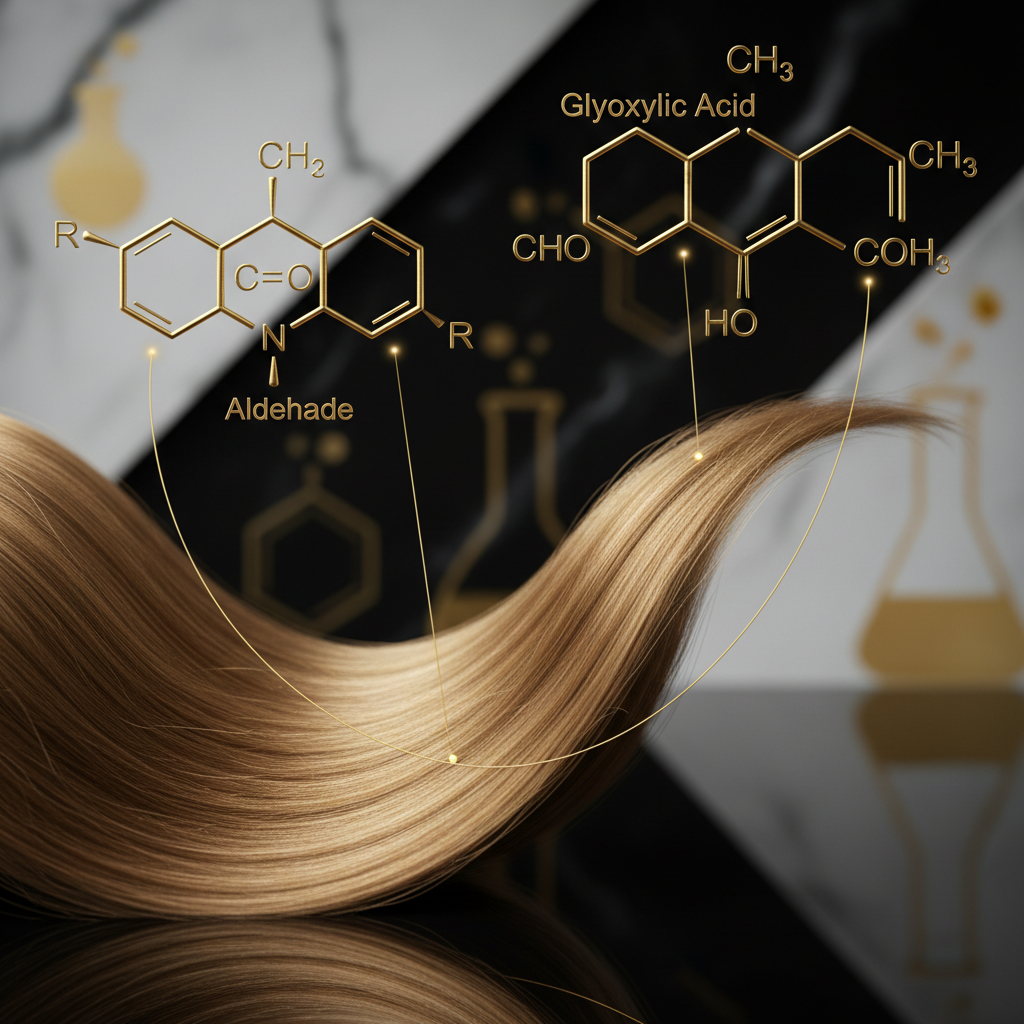
In modern glyoxylic acid formulations, the mechanism shifts. Glyoxylic acid interacts with keratin amino groups under heat to form hemiacetal-like complexes, altering internal hydrogen bonding and semi-permanently setting the hair in a smooth geometry without formal cross-linking by aldehydes.
What the evidence does not show
The science does not show that keratin treatments "heal" damaged hair or mend split ends. Once a hair fibre breaks, splits, or loses structural proteins through chemical bleaching, those biological structures cannot be biologically regenerated. Cosmetic treatments coat, seal, and temporarily bridge gaps, but they do not reverse follicular or cortical damage.
Furthermore, the evidence does not support claims that keratin treatments trigger follicular hair loss (alopecia). Hair loss involves the follicular growth cycle beneath the scalp. When clients notice thinning after a salon keratin process, it is almost exclusively mechanical hair breakage. Applying high heat (230 degrees Celsius) to fibres already weakened by bleach, alkaline relaxers, or repeated colouring oxidises the keratin matrix, denatures alpha-helices, and turns the hair brittle. The hair snaps along the shaft, which feels and looks like hair loss to the individual, even though the root remains intact.
Chemical mechanisms: aldehydes versus glyoxylic acid
To evaluate smoothing services accurately, one must understand how the chemical active alters fibre integrity.
| Mechanism Factor | Traditional Aldehyde Formula | Glyoxylic Acid Formula | Alkaline Relaxer (Sodium Hydroxide) |
|---|---|---|---|
| Active Ingredient | Methylene glycol (Formaldehyde) | Glyoxylic acid / Carbocisteine | Sodium or calcium hydroxide |
| Target Bond | Disulphide and amine cross-links | Amine groups and secondary bonds | Cysteine disulphide bonds (irreversible) |
| Working pH | 4.0 to 6.0 | 1.2 to 2.5 | 11.0 to 14.0 |
| Heat Requirement | 200 to 232°C (multiple passes) | 200 to 220°C (multiple passes) | No flat-iron heat during processing |
| Longevity | 12 to 20 weeks | 8 to 12 weeks | Permanent (until hair regrows) |
| Fibre Mechanism | External polymerisation and bridging | Heat-induced conformational alignment | Lanthionisation (permanently breaks bonds) |
Traditional formulas operate by forming an insoluble, cross-linked film across the cuticle layers. This matrix resists water absorption, preventing frizz in humid conditions. However, the Occupational Safety and Health Administration (OSHA) and European cosmetic regulators have repeatedly raised red flags. Heating methylene glycol releases formaldehyde fumes above legal workplace exposure limits (frequently exceeding 0.1 to 0.75 parts per million), creating respiratory and ocular risks for salon workers and clients.
Glyoxylic acid operates at a very low pH (1.5 to 2.0). It swells the outer cortex slightly without fully cleaving disulphide bonds. High-heat flat-ironing induces a conformational change in the hair's tertiary structure, temporarily relaxing curl patterns. While safer for inhalation, glyoxylic acid formulas can cause significant colour fade, particularly on dyed or lightened hair, and can still cause thermal degradation if the flat iron temperature is excessive.
Signs of thermal and chemical fibre damage
While treated hair often feels silky initially due to silicone conditioners and polymer sheaths, the underlying fibre can deteriorate beneath the surface. Watch for these diagnostic indicators:
- Loss of natural elasticity: Healthy wet hair stretches roughly 30 percent before snapping. Over-processed hair treated with extreme heat loses elasticity, snapping with minimal tension when wet.
- Bubble hair deformity: If hair retains moisture inside the cortex during high-heat flat ironing, the trapped water vaporises, creating tiny gas-filled cavities (vacuoles) inside the shaft. This produces severe brittleness.
- Mid-shaft snapping: Uneven breakage occurring 3 to 10 centimetres from the scalp, identifiable by blunt, broken ends without a follicular white bulb.
- Cuticle chipping: Scanning electron microscopy shows that repeated hot-iron passes melt the protective lipid layer (18-methyl eicosanoic acid, or 18-MEA) and cause cuticle scales to lift, crack, and break away.
Maintaining hair integrity after a smoothing treatment
If you choose a semi-permanent smoothing service, protective maintenance helps mitigate structural breakage:
- Lower the temperature: Ask your stylist to cap heat at 180 to 200 degrees Celsius, especially on bleached, fine, or naturally fragile hair.
- Space out treatments: Allow at least 12 to 16 weeks between sessions. Applying repeated treatments over previously ironed lengths causes cumulative thermal damage.
- Use sulphate-free, balanced cleansers: Harsh, high-pH shampoos strip the outer polymer coating rapidly and leave the raised cuticle vulnerable to environmental moisture. Use a shampoo with a pH of 4.5 to 5.5.
- Replenish moisture and surface lipids: Because high heat burns away the natural 18-MEA protective lipid layer, use leave-in conditioners containing ceramides, fatty acids, and light plant oils to restore hydrophobicity.
When breakage is mistaken for scalp disorders
It is vital to distinguish between hair fibre breakage and medical hair loss. When someone runs their hands through their hair after a treatment and sees numerous short strands, they often fear acute telogen effluvium or alopecia areata.
Examine the shed fibres under good lighting. A naturally shed hair that has completed its growth cycle features a small, white, bulbous root at one end. A snapped hair has no bulb, has sharp or frayed ends, and is often shorter than the rest of the hair.
If you are shedding full-length hairs with white bulbs at a rate exceeding 100 to 150 strands per day, or if you notice patchy circular bald spots on the scalp, the issue is not caused by the hair shaft treatment. Consult a GP, dermatologist, or qualified trichologist to investigate underlying hormonal, nutritional, or autoimmune causes.
Supporting hair vitality with Watermans
Maintaining strong, healthy-looking hair requires caring for both the scalp environment and the fibre itself. Chemical smoothing and intense heat strip away surface lipids, leaving fibres prone to snapping. Watermans approaches hair maintenance from the root up. Formulated without harsh sulphates, Watermans Grow Me Shampoo cleanses gently while supporting the scalp with biotin, rosemary, caffeine, and hydrolysed lupin protein. Following with Condition Me Conditioner replenishes vital surface conditioning, enhancing slip and moisture to protect fragile, treated fibres from unnecessary mechanical friction and brush-induced breakage.
Frequently asked questions about Keratin Treatment Science
Does a keratin treatment actually put natural protein back into the hair?
Keratin Treatment Science confirms that these treatments do not biologically replace missing proteins inside the cortex. While formulas contain hydrolysed keratin, the smoothing effect is achieved by chemical cross-linkers or organic acids that freeze the fibre into an aligned shape under intense heat. The added keratin simply helps form a temporary outer cosmetic film.
What is the difference between methylene glycol and formaldehyde?
Methylene glycol is the chemical formed when formaldehyde gas is dissolved in water. On the ingredient label, it may appear as methylene glycol, but once exposed to the heat of a salon flat iron (over 200 degrees Celsius), it dehydrates and converts back into formaldehyde gas, which is released into the surrounding air.
Can a keratin treatment cause true follicular hair loss?
No. Keratin treatments act strictly on the external hair shaft and do not penetrate deep into the follicle to disrupt the hair cycle. However, excessive flat-iron heat and aggressive chemical processing cause severe hair shaft breakage. Because the hair breaks near the root, people frequently mistake it for hair loss.
Why does hair become frizzy again after a few months?
The cross-linked polymer coating created during the treatment is not permanent. Daily washing, mechanical brushing, UV exposure, and water absorption gradually erode the surface seal. Once this barrier wears off, the hair returns to its natural porosity, allowing ambient humidity to re-enter the cortex and recreate frizz.
Conclusion
Understanding Keratin Treatment Science allows stylists and clients to separate marketing promises from chemical reality. Smoothing treatments are remarkable tools for controlling frizz, reducing styling time, and imparting temporary shine, but they work by mechanically altering cuticle architecture and polymerising hair surfaces through intense heat. They do not permanently repair broken bonds or cure biological damage. By choosing modern, formaldehyde-free formulations, keeping flat-iron temperatures reasonable, and supporting the hair fibre with gentle, moisture-rich cleansers, you can enjoy smoother styling while protecting the long-term structural integrity of your hair.
Sources and references
- Occupational Safety and Health Administration (OSHA), "Hazard Alert: Hair Smoothing Products That Could Release Formaldehyde", 2011.
- European Commission, Scientific Committee on Consumer Safety (SCCS), "Opinion on Methylene Glycol in Hair Straightening Products", 2012.
- Journal of Cosmetic Dermatology, "Chemical and physical properties of hair altered by chemical treatments", 2019.
- International Journal of Trichology, "Hair Cosmetics: An Overview", 2015.
- American Academy of Dermatology (AAD), "Hair styling without damage: Tips for chemical straighteners and smoothers", 2022.