Keratin Structure and Hair Fibre Integrity: An Evidence-Based Guide
8 min read ·
Explore the science of Keratin Structure and Hair Fibre Integrity, explaining how protein bonds, cortical filaments, and chemical damage dictate hair breakage and strength.
Quick answer: The relationship between Keratin Structure and Hair Fibre Integrity governs how hair stretches, bends, and resists mechanical snapping. Hair fibres are roughly 65% to 90% keratin protein by dry weight, organised into crystalline alpha-helical intermediate filaments embedded within an amorphous, sulfur-rich matrix. Covalent disulfide cross-links provide tensile strength, while non-covalent hydrogen and ionic salt bonds control flexibility. Cosmetic treatments, heat, and ultraviolet radiation degrade these chemical bonds, causing irreversible protein loss that topical conditioning agents can temporarily reinforce, but never biologically regenerate.
Key takeaways
- Hair consists predominantly of hard alpha-keratins, bound by robust disulfide bridges, flexible hydrogen bonds, and pH-sensitive ionic salt bonds.
- The cortical architecture, comprising intermediate filaments anchored inside an amorphous matrix, dictates the mechanical elasticity and tensile strength of the hair shaft.
- Chemical bleaching, permanent waving, thermal styling above 180 degrees Celsius, and UV exposure oxidise disulfide bonds into cysteic acid, causing cortex porosity and fibre fracture.
- Physical breakage along the hair shaft reflects structural failure, whereas follicular shedding and alopecia involve biological cycles at the scalp level.
- Topical bond builders, hydrolysed proteins, and lipids improve surface slip and reduce fracture rates, but they cannot restore original, pre-damage keratin geometry.
Keratin Structure and Hair Fibre Integrity: what the evidence shows
Research published in cosmetic and dermatological literature demonstrates that Keratin Structure and Hair Fibre Integrity depend directly on the structural organisation of cortical proteins. Human hair is composed of approximately 85% protein, 10% to 15% water, alongside small fractions of lipids, melanin, and trace minerals.
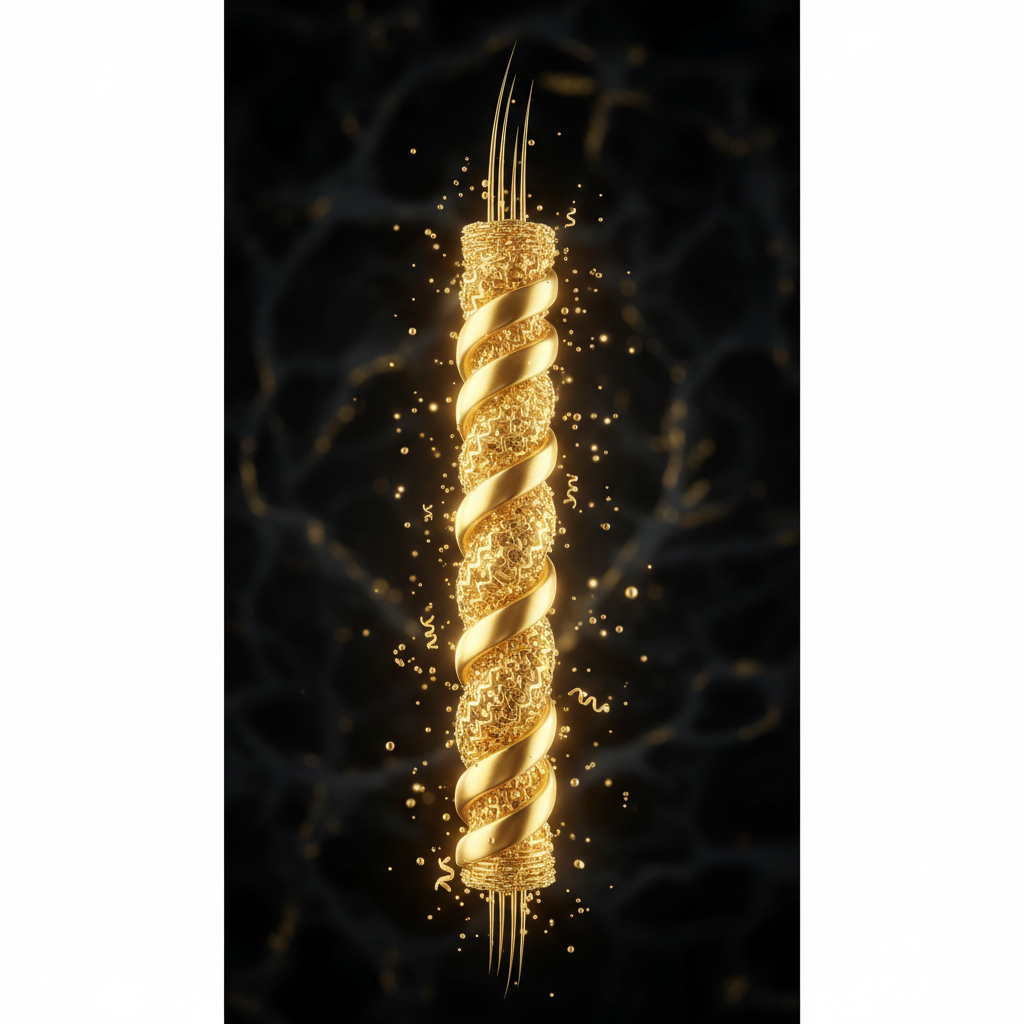
The protein portion consists of "hard" alpha-keratins rich in cysteine residues, distinct from the softer keratins found in human skin. Within the hair shaft, cortical cells house macrofibrils, which contain microfibrils or intermediate filaments. These filaments exist as coiled-coil dimers: two alpha-helical polypeptides wrap around one another, form tetramers, and pack into high-crystallinity protofilaments.
This crystalline framework sits within an amorphous matrix characterised by high-sulfur and high-glycine-tyrosine proteins. When you stretch a dry, healthy hair fibre, the alpha-helical coils deform and can extend up to roughly 30% of their length before entering a yield region where alpha-helices transition into beta-sheet conformations. Once the strain releases, the structural memory granted by the matrix snaps the helices back into place. If cross-linking bonds within this matrix are depleted through cosmetic processing or environmental oxidation, tensile strength plummets, resulting in mechanical snapping.
 [Alpha-Helical Keratin Polypeptides]
 │
 (Coiled-Coil Dimer)
 │
 [Tetrameric Subunits]
 │
 [Intermediate Filament (IF)]
 │
 ┌────────────────┴────────────────┐
 ▼ ▼
[Crystalline Core] [Amorphous Matrix]
Low sulfur, high tensile High-sulfur cysteine
Elasticity (alpha-helix) disulfide cross-linking
Chemical bonding: the engine of fibre strength
The cohesion of the keratin matrix relies on three primary categories of chemical bonds, each responding differently to daily wear and chemical exposure:
- Disulfide bonds (covalent): Formed between adjacent cysteine amino acids to create cystine. These covalent linkages are extraordinarily durable. They resist water, heat up to normal styling thresholds, and moderate mechanical tension. They provide the core structural architecture of the cortex.
- Hydrogen bonds (non-covalent): Formed between the oxygen and hydrogen atoms of adjacent peptide chains. While individually weak, they exist in vast quantities. Water easily disrupts hydrogen bonds, which is why wet hair stretches more readily and loses temporary heat-styled shapes when humid.
- Ionic salt bonds (non-covalent): Formed between positive and negative charges on basic and acidic amino acid side chains. These bonds depend strictly on pH. The isoelectric point of hair is approximately pH 3.67, while a neutral surface charge sits around pH 4.5 to 5.5. Exposure to alkaline products (pH above 8.0) ionises these residues, repelling chains apart, swelling the cuticle, and compromising internal resistance.
| Bond Type | Bond Energy / Strength | Disrupting Factors | Cosmetic Effect of Disruption |
|---|---|---|---|
| Disulfide | High (Covalent, ~250 kJ/mol) | Bleaching agents, perm reducers, high heat (>215°C) | Permanent loss of tensile strength, cortex porosity, snapping |
| Salt (Ionic) | Moderate (Electrostatic) | Alkaline chemicals, high pH water (>8.0), strong acids | Cuticular swelling, increased friction, decreased elasticity |
| Hydrogen | Low (Non-covalent, ~10 to 40 kJ/mol) | Water, steam, high ambient humidity | Reversible shape change, reduced wet stiffness |
What the evidence does not show
Popular marketing often claims that keratin shampoos and bond-rebuilding serums "resurrect", "cure", or "permanently fuse" split ends and broken cortical fibres. The biochemical evidence does not support this.
Hair above the scalp surface is non-living tissue (keratinised protein). It possesses no metabolic pathways, cellular machinery, or blood supply to regenerate original polypeptide chains. While cosmetic chemistry has introduced low-molecular-weight dicarboxylic acids, maleates, and hydrolysed peptides that enter the cortex and deposit temporary covalent or ionic links, they do not recreate native, biological alpha-helices.
Furthermore, structural breakage must never be confused with follicular shedding or biological hair loss. Thinning at the scalp, telogen effluvium, and androgenetic alopecia stem from follicular signaling, androgens, and cellular cycling. Topical keratin treatments have zero capacity to alter follicular dynamics or stop true follicular hair loss.
Mechanisms of keratin degradation
Keratin breakdown follows specific biophysical pathways depending on the stress applied to the fibre:
Chemical processing (bleaching and oxidation)
Alkaline persulfates and hydrogen peroxide oxidise disulfide linkages to dissolve melanin. A major side effect is the conversion of cystine into cysteic acid. Once cysteic acid forms, negative charges accumulate inside the cortex, repelling adjacent proteins, creating internal micro-voids, and destroying wet tensile resistance.
Thermal denaturation
Styling tools above 150 degrees Celsius cause moisture inside the cortex to flash boil if hair is damp, leading to bubble hair deformity. Between 180 and 220 degrees Celsius, the crystalline alpha-keratin transitions permanently into disordered structures, causing polypeptide chain cleavage and surface lipid oxidation.
Photochemical oxidation (UV radiation)
Ultraviolet-B (UVB) radiation damages protein chains directly, degrading tryptophan and cystine, while UVA radiation produces reactive oxygen species that oxidise proteins and degrade melanin pigments. The result is dry, straw-like hair that lacks surface shine and fractures during standard brushing.
Recognising compromised fibre integrity
Healthy hair fibres possess an intact, hydrophobic cuticle glued down by the 18-methyleicosanoic acid (18-MEA) lipid layer, shielding the cortex underneath. When internal keratin collapses, distinct signs emerge:
- Tricorrhexis nodosa: Microscopic node-like fractures along the hair shaft where cortical fibres fray outward like broken paintbrushes.
- Loss of elasticity: Wet hair snaps instantly when pulled with modest force, or stretches out like chewing gum without springing back.
- High porosity: The hair absorbs water rapidly, takes hours to dry, and tangles severely because cuticles are missing or stripped.
- Split ends (trichoptilosis): Complete longitudinal splitting of the distal shaft due to the loss of both cuticular protection and inter-macrofibrillar glue.
Protecting and supporting fibre structure
You cannot biologically heal damaged keratin, but targeted routines protect existing intact chains and reduce mechanical snapping:
- Maintain an acidic pH profile: Use cleansing and conditioning agents formulated between pH 4.5 and 5.5 to keep cuticles closed and preserve salt bonds.
- Incorporate protective wash care: Quality routines, including options like Watermans Grow Me shampoo and Condition Me conditioner, feature hydrolysed lupin and vegetable proteins that form lightweight protective films across the cuticle, alongside humectants that buffer moisture content.
- Mitigate mechanical shear: Detangle wet hair using wide-tooth tools, applying leave-in slip agents (such as silicones or natural triglycerides) to lower the friction coefficient between fibres.
- Thermal regulation: Limit hot tool temperatures to below 185 degrees Celsius and always apply thermal protectants containing polymers that disperse heat evenly across the shaft.
- Chemical moderation: Avoid overlapping permanent hair colour or bleach services over previously lightened lengths to limit cysteic acid build-up.
Frequently asked questions about Keratin Structure and Hair Fibre Integrity
How does moisture affect Keratin Structure and Hair Fibre Integrity?
Water disrupts temporary hydrogen bonds between keratin chains, increasing fibre elasticity while lowering wet stiffness. When soaked, hair can stretch significantly more than when dry, but its tensile breaking limit drops, making it far more vulnerable to snapping under heavy tension or aggressive brushing.
Can salon keratin treatments rebuild damaged hair cortexes?
No. Most salon smoothing treatments use cross-linking agents, heat, and aldehyde derivatives to form an outer resin shield around the hair shaft. While this seals the surface and flattens cuticles, it does not re-establish native alpha-helical coils inside the cortex and can sometimes cause thermal degradation from extreme flat-iron temperatures.
What is the difference between hair breakage and follicular shedding?
Breakage happens when mechanical or chemical damage snaps the dead shaft between the scalp and tip; you will see fragmented hair pieces without a white root bulb. Shedding is a biological process where an entire strand drops out from the follicle, visible by a tiny white keratinised bulb at its base.
What role does the cuticle play in preserving internal keratin?
The cuticle consists of overlapping, scale-like cells covered in a lipid layer called 18-MEA. This hydrophobic barrier deflects water, blocks chemical ingress, and prevents friction from exposing the cortex. When the cuticle is stripped, cortical keratin becomes vulnerable to environmental and mechanical erosion.
Preserving fibre integrity over time
Understanding Keratin Structure and Hair Fibre Integrity shifts haircare from cosmetic hope to material science. The hair fibre is an intricate composite of alpha-helical filaments, high-sulfur matrix proteins, and cross-linking bonds engineered for natural resilience. While daily chemical services, hot tools, and environmental stressors permanently degrade these structural networks, practical habits like acidic pH balancing, friction reduction, and thoughtful thermal protection help preserve the native cortex against unnecessary fracture.
Sources and references
- Robbins, C. R. (2012). Chemical and Physical Behavior of Human Hair. 5th ed. Springer-Verlag.
- Wolfram, L. J. (2003). "Human hair: a unique physicochemical composite." Journal of the American Academy of Dermatology, 48(6), S106-S114.
- Feughelman, M. (1997). Mechanical Properties and Structure of Alpha-keratin Fibres: Wool, Human Hair and Related Fibres. UNSW Press.
- Swift, J. A. (1999). "The mechanics of fracture of human hair." International Journal of Cosmetic Science, 21(4), 227-239.
- Cruz, C. F., et al. (2016). "Human hair keratin after chemical and physical treatments: an overview." International Journal of Cosmetic Science, 38(2), 111-124.