Hygral Fatigue in Curly Hair: Science, Symptoms, and Solutions
9 min read ·
Learn how Hygral Fatigue in Curly Hair develops, how to spot gummy or limp strands, and evidence-based ways to restore your curl pattern and protein balance.
Quick answer: Hygral Fatigue in Curly Hair occurs when the hair fibre undergoes structural damage caused by repeated, excessive swelling and contracting as water enters and leaves the cortex. Because curly hair has an elliptical shaft with natural variations in cuticle thickness, it is especially prone to this mechanical strain. The primary limitation in addressing it is that once internal protein bonds rupture from moisture stress, the cosmetic fibre cannot biologically heal itself; recovery relies on balancing protein and moisture to reinforce the cuticle.
Key takeaways
- Hygral fatigue is a specific form of mechanical hair shaft damage caused by constant cycles of water absorption and desiccation.
- Curly and coily hair types are naturally vulnerable due to structural cuticle irregularities along the twists and bends of the fibre.
- Typical signs include a limp, mushy, or gummy texture when wet, along with loss of curl elasticity, excessive frizz, and breakage.
- Hygral fatigue is not hair loss (which originates in the follicle); it is purely a cosmetic fibre degradation problem leading to breakage.
- Correcting the issue involves restricting prolonged water exposure, introducing hydrolysed proteins, and sealing the cuticle with emollient lipids.
Hygral Fatigue in Curly Hair: what the evidence shows
Hygral Fatigue in Curly Hair is thoroughly documented in cosmetic textile literature as a biomechanical failure of the keratin matrix. When water enters hair, the fibre can expand by up to 15 to 20 percent in diameter and roughly 1 to 2 percent in length. The hair cortex contains hygroscopic proteins that naturally bind water molecules. However, when the protective lipid barrier (primarily 18-methyleicosanoic acid, or 18-MEA) is eroded by chemical processing, harsh surfactants, or mechanical friction, water moves in and out of the cortex unchecked.
Research published in the Journal of Cosmetic Science shows that repeated wet-to-dry cycles exert severe mechanical stress on the endocuticle and cell membrane complex (CMC). In curly patterns (Types 3 and 4), the hair shaft is asymmetrical and flattened rather than round. Cuticle scales naturally lift slightly at the outer ridges of each curl twist. When high volumes of water flood these vulnerable sections, the repeated hydrostatic pressure weakens the cross-linked cell structure, leading to delamination of the cuticle scales, longitudinal cracking, and loss of tensile strength.
What the evidence does not show
Controlled cosmetic science does not support several common assumptions surrounding moisture damage.
First, the evidence does not show that hair can simply "drink" water indefinitely without consequence. The belief that healthy hair requires constant wetting, overnight conditioning, or perpetual saturation is contrary to fibre physics. Prolonged water immersion weakens the temporary hydrogen bonds that give curls their structural memory.
Second, hygral fatigue does not cause follicular hair loss or shedding. Alopecia and telogen effluvium originate within the living hair follicle inside the dermis. Hygral fatigue is strictly limited to the non-living hair shaft. While severe hygral damage leads to substantial hair breakage that can thin out the lengths and ends, it has no effect on the biological rate of hair growth from the scalp.
Finally, evidence does not show that cosmetic oils "hydrate" hair. Lipids cannot add moisture; instead, hydrophobic plant oils or silicones prevent water movement. Using oils to trap high levels of water inside an already swollen, compromised fibre can actually accelerate structural fatigue.
The biological and physical mechanism
The primary structural components of human hair are the outer cuticle, the inner cortex, and the central cell membrane complex that cements the cells together. The cortex consists of intermediate filament proteins embedded in an amorphous, sulphur-rich matrix.
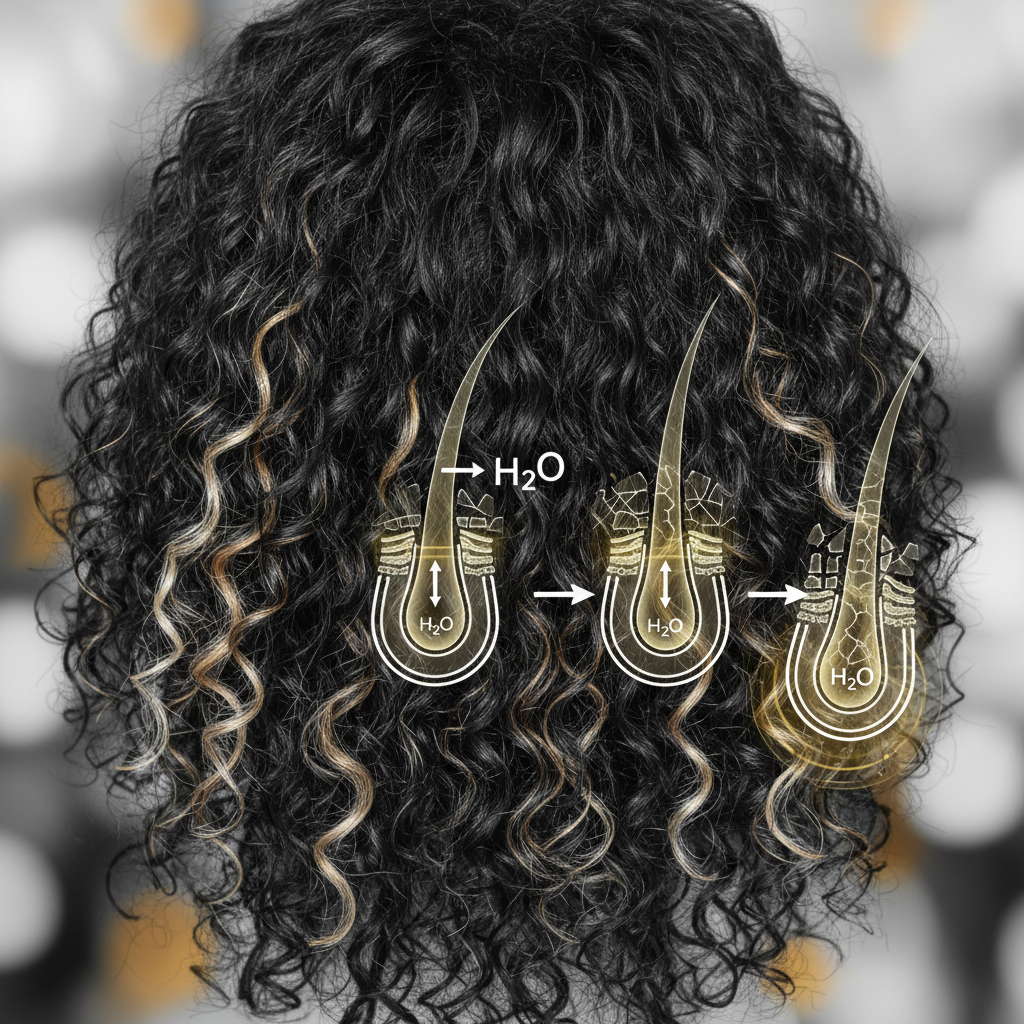
- Absorption and swelling: Untreated hair is naturally hydrophobic due to the surface lipid layer. Once this layer wears down, hair becomes hydrophilic. When immersed in water, capillary action draws water deep into the cortex. The matrix swells, pushing the cuticle scales outward.
- Desorption and contraction: As the hair dries, water evaporates and the cortex shrinks back to its baseline dimension.
- Tensile fatigue: If this expansion and contraction occurs daily, or if hair stays wet for hours at a time, the cell membrane complex undergoes cyclic fatigue. The structural proteins lose their ability to contract fully, much like an overstretched elastic band.
- Mechanical breakdown: The cuticle scales fail to lie flat against the shaft again. Friction between adjacent fibres rises, leading to tangling, surface erosion, and eventual snapping along the shaft.
Signs of hygral fatigue versus protein overload
Because both conditions cause dullness, frizz, and breakage, distinguishing between excess moisture and excess protein is essential for choosing the right corrective treatment.
| Diagnostic Sign | Hygral Fatigue | Protein Overload |
|---|---|---|
| Feel when wet | Mushy, gummy, excessively soft, or limp | Stiff, rough, brittle, and straw-like |
| Elasticity test | Stretches far beyond normal length without bouncing back, then breaks | Snaps almost immediately with minimal stretch |
| Curl definition | Curls sag, stretch out, or fail to clump | Curls look rigid, crunchy, frizzy, and lack movement |
| Primary structural cause | Weakened cell membrane complex from over-swelling | Excessive protein deposits blocking flexural movement |
| Corrective remedy | Hydrolysed protein treatments, reduced soaking, pH-balanced seals | Deep conditioning with protein-free emollients and heat |
What you can do to restore balance
Halting the cycle of moisture stress requires physical protection, reduced soaking times, and structural reinforcement.
Shorten wash and drying times
Avoid leaving curly hair saturated for hours. Never sleep with wet hair or leave deep conditioners on overnight. Use a microfibre towel or cotton T-shirt to gently blot out excess moisture without abrasive rubbing, and diffuse on a low-to-medium heat setting to return the hair to its dry, mechanically stable state promptly.
Incorporate hydrolysed proteins
Formulations containing hydrolysed keratin, wheat protein, silk, or amino acids can temporarily adsorb onto damaged sites along the cuticle and diffuse partially into the outer cortex. These proteins create cross-links that reinforce tensile strength, reduce excessive elasticity, and support curl bounce.
Use pre-shampoo lipid treatments
Applying a penetrative oil, such as coconut oil or babassu oil, prior to washing can significantly reduce hygral stress. Studies show that lauric acid in coconut oil possesses a low molecular weight and linear chain that allows it to penetrate the hair shaft, reducing the volume of water the cortex can absorb during washing by up to 20 percent.
Respect the natural pH of hair
Hair fibres are at their most resilient at an acidic pH between 4.5 and 5.5, which is known as the isoelectric point. At this pH, the electrical net charge of the hair is neutral, and the cuticle layers remain compact. Shampoos and conditioners formulated in this range help prevent unnecessary swelling of the shaft during cleansing.
Watermans haircare approach
Maintaining fibre integrity without overloading the cortex requires a measured cosmetic approach. Watermans incorporates nutrient-dense, pH-conscious formulations that support scalp health while protecting the hair shaft against daily friction and moisture fluctuations. By maintaining a clean scalp environment and delivering conditioning agents that smooth down lifted cuticles, balanced topical regimens help curly hair retain structural resilience against the mechanical stresses of washing and styling.
When the cause may be something else
If your curls are snapping or shedding heavily, hygral fatigue may not be the sole factor:
- Chemical over-processing: High-lift bleaching, permanent colour, and chemical relaxers cleave the disulfide bonds inside the cortex. This mimics the gummy texture of hygral fatigue, but the root cause is chemical dissolution rather than simply water stress.
- Excessive heat styling: Direct contact with high-temperature flat irons causes moisture within the cortex to boil rapidly, producing "bubble hair" and micro-fractures.
- Telogen effluvium: If you notice sudden, diffuse shedding with white bulbs attached to the ends of the hairs, this is shedding from the follicle triggered by systemic stress, illness, or nutritional deficiency, not fibre breakage.
When to seek professional advice
Consult a qualified trichologist or dermatologist if you experience sudden, widespread hair shedding, bald patches, or scalp irritation, itching, and scaling. These symptoms point toward physiological issues that cosmetic haircare cannot resolve. For structural damage where breakage is severe, an experienced curl specialist can assess your hair's tensile elasticity, trim compromised ends, and design a custom protein-to-moisture balance.
Frequently asked questions about Hygral Fatigue in Curly Hair
What is the fastest way to fix Hygral Fatigue in Curly Hair?
The fastest way to treat Hygral Fatigue in Curly Hair is to apply a dedicated hydrolysed protein treatment, shorten your wash routine, and stop soaking hair for extended periods. Protein binds to damaged sections of the cuticle to restore rigidity. Pair this with pre-wash penetrative oil treatments to block excessive water absorption until the cuticles smooth down.
Can low porosity hair experience hygral fatigue?
Yes, though it is far less common. Low porosity hair has tightly bound cuticle layers that resist water entry. However, if low porosity hair is repeatedly subjected to high heat, harsh clarifying treatments, or overnight deep conditioning, the cuticle can become damaged, allowing moisture to enter and get trapped within the cortex.
How does hygral fatigue differ from breakage?
Hygral fatigue is a specific cause, whereas breakage is the physical outcome. Hygral fatigue weakens the internal protein structure of the fibre through repeated water swelling. This sustained mechanical stress degrades the hair's natural elasticity, ultimately causing the strands to snap and break off along the shaft.
Does the "squish to condish" method cause hygral fatigue?
Not inherently. The technique uses mechanical pulsing with water and conditioner to encourage curl clumping. It only contributes to hygral fatigue if hair is kept soaking wet for excessive lengths of time or if moisturising products completely replace the structural protein your hair needs to maintain tensile balance.
Is sleeping with wet hair bad for curls?
Yes. Sleeping with wet hair leaves the fibre in a vulnerable, swollen state for 6 to 8 hours. The combination of prolonged internal water pressure and friction against a pillow can shear the cell membrane complex, rapidly encouraging moisture fatigue and fibre snapping.
Restoring strength to compromised curls
Managing Hygral Fatigue in Curly Hair requires understanding that water, while essential for curl formation, acts as a mechanical stressor in high volumes. Healthy curls rely on a careful equilibrium: enough moisture to maintain flexibility, backed by intact structural proteins and lipid layers to prevent excessive swelling. By limiting prolonged wetness, applying hydrolysed proteins, and sealing the fibre at a balanced pH, you can protect the cuticle, regain curl definition, and maintain resilient curls.
Sources and references
- Robbins, C. R. (2012). Chemical and Physical Behavior of Human Hair. 5th ed. Springer-Verlag New York.
- Ruetsch, S. B., et al. (2001). "Investigation of penetration of coconut oil into hair fibres using secondary ion mass spectrometry." Journal of Cosmetic Science, 52(3), 169-184.
- Evans, T., & Wickett, R. R. (2012). Practical Modern Hair Science. Allured Business Media.
- Kamath, Y. K., et al. (1984). "Mechanical properties of hair: Effects of moisture and temperature." Journal of Applied Polymer Science, 29(12), 4125-4133.
- Gavazzoni Dias, M. F. (2015). "Hair cosmetics: An overview." International Journal of Trichology, 7(1), 2-15.