Hydrolysed Proteins in Hair Care: Evidence, Mechanisms, and Fibre Repair
9 min read ·
Hydrolysed Proteins in Hair Care temporarily reinforce damaged hair fibres, boost elasticity, and reduce breakage. Learn how these low-molecular peptides work.
Quick answer: Hydrolysed Proteins in Hair Care are natural protein fragments chemically broken down through enzymatic or acid hydrolysis into low-molecular-weight peptides and amino acids. Because intact proteins are too large to cross the hair cuticle, these smaller fragments temporarily patch micro-cracks in the cortex, adsorb onto the cuticle, and increase water retention. Their primary limitation is that they provide temporary cosmetic reinforcement rather than permanent biological repair, washing out gradually with subsequent cleanses.
Key takeaways
- Natural proteins like keratin, wheat, silk, and collagen must be hydrolysed because whole proteins cannot penetrate beneath the hair cuticle.
- Molecular weight determines function: fragments below 1,000 Daltons can diffuse into the hair cortex, whereas larger peptides remain on the surface to form protective films.
- Hydrolysed proteins reduce hair fibre breakage, improve tensile strength, and boost elasticity, especially on bleached, heat-damaged, or chemically relaxed hair.
- Overusing high-molecular-weight proteins without balancing emollients can leave hair feeling brittle and stiff, often described colloquially as protein overload.
- Hydrolysed proteins treat hair shaft breakage; they do not alter biological hair growth or treat medical hair shedding at the follicle level.
Hydrolysed Proteins in Hair Care: what the evidence shows
Peer-reviewed cosmetic science demonstrates that hydrolysed proteins adhere to damaged hair fibres and improve their structural performance. Intact native proteins have molecular weights exceeding 30,000 to 100,000 Daltons (Da). Hair cuticle scales are tightly overlapped, presenting intercellular spaces between 5 and 15 nanometres wide. Intact proteins are simply too large to cross this barrier. Through hydrolysis, water molecules cleave peptide bonds, yielding peptide chains ranging between 150 and 5,000 Da.
Cosmetic chemists have confirmed that the smallest peptide fractions, especially those under 1,000 Da, penetrate the endocuticle and diffuse into the porous cortex of damaged hair fibres. Bleached or dyed hair possesses a net negative electrostatic charge due to the oxidation of 18-methyleicosanoic acid (18-MEA) and cysteic acid formation. Most hydrolysed proteins possess a net positive or amphoteric charge at the typical pH of hair products (pH 4.0 to 5.5). This allows them to bind to damaged sites via ionic attraction and hydrogen bonding, temporarily reinforcing tensile strength and reducing mechanical breakage during brushing.
Molecular weight and penetration: how the mechanism works
The performance of a hydrolysed protein depends on its average molecular weight distribution and its amino acid profile:
- Low molecular weight (under 1,000 Da): These small peptides and single amino acids penetrate the cuticle layer and enter the cortex. Once inside, they bind to existing keratin matrix structures, acting as humectants that draw and bind water within the hair fibre. This increases internal hydration and enhances fibre elasticity.
- Medium to high molecular weight (1,500 to 5,000+ Da): These larger peptides cannot reach the cortex. Instead, they deposit onto the outer cuticle scales, forming a cohesive, flexible film. This film smooths jagged edges, reduces surface friction, increases specular light reflection for shine, and protects against environmental abrasions.
Bleaching, chemical straightening, and repeated heat styling strip the protective lipid layer of the hair. This exposure leaves the keratin matrix vulnerable to moisture loss and mechanical stress. Hydrolysed proteins deposit directly into these microscopic voids, temporarily restoring structural integrity until the next wash cycle.
Common types of hydrolysed proteins compared
| Protein source | Typical molecular weight | Primary site of action | Key hair benefit |
|---|---|---|---|
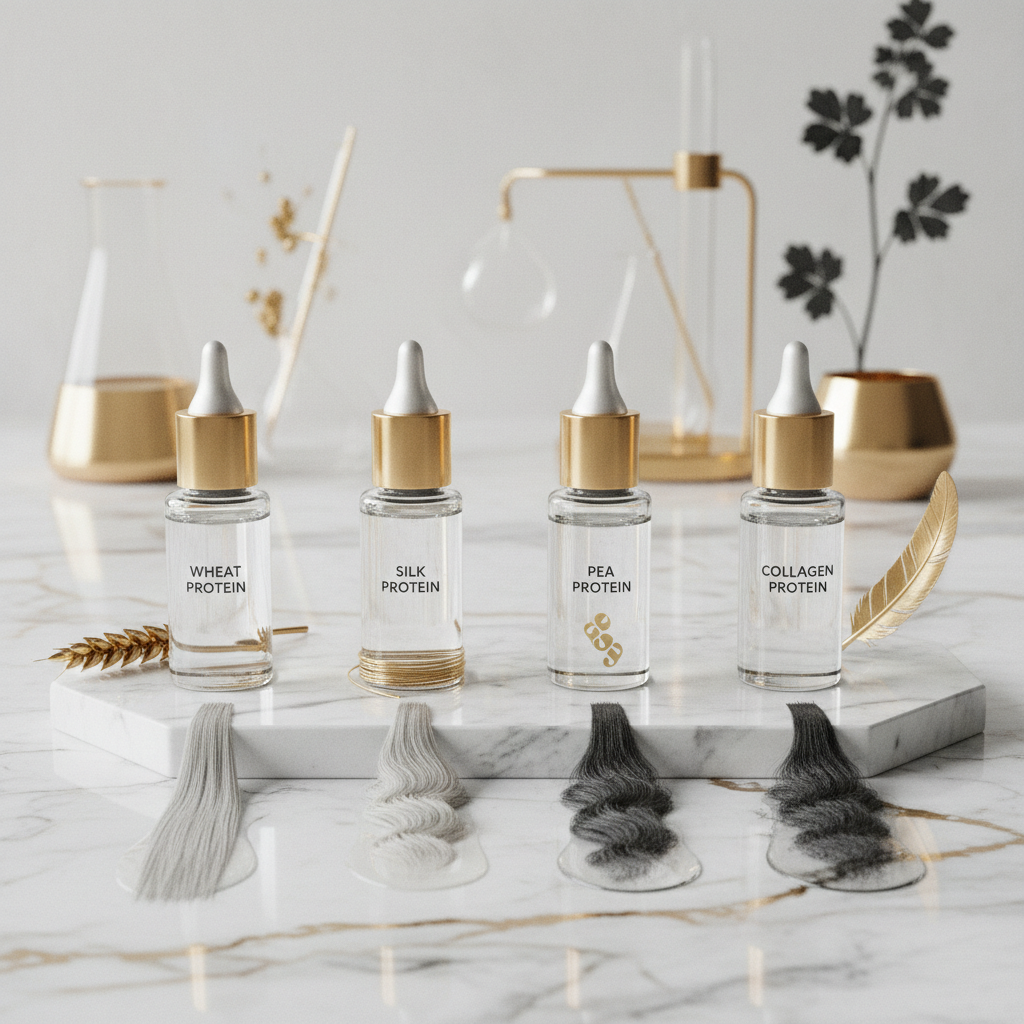
| Hydrolysed Keratin | 500 to 2,000 Da | Cuticle and cortex | Matches human hair amino acid profile; reinforces tensile strength and reduces breakage. |
| Hydrolysed Wheat Protein | 1,000 to 3,500 Da | Cuticle surface and endocuticle | Exceptional moisture retention; forms a smooth, protective film that boosts body and volume. |
| Hydrolysed Silk | 300 to 1,500 Da | Cuticle and shallow cortex | High levels of serine and glycine; imparts exceptional smoothness, slip, and light reflection. |
| Hydrolysed Collagen | 1,000 to 3,000 Da | Cuticle surface | High proline and hydroxyproline content; builds elasticity and protects against thermal stress. |
| Hydrolysed Rice Protein | 1,500 to 3,000 Da | Cuticle surface | Carries a higher cationic charge density; builds volume and helps detangle fine hair strands. |
What the evidence does not show
While hydrolysed proteins are exceptional conditioning agents, their biological scope is frequently exaggerated in advertising.
First, hydrolysed proteins do not permanently "repair" dead hair tissue. Hair is non-living keratinised tissue. Once peptide bonds inside the cortex break due to chemical bleaching or thermal degradation, cosmetic proteins cannot re-synthesise native alpha-helices or reform broken disulfide bridges. Hydrolysed proteins act as temporary fillers. When you wash your hair with clarifying surfactants, much of the deposited protein washes away.
Second, topical hydrolysed proteins do not stimulate hair growth or treat medical hair loss. Telogen effluvium, androgenetic alopecia, and alopecia areata occur deep within the dermal papilla inside the scalp follicle. Applying hydrolysed keratin or wheat protein to the scalp cannot reactivate a dormant hair follicle or inhibit dihydrotestosterone (DHT). Confusing shaft breakage with follicular shedding leads many people to misdiagnose their hair concerns.
Signs your hair needs protein vs moisture
Hair fibres require a balance of structural strength from proteins and suppleness from water and emollient lipids. Damaged hair displays distinct symptoms depending on what it lacks:
- Signs your hair needs protein: The hair stretches out significantly when wet without bouncing back, feeling mushy, gummy, or limp. Fine strands snap under slight tension because the internal cortex lacks rigidity. Chemical processing (bleaching, relaxing, or permanent waves) has created high porosity.
- Signs your hair needs moisture: The hair feels rough, raspy, and straw-like to the touch. When pulled gently while dry, it displays no elasticity and snaps immediately. Curls lose their definition and appear frizzy rather than clumped.
- Protein overload: Using intense leave-in protein treatments without adequate softening conditioning agents can cause excessive surface accumulation. The hair feels stiff, brittle, and dry, snapping easily when manipulated.
How to use hydrolysed proteins in your routine
To gain the structural benefits of hydrolysed proteins without creating surface stiffness, follow a targeted routine:
- Assess fibre porosity: High-porosity hair that has undergone chemical lightening or frequent thermal styling benefits from weekly protein-enriched conditioning masks. Low-porosity virgin hair rarely requires concentrated protein and can become stiff quickly.
- Pair with emollients: Always ensure products containing hydrolysed proteins also include emollients, such as cetyl alcohol, shea butter, argan oil, or panthenol. Emollients lubricate the hair cuticle, preventing the film-forming proteins from feeling coarse.
- Use rinse-off treatments for deep repair: Intensive rinse-off masks give low-molecular-weight peptides 5 to 15 minutes of contact time to diffuse through open cuticles into the cortex.
- Use leave-in products for surface shielding: Leave-in sprays containing hydrolysed silk or wheat protein help reduce friction during detangling and provide a sacrificial protective barrier against blow-dryer heat.
- Clarify periodically: If your hair begins to feel rigid, wash with a chelating or clarifying shampoo to strip away accumulated surface proteins, followed by a purely moisturising, protein-free conditioner.
When hair breakage is caused by something else
If your hair snaps easily and fails to respond to protein treatments, the underlying cause may lie beyond surface damage:
- Nutritional and metabolic deficiencies: Severe protein calorie malnutrition, iron deficiency anaemia, or thyroid disease can cause hair to grow with a fragile, defective cortex (trichorrhexis nodosa).
- Physical grooming trauma: Tight hairstyles that place constant traction on fibres, fine-tooth plastic combs with sharp seams, or aggressive towel-drying will snap healthy hair regardless of protein content.
- Mineral buildup from hard water: Calcium and magnesium ions from hard domestic water bind to hair fibres, creating a stiff mineral barrier that makes strands brittle and blocks conditioning agents from penetrating.
- Follicular shedding: If you are seeing full-length strands ending in a white bulb falling out in the shower, this is shedding from the scalp, not shaft breakage. Protein masks cannot resolve follicular shedding.
Professional assessment
Consult a certified trichologist or dermatologist if you notice rapid diffuse thinning, widening hair parts, or scalp irritation such as persistent flaking, burning, or redness. A professional can examine your scalp using trichoscopy to distinguish between shaft breakage, anagen arrest, and follicular miniaturisation. If your hair is breaking continuously after professional salon bleaching, visit an experienced colourist to perform a stand-alone conditioning treatment and evaluate whether the hair requires a trim to stop split ends from travelling up the shaft.
The Watermans perspective
At Watermans, our formulations focus on creating a supportive, balanced scalp and fibre environment. We understand that healthy hair starts at the root while demanding protection along the shaft. Rather than overloading fibres with heavy, unrefined proteins that leave hair brittle, our Grow Me Shampoo and Condition Me Conditioner blend hydrolysed lupin protein with targeted scalp nutrients like biotin, rosemary, and caffeine. Lupin peptides supply essential amino acids that condition the fibre, boost volume, and improve manageable body without causing buildup or heaviness, complementing your hair care routine from scalp to tip.
Frequently asked questions about Hydrolysed Proteins in Hair Care
Can Hydrolysed Proteins in Hair Care cause hair loss?
No. Hydrolysed proteins do not cause biological hair loss or damage the follicle. However, overusing concentrated, film-forming proteins without sufficient moisturising agents can make the hair fibre feel stiff and brittle. This brittleness can lead to increased fibre breakage along the shaft, which is sometimes mistaken for shedding from the roots.
What is the difference between keratin and hydrolysed keratin?
Native keratin is a large, fibrous, insoluble protein with a molecular weight of roughly 40,000 to 60,000 Daltons. It cannot pass through the hair cuticle. Hydrolysed keratin is native keratin broken down into low-molecular-weight peptides (often under 2,000 Daltons), allowing it to penetrate micro-fissures in damaged hair.
How often should I use protein-rich hair products?
It depends on your hair porosity and damage level. Bleached or chemically treated hair often benefits from a hydrolysed protein treatment once a week. Low-porosity, untreated, or fine hair usually only needs protein every four to six weeks, or via mild, daily-use balanced conditioners.
Is hydrolysed wheat protein safe for people with coeliac disease?
Generally, yes, because cosmetic proteins are applied topically to the hair and scalp, whereas coeliac disease is an autoimmune response triggered by dietary ingestion of gluten through the gut. However, individuals with severe contact dermatitis or direct wheat allergies should check cosmetic labels and perform a 24-hour skin patch test before use.
Can hydrolysed proteins repair split ends permanently?
No cosmetic ingredient can permanently repair split ends. Hydrolysed proteins, especially medium-weight variants, can temporarily seal split ends by forming an adhesive film along the cuticle. However, this effect washes away with shampooing. The only permanent solution for split ends is cutting them off with sharp shears.
Conclusion
Hydrolysed Proteins in Hair Care represent an essential tool for restoring tensile strength, elasticity, and smoothness to structurally compromised hair. By cleaving large raw proteins into bio-compatible peptides, modern cosmetic science allows these ingredients to target structural weaknesses directly at the cuticle and cortex. While they cannot replace permanent biological bonds or treat hair loss at the follicle, integrating hydrolysed proteins alongside hydrating emollients will help protect damaged hair fibres against everyday wear and tear.
Sources and references
- Journal of Cosmetic Science: Penetration of Hydrolyzed Wheat and Keratin Proteins into Human Hair Fibers, 2004.
- International Journal of Cosmetic Science: Effects of Hydrolyzed Proteins on the Mechanical Properties of Bleached Human Hair, 2008.
- Cosmetic Ingredient Review (CIR): Safety Assessment of Hydrolyzed Keratin and Hydrolyzed Wheat Protein as Used in Cosmetics, 2018.
- British Association of Dermatologists: Guidelines on the Investigation and Management of Hair Shaft Disorders, 2021.
Find these ingredients in Watermans products
- Panthenol (Provitamin B5): you will find this ingredient in our Heat Protection Spray.
- Shea Butter: you will find this ingredient in our Curly Hair Conditioner.