Hydrolysed Protein for Hair: How It Works and What It Cannot Do
8 min read ·
Discover how Hydrolysed Protein for Hair repairs cuticle damage, boosts tensile strength, and stops breakage, alongside key limits and usage tips.

Quick answer: Hydrolysed Protein for Hair is a cosmetic strengthening agent created by breaking large protein molecules into smaller peptide fragments via enzymatic or acid hydrolysis. These lightweight fragments temporarily fill structural gaps in the damaged cuticle, reduce porosity, and improve tensile strength against physical snapping. However, its benefits are purely topical and temporary. It cannot repair a severed cortex permanently, reverse chemical damage, or alter follicular hair growth cycles.
Key takeaways
- Hydrolysis breaks bulky proteins like wheat, keratin, silk, or soy into smaller peptides (typically 500 to 3,000 Daltons) capable of binding to the hair fibre.
- The smaller the molecular weight, the deeper the fragment can penetrate beneath the cuticle into the outer cortex.
- Hydrolysed protein targets hair breakage from mechanical and chemical damage, not follicular hair shedding or genetic hair loss.
- Low-porosity hair can experience stiffness and brittle textures if proteins accumulate on the surface without adequate moisture balance.
- Cosmetic effects rinse out over successive washes, requiring consistent routine maintenance rather than one-off applications.
Hydrolysed Protein for Hair: what the evidence shows
Hydrolysed Protein for Hair works primarily through adsorption, where small, positively charged peptide fragments bind to negatively charged, damaged sites along the keratin cuticle.

When hair undergoes bleaching, thermal styling above 180°C, or alkaline chemical straightening, the protective 18-methyleicosanoic acid (18-MEA) lipid layer is stripped away. This chemical trauma exposes raw keratin proteins and oxidises cystine into cysteic acid, creating a strong negative electrostatic charge across the fibre.
Peer-reviewed cosmetic science demonstrates that hydrolysed proteins derived from wheat, rice, silk, keratin, and collagen counteract this surface degradation. Because hydrolysed fragments carry an amphoteric or mildly cationic character, they naturally migrate toward these damaged, anionic sites. Studies published in the Journal of Cosmetic Science confirm that hydrolysed wheat protein and hydrolysed keratin increase the elastic modulus and tensile strength of bleached hair fibres. By temporarily reinforcing the cuticle scales and patching micro-fissures, hydrolysed proteins reduce moisture loss and limit mechanical friction during wet combing.
Furthermore, lower molecular weight proteins (around 500 to 1,500 Daltons) demonstrate partial penetration into the outer cortex. This internal deposition helps hair fibres retain essential hydration by improving water-binding capacity, making the hair feel more resilient, pliable, and noticeably fuller.
What the evidence does not show
It is critical to distinguish between structural hair cosmetic conditioning and follicular biology. Hydrolysed proteins do not:
- Cure genetic hair loss: Androgenetic alopecia is governed by dihydrotestosterone (DHT) and follicular miniaturisation. Topically applied hydrolysed protein cannot alter hormone receptors or regrow lost follicles.
- Stop telogen effluvium: Stress, dietary deficiencies, and hormonal shifts cause temporary diffuse hair shedding from the root. Protein applied to the lengths has zero biological effect on shedding inside the scalp.
- Permanently reconstruct broken disulphide bonds: Unlike targeted bond-building bis-aminopropyl compounds, hydrolysed peptides form weak hydrogen and ionic bonds. They wash away over several wash cycles.
- Make individual fibres grow faster: Keratinisation occurs deep within the hair bulb. Bathing the visible hair strand in protein extracts will not accelerate biological hair production.
Confusing breakage along the strand with true hair shedding is common. When people report that protein stopped their hair loss, they are usually observing fewer snapped fibres in their brush, not fewer roots leaving the scalp.
The mechanism: molecular weights and protein types
The performance of hydrolysed protein depends on two variables: the raw source material and the average molecular weight (measured in Daltons). Intact native proteins have molecular weights exceeding 100,000 Daltons, which are far too large to interact meaningfully with the hair cuticle. Hydrolysis cleaves these giants into functional segments.
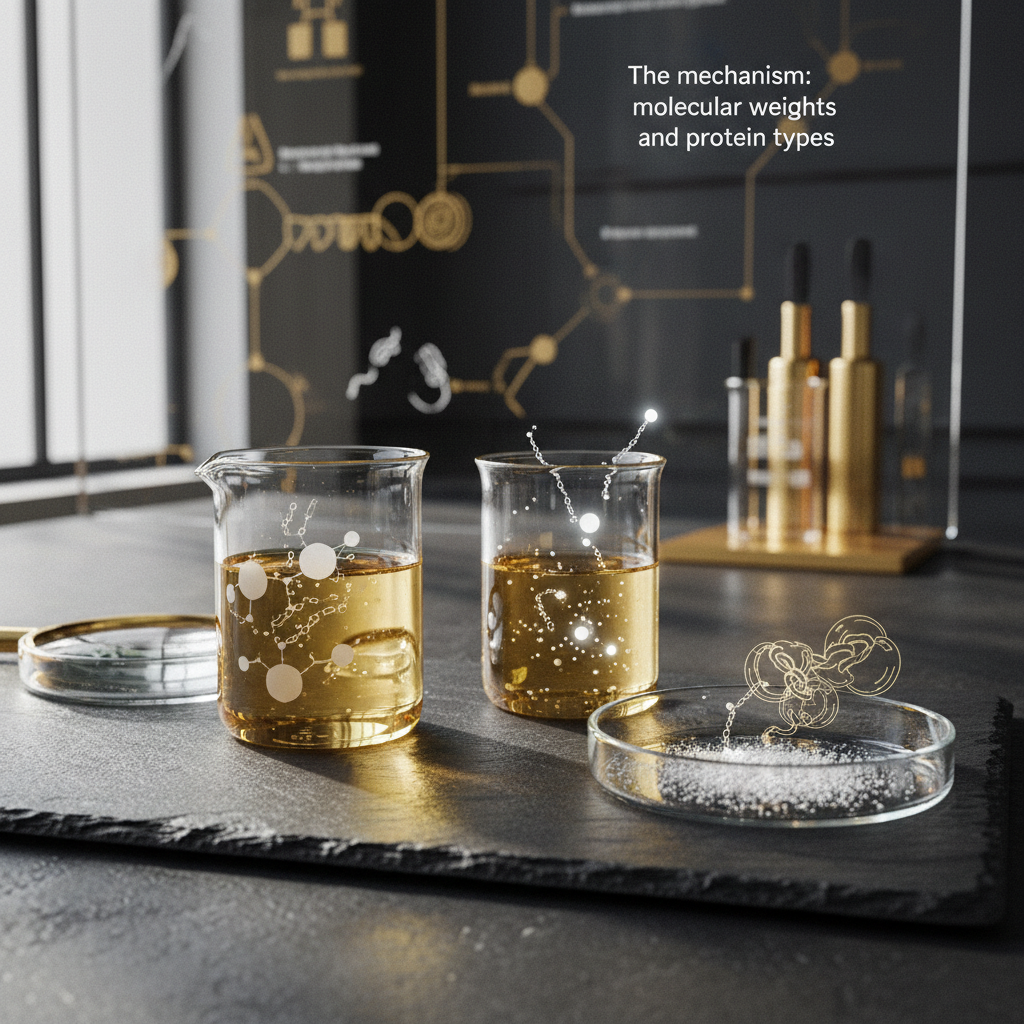
Smaller fragments (under 1,000 Daltons) can access the inner layers of a porous cuticle. Medium-to-large fragments (1,500 to 3,000 Daltons) primarily form protective, flexible films on the surface of the shaft, smoothing down jagged cuticle edges and reflecting light for added shine.
| Protein Type | Typical Molecular Weight (Daltons) | Primary Mechanism | Best Suited For |
|---|---|---|---|
| Hydrolysed Silk | 500 to 1,500 | Moisture retention, silky surface slip | Fine, easily weighed-down hair |
| Hydrolysed Keratin | 1,000 to 3,000 | Adsorption to damaged sites, cortex reinforcement | Bleached, chemically treated, or heat-damaged hair |
| Hydrolysed Wheat | 1,000 to 2,500 | Swelling reduction, tensile strength | Porous, frizzy, and brittle hair |
| Hydrolysed Collagen | 1,500 to 4,000 | Moisture-binding film, elasticity boost | Dry, coarse, or aging hair fibres |
| Hydrolysed Rice | 1,000 to 2,000 | Electrostatic repulsion, adds tactile volume | Fine, flat, low-density hair |
Signs your hair needs hydrolysed protein (versus moisture)
Hair fibre resilience relies on a balanced ratio of moisture (which provides suppleness and flexibility) and protein (which provides rigidity and tensile strength).
Signs your hair requires hydrolysed protein include:
- Excessive elasticity: Wet strands stretch far beyond their normal length and do not bounce back, turning mushy or gummy.
- Wet tangling and limpness: Hair feels like wet cotton wool and clumps unnaturally without holding any shape.
- Chemical porosity: The hair absorbs water instantly upon contact but dries out almost immediately, feeling porous and dry.
Conversely, signs that you have used too much protein include:
- Stiff, straw-like texture: Strands feel hard, unyielding, and dry despite heavy conditioning.
- Snapping without stretch: Dry strands break immediately under minimal mechanical tension.
- Dullness and buildup: The cuticle becomes coated in excess protein film, leaving hair rough and matte.
What you can do: building a balanced routine
To use hydrolysed proteins successfully, adjust frequency based on your hair's chemical history and baseline porosity.
- Assess damage levels: Bleached, highlighted, or chemically relaxed hair can tolerate leave-in sprays or deep treatments containing hydrolysed keratin or wheat protein once or twice a week. Untreated, low-porosity hair only needs hydrolysed protein once a month, if at all.
- Layer with emollients: Never use a concentrated protein treatment without following it with a conditioning agent rich in fatty alcohols (such as cetyl or stearyl alcohol) and natural lipids. This balances structural stiffness with pliable moisture.
- Check the ingredient order: On cosmetic labels, ingredients are listed by concentration down to 1%. If "Hydrolysed Keratin" appears in the first five ingredients, it is a high-potency treatment. If it sits near the bottom, it provides light humectant and smoothing benefits without structural hardening.
When the cause may be something else
If your hair continues to snap, snap at the roots, or shed excessively despite introducing protein, look beyond cosmetic products:
- Nutritional status: Dietary protein deficiency or severe iron deficiency (low serum ferritin) undermines keratin production inside the follicle, producing inherently weak hair shafts that break under normal brushing.
- Thyroid disorders: Both hypothyroidism and hyperthyroidism cause dry, brittle fibres accompanied by diffuse telogen shedding.
- Over-processing: If disulphide bonds have been completely destroyed by repetitive bleaching or improper relaxer overlaps, no amount of hydrolysed protein can restore structural integrity; the only true remedy is trimming off the compromised lengths.
When to seek professional guidance
If you notice bald patches, widening parts, rapid diffuse shedding, or scalp tenderness and inflammation, consult a registered trichologist or dermatologist. Cosmetic strengthening agents will not address dermatological conditions or biological disruptions to the hair growth cycle. A professional can run trichoscopy assessments, review blood panels, and differentiate between structural shaft breakage and follicular loss.
The Watermans perspective
While targeted cosmetic proteins play an important role in patching daily wear and tear along the hair lengths, resilient hair starts with a healthy, nourished scalp environment. Products like Watermans Grow Me Shampoo combine surface conditioning technology with botanical extracts, caffeine, biotin, and rosemary to support optimal conditions for hair density while keeping hair clean, clear, and fortified from root to tip.
Frequently asked questions about Hydrolysed Protein for Hair
How often should you use Hydrolysed Protein for Hair?
For bleached, relaxed, or heat-damaged hair, use a treatment containing Hydrolysed Protein for Hair once every 7 to 14 days. For virgin or low-porosity hair, limit application to once a month or choose rinse-out conditioners containing lower peptide concentrations to prevent stiffness and protein overload.
Can hydrolysed protein cause hair to snap?
Yes. Over-applying protein without adequate moisture causes excessive film deposition along the cuticle. This makes the fibre excessively rigid. When rigid hair lacks internal moisture, it loses its natural elasticity and snaps cleanly under mechanical stress like brushing or tying.
What is the difference between regular protein and hydrolysed protein?
Regular proteins, like whole eggs or dairy extracts, have massive molecular weights of several hundred thousand Daltons. They cannot penetrate the hair cuticle and simply sit on the surface. Hydrolysed protein is chemically broken down into tiny peptide chains that can adsorb directly to damaged sites.
Does hydrolysed protein stop hair loss?
No. Hydrolysed protein does not treat follicular hair loss, genetic thinning, or telogen shedding. It acts strictly on the external hair strand to temporarily reinforce micro-damage, which helps reduce physical fibre breakage rather than shedding from the follicle.
Summary on Hydrolysed Protein for Hair
Hydrolysed Protein for Hair remains one of the most reliable, research-backed cosmetic tools for reinforcing porous, damaged, and chemically treated strands. By selecting the correct molecular weight and balancing protein application with emollient moisture, you can reinforce tensile strength, reduce surface friction, and protect the lengths from premature snapping. Used thoughtfully as part of a balanced regime, it ensures vulnerable hair looks, feels, and handles at its absolute best.
Sources and references
- Journal of Cosmetic Science, "Investigation of the penetration of hydrolysed proteins into human hair by fluorescent microscopy", 2004.
- International Journal of Cosmetic Science, "Effects of cosmetic treatments on the physical and mechanical properties of hair fibres", 2012.
- Cosmetic Dermatology: Products and Procedures, Zoe Diana Draelos, Wiley-Blackwell, 2015.
- British Journal of Dermatology, "The structure and properties of hair cuticle and cortex", 2009.
Find these ingredients in Watermans products
- Wheat Amino Acids: you will find this ingredient in our Heat Protection Spray.