How to Stop Hair Snapping When Brushing: Evidence, Physics, and Solutions
8 min read ·
Learn how to stop hair snapping when brushing. Discover the evidence behind mechanical breakage, wet vs dry hair physics, and proven detangling habits.
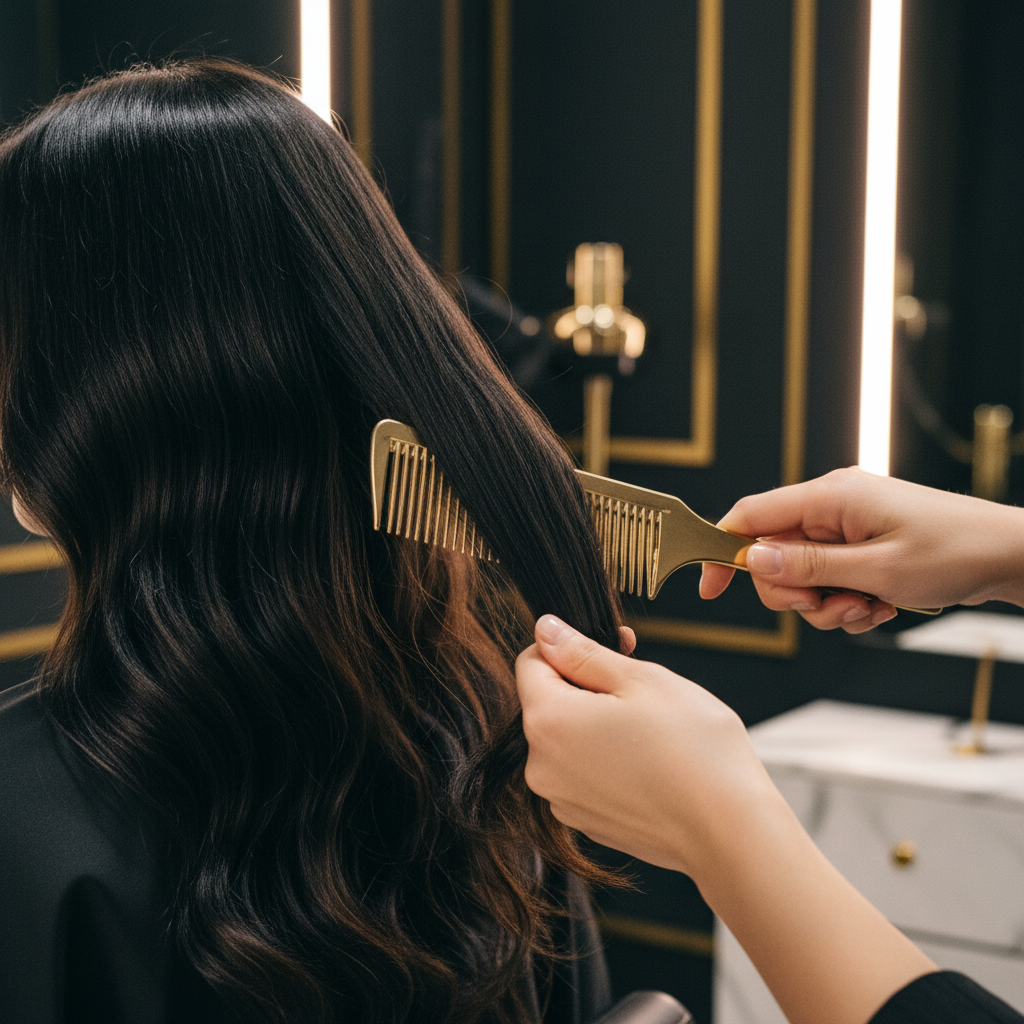
Quick answer: Learning how to stop hair snapping when brushing requires reducing mechanical friction, detangling strictly from ends to roots, and matching your technique to fibre hydration. Wet hair can stretch by roughly 30 percent before breaking but has weakened hydrogen bonds, while dry, chemically treated hair lacks lubrication. How to stop hair snapping when brushing depends primarily on using flexible tools on slip-primed fibres, though severe structural damage or internal health issues will still require professional assessment and chemical trimming.
Key takeaways
- Hair snapping during grooming is mechanical breakage, not follicular hair shedding or hair loss.
- Wet hair stretches easily due to disrupted hydrogen bonds, making wet brushing risky without slip-inducing conditioning agents.
- Dry, chemically lightened, or heat-styled hair has lost surface lipids (notably 18-methyl eicosanoic acid), dramatically increasing cuticle-on-tool friction.
- Always detangle in sections starting 2 to 3 inches from the tips, working incrementally upwards toward the scalp.
- Wide-tooth seamless combs or brushes with flexible bristles distribute detangling loads far better than rigid, fine-toothed tools.
How to Stop Hair Snapping When Brushing: what the evidence shows
Research into cosmetic trichology shows that hair fibres snap when tensile loads exceed the yield point of the cortex. Under normal, healthy conditions, human hair fibres possess impressive tensile strength. A single strand can support between 50 and 100 grams of weight. However, routine grooming creates combined stresses: longitudinal tension, transverse compression, and surface shear.
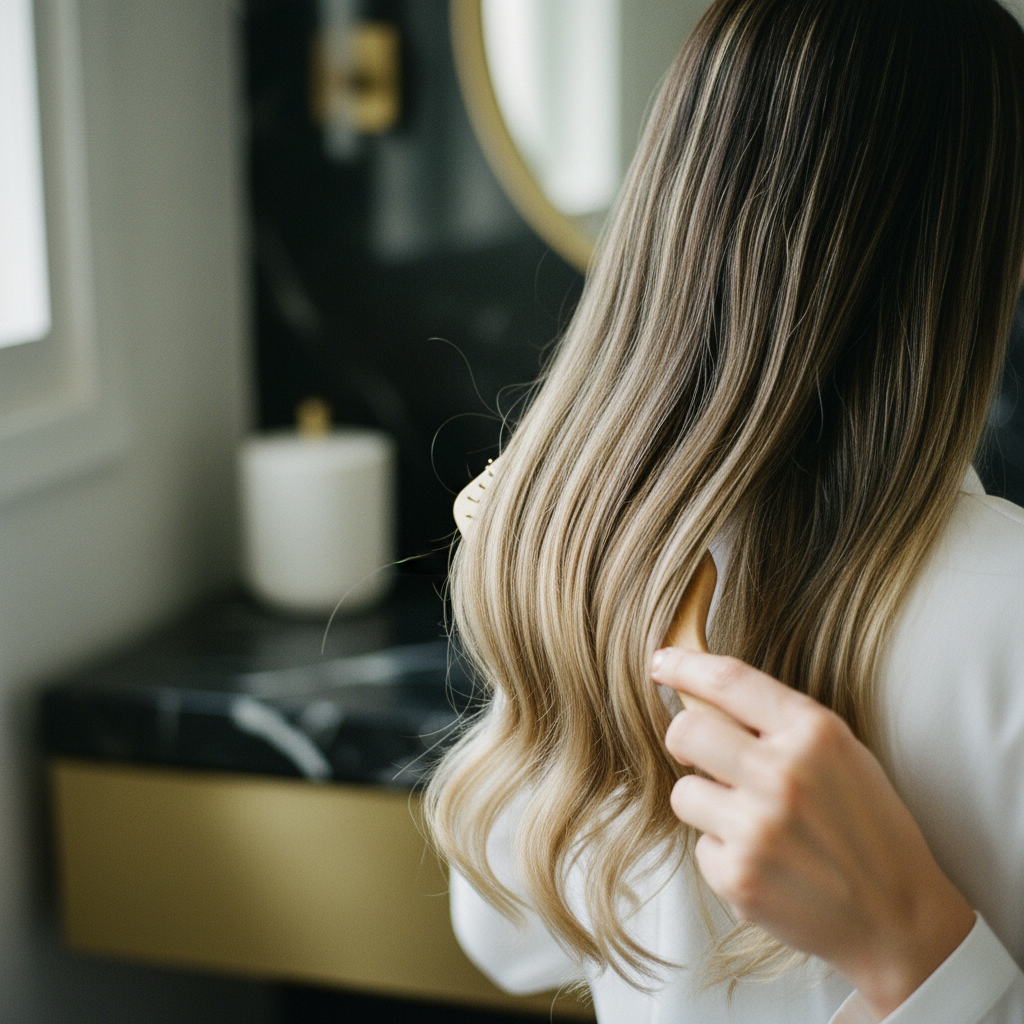
When exploring how to stop hair snapping when brushing, peer-reviewed cosmetic science consistently points toward friction reduction. A pristine hair fibre is enveloped by a protective lipid mono-layer of 18-methyl eicosanoic acid (18-MEA). This fatty acid layer repels moisture and lubricates the fibre surface, letting brush bristles glide with minimal drag.
Cosmetic processing such as bleaching, permanent waving, high-heat straightening, and oxidative colouring strips this 18-MEA lipid layer. Without it, the exposed cuticle scales flare outwards. When brush bristles catch on flared cuticles, the local friction force can easily exceed 1 to 2 Newtons. That force exceeds the shear tolerance of a compromised cortex, causing the fibre to snap cleanly or fray into longitudinal fissures (trichoptilosis).
What the evidence does not show
Controlled research does not support several persistent grooming myths:
- The 100-strokes-a-day rule: Victorian advice claimed vigorous brushing distributed scalp oils. Modern tribology (the study of friction and wear) demonstrates that repeated brushing cycles exponentially increase cuticle chipping and fibre fracture.
- Brushing stimulates follicular growth: Mechanical brushing does not treat hair loss or alter the biological hair cycle. Brushing only manipulates dead, keratinised fibres outside the scalp skin.
- Conditioners permanently rebuild broken bonds: While conditioning agents provide temporary slip, lubricity, and improved tensile flexibility, they cannot physically weld a snapped fibre back together.
The mechanical mechanism: wet vs dry hair
Understanding fibre physics helps resolve the long-standing debate over whether to brush wet or dry.
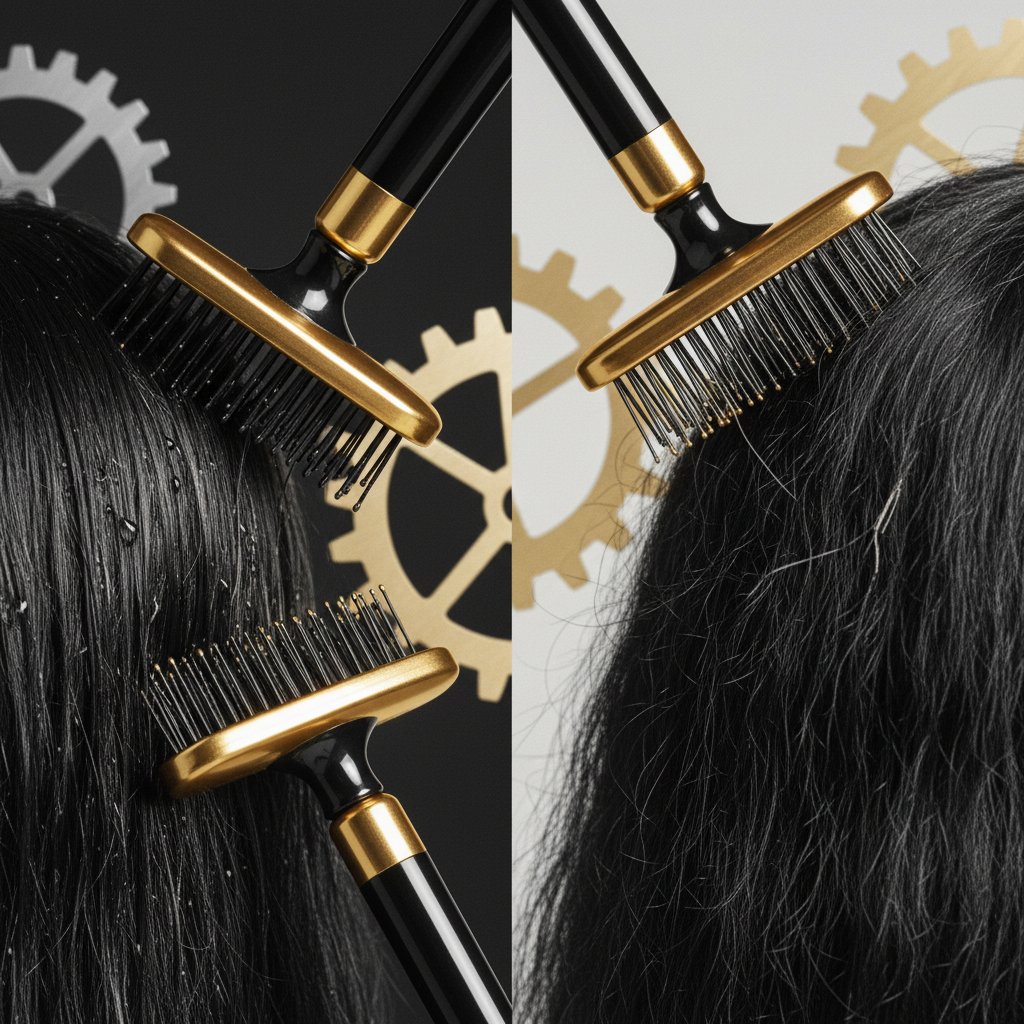
Healthy Dry Fibre:
[High Young's modulus] -> [Resists stretching] -> [Friction causes snapping if tangled]

Water Saturation:
[Water breaks hydrogen bonds] -> [Weakens cortex] -> [Stretches easily, snaps at lower absolute load]
When hair absorbs water, water molecules disrupt temporary hydrogen bonds within the keratin matrix. Dry hair has a high Young's modulus (stiffness) and requires significant force to stretch. Wet hair, conversely, stretches easily under modest force.
If wet hair is pulled forcefully with a rigid brush, it stretches beyond its elastic limit (roughly 30 percent elongation) into the plastic deformation phase. Once stretched past this threshold, the keratin matrix cannot return to its original shape. The fibre forms weak nodes and fractures.
Dry hair, on the other hand, does not stretch as readily, but it exhibits higher surface friction. When you pull a brush through dry, knotted hair, the knot tightens like a slipknot, creating concentrated shear stress that snaps the shaft instantly.
| Hair State | Cortical Behaviour | Major Risk Factor | Safest Detangling Strategy |
|---|---|---|---|
| Wet (No Slip) | Hydrogen bonds broken; low elastic limit | Extreme stretching leading to plastic failure | Avoid completely. Never drag a brush through unconditioned wet hair. |
| Wet (Conditioned) | Hydrogen bonds broken; cuticle surface lubricated | Over-stretching under tension | Use a wide-tooth comb or flexible-bristle brush, working gently from tips upward. |
| Damp (Towel-Dried) | Intermediate stiffness; cuticles flattening | Drag from uneven moisture evaporation | Apply leave-in detangler; use fingers first, then wide-toothed tools. |
| Dry (Damaged) | High stiffness; flared, stripped cuticles | High friction; mechanical knot jamming | Lightly mist with conditioning spray or serum to reduce bristle drag before brushing. |
Signs that hair is snapping rather than shedding
Stylists and dermatologists frequently encounter clients who confuse breakage with shedding. Distinguishing the two is essential:
- Fibre length: Snapped hairs are noticeably shorter than your natural length, featuring blunt, uneven, or frayed ends. Shed hairs represent the full length of your strand.
- The white bulb: A naturally shed hair that has completed its telogen phase carries a small, keratinised white bulb at the root end. Snapped hairs have no root bulb.
- Sink and clothing debris: If you notice hundreds of tiny, brittle 1 to 3 centimetre fragments scattered over your shoulders or bathroom sink after styling, your issue is mechanical snapping, not telogen effluvium or alopecia.
What you can do: actionable detangling techniques
To halt mechanical fibre snapping, adjust your daily handling routine around five evidence-based habits:
1. Detangle from bottom to top
Never insert a brush at your crown and pull downward toward your shoulders. This action gathers minor tangles into a compacted, impenetrable knot halfway down the shaft. Instead, isolate the bottom 2 to 3 inches of hair. Smooth that section completely before moving 2 inches higher. Work upward in small, deliberate increments.
2. Introduce cosmetic slip
Reduce cuticle-to-cuticle and cuticle-to-tool friction by coating hair in conditioning emulsions prior to combing. Products formulated with silicones, quaternary ammonium compounds (polyquaterniums), fatty alcohols, or light plant lipids dramatically reduce the work required to pass a comb through hair (measured as combing force in grams).
3. Choose the right tool design
Replace stiff nylon bristles and fine plastic combs with flexible-bristle detangling brushes or wide-tooth combs crafted from seamless, polished materials. Molded plastic combs with rough mould seams act like microscopic saws, abrading the cuticle scales with every pass.
4. Separate hair into manageable sections
Attempting to detangle high-density or coiled hair as a single mass multiplies mechanical resistance. Divide hair into four to six clips or twists. Work through each section individually to keep tensile forces controlled and uniform.
5. Never drag through knots
When your tool meets resistance, stop pulling immediately. Forcing a brush through resistance creates a peak tensile spike that snaps the fibre. Gently withdraw the brush, isolate the knot with your fingers, loosen the intertwined strands manually, and then resume light brushing.
When the cause may be something else
If you follow gentle brushing protocols but your hair continues to snap under negligible tension, the underlying issue may involve structural fibre weakness:
- Over-processing: Repeated chemical bleaching, oxidative dyes, relaxers, or perm solutions disrupt structural disulfide bonds within the cortex. Hair with depleted disulfide cross-linking cannot endure normal physical handling.
- Excessive thermal degradation: Regular styling at temperatures exceeding 180 to 200 degrees Celsius oxidises keratin proteins and vaporises structural moisture. This produces bubble hair (formation of microscopic air cavities inside the fibre), making the strand brittle enough to shatter on touch.
- Nutritional and metabolic factors: Severe protein deficiency, zinc depletion, iron deficiency, or thyroid irregularities can impair keratin synthesis within the follicle matrix, yielding structurally defective hair fibres prone to snapping.
- Genetic hair shaft disorders: Rare conditions like trichorrhexis nodosa or monilethrix cause structural nodes or beaded defects along the hair shaft that fracture spontaneously.
When to seek professional advice
Consult a qualified trichologist or dermatologist if:
- Hair breakage is accompanied by patchy scalp thinning, redness, flaking, or pain.
- Short fragments continue to break across the scalp despite halting all chemical and heat treatments.
- You observe widespread hair thinning combined with changes in nail texture, unexplained fatigue, or sudden weight shifts.
- Hair breaks close to the scalp surface across wide areas without significant chemical history.
Supporting fibre resilience with Watermans
While adjusting your mechanical brushing technique resolves immediate friction spikes, supporting long-term fibre integrity requires consistent conditioning care.
Watermans conditioners and leave-in formulations are specifically engineered to provide targeted cosmetic slip and enhance strand flexibility. By depositing lightweight conditioning agents that help seal cuticle irregularities, these formulations reduce combing resistance and cushion fibres against tensile stress. Used consistently alongside gentle detangling habits, Watermans products help preserve your lengths, reducing the friction that leads to mechanical snapping during daily brushing.
Frequently asked questions about How to Stop Hair Snapping When Brushing
Why does my hair snap more when it is wet?
Wet hair absorbs ambient moisture, which breaks the internal hydrogen bonds that give the cortex its stiffness. While wet fibres stretch easily, their threshold for irreversible deformation drops. Forcing a comb through wet, unconditioned strands stretches them beyond their elastic limit, resulting in snapping.
What brush material is best for preventing hair breakage?
Brushes featuring ultra-flexible synthetic bristles or wide-tooth combs moulded without rough seams are best. Flexible bristles bend when encountering resistance rather than forcing through a knot, preventing the sudden tensile spikes that cause hair breakage.
Can split ends cause hair to snap further up the shaft?
Yes. When a split end (trichoptilosis) is ignored, mechanical friction from brushing causes the vertical tear to travel upward along the cortex. This weakens the entire strand, causing the fibre to snap higher up the shaft under minimal brushing pressure.
How to stop hair snapping when brushing fine or chemically lightened hair?
To protect fine or bleached hair, apply a leave-in detangler containing conditioning lipids before brushing to reduce surface friction. Detangle only in small, divided sections from ends to roots, using a flexible-bristle brush, and avoid brushing dry hair without light lubrication.
Summary
Finding the right approach for how to stop hair snapping when brushing comes down to understanding fibre tribology: minimise surface friction, avoid extreme tensile force, and abandon aggressive downward strokes. By lubricating hair fibres, detangling in patient upward sections, using flexible seamless tools, and pairing gentle handling with conditioning routines, you can safeguard your hair shaft and keep your lengths intact.
Sources and references
- British Association of Dermatologists. Hair Breakage and Shaft Disorders, 2021.
- Robbins, C. R. Chemical and Physical Behavior of Human Hair. 5th ed., Springer-Verlag, 2012.
- Evans, T., and Wickett, R. R. Practical Modern Hair Science. Allured Business Media, 2012.
- Journal of Cosmetic Science. "A study of the mechanical properties of human hair fibres under combing stresses", 2017.
- International Journal of Trichology. "Hair shaft damage from cosmetic and mechanical practices", 2015.
Find these ingredients in Watermans products
- Zinc: you will find this ingredient in our Hair Vitamins.