How to Detangle Hair Without Breakage: Science and Technique
9 min read ·
Learn how to detangle hair without breakage using friction-reducing techniques, proper tools, and evidence-based methods tailored to your curl pattern.
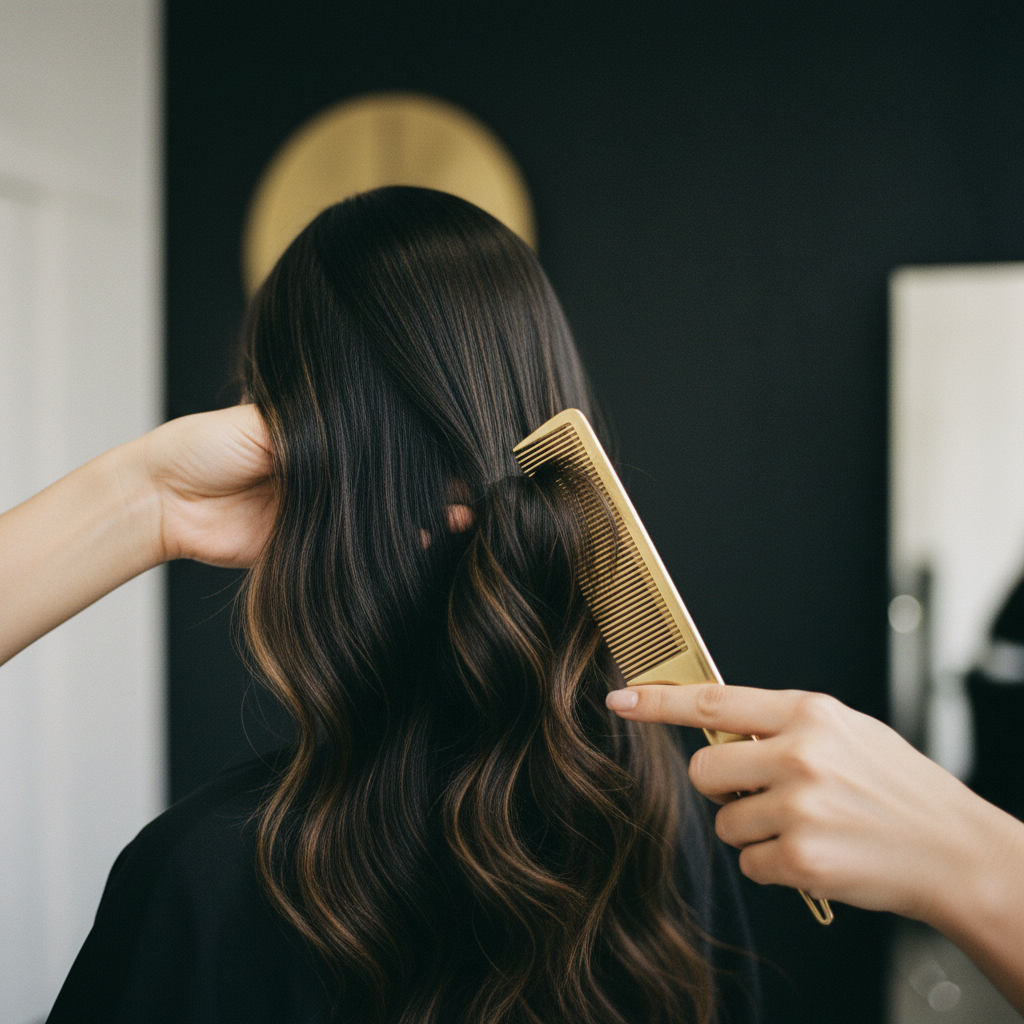
Quick answer: Learning how to detangle hair without breakage requires reducing friction, increasing fibre slip, and working systematically from ends to roots. Wet straight hair is structurally vulnerable due to weakened hydrogen bonds, whereas curly and textured hair detangles best when fully saturated with conditioner. By using wide-tooth tools or flexible bristles on lubricated sections, you prevent excess tensile stress. However, detangling cannot repair split ends that have already formed; existing structural damage must ultimately be trimmed away to stop ongoing knotting.
Key takeaways
- Hair stretches and breaks much more easily when wet because temporary hydrogen bonds are disrupted by water molecules.
- Different hair textures demand different protocols: straight to wavy fibres are often safest detangled dry or damp with light oil, while curly and coiling hair types need heavy wet conditioning slip.
- Never rake a comb downward from the scalp; working upward from ends to roots in small sections dramatically lowers mechanical shear stress.
- Conditioning agents lubricate the cuticle layer, reducing the combing force required by up to 50 percent or more.
- Severe knotting and recurring tangles usually signal lifted or missing cuticle scales, which require both friction management and occasional trimming.
How to Detangle Hair Without Breakage: what the evidence shows
Understanding how to detangle hair without breakage starts with the physics of the hair shaft. Hair fibres are covered by an external layer of overlapping cuticle scales, typically 5 to 10 layers thick. When these scales lie flat, individual hairs slide past one another with minimal friction. When hair sustains physical abrasion, chemical processing, or heat damage, the cuticle edges lift, curl, or chip away. Exposed, jagged cuticles catch on neighbouring hairs like microscopic Velcro, creating knots.
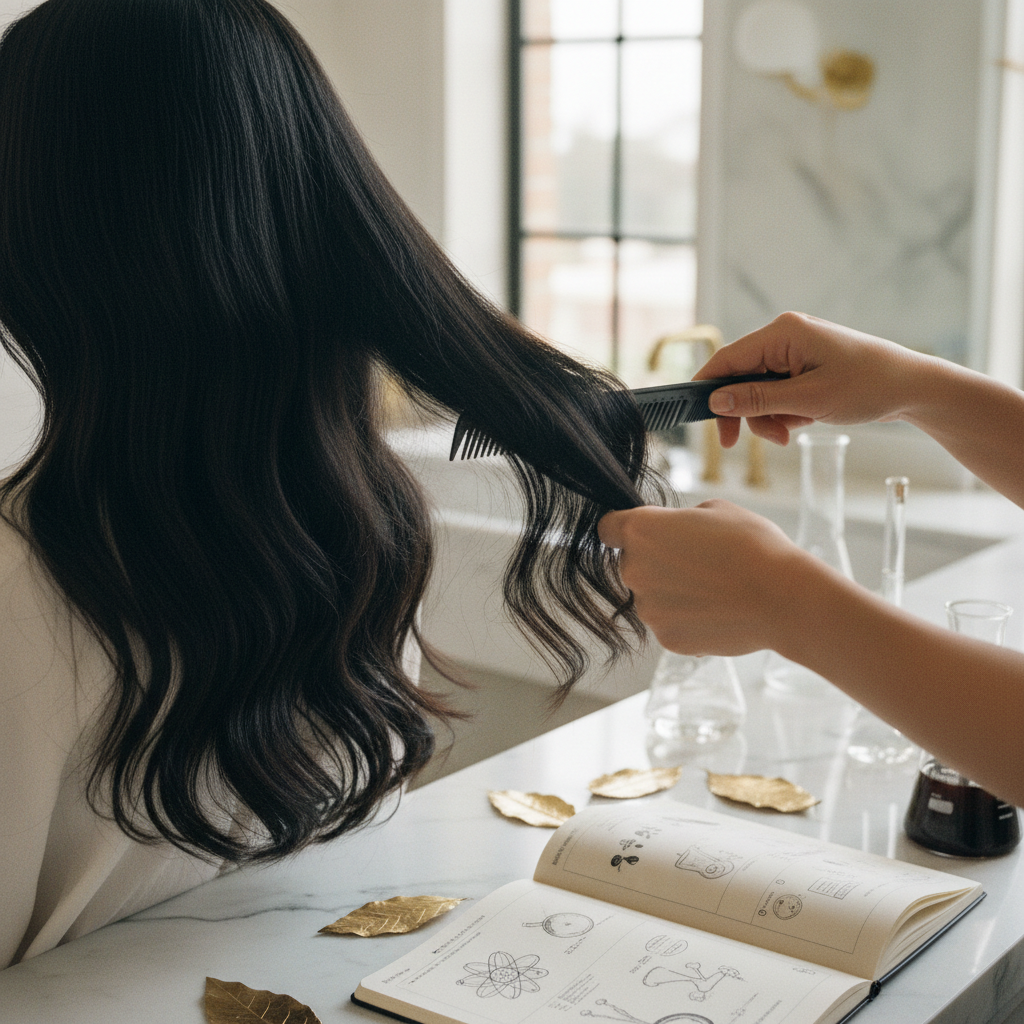
Cosmetic science research consistently demonstrates that mechanical grooming is a leading cause of fibre breakage. Studies measuring combing forces show that tugging directly on an established knot concentrates the entire pulling load onto a tiny fraction of the hair shaft. If this force exceeds the hair's tensile threshold (roughly 50 to 100 grams of force per healthy fibre, and far less for bleached or heat-damaged hair), the cortex snaps. To prevent this, force must be distributed evenly across lubricated strands rather than focused on locked tangles.
Hair structure and the wet versus dry debate
Whether you should detangle wet or dry depends on your hair's internal geometry and curl pattern. Water profoundly alters the mechanical behaviour of human hair. When hair is submerged, water penetrates the porous cortex and breaks the secondary hydrogen bonds that give the fibre its dry stiffness.
A saturated hair fibre can stretch by roughly 30 percent of its dry length before breaking, but its yield point drops significantly. This means wet hair deforms under very low tension. For straight to wavy hair (Types 1 and 2), detangling while soaking wet can easily cause plastic deformation, where the fibre stretches beyond its elastic limit and permanently thins or snaps.
For curly, coily, and afro-textured hair (Types 3 and 4), the equation flips. The natural curvature and elliptical cross-section of curly hair mean adjacent strands readily interlock when dry. Combing dry textured hair causes catastrophic friction and fractures the brittle bends along the fibre. For these types, the presence of water combined with a viscous, slip-enhancing conditioner cushions the strands and allows curls to separate smoothly.
| Hair Texture Group | Optimal Detangling State | Preferred Lubricant | Ideal Detangling Tool |
|---|---|---|---|
| Straight (Type 1) | Dry to damp | Lightweight dry oil or leave-in spray | Wide-tooth seamless comb or paddle brush |
| Wavy (Type 2) | Damp (towel-blotted) | Light leave-in conditioner or serum | Flexible-bristle detangling brush |
| Curly (Type 3) | Soaking wet | Rich rinse-out conditioner with high slip | Wide-tooth comb or flexible flex-head brush |
| Coily / Afro (Type 4) | Soaking wet in sections | Deep conditioner, butter-cream, or rich oil | Fingers first, followed by wide-tooth rake comb |
Step-by-step method to detangle safely
Applying the correct physical technique prevents the accumulation of excessive tensile force. Here is the scientifically sound approach to remove knots without snapping fibres.
1. Section the hair thoroughly
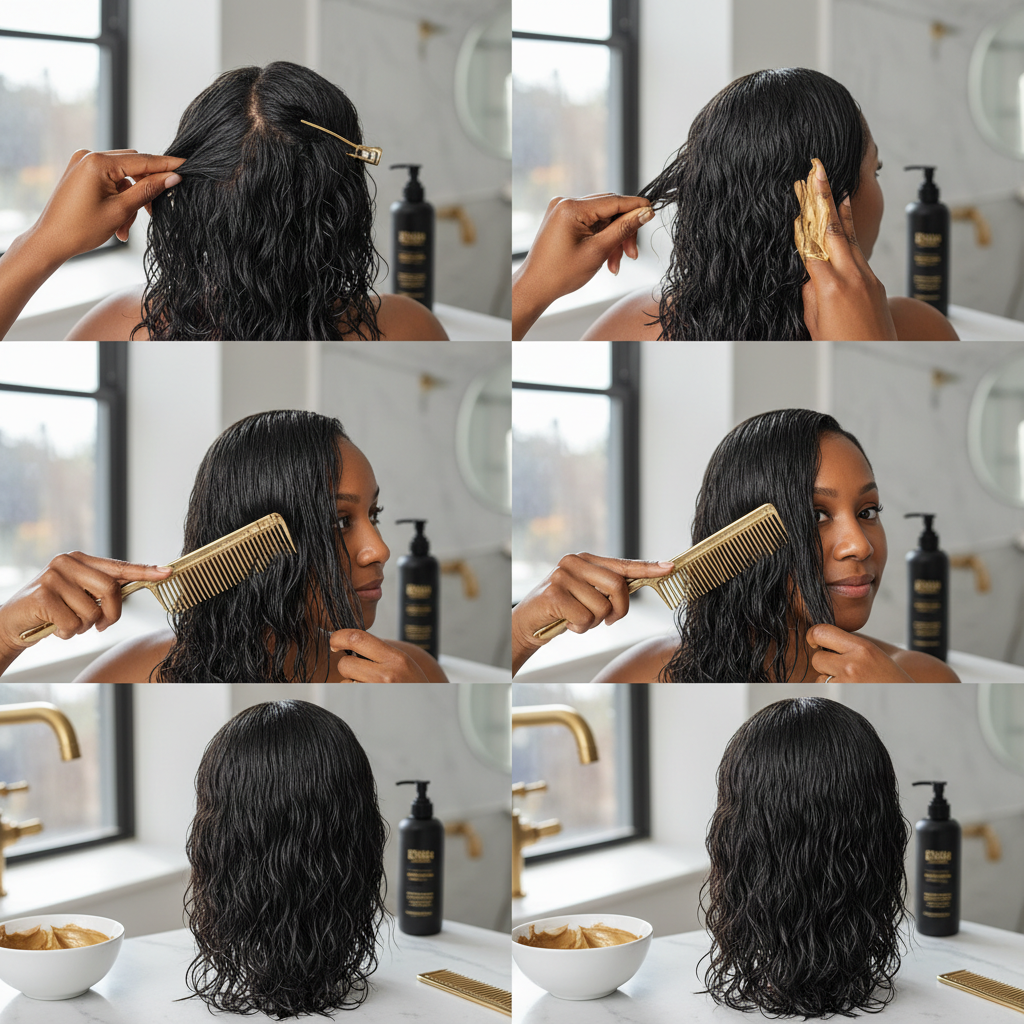
Divide your hair into at least four manageable quadrants using non-snag clips. Working with large masses of hair forces you to pull blindly through interior tangles. Smaller sections keep the tension visible and controllable.
2. Apply adequate slip
Never detangle raw, unconditioned hair. If detangling wet, saturate the section with water and apply a generous coating of conditioner formulated with fatty alcohols (such as cetyl or stearyl alcohol) and cationic surfactants (such as behentrimonium chloride). These ingredients neutralise static electrical charges and form a lubricating film over the cuticles. If detangling dry, apply a few drops of plant or mineral oil to reduce inter-fibre friction.
3. Finger-detangle first
Before introducing any tool, use your fingers to gently separate major clumps and locate dense knots. You can feel microscopic tension through your fingertips in ways a comb cannot communicate, allowing you to loosen locked loops without pulling them tight.
4. Work strictly from ends to roots
Place your comb or brush 2 to 3 inches from the very ends of the section. Gently clear that bottom zone first. Once the ends are completely free, move the tool an inch higher and stroke downward through the previously cleared area. Gradually work your way up to the scalp. If you comb straight down from the root, you push small, loose tangles downward, compressing them into an impenetrable mat near the ends.
5. Hold the hair above the tool
When working through a stubborn tangle, grip the hair firmly with your free hand between the knot and your scalp. This simple mechanical anchor absorbs the pulling force, preventing tension from pulling directly on the follicle and root sheath.
What the evidence does not show
Popular hair forums often promote the idea that specific detangling lotions or magical brush bristles can "melt away" knots without any physical separation. No cosmetic product can dissolve a knot; chemical bonds are not holding the hair together, physical friction is. Products merely reduce surface roughness to make mechanical separation easier.
Additionally, evidence does not support the claim that detangling stimulates faster hair growth from the scalp. While gentle detangling protects length retention by stopping breakage along the shaft, it has no biological effect on the follicular growth cycle or the speed at which hair emerges from the scalp.
The role of tools: combs, brushes, and seams
The physical construction of your detangling tool matters as much as your technique. Cheap, injection-moulded plastic combs often have sharp, raised seams running along the inner edges of each tooth. As hair slides through these microscopic plastic ridges, the seam slices directly into the cuticle layer, abrading the shaft and causing split ends.
Choose saw-cut, hand-polished combs made from vulcanite or acetate, or choose specialised detangling brushes with flexible, widely spaced synthetic bristles. Bristles that bend under resistance act as an automatic clutch system: instead of tearing through a knot when tension spikes, the bristles flex and slip out of the hair, alerting you to loosen the tangle manually.
When tangles signal an underlying issue
Excessive, chronic tangling is rarely just bad luck; it is usually a symptom of surface deterioration. If you notice your hair mats instantly after washing or brushing, look for these common underlying causes:
- Cuticle erosion from heat or chemicals: Bleaching, permanent colouring, and thermal styling strip the protective lipid layer (18-MEA) from the hair surface, leaving it hydrophilic and rough.
- Split ends (trichoptilosis): When an individual hair fibre splits into two or more strands, those frayed ends wrap around neighbouring healthy hairs like twine.
- Mineral deposits: Hard water leaves calcium and magnesium carbonates bound to the hair shaft, creating a stiff, gritty texture that magnifies inter-fibre friction.
- Trichorrhexis nodosa: A condition where weak points develop along the hair shaft, forming tiny nodes that readily snag adjacent fibres and snap under minor tension.
If you maintain gentle technique and your hair still tangles compulsively, visit a qualified trichologist or trusted hair stylist. A professional trim to eliminate frayed ends is often the only permanent resolution for chronic knotting.
Supporting hair condition with Watermans
Maintaining high tensile strength and smooth cuticle alignment minimises daily tangling. Watermans focuses on evidence-based scalp and hair support designed to keep the hair fibre resilient against daily mechanical stress. Formulations incorporating rosemary, hydrolysed proteins, and targeted botanicals help keep the hair shaft nourished and soft, lowering the surface resistance that triggers snagging. A well-conditioned scalp and strong hair fibre ensure you retain length and experience noticeably less comb-resistance over time.
Frequently asked questions about How to Detangle Hair Without Breakage
What is the single best rule for how to detangle hair without breakage?
The most critical rule for how to detangle hair without breakage is always working upward from the ends to the roots in small sections. Combing downward from the scalp forces small tangles into dense, compacted knots, dramatically multiplying mechanical tension and snapping fragile hair fibres.
Should I detangle wet or dry hair?
It depends on your curl pattern. Straight and wavy hair types are strongest when dry or lightly damp, as water weakens hydrogen bonds. Curly, coily, and afro-textured hair types should always be detangled soaking wet with a rich, slip-enhancing conditioner to stop dry friction fractures.
Why does my hair tangle again immediately after brushing?
Instant retangling usually points to lifted or eroded cuticles, often caused by heat tools, chemical lightening, or split ends. When the outer protective layer is damaged, cuticles interlock like Velcro. A trim and conditioning agents with cationic ingredients will help smooth the surface.
Can finger detangling replace a comb entirely?
Yes, many people with delicate, coily, or heavily damaged hair rely almost entirely on finger detangling. Fingers provide direct tactile feedback, allowing you to feel and unravel knots gently without applying the blunt, tearing force that combs and brushes can accidentally generate.
Does hard water make detangling more difficult?
Yes. Hard water contains dissolved minerals, particularly calcium and magnesium, that adhere to the hair shaft. These deposits leave a microscopic mineral film that creates friction, makes hair feel coarse, and prevents conditioning products from distributing evenly.
Sustainable detangling practices
Learning how to detangle hair without breakage is fundamentally an exercise in patience and mechanical awareness. Hair fibres cannot heal themselves once fractured; every snap of the cortex reduces the overall density and health of your ends. By choosing seamless tools, respecting your hair type's wet-versus-dry mechanics, and generous lubrication, you safeguard the structural integrity of your hair through every wash cycle.
Sources and references
- Robbins, C. R. (2012). Chemical and Physical Behavior of Human Hair. 5th ed. Springer-Verlag.
- Evans, T. A., & Wickett, R. R. (2012). Practical Modern Hair Science. Allured Business Media.
- Cruz, C. F., et al. (2016). "Human hair characteristics and methods to investigate hair properties." International Journal of Cosmetic Science, 38(5), 443-460.
- Swift, J. A. (1999). "The mechanics of fracture of human hair." International Journal of Cosmetic Science, 21(4), 227-239.
- Sinclair, R. D. (2007). "Healthy hair: what is it?" Journal of Investigative Dermatology Symposium Proceedings, 12(2), 2-5.
Find these ingredients in Watermans products
- Rosemary Extract: you will find this ingredient in our Hair Growth Shampoo.