How to Detangle Curly Hair: The Evidence-Based Guide
9 min read ·
Learn how to detangle curly hair safely without breakage. Expert guide covering hair physics, slip conditioners, bottom-up combing, and shedding versus snapping.
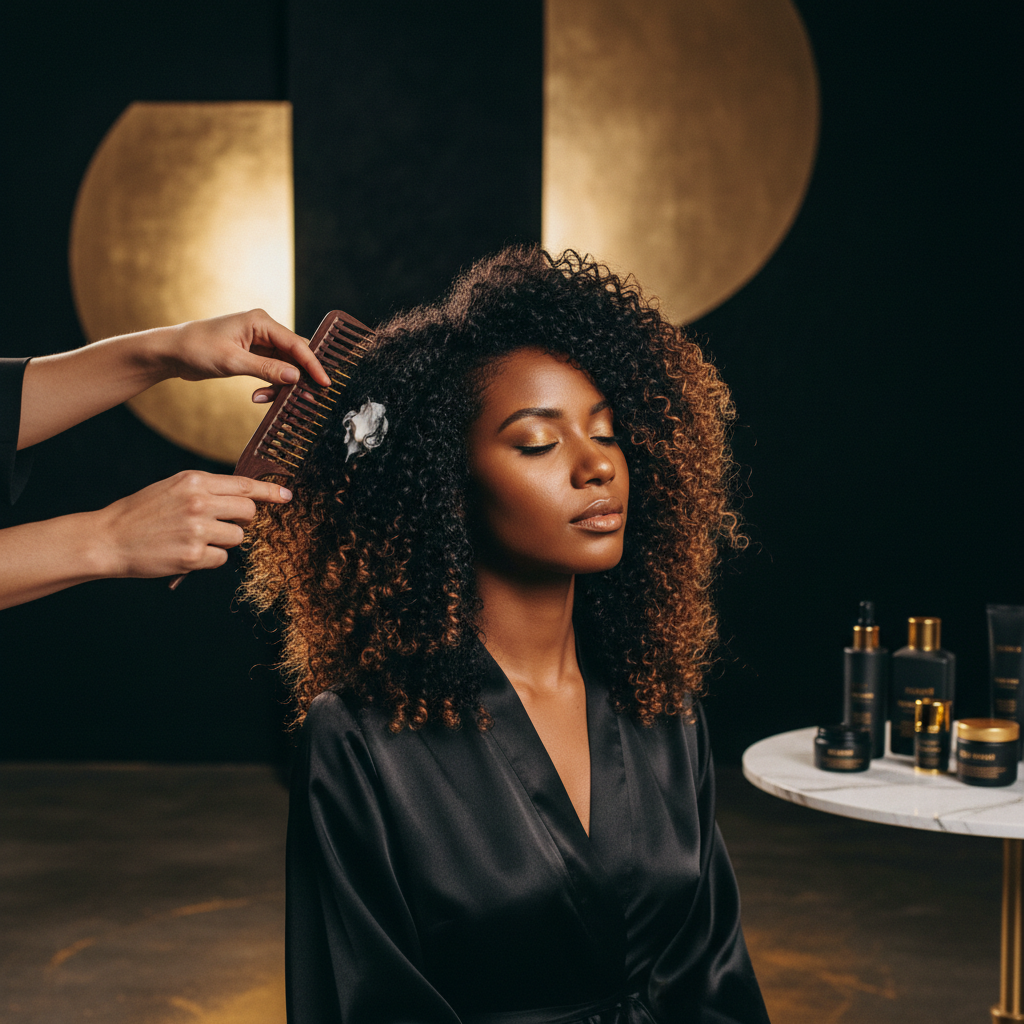
Quick answer: Knowing How to Detangle Curly Hair without causing mechanical breakage requires working on wet, conditioner-coated strands using a bottom-up technique. Curly hair fibres have an elliptical cross-section and raised cuticle edges that interlock easily, multiplying friction. Detangling dry curls creates severe tensile stress, snapping fibres along the shaft. The main limitation is that detangling cannot repair pre-existing split ends or structural cortex damage; it only prevents further breakage while releasing shed fibres trapped within the curl pattern.
Key takeaways
- Curly hair is naturally more fragile than straight hair due to structural torsion points along the asymmetrical hair shaft.
- Always detangle wet hair coated with a slippery conditioner or slip-inducing leave-in product; dry brushing causes acute cuticular fracture and fibre snapping.
- Work systematically in small sections, moving strictly from the ends up towards the roots using fingers or a wide-tooth comb.
- Shed hairs (roughly 50 to 100 strands lost daily as part of the normal telogen cycle) stay trapped in curl coils and must be gently eased out to avoid knot formation.
- Breakage is fibre fracture along the shaft, whereas hair loss occurs at the follicle level. Gentle detangling addresses breakage, not follicular shedding or alopecia.
How to Detangle Curly Hair: what the evidence shows
Understanding How to Detangle Curly Hair begins with hair physics. Curly hair fibres grow from curved, asymmetrical follicles, producing an elliptical or flattened cross-section. This shape causes natural twists along the length of each strand. At every twist, the hair exhibits structural torsion points where cuticular scales do not lie entirely flat. When adjacent curls rub together, these raised edges catch on one another, creating friction and intertwining into knots.
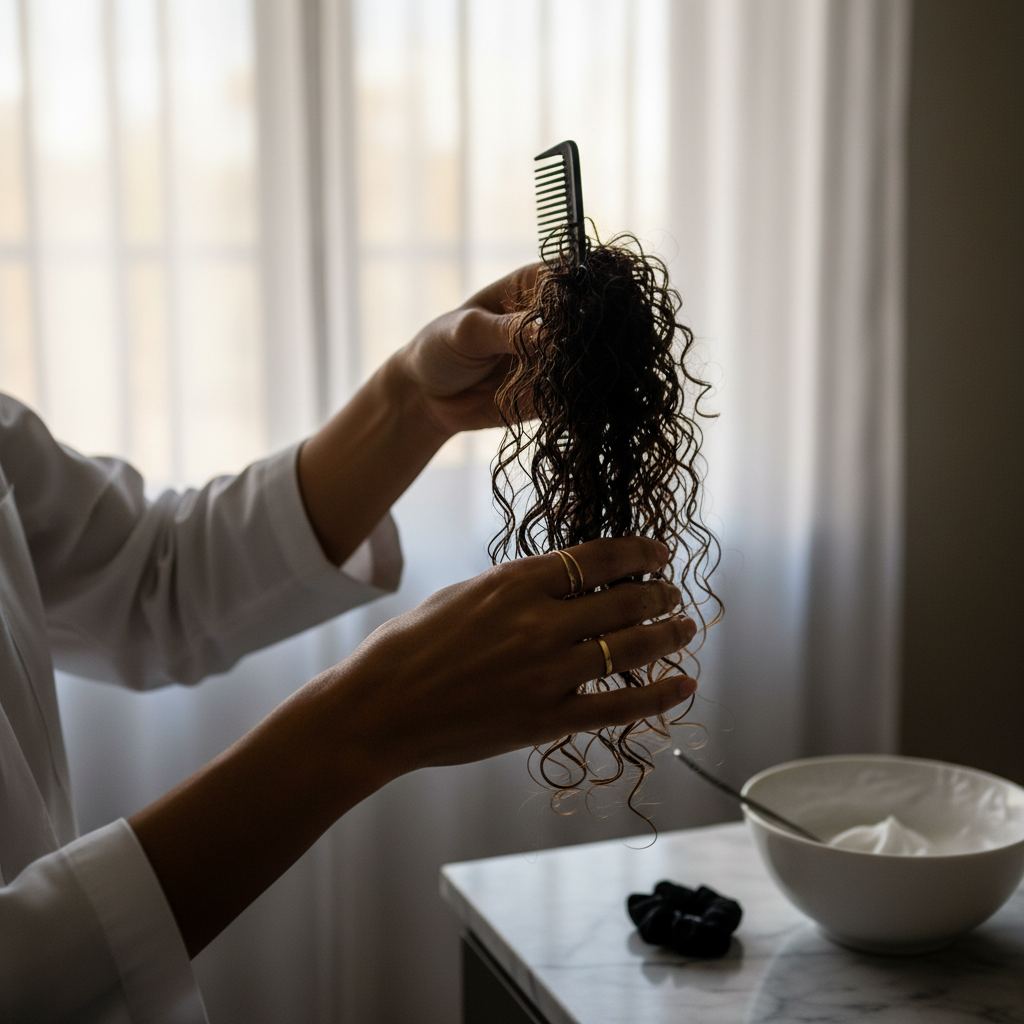
Cosmetic tribology (the study of friction and lubrication on biological fibres) demonstrates that dry hair has a significantly higher coefficient of friction than lubricated hair. When you pull a comb through dry curls, the force required to separate interlocking cuticles often exceeds the tensile strength of the hair fibre (typically around 1.5 to 2.0 Newtons for healthy hair, and much lower for porous or chemically treated hair). The result is catastrophic mechanical breakage, presenting as fractured mid-lengths, split ends, and stripped cuticle layers.
Controlled studies in cosmetic science confirm that water combined with cationic surfactants or film-forming polymers dramatically lowers detangling force. Water swells the hair shaft slightly and increases elasticity, while conditioners deposit positively charged molecules that neutralise negative surface charges, smoothing the cuticle and providing hydrodynamic slip.
The mechanics of knotting: why curly hair tangles
Curl tangles occur through three primary mechanisms:
- Cuticular interlocking: Because curly strands change direction constantly, cuticles face varying angles. When fibres slide against each other, the scale edges act like microscopic ratchets, moving freely in one direction but locking firmly in the reverse.
- Shed hair retention: The human scalp sheds between 50 and 100 club hairs every day. On straight hair, gravity allows these shed strands to fall away freely. In curly textures (Types 3 and 4), shed strands become coiled within active, growing hair. If left unmanaged, these dead fibres wrap around neighbouring strands, creating complex bird's-nest tangles and fairy knots (single-strand knots, or trichonodosis).
- Moisture depletion and porosity: Dehydrated hair or hair with high porosity has lifted cuticles that feel rough. This lack of natural lipid lubrication (sebum struggles to travel down the winding path of a curly hair shaft) amplifies inter-fibre friction.
Step-by-step: the correct method for detangling curls
To preserve tensile integrity and keep curl clumps intact, follow this systematic procedure.
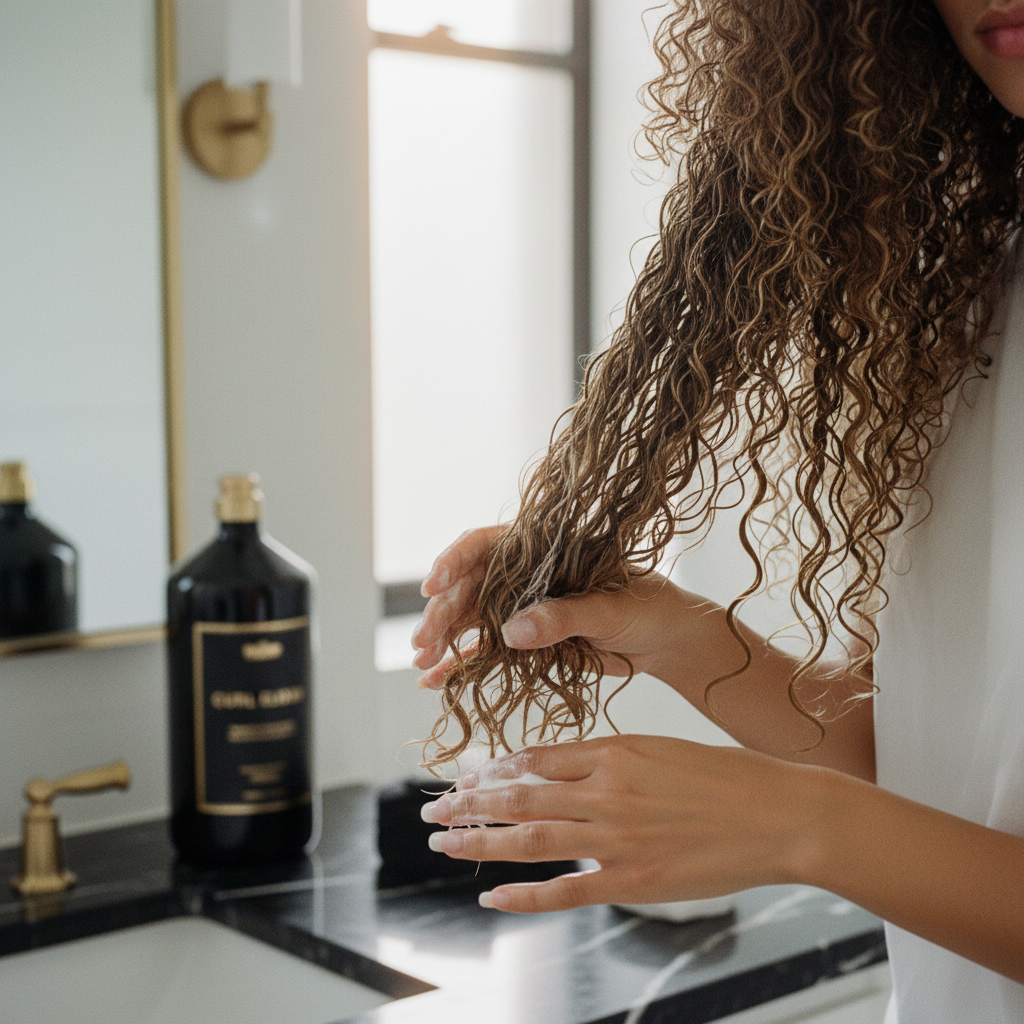
Step 1: Pre-dampen and apply slip
Never detangle bone-dry curls. Saturate your hair thoroughly with warm water in the shower. Apply a generous amount of a rich, slip-enhancing conditioner. Look for formulations containing behentrimonium chloride, cetrimonium chloride, or fatty alcohols like cetyl and stearyl alcohol. These ingredients coat the cuticle, dramatically reducing mechanical resistance.
Step 2: Section the hair
Working through an entire head of curls at once leads to snagging and missed knots. Divide your hair into at least four to eight manageable sections, depending on density and coil tightness. Secure each section with non-snagging clips.
Step 3: Finger-detangle first
Before introducing a mechanical tool, use your fingers to gently pull apart larger knots. Your fingers can sense tension and separate intertwined strands without tearing through them. If you hit a tight knot, gently pull the surrounding strands outward rather than ripping straight down through the knot.
Step 4: Use the bottom-up method
Take your tool of choice (a wide-tooth comb or a flexible-bristle detangling brush) and place it roughly two inches from the ends of the hair. Comb downwards to clear any tangles at the very tips. Move up another two inches and comb down through the cleared section. Repeat this incremental climbing process until you can smoothly pass the tool from your roots to your ends without catching.
Step 5: Rinse with cool-to-warm water
Rinse out the conditioner while maintaining the vertical alignment of the hair strands. Avoid swirling or piling hair on top of your head, as this immediately introduces fresh tangles.
| Detangling Method | Hair State | Mechanical Stress Level | Risk of Breakage | Best Suited For |
|---|---|---|---|---|
| Dry Brushing | Bone dry | Extremely High | Severe (cuticle peeling, snap fracture) | Straight hair types only; avoid for curls |
| Finger Detangling | Damp to wet with conditioner | Very Low | Minimal (tactile feedback prevents tearing) | Fragile coils, high-porosity curls, tight 3C to 4C textures |
| Wide-Tooth Comb | Soaking wet with conditioner | Low | Low to Moderate (if worked bottom-up) | Wavy to curly patterns (2C to 3B) |
| Flexible-Bristle Brush | Soaking wet with conditioner | Moderate | Low (flexing pins release excess tension) | High-density curls needing thorough shed-hair removal |
Signs of mechanical damage versus normal shedding
Many people confuse the ball of hair accumulated during detangling with sudden hair loss. It is critical to distinguish between normal follicular shedding and mechanical fibre breakage:
- Normal telogen shedding: A shed hair has completed its growth cycle and dropped from the follicle. Inspect the strand: if it is long (full length of your hair) and features a tiny, firm, white or clear bulb at one end, this is an intact shed hair. Seeing a substantial collection of these on wash day is normal, especially if you only detangle once or twice a week.
- Mechanical breakage: If the strands collecting in your comb are short, uneven fragments lacking a bulb, your hair is snapping. Other signs include frayed ends, white dots along the hair shaft (trichorrhexis nodosa), and sudden thinning at the mid-lengths and ends while the roots remain thick.
What cosmetic treatments cannot do
Detangling techniques cannot alter the genetic growth pattern of the follicle, nor can they magically mend a hair strand that has split down the centre. While conditioners and slip agents lubricate the cuticle, they do not permanently bond severed fibres. If single-strand knots (trichonodosis) form on the ends of your curls, the only true remedy is a professional micro-trim. Attempting to comb through a tight knot that has looped onto itself will simply pull and snap the healthy shaft above it.
When to seek professional advice
If you notice widespread thinning at the scalp, distinct circular bald patches, scaling, redness, or burning sensations, detangling friction is not your core issue. These are signs of follicular hair loss conditions such as telogen effluvium, androgenetic alopecia, or scalp dermatitis. Consult a GP, NHS dermatologist, or a qualified trichologist for a clinical diagnosis.
For managing curly textures, particularly if you experience chronic matted tangles or severe dryness, visiting a specialist curl stylist can help establish a safe maintenance routine and clear damaged ends.
Watermans: supporting scalp vitality and hair strength
While mastering mechanical detangling preserves the length you have, healthy hair begins at the scalp. Watermans focuses on evidence-based formulas designed to promote a healthier-looking, revitalised scalp environment.
Using gentle, sulphate-free cleansers like Watermans GrowMe Shampoo helps cleanse curly hair without aggressively stripping the natural sebum necessary for fibre lubrication. Paired with nutrient-rich conditioning agents, supporting your hair with caffeine, biotin, and rosemary extract ensures your strands feel stronger, look visibly fuller, and possess the resilience needed to withstand everyday handling and styling routines.
Frequently asked questions about How to Detangle Curly Hair
How often should you detangle curly hair?
Most people with curly hair should detangle once or twice a week, ideally on wash day while hair is coated in conditioner. Detangling daily is unnecessary and increases mechanical wear, while waiting more than two weeks allows shed hairs to form dense, matting tangles that are difficult to separate safely.
Is it better to detangle curls wet or dry?
For wavy and curly hair, wet detangling with a slippery conditioner is far safer. Dry hair has high friction, meaning teeth or bristles catch on cuticular scales and snap fibres. The only exception is coarse afro-textured coils that experience extreme elasticity when wet; in those cases, damp detangling with a rich plant oil or leave-in butter prevents over-stretching.
What is the best tool for detangling curly hair?
The best initial tool is your own fingers, as they provide tactile feedback when a knot is too tight to pull through. For mechanical tools, choose a seamless wide-tooth comb or a brush with flexible, widely spaced rubber or plastic bristles. Never use fine-tooth combs or brushes with rigid, hard ball-tipped pins, which can snag inside curl loops.
How to Detangle Curly Hair that is severely matted?
To address severe matting, do not use water alone, as water causes the hair shaft to swell and can lock knots tighter. Instead, saturate the matted area with a slippery oil or heavy silicone-based conditioner. Use your fingers to gently loosen the outer edges of the mat, teasing strands apart horizontally, strand by strand, before attempting to comb from the bottom up.
Master your curl routine
Learning How to Detangle Curly Hair correctly transforms wash day from a source of frustration into a restorative ritual that safeguards your hair's structural integrity. By treating curls with patience, working bottom-up on saturated strands, and relying on generous slip, you can release shed fibres effortlessly while keeping mechanical breakage to an absolute minimum.
Sources and references
- British Association of Dermatologists. Hair Breakage and Cosmetic Hair Care. bad.org.uk
- Robbins, C. R. Chemical and Physical Behavior of Human Hair. 5th Edition, Springer-Verlag, 2012.
- Evans, T. & Wickett, R. R. Practical Modern Hair Science. Allured Business Media, 2012.
- Wolfram, L. J. Human hair: A unique physicochemical composite. Journal of the American Academy of Dermatology, 2003. DOI: 10.1067/mjd.2003.276.
- Dawber, R. Hair: Its structure and response to cosmetic preparations. Clinics in Dermatology, 1996.
Find these ingredients in Watermans products
- Biotin: you will find this ingredient in our Hair Growth Shampoo.