How Conditioners Reduce Combing Friction: The Science of Smooth Detangling
8 min read ·
Learn how conditioners reduce combing friction through electrostatic neutralisation and boundary lubrication to protect against mechanical hair breakage.
Quick answer: Hair fibre physics explains how conditioners reduce combing friction through electrostatic neutralisation and boundary lubrication. Damaged, wet hair carries a strong negative electrical charge that lifts cuticle scales, creating mechanical resistance against styling tools. Conditioners deposit positively charged cationic surfactants, fatty alcohols, and silicones that bind to the negatively charged keratin surface. This interaction smooths raised cuticles, neutralises static, and creates a slippery protective film, though it cannot permanently repair underlying structural cortex damage.
Key takeaways
- Wet combing friction is primarily caused by capillary adhesion, water swelling, and exposed, negatively charged cuticle edges.
- Cationic surfactants bind electrostatically to damaged keratin sites, depositing a lubricating mono-layer that lowers the friction coefficient.
- Fatty alcohols and conditioning polymers provide hydrodynamic boundary lubrication, allowing comb teeth to glide without snagging.
- Reducing combing resistance prevents cuticle chipping, longitudinal splitting, and tensile mechanical breakage.
- Conditioning treatments provide temporary cosmetic surface modifications that wash away over time rather than permanent biological repairs.
How Conditioners Reduce Combing Friction: what the evidence shows
Understanding how conditioners reduce combing friction requires looking at the hair fibre under a scanning electron microscope. Healthy hair consists of an outer protective cuticle layer formed of overlapping, shingle-like scales pointing toward the tip. When you wash your hair, especially with water at neutral to alkaline pH levels, the hair fibre swells, and negative electrical charges (anionic sites) multiply along the shaft due to the ionisation of surface cysteic acid groups.
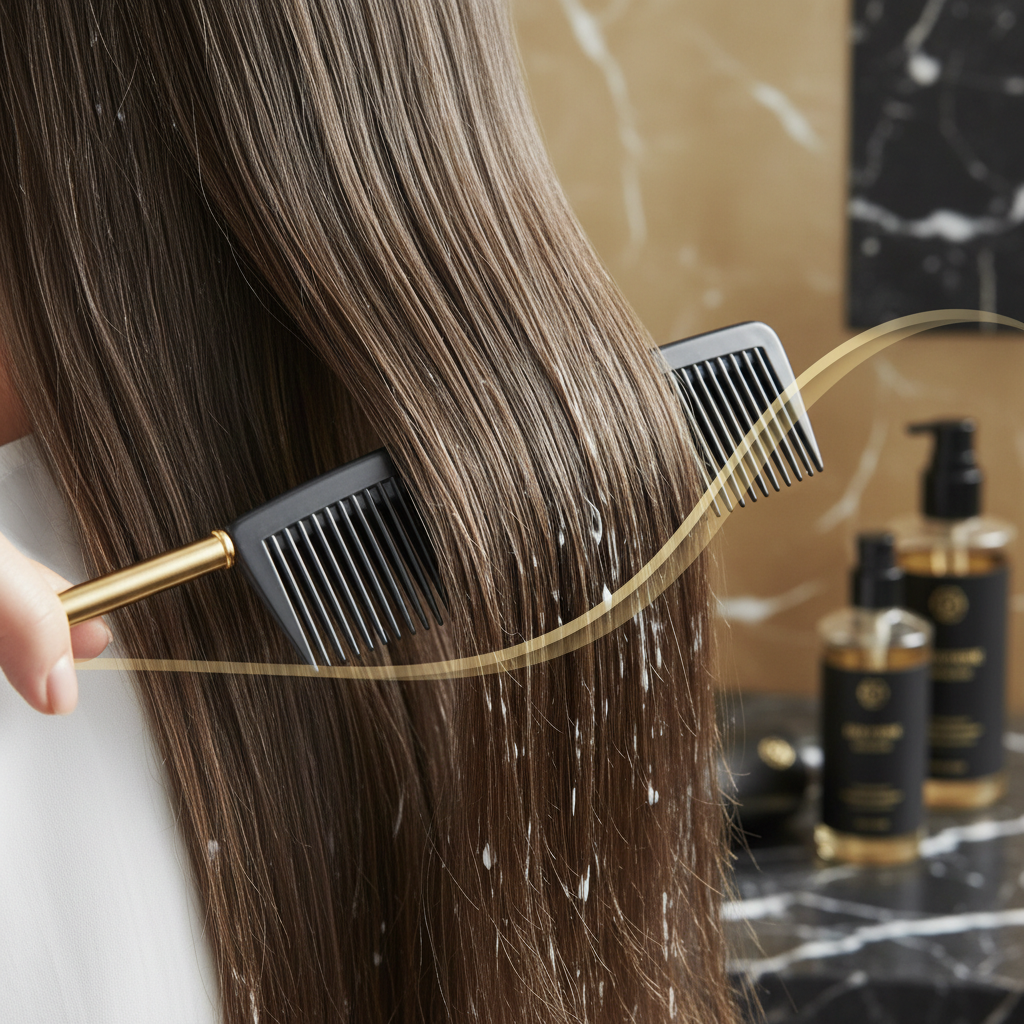
Research published in the Journal of Cosmetic Science and cosmetic physics literature demonstrates that wet hair exhibits dramatically higher combing forces than dry hair. The capillary action of water binds individual fibres together, while lifted cuticle edges catch against one another and against the teeth of a comb.
Conditioners counteract this mechanical resistance through two primary mechanisms:
- Electrostatic neutralisation: Conditioning agents contain cationic surfactants (such as cetrimonium chloride or behentrimonium chloride) featuring positively charged quaternary nitrogen heads. Because opposites attract, these molecules adhere firmly to the negatively charged, damaged sites on the hair surface. This charge neutralisation flattens cuticle scales and prevents fibres from repelling each other or clinging stubbornly to grooming tools.
- Boundary lubrication: Along with cationic agents, conditioners incorporate high-molecular-weight fatty alcohols (like cetyl and stearyl alcohol) and lipid-replacing emollients. These uncharged, hydrophobic materials form an ultra-thin boundary film across the cuticle. This micro-layer significantly reduces the hair's surface friction coefficient (often by 50% to over 80% in laboratory tensile testing), allowing grooming tools to slide past without dragging.
By reducing combing forces, conditioners directly prevent mechanical fatigue, which is the leading cause of mid-shaft snapping and split ends.
The tribology of hair: wet versus dry combing forces
Tribology is the science of friction, lubrication, and wear between interacting surfaces. In hair tribology, combing friction is divided into wet combing and dry combing, each responding differently to product application.
| Physical Property | Untreated Wet Hair | Conditioned Wet Hair | Untreated Dry Hair | Conditioned Dry Hair |
|---|---|---|---|---|
| Surface Charge | Strongly negative (-20 to -40 mV) | Neutralised to near zero | Mildly negative | Neutralised |
| Cuticle Position | Swollen and partially lifted | Flattened and sealed | Flat to ruffled | Tightly smoothed |
| Primary Friction Cause | Capillary adhesion and scale interlock | Low-shear boundary layer glide | Static flyaway and surface roughness | Smooth hydrophobic film |
| Peak Combing Force | High (often exceeding 1.5 to 2.5 N) | Low (typically under 0.5 N) | Moderate (0.8 to 1.2 N) | Very low (under 0.3 N) |
| Breakage Risk | High tensile stretching and snap | Minimal snagging or snapping | Tangling and static breakage | Minimal friction wear |
What the evidence does not show
While cosmetic formulations excel at surface lubrication, marketing claims often overstate what boundary layers can accomplish.
The evidence does not show that conditioners can permanently mend split ends or restore broken disulfide bonds within the cortex. Cationic surfactants and silicones adhere purely through ionic and hydrophobic attraction. They rinse away gradually, particularly when exposed to clarifying shampoos.
Furthermore, reducing combing friction does not resolve physiological hair shedding or hair loss conditions such as androgenetic alopecia or telogen effluvium. Lubricating the hair shaft reduces mechanical snapping (breakage), but it has no biological influence on the dermal papilla, the hair follicle, or the cellular hair growth cycle within the scalp.
The mechanical consequences of high combing friction
When hair lacks surface lubrication, normal grooming exerts extreme mechanical strain on individual fibres. Understanding how conditioners reduce combing friction highlights the risks of skipping post-wash treatments:
- Cuticle scale fracture: When comb teeth catch on rough, unlubricated cuticles, the mechanical force shears the protective scale edges clean off, exposing the delicate interior cortex.
- Longitudinal splitting: Forceful detangling concentrates stress along micro-cracks in the fibre, propagating fissures down the shaft that result in split ends.
- Tensile snapping: Wet hair can stretch by 30% to 50% before breaking, but its elastic recovery is fragile. High combing friction forces the fibre past its plastic deformation threshold, snapping the hair mid-shaft. Stylists and clients often mistake this fractured debris for hair loss, when it is strictly mechanical breakage.
- Static triboelectric charging: In dry hair, friction strips electrons from the surface, creating like charges that make fibres repel each other, generating frizz and unmanageable flyaways.
Optimal conditioning practices to minimise friction
To maximise the friction-reducing benefits of your conditioning routine, apply these evidence-based techniques:
- Remove excess water first: Waterlogged hair dilutes the active cationic agents. Gently squeeze excess water from the mid-lengths and ends before applying conditioner to ensure maximum adsorption to the cuticle.
- Focus on the oldest lengths: Cuticles near the scalp have minimal wear and natural sebum protection. Mid-lengths and ends feature accumulated weathering, greater negative charge, and the highest friction coefficient, making them the primary target for conditioning lipids.
- Use wide-toothed, seamless tools: Even well-conditioned hair can snag on cheap, injection-moulded plastic combs with jagged seam lines. Choose wide-toothed, seamless, or saw-cut combs to detangle wet hair gently.
- Work from ends upward: Start detangling at the bottom 5 cm of the hair, gradually moving up toward the roots. This prevents smaller knots from consolidating into severe, high-friction tangles.
- Incorporate acidic rinses if needed: Formulations buffered to a mildly acidic pH (around 3.5 to 5.0) contract the cuticle scales tightly against the shaft, boosting smoothness and amplifying lubricating performance.
Watermans approaches to fibre resilience and surface management
Minimising friction requires balancing external boundary lubrication with internal tensile strength. Watermans approaches hair wellness with formulas engineered to support the fibre surface alongside the scalp environment.
Watermans conditioners combine lightweight softening agents and botanical extracts designed to coat the cuticle, ease detangling, and defend vulnerable hair strands from grooming friction. By reducing mechanical resistance during daily styling, these formulas protect brittle lengths from unnecessary breakage, helping your hair retain its natural density and vibrant feel.
When combing resistance indicates other issues
If your hair remains difficult to comb despite using high-performing conditioning agents, the root cause may extend beyond basic surface friction:
- Severe chemical degradation: Bleaching, high-lift colouring, or chemical relaxers strip away the natural protective 18-methyleicosanoic acid (18-MEA) lipid layer entirely. Once this natural boundary is gone, standard conditioners struggle to create a durable slip, requiring intensive protein-bonding or lipid-replenishing treatments.
- Hard water mineral buildup: High concentrations of calcium and magnesium salts (often above 180 mg/L) react with surfactants to form an insoluble mineral film on the hair shaft. This crust roughens the surface, neutralises conditioning slip, and makes hair feel like straw.
- Extreme heat styling damage: Frequent flat ironing above 185°C denatures keratin proteins and welds cuticle scales together in irregular patterns, creating permanent rough patches that catch combs.
Frequently asked questions about How Conditioners Reduce Combing Friction
How do conditioners reduce combing friction on damaged hair?
Damaged hair has lost its protective 18-MEA lipid layer, exposing negatively charged cysteic acid sites. Conditioners contain positively charged cationic surfactants that adsorb directly to these negative patches. This electrostatic bond flattens lifted cuticle scales and coats the fibre in an emollient boundary film, lowering the friction coefficient and allowing grooming tools to pass through smoothly without snagging.
Does reducing combing friction stop hair loss?
No, reducing combing friction stops hair breakage, not hair loss. Hair loss occurs at the follicular level under the scalp, driven by genetics, hormones, or systemic health. Combing friction causes tensile snap along the hair shaft. While conditioner minimises fractured hair pieces in your brush, it has no impact on biological hair shedding from the follicle.
Why is wet hair harder to comb than dry hair without conditioner?
Wet hair experiences high capillary adhesion, as water droplets pull neighbouring strands together. Furthermore, water penetrates the cortex and swells the fibre, lifting the cuticle edges. When a comb passes through wet, unconditioned hair, these raised cuticles interlock and snag against each other, requiring up to two to three times more force to comb through than dry hair.
What ingredients are most effective for lowering combing friction?
Cationic surfactants like behentrimonium chloride and cetrimonium chloride provide the strongest electrostatic smoothing. Long-chain fatty alcohols (such as cetyl and stearyl alcohol) add boundary lubrication, while functional silicones (such as dimethicone and amodimethicone) offer exceptionally low shear resistance, producing an ultra-slippery surface for effortless detangling.
Can using too much conditioner increase combing friction?
Overusing heavy conditioning products does not typically increase friction, but it can cause product build-up. This accumulation attracts environmental debris and makes fine hair feel limp, greasy, and weighed down. For optimal detangling without heaviness, distribute a measured amount evenly through the mid-lengths and ends, then rinse thoroughly.
Maintaining smooth hair and low grooming friction
The mechanical science behind how conditioners reduce combing friction is straightforward: by neutralizing surface charges and laying down a low-shear lubricating film, conditioners transform a high-resistance, vulnerable fibre into a sleek, resilient surface. While these treatments cannot fundamentally alter the internal biological health of the follicle, using them consistently shields the hair cuticle from daily grooming damage, keeping hair looking lustrous, supple, and protected against everyday breakage.
Sources and references
- Journal of Cosmetic Science: "Measurement of the Combing Force of Hair and the Effect of Conditioning Agents"
- Society of Cosmetic Chemists (SCC): "Hair Tribology and the Physics of Conditioning"
- International Journal of Trichology: "Hair Cosmetics: An Overview" (2015)
- Robbins, C. R.: Chemical and Physical Behavior of Human Hair, Springer-Verlag (5th Edition, 2012)
- Journal of the Society of Cosmetic Chemists: "The Effect of Cationic Polymers on the Combing Properties of Hair"