Heat Damage and Keratin Protection: The Science of Thermal Hair Styling
9 min read ·
Understand how Heat Damage and Keratin Protection work together to safeguard hair fibres from high temperatures, protein breakdown, and irreversible structural breakage.
Quick answer: Understanding Heat Damage and Keratin Protection requires looking at the physical structure of the hair fibre under thermal stress. Temperatures above 150°C denature alpha-keratin into disordered beta-sheet proteins, melt cuticle lipids, and vaporise internal moisture, leading to irreversible mechanical weakness and breakage. Topical thermal protectants form a heat-distributing shield and slow dehydration, but they cannot make hair immune to heat. Protection formulas reduce thermal transfer rather than completely preventing biological protein degradation under excessive temperatures.
Key takeaways
- Hair consists of roughly 85% to 90% keratin protein, arranged in crystalline alpha-helices held together by disulphide and hydrogen bonds.
- Thermal styling tools above 150°C initiate protein denaturation, while temperatures over 200°C degrade tryptophan and convert disulphide cystine into cysteic acid.
- Using hot styling tools on damp hair causes flash boiling of internal water, creating irreversible structural cavities known as bubble hair.
- Thermal protectants act as sacrificial heat conductors and moisture barriers, reducing structural stress rather than eliminating thermal transfer entirely.
- Once keratin is denatured and the cuticle fractures, the damage cannot be reversed biologically; prevention and cosmetic film-formers are your main defence.
Heat Damage and Keratin Protection: what the evidence shows
Research into hair photochemistry and thermal biophysics shows that heat alters both the outer cuticle and the inner cortex. When you apply direct heat through flat irons, curling wands, or high-velocity blow dryers, the hair fibre undergoes rapid physical stress.
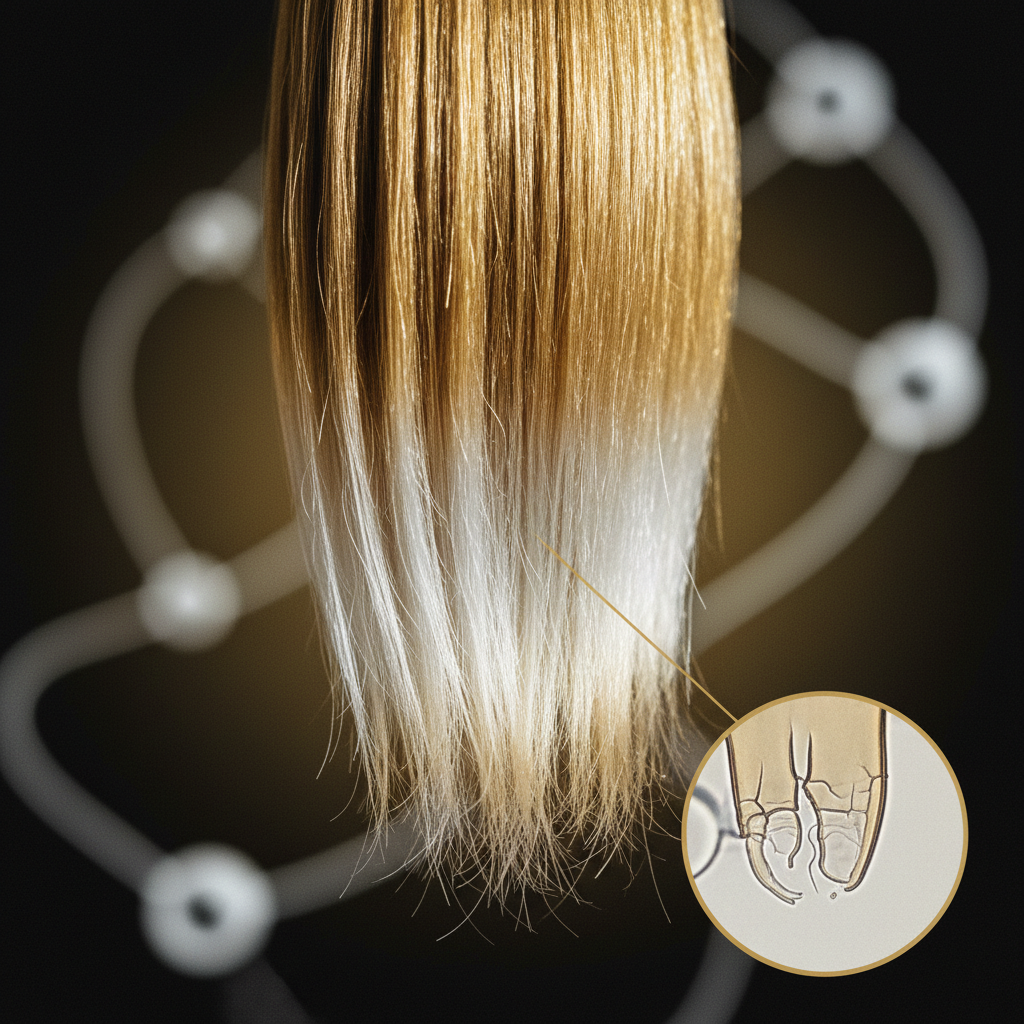
Keratin proteins naturally exist in an orderly alpha-helical conformation. Thermal analysis studies, specifically differential scanning calorimetry (DSC), demonstrate that dry hair protein undergoes a structural transition between 140°C and 160°C. Above this range, alpha-keratin unfolds into an amorphous beta-sheet structure. This denaturation breaks the hydrogen bonds that give hair its natural elasticity and causes the fibre to lose its tensile strength.
When temperatures reach 180°C to 230°C, chemical decomposition begins. At these temperatures, cysteine amino acids oxidise, cystine disulphide bonds break, and tryptophan degrades. This internal oxidation manifests as brittle strands, dry ends, and split tips.
Cosmetic chemists formulate thermal protectants using silicones (such as dimethicone and amodimethicone), polyquaternium polymers, and hydrolysed proteins. Studies measuring heat transfer show that these ingredients coat the cuticle, reduce surface friction, distribute heat more evenly along the shaft, and slow the rate of water loss. However, these formulations cannot prevent protein oxidation if you expose the hair fibre to extreme temperatures for prolonged contact periods.
The molecular mechanism: how heat breaks down keratin
To understand why thermal protection is necessary, you have to look at what happens inside the cortex during styling. The hair shaft is not living tissue; it cannot synthesise new proteins to repair structural loss.
1. Cuticle lipid breakdown (100°C to 140°C)
The outermost protective layer of the hair consists of overlapping cuticle scales bound by the 18-methyleicosanoic acid (18-MEA) lipid layer. Mild to moderate heat strips these essential surface lipids. Without 18-MEA, the hair becomes hydrophilic (water-absorbing), prone to frizz, and rough to the touch.
2. Alpha-to-beta keratin denaturation (140°C to 180°C)
As heat climbs past 140°C, the coiled coils of keratin uncoil. The hydrogen bonds holding the alpha-helical proteins together snap. If you stretch and iron hair at this stage, the proteins lock into a flat, deformed shape. DSC tests show that repeated heat styling lowers the denaturation temperature of the hair, meaning each thermal session makes the hair progressively more vulnerable to subsequent heat.
3. Disulphide bond cleavage and cysteic acid formation (above 190°C)
Cystine provides the rigid structural scaffolding of the cortex through strong disulphide bonds. High temperatures split these bonds, forming cysteic acid through oxidation. Once cystine levels drop, the hair fibre loses its structural memory, rendering it brittle and prone to snapping under routine brushing.
4. Bubble hair formation
Styling wet or damp hair with flat irons causes immediate water vaporisation. Water expands inside the cortex faster than it can escape through the porous cuticle, forming microscopic steam bubbles within the fibre. This condition, medically termed bubble hair, permanently weakens the shaft, causing hair to snap off at the site of the void.
| Temperature Range | Structural Effect on Fibre | Visible Symptoms | Recommended Safeguard |
|---|---|---|---|
| Below 130°C | Surface moisture loss; minimal protein change | Temporary dryness, mild dullness | Keep tool moving; use light leave-in |
| 130°C to 160°C | 18-MEA lipid loss; onset of alpha-keratin uncoiling | Frizz, rough texture, reduced shine | Apply silicone or polymer heat protectant |
| 160°C to 190°C | Advanced protein denaturation; hydrogen bond disruption | Loss of natural curl pattern, weakened elasticity | Use variable heat settings; limit tool passes |
| 190°C to 230°C | Disulphide bond cleavage; cysteic acid creation; keratin decomposition | Severe breakage, split ends, extreme porosity | Avoid altogether, especially on chemically treated hair |
Signs of thermal damage to watch for
Heat damage often accumulates gradually before culminating in visible fibre snapping. Watch for these distinct mechanical indicators:
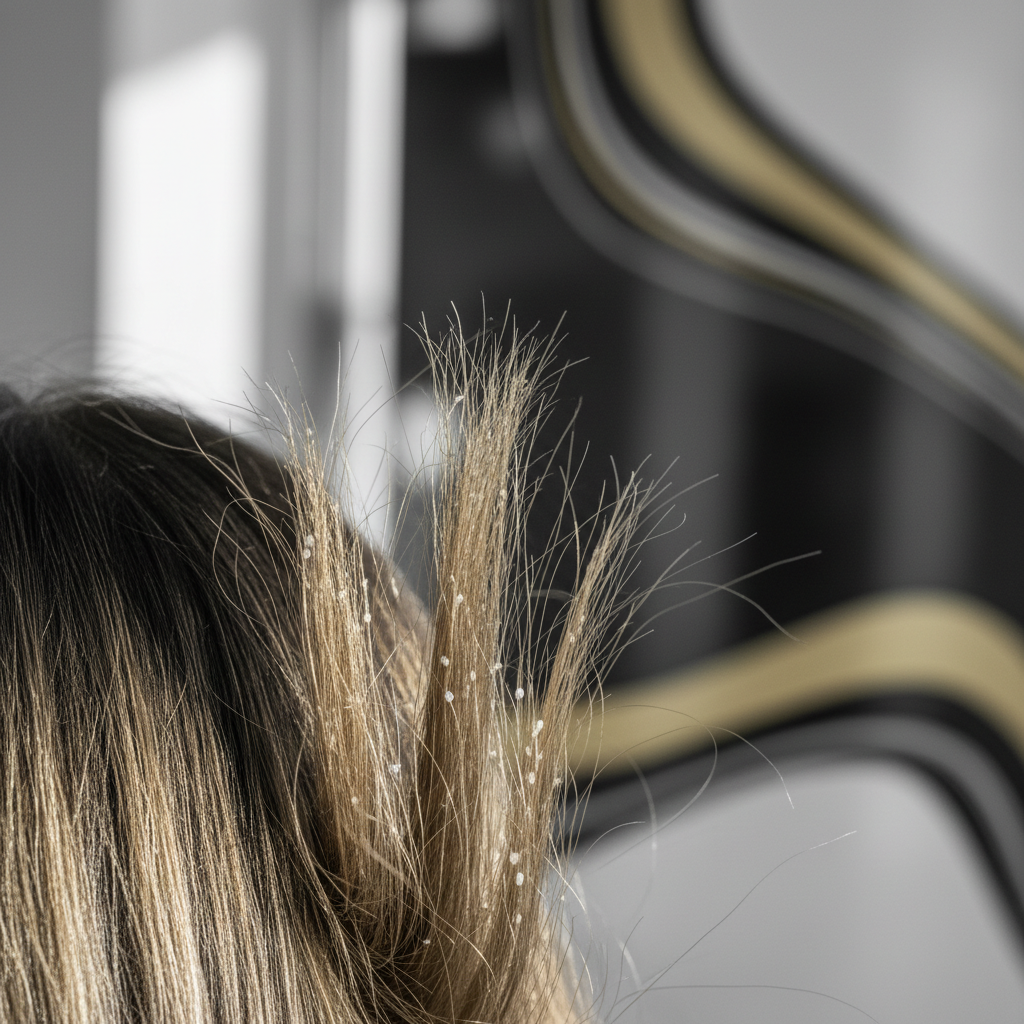
- Altered curl patterns: Natural waves or curls stretch out or turn limp, failing to spring back after washing.
- Excessive wet elasticity or gummy feel: When wet, severely heat-degraded hair stretches excessively without snapping back, or feels spongy due to cortical collapse.
- Dry snapping during detangling: Short pieces of hair shedding across your shoulders without a white root bulb indicate fibre breakage rather than natural hair shedding.
- Split ends and trichorrhexis nodosa: The development of tiny white nodes or fractured points along the shaft where the cuticle has completely worn away.
- High porosity and rapid moisture loss: Hair absorbs water instantly in the shower but dries out into a rough, straw-like state within minutes of towel drying.
What you can do to protect keratin integrity
While you cannot rebuild denatured protein back to its native state, you can minimise damage and cosmetically fortify fragile strands.
Adjust your styling habits
- Never style damp hair: Ensure hair is 100% dry before using hot irons to avoid steam-induced cavitation.
- Drop the heat: Fine, bleached, or previously damaged hair should not be styled above 150°C. Coarse or resistant hair rarely needs more than 185°C.
- One smooth pass: Glide your styling tool down the strand in a single, fluid motion. Clamping down on one spot for several seconds creates concentrated thermal burns.
- Reduce frequency: Limit direct iron styling to once or twice a week, allowing the hair to preserve its natural moisture balance between sessions.
Apply targeted protection
Use leave-in sprays and serums containing amodimethicone, dimethicone, hydrolysed vegetable proteins, or copolymer films. These ingredients act as a thermal buffer, absorbing the initial heat shock and ensuring heat distributes evenly across the shaft rather than searing the outer cuticle. Hydrolysed keratin and wheat proteins can temporarily deposit into surface micro-cracks, improving tensile strength and smoothing the cuticle layer.
Support the scalp and fibre environment
Healthy styling routines start in the shower. Selecting gentle, sulphate-free cleansers and moisture-rich conditioners helps maintain fibre hydration. Products that supply natural oils, amino acids, and antioxidant support keep the hair shaft flexible, making it far more resilient to daily styling tension.
When selecting supportive products, Watermans offers nutrient-dense shampoos, conditioners, and scalp treatments formulated with hydrolysed lupin protein, biotin, and natural oils. These formulas support fibre resilience, maintain scalp vitality, and provide conditioning slip that protects fragile, heat-stressed lengths from mechanical breakage during detangling.
When the cause may be something else
It is vital to distinguish between heat-induced breakage and actual follicular hair loss. If you see full-length hairs on your brush complete with a small white bulb at the tip, you are witnessing follicular shedding.
Conditions like telogen effluvium, triggered by hormonal shifts, severe illness, or nutritional deficiencies, cause widespread shedding from the scalp. Genetic androgenetic alopecia causes gradual follicular miniaturisation rather than physical snapping of the shaft.
Chemical treatments like bleaching, perm solutions, and chemical relaxers also break disulphide bonds chemically. If you use heat styling tools on top of heavily bleached hair, the rate of mechanical breakage multiplies exponentially.
When to seek professional advice
If you notice significant shedding from the root, widespread scalp thinning, or patchy bald areas, consult a trichologist or dermatologist. Hot tools break hair shafts, but they do not cause sudden root-level alopecia unless a scalding burn injures the scalp tissue directly.
For structural heat damage, a professional stylist can assess the cortex integrity using wet elasticity tests and trim split ends before fractures travel up the hair shaft.
Frequently asked questions about Heat Damage and Keratin Protection
Can damaged keratin repair itself naturally?
No. Hair fibre is non-living biological tissue. Once heat denatures alpha-keratin or cleaves disulphide bonds, the body cannot synthesise new protein to repair the shaft. You can use protein treatments and conditioning films to temporarily patch the damage, but permanent resolution requires trimming the fractured ends.
How do thermal sprays provide Heat Damage and Keratin Protection?
Thermal sprays provide Heat Damage and Keratin Protection by coating the hair fibre with heat-conductive polymers and silicones. These ingredients reduce friction, seal the cuticle to prevent sudden moisture evaporation, and slow the transfer of heat into the cortex, minimising protein degradation during styling.
Does blow drying cause as much damage as a flat iron?
Blow drying can cause heat damage, but it generally operates at lower surface temperatures (50°C to 80°C) than flat irons (150°C to 230°C). However, holding a dryer nozzle directly against hair or blow drying wet hair on maximum heat can cause cuticle peeling and bubble hair formation over time.
At what exact temperature does hair start to burn?
Protein denaturation begins around 140°C to 150°C. Permanent structural degradation, disulphide bond destruction, and tryptophan oxidation accelerate rapidly above 190°C. By 230°C, untreated hair fibres suffer severe cuticle melting and irreversible mechanical failure.
Can coconut or argan oil replace a commercial heat protectant?
No. Pure plant oils do not provide the uniform heat distribution or thermal buffering that engineered styling polymers offer. Some natural oils have smoke points close to flat iron temperatures and can cause scorching, increasing heat stress on the hair shaft rather than protecting it.
Maintaining your hair integrity over time
Managing Heat Damage and Keratin Protection requires balancing aesthetic styling with physical preservation. Extreme temperatures fundamentally degrade hair proteins, changing natural alpha-keratin into brittle, weakened structures that snap under everyday friction. By applying polymer-based thermal protectants, lowering appliance temperatures, never ironing damp hair, and nourishing your lengths with protein-rich conditioning products, you can preserve the elasticity, softness, and natural vitality of your hair over the long term.
Sources and references
- Journal of Cosmetic Science: "Thermal analysis of hair: thermal degradation of hair proteins and differential scanning calorimetry" (2004).
- International Journal of Cosmetic Science: "The effect of heat on hair chemical and physical properties" (2011).
- Journal of Investigative Dermatology: "Bubble hair: a unique morphologic abnormality of the hair shaft caused by thermal injury" (1994).
- Society of Cosmetic Chemists: "Hair breakage during styling: the role of heat and chemical treatments" (2018).
Find these ingredients in Watermans products
- Biotin: you will find this ingredient in our Hair Growth Shampoo.